
10 Best TDEE Calculators Ranked for Accuracy, Output, and Design
Looking for the best TDEE calculator? We ranked 10 tools by formula accuracy, output depth, and UI to help you find your daily calorie burn fast.

Your body has a number. Let's find it.
We calculate the exact calorie target your body needs, built from your stats and goal, then track everything against it daily. Log meals, add workouts, set a weight goal, and watch your numbers update in real time. Check in weekly to see calories, water, and weight trend in one place.
No spreadsheets. No guessing. Just results.

Total Daily Energy Expenditure (TDEE) is the total number of calories your body burns in a 24-hour period. The calculation combines basal metabolic rate (BMR), non-exercise activity thermogenesis (NEAT), exercise activity thermogenesis (EAT), and the thermic effect of food (TEF). Together, these four components determine how many calories the body actually uses each day.
TDEE calculators estimate this number using validated metabolic equations and activity multipliers. The three most widely used BMR formulas are Mifflin-St Jeor, Harris-Benedict, and Katch-McArdle. The Mifflin-St Jeor equation is the most accurate for the general adult population, confirmed in a 1990 study in the American Journal of Clinical Nutrition.
This list ranks the 10 best TDEE calculators based on formula quality, output depth, companion tools, interface clarity, and how well each one serves users with different body composition goals. The full TDEE reference page explains how total daily energy expenditure is calculated and covers how each formula works in practical detail.
10 Best TDEE Calculators, Reviewed and Ranked
The 10 best TDEE calculators below cover everything from general-purpose calculator platforms to women-specific and fitness-brand tools. Each entry has been reviewed for the BMR formula it uses, the calorie and macro output it produces, and the companion calculators available on the same site.
1. TDEE Calculator Kit
TDEE Calculator Kit uses the Mifflin-St Jeor equation by default and switches to the Katch-McArdle formula automatically when body fat percentage is entered. This best TDEE calculator outputs TDEE, BMR, BMI, and macro targets for three goals: fat loss, maintenance, and muscle gain. Five activity levels span from sedentary to extra-active, and all results display instantly on the same page.
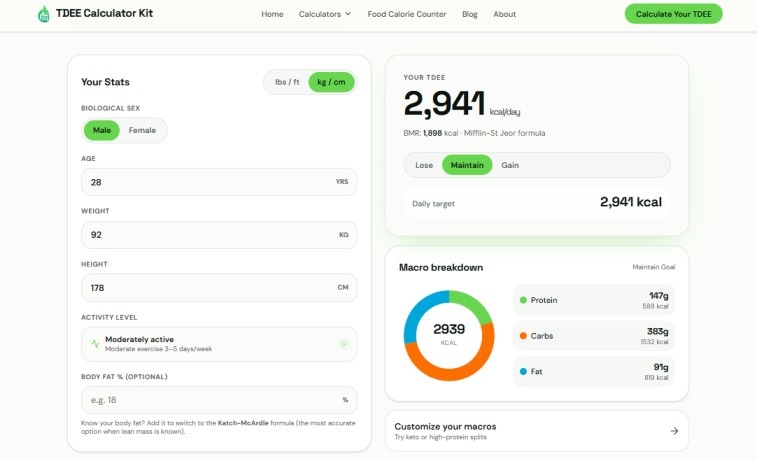
The platform pairs the TDEE tool with a calorie deficit calculator, a BMR calculator, and a food calorie counter, making it one of the most connected free calculator sites available. Output is color-coded by weight goal, and both Imperial and metric inputs are supported. No email address or account registration is required to view complete results at any point.
Feature | Detail |
|---|---|
UI/UX Rating | 9.5 / 10 |
Key Highlights | Dual-formula support (Mifflin-St Jeor and Katch-McArdle), goal-based macro breakdown, instant results, no sign-up required |
Calculators Available |
2. Calculator.net TDEE Calculator
Calculator.net is one of the largest calculator platforms online, and its TDEE section reflects that scale. This best TDEE calculator runs three formulas, Mifflin-St Jeor, Harris-Benedict, and Katch-McArdle, and shows all three calorie results side by side for a direct formula comparison. The interface is text-heavy and functional rather than visual, but it loads fast and produces reliable outputs without requiring registration.
Feature | Detail |
|---|---|
UI/UX Rating | 7 / 10 |
Key Highlights | Three-formula side-by-side comparison, deep explanatory content, no registration required |
Calculators Available | TDEE Calculator, BMI Calculator, Calorie Calculator, Macro Calculator |
3. TDEECalculator.net
TDEECalculator.net is a standalone TDEE platform that returns TDEE, BMR, BMI, and macro targets in a single results screen using the Mifflin-St Jeor equation. The dashboard-style output groups calorie targets for fat loss, maintenance, and bulking alongside macro gram weights for each goal state. The interface is clean and mobile-ready. No account or email address is required to view the full output at any point.
Feature | Detail |
|---|---|
UI/UX Rating | 8 / 10 |
Key Highlights | Full macro breakdown per goal, BMI output, dashboard-style results layout, no sign-up needed |
Calculators Available | TDEE Calculator (multi-metric output with macro and BMI display) |
4. TDEE.is
TDEE.is is a focused TDEE calculator built on the Mifflin-St Jeor equation that outputs calorie targets for cutting, maintaining, and gaining, alongside a macro breakdown for each state. A notable feature is built-in support for women's life stages, including the luteal phase, pregnancy, breastfeeding, and perimenopause, alongside standard activity levels. The single-page layout keeps results readable without extra scrolling or pop-ups.
Feature | Detail |
|---|---|
UI/UX Rating | 8.5 / 10 |
Key Highlights | Women's life-stage calorie adjustments, Mifflin-St Jeor formula, macro output per goal state, clean single-page layout |
Calculators Available | TDEE Calculator (with goal-based and life-stage-specific calorie output for women) |
5. Hybrid Calisthenics TDEE Calculator
Hybrid Calisthenics is a bodyweight training platform whose TDEE calculator targets performance-oriented users. This top TDEE calculator applies the Mifflin-St Jeor equation and returns TDEE, BMR, and calorie targets for weight loss, maintenance, and muscle building in a concise output format. The surrounding site content covers progressive calisthenics programming, making the calculator relevant for users who train without gym equipment or barbells.
Feature | Detail |
|---|---|
UI/UX Rating | 7.5 / 10 |
Key Highlights | Training-context framing, Mifflin-St Jeor formula, goal-based calorie output, calisthenics content ecosystem |
Calculators Available | TDEE Calculator (integrated with bodyweight training program resources) |
6. For Hers TDEE Calculator
For Hers is a women's health platform that covers hormone management, weight loss, and clinical care. This best TDEE calculator on the site uses the Mifflin-St Jeor formula and returns calorie targets for fat loss, maintenance, and muscle gain within a sex-specific healthcare context. The surrounding platform links to medically supervised weight management programs for women who want clinical support beyond the calorie estimate.
Feature | Detail |
|---|---|
UI/UX Rating | 8 / 10 |
Key Highlights | Women's health context, Mifflin-St Jeor formula, clinical platform credibility, mobile-friendly layout |
Calculators Available | TDEE Calculator (within the For Hers women's health tools section) |
7. Vanswe Fitness TDEE Calculator for Weight Loss
Vanswe Fitness positions its TDEE calculator specifically for weight loss calorie planning. The tool applies the Mifflin-St Jeor equation and produces a maintenance calorie estimate alongside a recommended deficit target based on the selected activity level. The surrounding site focuses on home fitness equipment, giving the calculator practical context for users building an at-home workout routine. Full results appear without a registration gate.
Feature | Detail |
|---|---|
UI/UX Rating | 7 / 10 |
Key Highlights | Weight loss calorie focus, Mifflin-St Jeor formula, deficit-based output, no account required |
Calculators Available | TDEE Calculator (weight loss calorie planning, paired with home gym equipment content) |
8. NutraBio TDEE Calculator
NutraBio is a sports nutrition brand whose TDEE calculator is embedded in its blog section. The tool runs the Mifflin-St Jeor equation and returns a single maintenance calorie figure. Output is more basic than standalone TDEE platforms, but it is paired with supplement guidance and meal timing content on the same page. The calculator is most useful for NutraBio users who want a quick calorie reference within their current nutrition context.
Feature | Detail |
|---|---|
UI/UX Rating | 6.5 / 10 |
Key Highlights | Mifflin-St Jeor formula, supplement-context pairing, quick single-output format, no sign-up required |
Calculators Available | TDEE Calculator (blog-embedded; no companion calculator suite) |
9. Online Doctor SuperDrug TDEE Calculator
The Online Doctor SuperDrug TDEE calculator comes from the digital health service of SuperDrug, a major UK pharmacy and healthcare retailer. The tool applies the Mifflin-St Jeor equation and outputs a clear daily calorie estimate alongside basic weight goal guidance. The healthcare source adds medical credibility, and the platform connects to supervised weight management services for users who want clinical support beyond the calculator result.
Feature | Detail |
|---|---|
UI/UX Rating | 7.5 / 10 |
Key Highlights | Medical-grade credibility, Mifflin-St Jeor formula, UK healthcare context, clear layout |
Calculators Available | TDEE Calculator (part of SuperDrug Online Doctor's health tools section) |
10. Legion Athletics TDEE Calculator
Legion Athletics publishes one of the most content-backed TDEE calculators in the fitness space. Written by Michael Matthews (certified personal trainer and bestselling author) and reviewed by Dr. Brian Grant (DPT, CSCS), the tool offers Mifflin-St Jeor as the default alongside Harris-Benedict and Katch-McArdle options. Supporting content explains which formula fits each body composition type. One friction point: results require an email submission before they are displayed on screen.
Feature | Detail |
|---|---|
UI/UX Rating | 8.5 / 10 |
Key Highlights | Expert-authored content, three formula options explained, science-reviewed methodology, Mifflin-St Jeor default |
Calculators Available | TDEE Calculator (within Legion's fitness tools and nutrition education blog) |
How We Picked the Best TDEE Calculators?
The best TDEE calculator does more than produce a single calorie number. It returns BMR alongside TDEE, macro targets for each weight goal, and a result that makes nutritional sense without requiring the user to have specialist knowledge before they start.
Five objective criteria were used to review and rank all 10 tools on this list. Each criterion reflects a measurable quality that separates a useful TDEE tool from a basic online form.
Formula Accuracy: Does the tool use Mifflin-St Jeor, Katch-McArdle, or another validated equation for BMR?
Output Depth: Does it return TDEE, BMR, macros, and goal-specific calorie targets in one place?
Activity Level Granularity: Does it offer at least five distinct multipliers, from sedentary to extra-active?
Companion Tools Available: Are additional calculators on the same platform for deeper nutrition planning?
Interface Quality: Is the result clear, mobile-friendly, and readable without specialist knowledge?
Calculators that return only a single calorie number with no BMR or macro output were excluded from this list. Tools that require email registration before displaying results were ranked lower than those that show output immediately.
What Is the Most Accurate TDEE Formula?
The Mifflin-St Jeor equation is the most accurate TDEE formula for the general adult population. Published in 1990 in the American Journal of Clinical Nutrition, it calculates BMR from body weight, height, age, and biological sex, then multiplies that value by a validated activity factor to produce a full TDEE estimate.
The Katch-McArdle formula produces better results for lean and athletic individuals because it uses lean body mass rather than total body weight as the primary input variable. It requires body fat percentage, which the Mifflin-St Jeor formula does not.
Formula | Best For | Requires Body Fat % |
|---|---|---|
Mifflin-St Jeor | General adult population | No |
Harris-Benedict | Historical reference; tends to overestimate slightly | No |
Katch-McArdle | Lean and athletic individuals | Yes |
Cunningham | High-performance athletes | Yes |
A 2005 systematic review by Frankenfield and colleagues found the Mifflin-St Jeor equation lands within 10 percent of measured resting metabolic rate for 82 percent of non-obese adults. Harris-Benedict produces higher estimates that may push maintenance calorie targets above what the body actually needs for many users.
What Is the Difference Between TDEE and BMR?
BMR (Basal Metabolic Rate) is the number of calories the body burns at complete rest to support organ function, circulation, and temperature regulation throughout the day. TDEE adds all movement, training, and food digestion on top of BMR. Use the BMR Calculator to isolate the resting calorie number before applying an activity multiplier.
For a sedentary adult, TDEE equals approximately 1.2 times BMR. For an extra-active individual, TDEE reaches up to 1.9 times BMR. BMR accounts for 60 to 70 percent of TDEE for most adults, making resting metabolic rate the single largest component in the total daily calorie calculation.
Key Rule: All Calorie Targets Are Set From TDEE, Not BMR
Eating at BMR level for an extended period causes metabolic adaptation, lean muscle loss, and hormonal disruption. The body interprets sustained sub-BMR intake as a starvation signal and reduces its total energy output to compensate, which lowers TDEE further over time.
Is TDEE the Same as Maintenance Calories?
TDEE and maintenance calories represent the same daily calorie value. Eating at TDEE keeps body weight stable over a consistent 2 to 3 week period. Any sustained deviation from TDEE in either direction drives measurable body weight change across that same timeframe.
For most adult women, TDEE falls between 1,600 and 2,400 kcal per day. For most adult men, TDEE falls between 2,000 and 3,200 kcal per day. Athletes, physical laborers, and individuals at high body weights exceed these ranges; sedentary older adults often sit below them.
TDEE Determines Body Weight Direction:
Below TDEE: Calorie deficit state, body fat loss
At TDEE: Calorie balance state, weight maintenance
Above TDEE: Calorie surplus state, body weight gain
TDEE is the reference point for every calorie-based nutrition plan, from a fat loss phase to a controlled muscle gain phase. Any change to intake or activity that shifts daily calories relative to TDEE produces a corresponding body weight change.
What Is a Safe Calorie Deficit Below TDEE for Weight Loss?
A safe calorie deficit for weight loss is 300 to 500 kcal per day below TDEE. This rate produces 0.5 to 1 pound of fat loss per week without triggering metabolic adaptation, lean muscle loss, or nutritional deficiency. The Calorie Deficit Calculator generates a specific deficit target based on your TDEE and the weekly fat loss rate you choose.
Deficits larger than 1,000 kcal per day are linked to lean muscle loss and long-term metabolic suppression. Research published in Obesity Reviews found that aggressive caloric restriction reduces TDEE by 15 to 25 percent through adaptive thermogenesis, a documented metabolic response to sustained low calorie intake that lowers total daily energy expenditure beyond what formula math predicts.
Signs a Calorie Deficit Is Too Aggressive:
Weekly weight loss consistently exceeds 1.5 pounds
Energy drops noticeably during training sessions
Sleep quality declines despite adequate calorie intake overall
Hunger becomes unmanageable rather than moderate and intermittent
Does Your TDEE Change as You Lose Weight?
TDEE decreases progressively as body weight falls because BMR is proportional to total body mass and lean muscle mass at the same time. Losing 10 kg of body weight typically reduces BMR by 100 to 150 kcal per day, lowering TDEE by a corresponding amount. Failing to recalculate after significant weight loss causes the original calorie deficit to disappear gradually over several weeks.
Metabolic adaptation also suppresses TDEE by 10 to 15 percent beyond what formula math predicts during extended calorie restriction. Recalculating TDEE every 10 to 15 pounds of weight change keeps calorie targets aligned with actual daily energy needs and prevents the fat loss plateau most dieters encounter around 8 to 12 weeks into a calorie deficit.
How Often Should You Recalculate Your TDEE?
Recalculate TDEE every 4 to 6 weeks, or after any 10 to 15 pound change in body weight. Three additional events trigger a recalculation outside the standard schedule:
Significant Body Composition Change: Adding or losing 5 kg of lean mass shifts BMR measurably because muscle burns more calories at rest than fat tissue
Activity Level Change: Starting or stopping a structured training program changes the activity multiplier by 0.175 to 0.35
Age Milestone: BMR declines 1 to 2 percent per decade after age 20 due to gradual muscle mass reduction without resistance training
The correct method for testing any TDEE estimate is to eat at the calculated number for 2 to 3 weeks, weigh daily (fasted), calculate a 7-day body weight average each week, and adjust intake by 100 kcal per day if the trend does not match the intended goal direction.
Can a TDEE Calculator Help You Plan for Muscle Gain?
A TDEE calculator provides the calorie surplus target needed for planned muscle gain. Eating 300 to 500 kcal above TDEE, paired with progressive resistance training, produces lean muscle growth without excess fat accumulation. This approach is called a lean bulk, and it differs from an uncontrolled bulk where daily surplus calories exceed 500 kcal per day.
Research on caloric surplus in resistance-trained adults shows that 250 to 500 kcal above TDEE produces the most favorable ratio of muscle to fat gain. Surpluses larger than 500 kcal per day result in a higher proportion of fat storage relative to new muscle tissue, which reduces body composition quality even as scale weight rises.
Protein Target During Muscle Gain: 1.6 to 2.2 grams per kilogram of body weight per day, based on the 2017 meta-analysis by Morton and colleagues in the British Journal of Sports Medicine.
How Accurate Are Online TDEE Calculators?
Online TDEE calculators are accurate within a 10 percent margin for most adults when inputs are entered with honesty about actual activity levels and current body weight. A 2005 systematic review by Frankenfield and colleagues confirmed this margin for the Mifflin-St Jeor equation across non-obese adults. For a person with an estimated TDEE of 2,300 kcal, the actual value likely falls between 2,070 and 2,530 kcal.
The biggest source of error in TDEE calculations is activity level self-assessment. Research shows approximately 80 percent of users overestimate their activity level by at least one tier, adding 200 to 400 excess kcal to the daily estimate and pushing the number above real maintenance. Using the Food Calorie Counter alongside your TDEE result helps identify whether the gap is coming from underreported food intake or an inflated activity multiplier.
The correct approach is to use the TDEE estimate as a starting point, then calibrate over 2 to 3 weeks:
Weigh daily in the morning, fasted
Calculate the 7-day body weight average each week
Adjust daily intake by 100 to 200 kcal per day if the weight trend does not match the goal direction
What Inputs Does a TDEE Calculator Need to Be Accurate?
A TDEE calculator needs five core inputs to return a useful result: age, biological sex, body weight, height, and activity level. Body fat percentage is optional but improves accuracy by switching the base formula from Mifflin-St Jeor to Katch-McArdle, which uses lean body mass instead of total body weight as the primary variable.
Accurate activity level selection is the most critical factor after formula choice. The five standard activity tiers and their validated multipliers are:
Activity Level | Description | Multiplier |
|---|---|---|
Sedentary | Desk work, fewer than 5,000 daily steps, no training | 1.2 |
Lightly Active | 1 to 3 days of light exercise per week | 1.375 |
Moderately Active | 3 to 5 days of moderate training per week | 1.55 |
Very Active | 6 to 7 days of hard training per week | 1.725 |
Extra Active | Two-a-day training sessions or physically demanding job | 1.9 |
Users who train 3 to 4 days per week but sit at a desk for the remainder of their day should select Moderately Active, not Very Active. Choosing one tier too high adds 200 to 400 kcal to the TDEE estimate, which is enough to erase a weight loss deficit and stall progress entirely.
Is a TDEE Calculator Accurate for Women?
TDEE calculators are accurate for women but produce more variable results than men because of hormonal fluctuations across the menstrual cycle, life stages including pregnancy and perimenopause, and typically lower lean muscle mass that reduces BMR relative to total body weight. The Mifflin-St Jeor equation accounts for sex-specific differences through a constant adjustment of minus 161 kcal in the BMR formula applied to women specifically.
During the luteal phase of the menstrual cycle (days 15 to 28), resting metabolic rate increases by 2 to 10 percent compared to the follicular phase. This raises daily calorie burn by 50 to 150 kcal and may make calorie deficit adherence harder in the 7 to 10 days before menstruation. TDEE calculators like TDEE.is include specific settings for life-stage adjustments to account for these variables within the daily calorie estimate.