
Calories Burned Walking: By Distance, Steps, and Pace
How many calories does walking burn? MET-based tables by weight and pace for every distance, step count, and time format. Treadmill walking, all major distances, and step counts covered.

Your body has a number. Let's find it.
We calculate the exact calorie target your body needs, built from your stats and goal, then track everything against it daily. Log meals, add workouts, set a weight goal, and watch your numbers update in real time. Check in weekly to see calories, water, and weight trend in one place.
No spreadsheets. No guessing. Just results.
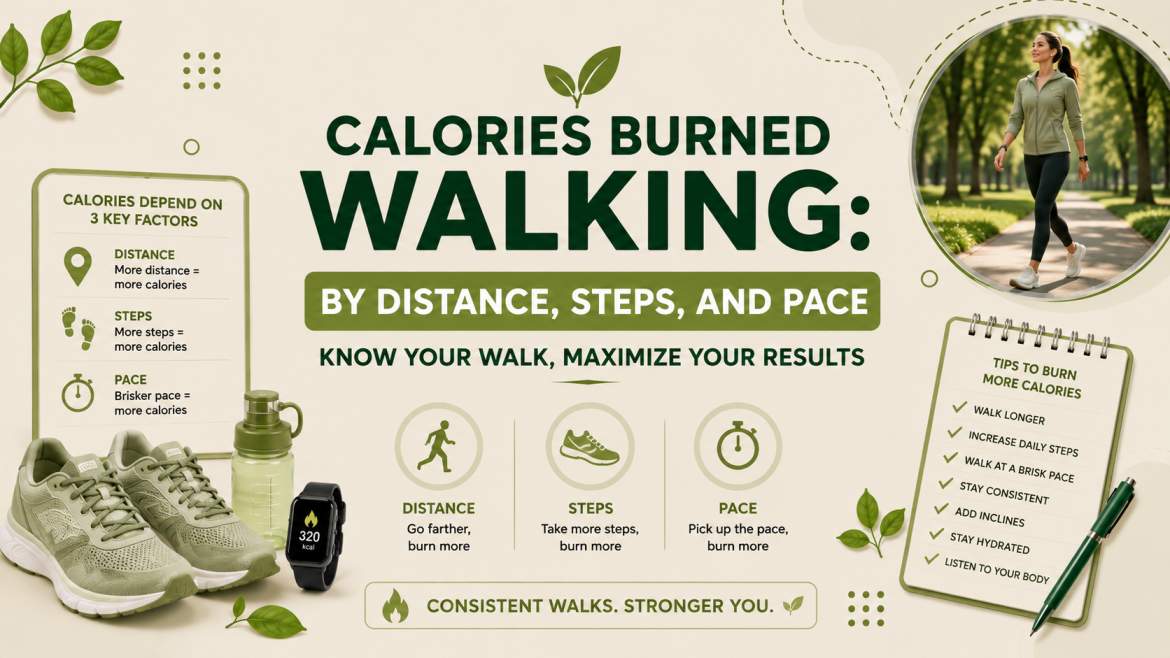
Calories burned walking is the total energy the body uses during a walk, measured in kilocalories (kcal). Four variables determine the output: body weight, walking pace, distance or duration, and terrain. Most adults burn between 65 and 175 calories per mile walking, depending on weight and speed. The walking calorie calculator generates a personalized estimate using MET (Metabolic Equivalent of Task) values from the 2024 Adult Compendium of Physical Activities.
Walking is the most widely practiced physical activity worldwide and the foundation of daily energy expenditure outside the gym. Unlike running, it carries near-zero injury risk at typical training volumes. Unlike cycling, it requires no equipment. A consistent daily walking habit creates a meaningful calorie deficit over weeks and months regardless of pace.
This hub covers how walking calorie burn is calculated, what changes the output, and how every major walking format compares. Each section links to a dedicated calculator page and informational hub for full weight-by-pace tables. To connect your walking output to your total daily energy budget, use the TDEE calculator.
What Is the MET Formula for Walking Calories?
The MET formula for walking calorie burn is:
Calories = MET × body weight (kg) × duration (hours)
One MET equals 1 kcal per kilogram of body weight per hour at rest. Walking at 3 mph carries a MET of 3.5, meaning it costs 3.5 times more energy than sitting still.
MET values for all walking speeds come from the 2024 Adult Compendium of Physical Activities, validated through indirect calorimetry in research settings. The main calories burned calculator uses this same dataset for all activity types.
How Do Walking MET Values Change by Speed?
Speed is the primary intensity driver in the MET formula for walking. Each speed tier carries a distinct MET. The table below shows how walking pace changes calorie burn per 30 minutes for a 154 lb (70 kg) person.
Walking Pace | Speed (mph) | MET | Calories / 30 Min (70 kg) | Calories / Mile (70 kg) |
|---|---|---|---|---|
Very slow stroll | 2.0 mph | 2.5 | 88 kcal | 73 kcal |
Slow walk | 2.5 mph | 3.0 | 105 kcal | 78 kcal |
Casual walk | 3.0 mph | 3.5 | 122 kcal | 81 kcal |
Brisk walk | 3.5 mph | 4.3 | 151 kcal | 86 kcal |
Fast walk | 4.0 mph | 5.0 | 175 kcal | 88 kcal |
Power walk | 4.5 mph | 6.3 | 221 kcal | 98 kcal |
Race walk | 5.0 mph | 8.0 | 280 kcal | 112 kcal |
Source: 2024 Adult Compendium of Physical Activities, ACSM.
Does Body Weight Change Walking Calorie Burn?
Body weight scales calorie burn linearly in the MET formula. A 200 lb (91 kg) person burns approximately 30% more than a 154 lb (70 kg) person walking at the same pace. Every 10 lb (4.5 kg) of additional body weight adds roughly 5 to 8% more calories per session.
What Factors Affect How Many Calories You Burn Walking?
Six variables determine total calorie expenditure during a walk. Each interacts with the MET formula in a different way.
1. Body Weight
Walking burns more calories at higher body weights because the body must move more mass against gravity. A 220 lb (100 kg) person burns approximately 160 calories per mile walking; a 130 lb (59 kg) person burns approximately 96 calories per mile at the same pace.
2. Walking Speed
Speed determines the MET value. Moving from a casual 3 mph walk (MET 3.5) to a brisk 4 mph walk (MET 5.0) raises calories per minute by approximately 43%. Power walking at 4.5 mph (MET 6.3) burns 80% more per minute than a slow 2.5 mph stroll.
3. Distance and Duration
Total calorie burn increases proportionally with distance at any given pace. Walking 4 miles burns exactly twice the calories of walking 2 miles at the same speed. Duration produces the same linear relationship.
4. Terrain and Incline
Terrain Modifier | Calorie Impact vs Flat |
|---|---|
5% uphill | +30 to 40% |
10% uphill | +50 to 60% |
Sand (dry) | +150 to 170% (research from Journal of Experimental Biology) |
Sand | +30 to 50% |
Trail surface | +5 to 15% |
Water walking | +130 to 200% (MET 4.5 to 8.0) |
5. Carrying Load
Adding weight increases calorie burn proportionally. Walking with a weighted vest or backpack adds approximately 1 additional calorie per mile for every 1% of body weight added as load. A 154 lb person carrying 15 lb (approximately 10% of body weight) burns roughly 10% more calories per mile.
6. Fitness Level
A more conditioned walker moves more efficiently, burning slightly fewer calories per mile at the same pace. This is a small effect for walking compared to running, but it becomes measurable across high-volume training weeks.
How Many Calories Does Walking Burn by Distance?
The table below shows calories burned at a brisk 3.5 mph pace (MET 4.3) across common walking distances and body weights. These are gross calories including resting metabolic rate during the walk.
Distance | 130 lb (59 kg) | 154 lb (70 kg) | 185 lb (84 kg) | 220 lb (100 kg) |
|---|---|---|---|---|
1 mile | 74 kcal | 88 kcal | 106 kcal | 126 kcal |
2 miles | 148 kcal | 176 kcal | 212 kcal | 252 kcal |
3 miles | 222 kcal | 264 kcal | 318 kcal | 378 kcal |
4 miles | 296 kcal | 352 kcal | 424 kcal | 504 kcal |
5 miles | 370 kcal | 440 kcal | 529 kcal | 630 kcal |
10 miles | 740 kcal | 880 kcal | 1,058 kcal | 1,260 kcal |
Based on MET 4.3 at 3.5 mph on flat terrain.
Each distance in this table has a dedicated page with full pace-by-weight tables:
How Many Calories Does Walking Burn by Step Count?
Step-based calorie estimates use stride length to convert steps to distance, then apply the MET formula. Average stride length varies from approximately 2.1 ft (shorter adults) to 2.7 ft (taller adults). The general estimate is 2.2 to 2.5 feet per step for adults of average height.
Calories Burned Walking by Step Count (Moderate 3 mph Pace)
Step Count | 130 lb (59 kg) | 154 lb (70 kg) | 185 lb (84 kg) | 220 lb (100 kg) |
|---|---|---|---|---|
5,000 steps | 140 kcal | 175 kcal | 210 kcal | 250 kcal |
7,000 steps | 196 kcal | 245 kcal | 294 kcal | 350 kcal |
8,000 steps | 224 kcal | 280 kcal | 336 kcal | 400 kcal |
10,000 steps | 280 kcal | 350 kcal | 420 kcal | 500 kcal |
12,000 steps | 336 kcal | 420 kcal | 504 kcal | 600 kcal |
15,000 steps | 420 kcal | 525 kcal | 630 kcal | 750 kcal |
Assumes moderate walking pace (3 mph, MET 3.5) and average stride length. Values are approximate.
The 10,000-step benchmark originated from a 1960s Japanese marketing campaign, not clinical research. A 2021 JAMA Internal Medicine study by Lee et al. found that mortality benefits plateaued at approximately 7,000 to 8,000 steps per day.
Step-count pages in this cluster:
How Many Calories Does Walking Burn by Time?
Time-based calorie burn depends on walking speed. The table below shows calories burned across three common walking paces for standard session durations, based on a 154 lb (70 kg) person.
Duration | Slow (3 mph / MET 3.5) | Brisk (3.5 mph / MET 4.3) | Fast (4 mph / MET 5.0) |
|---|---|---|---|
15 minutes | 61 kcal | 75 kcal | 88 kcal |
20 minutes | 82 kcal | 100 kcal | 117 kcal |
30 minutes | 122 kcal | 150 kcal | 175 kcal |
45 minutes | 184 kcal | 226 kcal | 263 kcal |
60 minutes | 245 kcal | 301 kcal | 350 kcal |
120 minutes | 490 kcal | 602 kcal | 700 kcal |
All values at 70 kg on flat terrain.
Time-based pages in this cluster:
How Many Calories Does Walking Burn Per Mile?
Walking burns between 65 and 175 calories per mile for most adults at typical walking speeds. The widely cited "100 calories per mile" estimate applies to runners, not walkers.
Lighter adults walking slowly burn closer to 65 kcal per mile. Heavier adults power walking at 5 mph burn up to 175 kcal per mile.
The calories burned walking per mile page covers the full weight-by-pace table, the walking vs running per-mile comparison, and the net vs gross calorie distinction.
How Does Treadmill Walking Compare to Outdoor Walking for Calories?
Treadmill walking burns within 2 to 5% of outdoor walking at the same displayed speed on flat settings. The treadmill removes wind resistance and terrain variation, but the consistent belt surface closely replicates flat-road walking energy cost.
The real advantage of treadmill walking for calorie burn is incline control. Every 1% of treadmill incline adds approximately 4 to 5 extra calories per mile for a 154 lb person at 3.5 mph. At 10% incline, calorie burn nearly doubles compared to flat walking.
Treadmill Incline | Calories Per Mile (70 kg, 3.5 mph) |
|---|---|
0% (flat) | 88 kcal |
2% | 97 kcal |
5% | 114 kcal |
8% | 133 kcal |
10% | 148 kcal |
12% | 165 kcal |
15% | 190 kcal |
The treadmill walking calorie page covers the full speed × incline × weight matrix with calorie display accuracy notes.
What Is Brisk Walking and How Many Calories Does It Burn?
Brisk walking is defined as a pace of 3 to 4.5 mph where breathing quickens but conversation remains possible. The NHS defines brisk walking as effort that raises heart rate to 50 to 70% of maximum. The CDC classifies it as moderate-intensity aerobic activity.
The MET range for brisk walking is 4.3 to 5.0, significantly above casual walking at 3.5 and approaching light jogging territory. A 154 lb (70 kg) person burns approximately 150 to 175 calories in 30 minutes of brisk walking, compared to 122 calories at a casual 3 mph pace.
Brisk Walking Calories by Weight and Duration
Body Weight | 30 Min Brisk Walk (3.5 mph) | 60 Min Brisk Walk (3.5 mph) | Per Mile |
|---|---|---|---|
130 lb (59 kg) | 129 kcal | 258 kcal | 74 kcal |
154 lb (70 kg) | 150 kcal | 301 kcal | 88 kcal |
185 lb (84 kg) | 180 kcal | 361 kcal | 106 kcal |
220 lb (100 kg) | 215 kcal | 430 kcal | 126 kcal |
Based on MET 4.3 at 3.5 mph on flat terrain.
The distinction between casual and brisk walking matters for calorie planning. Moving from 3 mph to 3.5 mph raises output by approximately 22% per session without changing duration. Moving to 4 mph adds roughly 43% more calories per minute compared to a slow stroll.
How Does Uphill Walking Change Calorie Burn?
Walking uphill burns significantly more calories than flat walking because the body must do additional mechanical work against gravity on every step. A 5% grade adds approximately 30 to 40% more calories per mile. A 10% grade adds 50 to 60%.
Calorie Increase by Uphill Grade (154 lb / 70 kg, 3.5 mph)
Grade | Calories Per Mile | Increase vs Flat |
|---|---|---|
0% (flat) | 88 kcal | baseline |
2% | 97 kcal | +10% |
5% | 114 kcal | +30% |
8% | 133 kcal | +51% |
10% | 148 kcal | +68% |
12% | 165 kcal | +88% |
15% | 190 kcal | +116% |
Estimates based on ACSM metabolic equation for walking at grade.
Research published in the European Journal of Applied Physiology confirms that oxygen consumption per step increases proportionally with gradient from 0 to 15%. Above 15%, stride length shortens and efficiency drops, reducing the per-step calorie gain.
Adding incline to a treadmill session is one of the most time-efficient ways to raise walking calorie burn without increasing pace. Walking 30 minutes at 3.5 mph and 10% incline burns approximately 280 calories for a 154 lb person, nearly double the flat-walking output in the same time.
What Is Power Walking and How Does It Compare to Regular Walking?
Power walking is a technique-driven form of fast walking at 4 to 5.5 mph. It uses an exaggerated arm swing, heel-to-toe footfall, and a slightly forward-leaning upright posture. The MET range for power walking is 6.3 to 8.0, well above brisk walking at 4.3 to 5.0 and overlapping with slow jogging at MET 8.3.
A 154 lb (70 kg) person power walking at 4.5 mph burns approximately 221 calories in 30 minutes. The same person jogging at 5 mph burns approximately 290 calories in the same window.
Power Walking vs Other Intensities (154 lb / 70 kg, 30 Min)
Activity | Speed | MET | Calories / 30 Min |
|---|---|---|---|
Casual walk | 3.0 mph | 3.5 | 122 kcal |
Brisk walk | 3.5 mph | 4.3 | 150 kcal |
Fast walk | 4.0 mph | 5.0 | 175 kcal |
Power walk | 4.5 mph | 6.3 | 221 kcal |
Race walk | 5.0 mph | 8.0 | 280 kcal |
Jogging | 5.0 mph | 8.3 | 290 kcal |
Power walking produces approximately 76% of the calorie output of slow jogging per unit of time, with significantly lower joint impact. For people who cannot run due to knee or hip conditions, power walking is the most calorie-efficient injury-safe alternative.
How Does Walking Compare to Running for Calorie Burn?
Walking and running burn different amounts of calories per mile and per minute. Both comparisons matter for training decisions, and the per-mile gap is far smaller than most people expect.
Walking vs Running Per Mile (154 lb / 70 kg)
Activity | Speed | Calories Per Mile |
|---|---|---|
Slow walk | 2.5 mph | 78 kcal |
Brisk walk | 3.5 mph | 88 kcal |
Fast walk | 4.0 mph | 88 kcal |
Power walk | 4.5 mph | 98 kcal |
Jogging | 5.0 mph | 99 kcal |
Running | 6.0 mph | 112 kcal |
Running burns approximately 27% more calories per mile than brisk walking. The gap is narrow because both activities cover the same distance. The flight phase of running, where both feet briefly leave the ground simultaneously, accounts for the additional per-mile cost.
Walking vs Running Per 30 Minutes (154 lb / 70 kg)
Activity | Speed | Calories / 30 Min |
|---|---|---|
Brisk walk | 3.5 mph | 150 kcal |
Fast walk | 4.0 mph | 175 kcal |
Power walk | 4.5 mph | 221 kcal |
Jogging | 5.0 mph | 290 kcal |
Running | 6.0 mph | 343 kcal |
Per minute of exercise, running burns 123% more than brisk walking. A 30-minute run covers 3 miles and burns 343 kcal; a 30-minute brisk walk covers 1.75 miles and burns 150 kcal. The time efficiency gap is significant when total session time is the constraint.
For people managing injuries, weight bearing, or joint conditions, walking offers a sustainable daily calorie burn that compounds over weeks without the recovery demands of running.
How Does Walking Compare to Swimming for Calorie Burn?
Walking and swimming both qualify as low-to-moderate impact aerobic activities, but their calorie outputs differ by intensity choice. Swimming removes ground impact entirely while burning significantly more calories per minute at vigorous effort.
At moderate intensity, a 154 lb (70 kg) person burns:
Brisk walking at 3.5 mph (MET 4.3): 150 kcal per 30 minutes
Freestyle swimming, moderate effort (MET 5.8): 203 kcal per 30 minutes
Vigorous breaststroke (MET 10.3): 360 kcal per 30 minutes
Moderate freestyle swimming burns approximately 35% more per 30 minutes than brisk walking. Vigorous swimming nearly doubles the output. Walking holds one practical advantage: it can be sustained outdoors for hours with no facility, lane booking, or equipment. Swimming requires access to a pool and adds transition time.
For joint conditions affecting the lower body, swimming may allow higher training frequency than walking. For cardiovascular baseline activity and daily step accumulation, walking is more accessible for most people.
What Are the Different Walking Formats and Their Calorie Outputs?
Walking covers more terrain than most people consider. Each format has a distinct MET value and calorie profile that changes meaningfully with intensity, equipment, and surface.
Walking Format | MET Range | Calories / 30 Min (70 kg) | Key Variable |
|---|---|---|---|
Casual walk (3 mph) | 3.5 | 122 kcal | Speed |
Brisk walk (3.5 mph) | 4.3 | 150 kcal | Speed |
Power walk (4.5 mph) | 6.3 | 221 kcal | Speed + technique |
Treadmill walking | 3.5 to 6.0 | 122 to 210 kcal | Incline setting |
Uphill / incline walk | 5.0 to 8.0 | 175 to 280 kcal | Grade % |
Nordic walking | 4.8 to 6.0 | 168 to 210 kcal | Pole engagement |
Beach / sand walking | 6.0 to 9.5 | 210 to 333 kcal | Sand firmness |
Water walking | 4.5 to 8.0 | 158 to 280 kcal | Water depth |
Stroller walking | 3.5 to 4.5 | 128 to 165 kcal | Stroller weight |
Walking after eating | 3.5 to 4.3 | 40 to 75 kcal (1530 min) | Duration |
Source: 2024 Adult Compendium of Physical Activities. Values at 70 kg.
Beach walking on dry sand burns up to 170% more calories than pavement walking at the same pace, according to research from the Journal of Experimental Biology. Nordic walking with poles engages the upper body and raises calorie burn 20 to 46% above regular walking, per a study published in the Journal of the American Geriatrics Society (2008). Water walking produces a wide MET range depending on depth: waist-deep water walking can burn as much as vigorous land-based walking.
How Does Walking Relate to TDEE and Weight Loss?
Calories burned walking represent one component of Total Daily Energy Expenditure (TDEE). TDEE is the total energy the body uses in 24 hours across resting metabolism, digestion, non-exercise activity, and structured exercise. Walking contributes to both structured exercise and non-exercise activity thermogenesis (NEAT).
A calorie deficit of 3,500 kcal produces approximately 1 lb of fat loss over time. Brisk walking for 30 minutes per day at 3.5 mph burns approximately 150 calories per session for a 154 lb person. Across 5 days per week, that is 750 calories per week from walking alone.
Walking Frequency and Fat Loss Benchmarks (154 lb / 70 kg, Brisk 3.5 mph)
Weekly Frequency | Weekly Calories | Monthly Calories | Fat Loss Equivalent |
|---|---|---|---|
3 × 30 minutes | 450 kcal | 1,800 kcal | ~0.5 lb/month |
5 × 30 minutes | 750 kcal | 3,000 kcal | ~0.9 lb/month |
Daily 30 minutes | 1,050 kcal | 4,200 kcal | ~1.2 lb/month |
Daily 60 minutes | 2,100 kcal | 8,400 kcal | ~2.4 lb/month |
10,000 steps daily | 1,750 kcal/week | 7,000 kcal | ~2.0 lb/month |
Assumes 3,500 kcal = 1 lb fat. No dietary change. Values are approximate planning figures.
Walking alone produces gradual fat loss. Combined with a 200 to 300 kcal daily dietary reduction, a 30-minute daily walk supports 0.7 to 1.0 lb of fat loss per week for a 154 lb person.
What Is the Difference Between Gross and Net Calories Burned Walking?
Gross calories burned walking includes resting metabolic rate (RMR) during the session. Net calories burned subtracts RMR, showing only the additional energy from the walk itself.
For a 154 lb (70 kg) person walking 30 minutes at 3.5 mph:
Metric | Value |
|---|---|
Gross calories burned | 150 kcal |
RMR during 30 minutes (~0.7 kcal/min) | ~21 kcal |
Net calories burned | ~129 kcal |
Net calories burned walking are approximately 12 to 15% below gross calories. Most fitness trackers and apps report gross calories. Net calories give a more accurate picture of the actual additional deficit created by the walk.
Frequently Asked Questions About Calories Burned Walking
How Many Calories Does Walking Burn?
Walking burns 65 to 175 calories per mile depending on body weight and pace. A 154 lb (70 kg) person walking briskly at 3.5 mph burns approximately 88 calories per mile, or 150 calories per 30 minutes. A 220 lb person burns approximately 126 calories per mile at the same pace.
How Many Calories Does Walking Burn per Step?
Walking burns approximately 0.04 to 0.07 calories per step depending on body weight and pace. A 154 lb person at 3 mph burns approximately 0.05 calories per step. At 10,000 steps, this produces approximately 500 calories. The exact figure depends on stride length, which varies with height.
Is Walking Enough Exercise to Lose Weight?
Walking alone supports weight loss at a rate of 0.5 to 1.5 lb per month when done consistently without increasing food intake, depending on frequency and body weight. Adding dietary reduction alongside daily walking significantly accelerates results. Research from the Mayo Clinic confirms that walking burns enough calories to support a modest sustained deficit when done daily at moderate intensity.
How Long Should You Walk to Burn 500 Calories?
The time needed to burn 500 calories depends on body weight and pace. A 154 lb person walking briskly at 3.5 mph needs approximately 100 minutes. A 185 lb person at the same pace reaches 500 calories in approximately 83 minutes. A 220 lb person achieves it in approximately 70 minutes. Faster paces reduce the time required proportionally.
Does Walking After Eating Burn More Calories?
Walking after eating burns the same calories per step as walking at any other time. The significance of post-meal walking is metabolic, not caloric. A 2013 study in Diabetes Care by DiPietro et al. found that three 15-minute walks after meals reduced blood glucose spikes more effectively than one 45-minute morning walk. For specific post-meal calorie data, see dedicated resources for post-meal walking.
How Does the Walking Calorie Calculator Work?
The walking calorie calculator uses the MET formula: Calories = MET × weight (kg) × duration (hours). It accepts inputs in either distance (miles or km) or step count, and applies the appropriate MET for the selected walking speed. The MET values come from the 2024 Adult Compendium of Physical Activities published by the American College of Sports Medicine.