
What Is BMR and How It Affects TDEE? A Complete Guide
BMR is the largest component of TDEE, accounting for 60 to 70% of total daily calorie burn. Learn how BMR is calculated, what changes it, and how every BMR shift directly affects your TDEE.

Your body has a number. Let's find it.
We calculate the exact calorie target your body needs, built from your stats and goal, then track everything against it daily. Log meals, add workouts, set a weight goal, and watch your numbers update in real time. Check in weekly to see calories, water, and weight trend in one place.
No spreadsheets. No guessing. Just results.
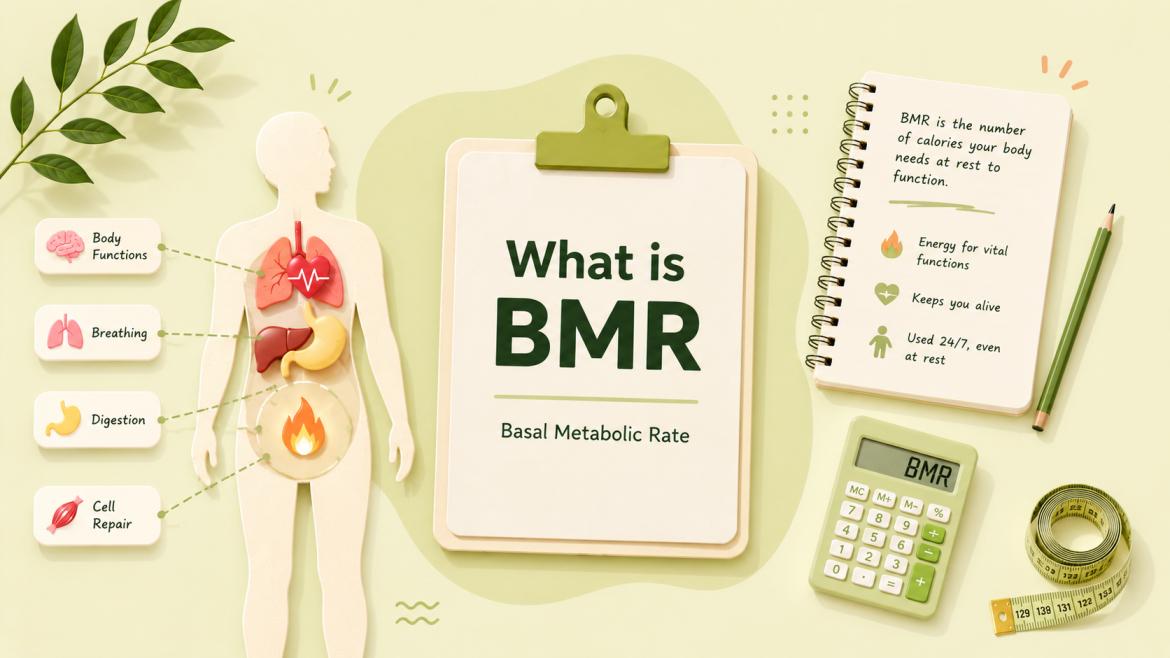
Basal Metabolic Rate (BMR) is the number of calories your body burns at complete rest over a 24-hour period. It represents the minimum energy required to keep vital organs functioning, including the heart, lungs, kidneys, liver, brain, and nervous system. BMR is measured under fasting conditions with no physical activity present.
BMR is the single largest component of Total Daily Energy Expenditure (TDEE). TDEE is the total number of calories your body burns across an entire day, covering rest, movement, exercise, and food digestion. Because BMR accounts for 60 to 70% of TDEE for most adults, any change in BMR produces a proportionally large change in the TDEE value used to set calorie targets.
Understanding what BMR is, what determines it, how BMR is calculated, and how it feeds directly into TDEE gives you the foundation to set accurate calorie targets for weight loss, weight maintenance, or muscle gain. This article covers all of those relationships in full detail.
What Is BMR and What Does It Measure?
BMR stands for Basal Metabolic Rate. It measures the number of calories the body burns per day to sustain all involuntary biological processes while at complete rest, in a fasted state, at a thermoneutral temperature. BMR is not the same as resting metabolic rate (RMR), though the two terms are often used interchangeably in non-clinical settings.
The distinction matters. RMR is measured under less strict conditions than BMR. RMR is typically 10 to 20% higher than true BMR because it allows for minimal activity and does not require a strict fasting period. Most online calculators produce RMR estimates rather than true BMR. For the purposes of TDEE calculation, RMR and BMR are used equivalently because both are multiplied by the same activity multiplier to produce a TDEE estimate.
What Biological Processes Does BMR Cover?
BMR covers every involuntary physiological process the body runs continuously. These processes consume energy whether a person is sleeping, sitting, or standing still.
Biological System | Process Covered by BMR | Approximate Share of BMR |
|---|---|---|
Cardiovascular | Heart muscle contractions, blood circulation | 7 to 9% |
Respiratory | Breathing, gas exchange in the lungs | 4 to 5% |
Renal | Kidney filtration, urine production | 7 to 9% |
Hepatic | Liver metabolism, detoxification, protein synthesis | 20 to 23% |
Neurological | Brain function, nerve signal transmission | 20 to 23% |
Muscular (resting) | Resting muscle tone, cellular repair | 18 to 26% |
Thermoregulation | Core temperature maintenance | 5 to 10% |
The liver and brain together account for roughly 40 to 50% of BMR despite representing a small fraction of total body mass. This explains why lean body mass is a stronger predictor of BMR than total body weight alone. Organs are metabolically expensive structures.
How BMR Differs From TDEE?
BMR and TDEE (Total Daily Energy Expenditure) both measure calorie expenditure, but they cover different scopes. BMR is a subset of TDEE. TDEE is always higher than BMR because it adds all forms of physical activity and the energy cost of digesting food.
Feature | BMR | TDEE |
|---|---|---|
Full name | Basal Metabolic Rate | Total Daily Energy Expenditure |
What it measures | Calories burned at complete rest | Total calories burned in 24 hours |
Activity included | None | NEAT, EAT, TEF, and BMR combined |
Typical share of TDEE | 60 to 70% | 100% (the total) |
Used as a calorie target | No — it is an input, not a goal | Yes — maintenance, fat loss, and muscle gain targets are set from TDEE |
Example value, 75 kg adult male | Approximately 1,750 calories | Approximately 2,100 to 3,325 calories depending on activity |
Eating at BMR is not a calorie target. It means consuming only enough to sustain organs at rest, leaving no energy for any waking movement. For a moderately active adult, eating at BMR creates a deficit of 700 to 1,000 calories per day relative to true TDEE, which risks lean muscle loss and metabolic adaptation within weeks.
Explore this TDEE vs. BMR guide to learn about their differences in detail.
What Are the Four Components of TDEE and Where Does BMR Fit?
TDEE is the sum of four physiological components. BMR is the dominant one. The other three, Non-Exercise Activity Thermogenesis (NEAT), EAT, and TEF, are added on top of BMR to produce the full TDEE estimate. Understanding each component explains why TDEE differs so much between people who have similar BMR values.
The Four TDEE Components
Component | Full Name | What It Covers | Typical Share of TDEE |
|---|---|---|---|
BMR | Basal Metabolic Rate | All calorie burn at complete rest | 60 to 70% |
NEAT | Non-Exercise Activity Thermogenesis | All movement outside planned exercise | 15 to 30% |
EAT | Exercise Activity Thermogenesis | Planned structured training sessions | 5 to 10% |
TEF | Thermic Effect of Food | Energy used to digest and metabolize food | 8 to 10% |
BMR sets the floor of TDEE. A person with a BMR of 1,400 calories can have a TDEE ranging from 1,680 calories (sedentary, 1.2 multiplier) to 2,660 calories (extra active, 1.9 multiplier). The 980-calorie range between those two extremes comes entirely from NEAT, EAT, and Thermic Effect of Food (TEF) sitting on top of the same BMR foundation.
How BMR Drives TDEE Through the Activity Multiplier?
TDEE is calculated by multiplying BMR by a standardized activity multiplier. The multiplier was originally defined by McArdle, Katch, and Katch in Exercise Physiology. Each level captures a different combination of NEAT, Exercise Activity Thermogenesis (EAT), and incidental daily movement.
Activity Level | Multiplier Applied to BMR | What It Captures | Daily TDEE for a 1,600 BMR |
|---|---|---|---|
Sedentary | 1.2 | Desk job, under 5,000 steps, no training | 1,920 calories |
Lightly Active | 1.375 | Light training 1 to 3 days, moderate steps | 2,200 calories |
Moderately Active | 1.55 | Training 3 to 5 days, active daily routine | 2,480 calories |
Very Active | 1.725 | Hard training 6 to 7 days, high step count | 2,760 calories |
Extra Active | 1.9 | Physical job plus daily training | 3,040 calories |
Because BMR is the number being multiplied, every error in BMR estimation is amplified through the multiplier. A BMR overestimate of 150 calories produces a TDEE overestimate of 232 calories at a 1.55 multiplier. This is why accurate BMR calculation is the first priority in any TDEE-based calorie plan.
What Factors Determine Your BMR?
BMR is determined by four primary biological variables: body weight, height, age, and biological sex. A fifth variable, lean body mass, is not captured by standard formulas but is the underlying driver of most BMR differences between individuals of similar demographics.
Primary BMR Determinants and Their Effects on TDEE
Variable | Effect on BMR | Effect on TDEE | Magnitude |
|---|---|---|---|
Body weight | Higher weight raises BMR | Higher weight raises TDEE proportionally | Each additional kg adds roughly 10 to 13 BMR calories per day |
Height | Greater height raises BMR | Greater height raises TDEE modestly | Each additional cm adds roughly 6 BMR calories per day (Mifflin) |
Age | Older age lowers BMR | Older age lowers TDEE proportionally | BMR falls approximately 1 to 2% per decade from age 30 onward |
Biological sex | Male sex raises BMR | Male sex raises TDEE proportionally | Males have BMRs 5 to 10% higher than females at the same weight and height |
Lean body mass | More muscle raises BMR | More muscle raises TDEE proportionally | Each kg of muscle burns approximately 13 kcal/day vs 4 kcal/day for fat |
Why Lean Body Mass Is the Most Actionable BMR Variable?
Lean body mass is the weight of everything in your body except fat: muscle, bone, organs, connective tissue, and water. Muscle tissue is the most metabolically active lean tissue by volume. Each kilogram of muscle burns approximately 13 calories per day at rest. Each kilogram of fat tissue burns only approximately 4 calories per day.
This gap explains why body composition affects both BMR and TDEE without changing total body weight. Two adults of identical weight, height, age, and sex can have BMRs differing by 200 to 400 calories per day if one carries 10 more kilograms of lean mass than the other.
Body Weight | Body Fat % | Lean Mass (kg) | Estimated BMR (Katch-McArdle) | Estimated TDEE at 1.55 |
|---|---|---|---|---|
80 kg | 10% | 72 kg | 1,925 calories | 2,984 calories |
80 kg | 20% | 64 kg | 1,752 calories | 2,716 calories |
80 kg | 30% | 56 kg | 1,580 calories | 2,449 calories |
80 kg | 40% | 48 kg | 1,407 calories | 2,181 calories |
The TDEE difference between the leanest and highest body fat example is 803 calories per day at the same total body weight. Using a standard BMR formula based on total weight rather than lean mass underestimates TDEE for lean individuals and overestimates it for those with high body fat percentages. This is the primary reason athletes and individuals with atypical body compositions should use the Katch-McArdle formula.
How Is BMR Calculated and How Does Each Formula Affect TDEE?
Three formulas are widely used to estimate BMR. Each produces a slightly different result and each was derived from a different research population. The BMR value produced by each formula feeds directly into the TDEE calculation as the number to which the activity multiplier is applied.
The Mifflin-St Jeor Equation
The Mifflin-St Jeor Equation, published in 1990, is the most widely validated formula for healthy adults. A 2005 study in the Journal of the American Dietetic Association found it predicted measured resting metabolic rate within plus or minus 10% for 82% of test subjects. It is the default formula used in most clinical nutrition software.
For males:
BMR = (10 × weight in kg) + (6.25 × height in cm) - (5 × age in years) + 5
For females:
BMR = (10 × weight in kg) + (6.25 × height in cm) - (5 × age in years) - 161
Example (30-year-old female, 65 kg, 162 cm):
BMR = (10 × 65) + (6.25 × 162) - (5 × 30) - 161 BMR = 650 + 1,012.5 - 150 - 161 = 1,351.5 calories
TDEE at moderately active = 1,351.5 × 1.55 = 2,094.8 calories
The Harris-Benedict Equation (Revised 1984)
The Harris-Benedict Equation was originally published in 1919 and revised by Roza and Shizgal in 1984. It tends to overestimate BMR by 5% compared to direct measurement, particularly in individuals with higher body fat percentages. This overestimate carries through directly to the TDEE calculation.
Revised Harris-Benedict for males:
BMR = (13.397 × weight in kg) + (4.799 × height in cm) - (5.677 × age) + 88.362
Revised Harris-Benedict for females:
BMR = (9.247 × weight in kg) + (3.098 × height in cm) - (4.330 × age) + 447.593
The Katch-McArdle Equation
The Katch-McArdle Equation calculates BMR from lean body mass rather than total body weight. It is the most accurate formula for athletes, resistance-trained individuals, and anyone with a measured body fat percentage that differs significantly from population averages.
For both sexes:
BMR = 370 + (21.6 × lean body mass in kg)
Lean body mass = total body weight × (1 - body fat percentage as a decimal)
Example (80 kg person with 18% body fat):
Lean body mass = 80 × 0.82 = 65.6 kg BMR = 370 + (21.6 × 65.6) = 370 + 1,417 = 1,787 calories
TDEE at moderately active = 1,787 × 1.55 = 2,769.9 calories
How Formula Choice Affects TDEE Estimates?
Because BMR feeds directly into the TDEE formula as a multiplied input, differences between formulas produce proportionally larger TDEE differences.
Formula | BMR Estimate (example: 35-year-old male, 80 kg, 178 cm, 18% BF) | TDEE at 1.55 Multiplier | Difference vs Mifflin |
|---|---|---|---|
Mifflin-St Jeor | 1,826 calories | 2,830 calories | Baseline |
Harris-Benedict (revised) | 1,914 calories | 2,967 calories | +137 calories |
Katch-McArdle (at 18% BF) | 1,787 calories | 2,770 calories | -60 calories |
A 137-calorie difference between Mifflin-St Jeor and Harris-Benedict at the TDEE level means that someone using Harris-Benedict thinks their maintenance is 2,967 calories when it may actually be 2,830. Eating at 2,967 while truly maintaining at 2,830 creates a 137-calorie daily surplus, equivalent to approximately 6 kg of potential fat gain per year if left uncorrected.
How Does BMR Change Over Time and What Does That Mean for TDEE?
BMR is not fixed. It changes with body weight, body composition, age, and hormonal status. Because BMR is the foundation of TDEE, every change in BMR produces a corresponding change in maintenance calories, fat loss rate, and muscle gain rate.
How Weight Loss Changes BMR and TDEE?
Every kilogram of body weight lost reduces BMR. This occurs because a smaller body has less metabolically active tissue to maintain. The effect applies whether the weight lost is fat, muscle, or both.
Weight Lost | BMR Reduction (Estimated) | TDEE Reduction at 1.55 | Impact on a Planned 500-Calorie Deficit |
|---|---|---|---|
3 kg | 24 to 36 cal/day | 37 to 56 cal/day | Deficit narrows to 444 to 463 cal/day |
5 kg | 40 to 60 cal/day | 62 to 93 cal/day | Deficit narrows to 407 to 438 cal/day |
10 kg | 80 to 120 cal/day | 124 to 186 cal/day | Deficit narrows to 314 to 376 cal/day |
15 kg | 120 to 180 cal/day | 186 to 279 cal/day | Deficit narrows to 221 to 314 cal/day |
A person who loses 10 kg without recalculating their TDEE is eating at what was originally a 500-calorie deficit but is now only a 314 to 376-calorie deficit. Their fat loss rate drops from approximately 0.45 kg per week to approximately 0.3 kg per week without any change in behavior.
How Muscle Gain Changes BMR and TDEE?
Resistance training builds lean muscle mass, which raises BMR permanently. Each kilogram of muscle added through training increases BMR by approximately 13 calories per day. At a moderately active multiplier of 1.55, each kilogram of new muscle raises TDEE by approximately 20 calories per day.
Lean Mass Gained | BMR Increase | TDEE Increase at 1.55 Multiplier |
|---|---|---|
1 kg | 13 cal/day | 20 cal/day |
3 kg | 39 cal/day | 60 cal/day |
5 kg | 65 cal/day | 101 cal/day |
10 kg | 130 cal/day | 202 cal/day |
An athlete who builds 10 kg of lean mass over several years raises their TDEE by approximately 202 calories per day. Over one year, this represents 73,730 additional maintenance calories, equivalent to approximately 9.7 kg of additional fat-burning capacity without any change in exercise or diet.
How Age Affects BMR and TDEE?
Age is a direct input in the Mifflin-St Jeor and Harris-Benedict formulas. Both subtract a fixed number of calories per year of age. The Mifflin-St Jeor formula subtracts 5 calories per year of age for both sexes.
Research published in Science in 2021, analyzing doubly labeled water data from 6,421 individuals across 29 countries, found that metabolic rate remains stable from age 20 to 60. After age 60, it declines by approximately 0.7% per year. The previously assumed continuous decline through middle adulthood was not supported by this dataset.
The practical finding is that BMR decline before age 60 is driven primarily by loss of lean muscle mass, not aging itself. Sarcopenia, the progressive loss of skeletal muscle with age, is the mechanism. Because muscle burns more calories at rest than fat tissue, muscle loss directly reduces BMR and therefore TDEE.
Age Range | Primary BMR Change Mechanism | Effect on TDEE | Key Intervention |
|---|---|---|---|
20 to 40 | Stable if lean mass maintained | Stable TDEE | Maintain resistance training |
40 to 60 | Gradual lean mass decline without training | TDEE declines 50 to 150 cal/day | Progressive resistance training essential |
60 to 70 | Accelerated lean mass decline, formula subtraction | TDEE declines 150 to 250 cal/day | High protein intake plus resistance training |
70 and above | Sarcopenia, reduced organ function | TDEE declines 250 to 400+ cal/day | Supervised training plus protein optimization |
How Does BMR Affect Fat Loss and Calorie Deficit Calculations?
Fat loss requires eating below TDEE. Because BMR is the largest component of TDEE, the size of a safe and effective caloric deficit is always calculated relative to TDEE, not BMR. Setting a deficit relative to BMR rather than TDEE is one of the most common calorie planning errors.
Why Deficits Must Be Set From TDEE, Not BMR
For a moderately active adult woman with a BMR of 1,350 calories and a TDEE of 2,093 calories, setting a 500-calorie deficit produces two very different calorie targets depending on the starting point.
Deficit from TDEE: 2,093 - 500 = 1,593 calories per day (correct target)
Deficit from BMR: 1,350 - 500 = 850 calories per day (extreme and dangerous)
Eating 850 calories per day creates a true daily deficit of 1,243 calories relative to her TDEE. Over one week, that is a deficit of 8,701 calories. At that rate, lean muscle mass is broken down alongside fat. Hormonal function declines. Metabolic adaptation accelerates. BMR itself decreases further as the body responds to severe restriction.
Recommended Deficit Sizes Relative to TDEE
Fat Loss Goal | Daily Deficit from TDEE | Weekly Fat Loss Estimate | Risk Level |
|---|---|---|---|
Slow and sustainable | 200 to 300 calories | 0.18 to 0.27 kg/week | Low |
Standard fat loss | 400 to 500 calories | 0.36 to 0.45 kg/week | Low to moderate |
Accelerated fat loss | 600 to 750 calories | 0.54 to 0.68 kg/week | Moderate |
Aggressive (not advised long-term) | 750 to 1,000 calories | 0.68 to 0.9 kg/week | High |
Most clinical nutrition guidelines recommend never eating below 1,200 calories per day for women or 1,500 calories per day for men, regardless of BMR or TDEE. These floors exist to preserve micronutrient intake, lean body mass, and hormonal function during a caloric deficit.
What Is Metabolic Adaptation and How Does It Change BMR and TDEE?
Metabolic adaptation is the process by which the body reduces total calorie expenditure in response to sustained caloric restriction. It is a normal physiological defense mechanism, not a sign that a diet has failed. Metabolic adaptation affects all four components of TDEE, but BMR reduction and NEAT suppression are the two largest contributors.
How Metabolic Adaptation Reduces BMR and TDEE
When calorie intake is restricted for several weeks, the following changes occur in sequence.
Body weight drops, reducing BMR because a smaller body requires less energy to maintain
NEAT decreases as fatigue rises and unconscious movement slows, cutting TDEE by 150 to 500 calories per day
Adaptive thermogenesis occurs beyond simple weight loss, where BMR falls by more than predicted by body weight alone, driven by reductions in thyroid hormone (T3) and leptin concentrations
TEF decreases because total food volume is lower, reducing the absolute calorie cost of digestion
Research on adaptive thermogenesis has found that sustained dieting can reduce BMR by an additional 5 to 15% beyond what is predicted by weight loss alone. For a person whose formula-predicted BMR at their new weight is 1,400 calories, true BMR after extended dieting may be 1,190 to 1,330 calories due to adaptive suppression.
How This Affects TDEE-Based Planning
Because both BMR and NEAT are suppressed during dieting, the TDEE calculated at the start of a fat loss phase overstates the true TDEE as the phase continues. A calculated TDEE of 2,100 calories at week one may represent a true expenditure of only 1,750 to 1,900 calories by week ten.
Managing this effect requires three practical responses:
Recalculate BMR and TDEE every 4 to 6 weeks using updated body weight
Take planned diet breaks of 7 to 14 days at maintenance calories every 8 to 12 weeks to allow BMR and NEAT to partially recover
Maintain resistance training throughout the deficit to preserve lean mass and protect the BMR floor
How Does Protein Intake Affect BMR and TDEE?
Dietary protein does not change BMR directly. It affects TDEE through the Thermic Effect of Food (TEF) and indirectly protects BMR by preserving lean muscle mass during a caloric deficit. Both effects are meaningful enough to influence calorie planning based on TDEE.
Protein and TEF
TEF is the calorie cost of digesting and absorbing food. Protein has the highest thermic effect of any macronutrient, burning 20 to 35 calories for every 100 calories of protein consumed. Carbohydrates burn 5 to 10 calories per 100 calories consumed. Fat burns 0 to 3 calories per 100 calories consumed.
Macronutrient | Thermic Effect | Calories Burned per 100 kcal Consumed | Effect on TDEE |
|---|---|---|---|
Protein | 20 to 35% | 20 to 35 calories | Raises TEF component of TDEE |
Carbohydrates | 5 to 10% | 5 to 10 calories | Modest TEF contribution |
Fat | 0 to 3% | 0 to 3 calories | Minimal TEF contribution |
An individual eating 2,000 calories per day at 30% protein (600 calories from protein) burns 120 to 210 additional calories through protein digestion compared to someone eating 10% protein. This raises effective TDEE by 80 to 140 calories per day without any change in activity level.
Protein and BMR Preservation During a Deficit
During a caloric deficit, the body breaks down both fat and lean muscle for energy. Higher protein intake limits muscle protein breakdown, preserving lean mass and protecting BMR from declining beyond what weight loss alone causes.
Research consistently shows that protein intakes of 1.6 to 2.4 g/kg of body weight per day during a caloric deficit produce significantly better lean mass retention than lower intakes, even when total calories are identical. Preserving lean mass during fat loss keeps BMR higher, which keeps TDEE higher, which makes long-term weight maintenance easier after the deficit phase ends.
How Often Should You Recalculate BMR and TDEE?
Because BMR changes with body weight, body composition, age, and activity, both BMR and the TDEE derived from it should be recalculated regularly. Using outdated values causes calorie targets to drift away from true maintenance or desired deficit.
Recalculation Triggers for BMR and TDEE
Recalculate both BMR and TDEE when any of the following conditions are met:
Body weight has changed by 3 to 4 kg since the last calculation
Four to six weeks have passed during an active fat loss or muscle gain phase
Training frequency, intensity, or type has changed significantly
Occupation or daily movement pattern has changed
A significant change in body composition has been confirmed through measurement
Consistent calorie tracking at the current target is not producing the expected weight change
Step-by-Step Recalculation Process
Follow this process each time a recalculation is needed.
Weigh yourself first thing in the morning, after using the bathroom, before eating or drinking
Use your current body weight, height, and age in the Mifflin-St Jeor formula (or Katch-McArdle if body fat percentage is known)
Calculate your updated BMR
Multiply by the activity multiplier that best reflects your current week, not an idealized version
Set your new TDEE-based calorie target at maintenance, or apply the appropriate deficit or surplus for your goal
Track intake and body weight for two to three weeks to validate the new estimate
If body weight moves faster than expected in either direction, the BMR calculation is likely accurate but the activity multiplier is off. Adjust the multiplier first before changing the BMR formula.
What Are the Most Common BMR Mistakes That Cause TDEE Errors?
Every error in BMR calculation feeds directly into the TDEE value. Small errors at the BMR level become large errors at the planning level once the activity multiplier is applied. The following mistakes are the most frequent causes of inaccurate TDEE targets.
Mistake 1. Using Total Body Weight Instead of Lean Mass for Athletes
Standard BMR formulas based on total body weight produce inaccurate results for individuals with high lean mass or high body fat percentages. An athlete with 10% body fat at 80 kg has a Mifflin BMR of approximately 1,914 calories. Their Katch-McArdle BMR based on 72 kg lean mass is approximately 1,925 calories. The difference is minor for the lean athlete.
For an individual at 40% body fat at the same 80 kg, Mifflin produces approximately 1,914 calories while Katch-McArdle produces approximately 1,407 calories. The 507-calorie gap at BMR level becomes a 786-calorie TDEE error at a 1.55 multiplier. Using Mifflin for this individual overestimates TDEE by 786 calories per day.
Mistake 2. Not Recalculating BMR After Significant Weight Change
Each kilogram of weight lost lowers BMR by 8 to 12 calories per day. After losing 10 kg, the old BMR calculation overstates the new BMR by 80 to 120 calories. At a 1.55 multiplier, this becomes a 124 to 186-calorie TDEE overestimate. A person eating at their original TDEE minus 500 calories is actually eating only 314 to 376 calories below their true current TDEE.
Mistake 3. Selecting the Wrong Activity Multiplier
Because TDEE multiplies BMR, the activity multiplier error amplifies any BMR inaccuracy. Choosing "very active" (1.725) instead of "moderately active" (1.55) on a BMR of 1,800 calories produces a TDEE overestimate of 315 calories per day. This single selection error can eliminate a planned 500-calorie fat loss deficit, producing a net deficit of only 185 calories and reducing weekly fat loss from 0.45 kg to approximately 0.17 kg.
Mistake 4. Using BMR as a Calorie Floor Instead of TDEE
Some people interpret BMR as the minimum safe calorie intake. This is incorrect. BMR represents the calories needed for organ function at rest only. Every waking movement requires energy above BMR. For a moderately active adult, the minimum safe calorie intake during a fat loss phase is set by TDEE minus a moderate deficit, not by BMR itself.
Key Takeaways
BMR is the number of calories the body burns at complete rest to sustain all vital functions; it accounts for 60 to 70% of TDEE
TDEE is calculated by multiplying BMR by an activity multiplier; the multiplier ranges from 1.2 (sedentary) to 1.9 (extra active)
Every BMR error is amplified through the activity multiplier into a larger TDEE error; a 150-calorie BMR overestimate becomes a 232-calorie TDEE overestimate at a 1.55 multiplier
The Mifflin-St Jeor Equation is the most validated BMR formula for healthy adults; the Katch-McArdle formula is more accurate for athletes and individuals with measured body fat data
Lean body mass is the primary driver of BMR differences between people of similar weight, height, age, and sex; each kg of muscle burns approximately 13 kcal/day versus 4 kcal/day for fat tissue
Weight loss lowers BMR; losing 10 kg without recalculating TDEE narrows a planned 500-calorie deficit to approximately 314 to 376 calories per day
Muscle gain raises BMR permanently; each kilogram of lean mass added raises TDEE by approximately 20 calories per day at a moderately active multiplier
Metabolic adaptation reduces BMR beyond simple weight loss through adaptive thermogenesis, thyroid hormone suppression, and NEAT reduction
High protein intake (1.6 to 2.4 g/kg/day) raises TDEE through TEF and protects BMR by preserving lean mass during a caloric deficit
BMR and TDEE should be recalculated every 4 to 6 weeks or after every 3 to 4 kg of weight change to keep calorie targets accurate