
Elliptical vs. Treadmill Calories Burned: Full Comparison
The treadmill burns more calories than the elliptical at equivalent effort for most adults. The gap narrows on incline treadmill and widens on flat running. This guide compares MET values, per-session outputs by body weight, and which machine is better for weight loss by training goal.

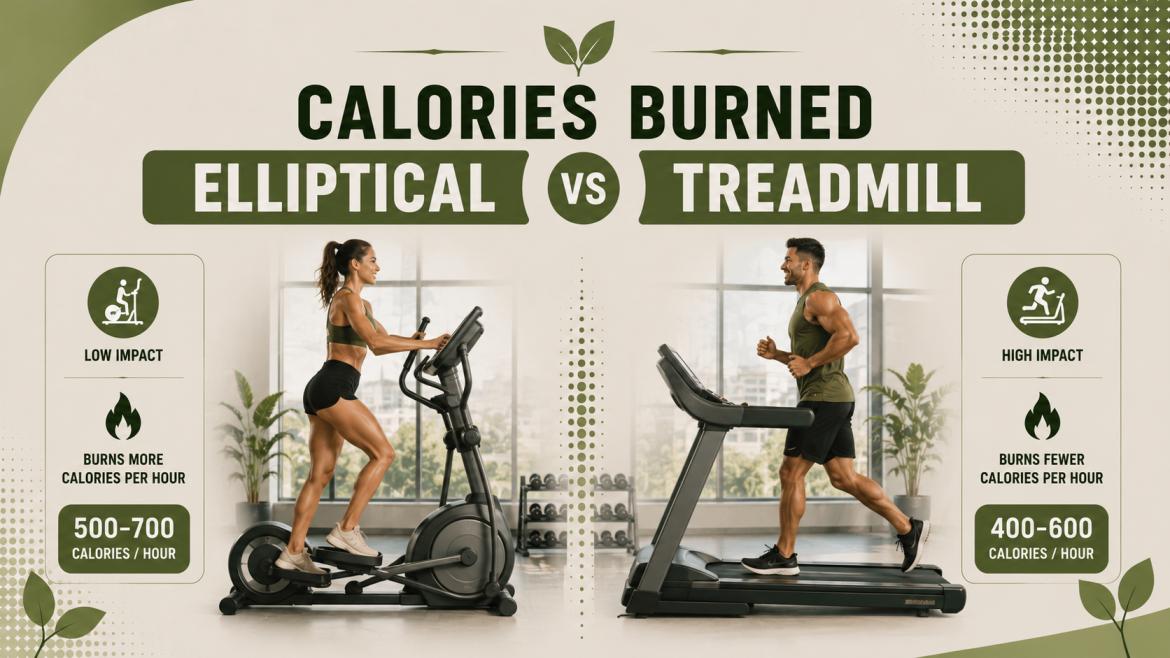
The treadmill burns more calories than the elliptical at equivalent subjective effort for most adults. A 154 lb (70 kg) person running on a treadmill at 5 mph burns approximately 290 calories in 30 minutes. The same person at vigorous elliptical effort (MET 8.0) burns approximately 280 calories in the same window. The gap is small at matched intensities but widens significantly as treadmill pace increases.
Use the elliptical calorie calculator to calculate elliptical session output for your body weight and effort level.
The elliptical vs treadmill question is one of the most searched gym cardio comparisons. The answer depends on three variables: training goal (maximum calorie burn vs joint preservation), effort level applied to each machine, and incline or resistance settings used.
This article covers MET-based calorie comparisons across effort levels, body weight tables for both machines, incline treadmill vs vigorous elliptical, and which machine wins for weight loss by specific training context.
Elliptical vs Treadmill MET Values
MET values are the foundation of any fair calorie comparison. MET represents oxygen consumption relative to rest and is standardised across body weights. Comparing MET values for equivalent effort levels on each machine shows which activity demands more energy per unit of time.
For the full elliptical calorie hub covering all session lengths and effort tables, see the calories burned elliptical guide. For the broader activity comparison placing both machines alongside cycling, rowing, and swimming, see the calories burned guide.
Elliptical vs Treadmill MET Comparison by Activity Level
Activity | MET | Effort Classification |
|---|---|---|
Elliptical, light effort | 4.6 | Light |
Treadmill walking, 3.0 mph | 3.5 | Light |
Treadmill walking, 3.5 mph | 4.3 | Light to moderate |
Elliptical, moderate effort | 6.0 | Moderate |
Treadmill walking, incline 5%, 3.5 mph | 6.0 | Moderate |
Elliptical, vigorous effort | 8.0 | Vigorous |
Treadmill running, 5 mph | 8.3 | Vigorous |
Treadmill running, 6 mph | 9.8 | Very vigorous |
Elliptical, very vigorous | 9.0 | Very vigorous |
Treadmill running, 6.5 mph | 11.0 | Very vigorous |
Source: 2024 Adult Compendium of Physical Activities (Ainsworth et al.)
The treadmill at flat running paces above 5 mph consistently outperforms the elliptical at vigorous effort. Below 5 mph running speed, moderate-to-vigorous elliptical effort produces comparable or higher MET values than treadmill walking. The crossover point is approximately MET 6.0, where vigorous elliptical and incline treadmill walking overlap.
Elliptical vs Treadmill Calories in 30 Minutes by Body Weight
Thirty minutes is the standard benchmark for comparing cardio machine outputs. The table below shows calorie output for both machines across common body weights at matched effort levels.
30-Minute Calorie Comparison: Elliptical vs Treadmill (Vigorous Effort)
Body Weight | Elliptical Vigorous (MET 8.0) | Treadmill Run 5 mph (MET 8.3) | Difference |
|---|---|---|---|
120 lb (54 kg) | 216 kcal | 224 kcal | -8 kcal |
130 lb (59 kg) | 236 kcal | 245 kcal | -9 kcal |
150 lb (68 kg) | 272 kcal | 282 kcal | -10 kcal |
154 lb (70 kg) | 280 kcal | 290 kcal | -10 kcal |
185 lb (84 kg) | 336 kcal | 348 kcal | -12 kcal |
220 lb (100 kg) | 400 kcal | 415 kcal | -15 kcal |
The calorie gap at vigorous effort vs 5 mph running is approximately 10 calories per 30 minutes for a 154 lb person. This is a 3.4% difference, smaller than the margin of error in most machine display readings. At this pace comparison, vigorous elliptical and 5 mph treadmill running are effectively equivalent in 30-minute calorie output.
Elliptical vs Treadmill: Where the Gap Widens
The calorie gap between treadmill and elliptical grows substantially as treadmill running speed increases above 5 mph. At 6 mph and beyond, the treadmill clearly outperforms the elliptical at any effort level.
30-Minute Elliptical vs Treadmill Comparison (154 lb / 70 kg)
Activity | MET | Calories / 30 Min |
|---|---|---|
Elliptical, light | 4.6 | 161 kcal |
Treadmill walk, 3.5 mph | 4.3 | 150 kcal |
Elliptical, moderate | 6.0 | 210 kcal |
Treadmill walk, incline 5%, 3.5 mph | 6.0 | 210 kcal |
Elliptical, vigorous | 8.0 | 280 kcal |
Treadmill run, 5 mph | 8.3 | 290 kcal |
Elliptical, very vigorous | 9.0 | 315 kcal |
Treadmill run, 6 mph | 9.8 | 343 kcal |
Treadmill run, 6.5 mph | 11.0 | 385 kcal |
Treadmill run, 8 mph | 13.5 | 473 kcal |
At 6 mph treadmill running, the calorie gap over 30 minutes is 63 calories above very vigorous elliptical for a 154 lb person. At 8 mph, the treadmill produces 158 more calories than very vigorous elliptical in 30 minutes. For people who can sustain running at 6 mph or faster, the treadmill clearly wins on raw calorie output per session.
Incline Treadmill vs Elliptical Calorie Comparison
Incline treadmill walking at 3.5 to 4.0 mph with 8 to 15% grade produces output that overlaps with moderate-to-vigorous elliptical effort. This is the most relevant comparison for gym users who cannot sustain running speeds above 5 mph.
Incline Treadmill vs Elliptical (154 lb / 70 kg, 30 Minutes)
Activity | MET | Calories / 30 Min |
|---|---|---|
Treadmill walk, flat, 3.5 mph | 4.3 | 150 kcal |
Elliptical, moderate effort | 6.0 | 210 kcal |
Treadmill walk, 5% incline, 3.5 mph | 6.0 | 210 kcal |
Treadmill walk, 10% incline, 3.5 mph | 7.5 | 263 kcal |
Elliptical, vigorous effort | 8.0 | 280 kcal |
Treadmill walk, 15% incline, 3.5 mph | 8.5 | 298 kcal |
Treadmill walking at 15% incline at 3.5 mph produces approximately 298 calories in 30 minutes for a 154 lb person. This slightly exceeds vigorous elliptical output of 280 calories. For gym users who prefer walking on the treadmill over running, a 12 to 15% incline at 3.5 mph is the closest calorie-matched alternative to vigorous elliptical use.
Elliptical vs Treadmill: Joint Impact Comparison
Calorie output is only one dimension of the elliptical vs treadmill comparison. Joint impact is the other clinically relevant factor.
Elliptical vs Treadmill: Impact Force Comparison
Variable | Elliptical | Treadmill (Running) |
|---|---|---|
Ground-reaction force per stride | 0.5 to 0.8 × body weight | 2.0 to 3.0 × body weight |
Knee joint stress per stride | Low | High to very high |
Hip joint stress | Low to moderate | Moderate to high |
Shin splint risk | Very low | Moderate to high |
Suitable for knee OA | Yes, generally | Contraindicated in severe OA |
Impact classification | Low impact | High impact |
Ground-reaction force data: Whittle (2007), Gait Analysis, 4th ed.; impact classifications per ACSM guidelines.
Research published in Gait and Posture (Burnfield et al., 2007) confirmed that elliptical trainers produce ground-reaction forces approximately 75 to 80% lower than treadmill running at equivalent cardiovascular intensities. For individuals with osteoarthritis, stress fractures, or post-surgical lower extremity recovery, this difference is clinically significant.
The practical recommendation: for maximum calorie burn per session, use the treadmill at running speeds above 5 mph if joints tolerate it. For equivalent calorie output at lower joint stress, use the elliptical at vigorous-to-very-vigorous effort. For both weight loss and joint preservation combined, the elliptical at vigorous effort is the superior choice.
Is Elliptical or Treadmill Better for Weight Loss?
The answer depends on which constraint is binding: time, joint tolerance, or fitness level.
Maximum calorie burn per hour: Treadmill running at 6+ mph wins by 15 to 30% over vigorous elliptical
Sustainable daily use without joint pain: Elliptical at vigorous effort produces nearly identical weekly deficit with far lower injury risk
Beginners or deconditioned adults: Elliptical at moderate effort is accessible from session one; treadmill running requires cardiovascular base-building first
Joint conditions (knee OA, shin splints, stress fractures): Elliptical is the indicated choice; treadmill running may be contraindicated
A 154 lb person who can sustain vigorous elliptical use daily burns approximately 2,940 calories per week (7 × 420 calories, 45-min sessions). The same person running at 5 mph daily for 45 minutes burns approximately 3,045 calories per week. The 105-calorie weekly difference is smaller than one additional 10-minute elliptical session. For sustainable daily use, the elliptical wins by survivability.
For 30-minute session weight loss planning on the elliptical with weekly deficit tables, see the calories burned on elliptical 30 minutes guide. For elliptical calorie output expressed per machine-displayed mile, see the elliptical calories per mile guide. Use the TDEE calculator to find your maintenance calorie target before planning a weekly deficit from either machine.
Frequently Asked Questions About Elliptical vs Treadmill Calories
Does the Elliptical or Treadmill Burn More Calories?
The treadmill burns more calories per session than the elliptical at running speeds above 5 mph. At vigorous elliptical effort (MET 8.0) vs treadmill running at 5 mph (MET 8.3), the calorie gap is approximately 10 calories per 30 minutes for a 154 lb person — less than 4%. At treadmill running speeds of 6 mph and above, the treadmill clearly outperforms the elliptical. At walking speeds on the treadmill, the elliptical at moderate-to-vigorous effort burns more calories.
Is the Elliptical as Good as Running on a Treadmill for Cardio?
Vigorous elliptical effort (MET 8.0) produces oxygen consumption and heart rate responses comparable to running at approximately 5 mph (MET 8.3). A study published in Medicine and Science in Sports and Exercise (Picard et al., 1998) found that peak oxygen uptake on the elliptical was not significantly different from treadmill running at equivalent perceived exertion. The elliptical provides equivalent cardiovascular stimulus at significantly lower joint load.
Which Burns More Calories: Elliptical or Incline Treadmill?
Incline treadmill walking at 15% grade and 3.5 mph (MET 8.5) burns approximately 298 calories in 30 minutes for a 154 lb person. Vigorous elliptical effort (MET 8.0) burns approximately 280 calories in the same window. Incline treadmill at high grade slightly exceeds vigorous elliptical output. At incline below 10%, the vigorous elliptical and incline treadmill walk produce nearly identical 30-minute calorie output.
How Do I Burn the Same Calories on the Elliptical as Running?
To match treadmill running at 5 mph (MET 8.3) on the elliptical, maintain vigorous effort (MET 8.0) with active arm use and resistance at level 7 to 9. To match running at 6 mph (MET 9.8), push to very vigorous elliptical effort (MET 9.0) with resistance at level 10 to 12 and incline engaged. The calorie matching is approximate because individual fitness levels affect actual oxygen consumption on both machines.
Does the Elliptical Burn as Many Calories as Running for Weight Loss?
Over a sustained week of daily sessions, vigorous elliptical use and moderate running at 5 mph produce nearly identical weekly calorie deficits for most adults. A 154 lb person burns approximately 2,940 calories per week from seven 45-minute vigorous elliptical sessions versus approximately 3,045 from equivalent running sessions. The 105-calorie weekly difference is trivial. For sustainable daily use without injury accumulation, the elliptical produces equivalent fat loss outcomes.
What Burns More Calories: Elliptical or Walking?
The elliptical at any effort above light (MET 4.6) burns significantly more calories than brisk walking (MET 4.3) at the same duration. For a 154 lb person in 30 minutes: brisk walking produces approximately 150 calories while moderate elliptical produces approximately 210 calories — a 40% difference. Vigorous elliptical (280 calories) burns approximately 87% more than brisk walking in the same 30-minute window.