
Best Calories Burned Calculators: 10 Tools Compared
Not every calories burned calculator uses the same method, and the gap between a careful MET-based tool and a rough one-size-fits-all guess can be hundreds of calories per session. We reviewed 10 calculators on formula accuracy, activity database depth, and interface quality to find the ones worth trusting.

Your body has a number. Let's find it.
We calculate the exact calorie target your body needs, built from your stats and goal, then track everything against it daily. Log meals, add workouts, set a weight goal, and watch your numbers update in real time. Check in weekly to see calories, water, and weight trend in one place.
No spreadsheets. No guessing. Just results.
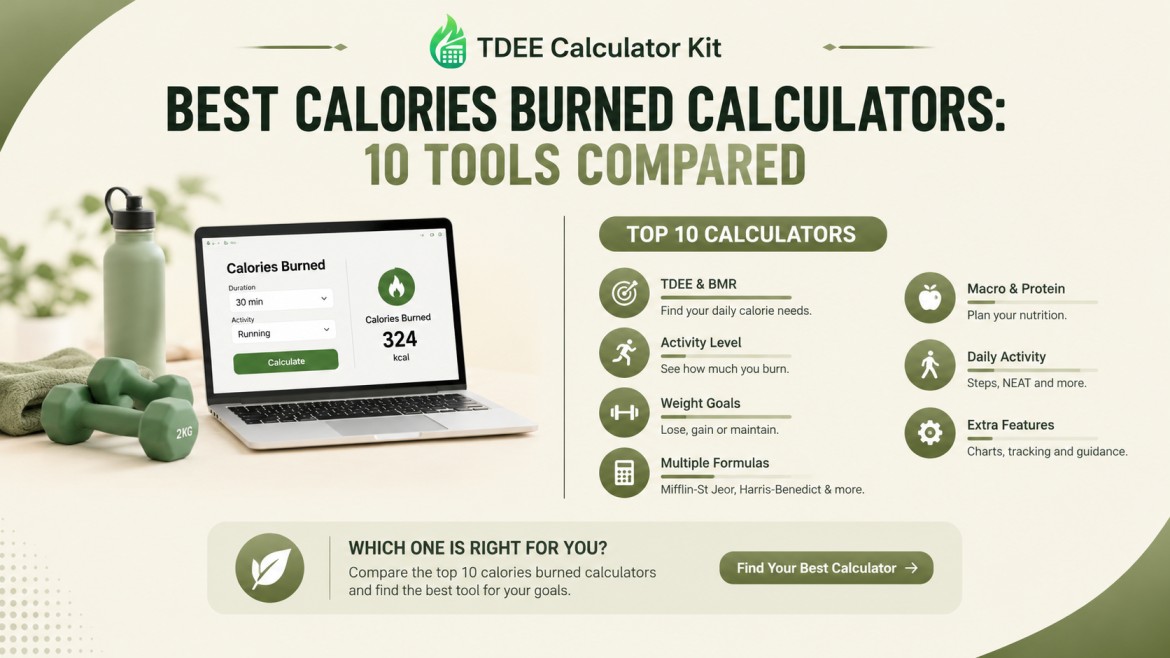
A calorie deficit depends on both sides of the equation, what gets eaten and what gets burned. Guessing the second number undoes the precision of tracking the first.
This is exactly why a reliable calorie burned calculator earns a place in any serious tracking routine. Calories burned during exercise is estimated using the Metabolic Equivalent of Task, or MET. This standardized measure shows how much energy an activity requires compared to sitting still. One MET equals roughly 1 kcal per kilogram of body weight per hour.
The calculation multiplies an activity's MET value by body weight and the duration of the session. Small differences in which MET database a tool uses, and how many activities it covers, directly change the result a user sees.
This list ranks the 10 best calories burned calculators based on formula accuracy, activity database size, and output depth. How clearly each tool presents its results matters too.
10 Best Calories Burned Calculators, Reviewed and Ranked
The calculators below range from general-purpose MET tools to specialist platforms built for running, bodybuilding, and medical use. Each entry covers the formula used, the activity database size, and the companion tools available on the same site.
1. TDEE Calculator Kit
TDEE Calculator Kit's calories burned calculator applies the standard MET formula. It multiplies activity MET value by body weight and session duration, across a wide range of exercises and daily activities. Results display instantly without requiring an account or email address.
Rather than one generic tool, the site runs a set of different calorie burned calculators, each built around a specific activity, together covering 100+ activities. Read the full calories burned guide for dedicated calculators spanning cycling, swimming, HIIT, walking, and dozens more.
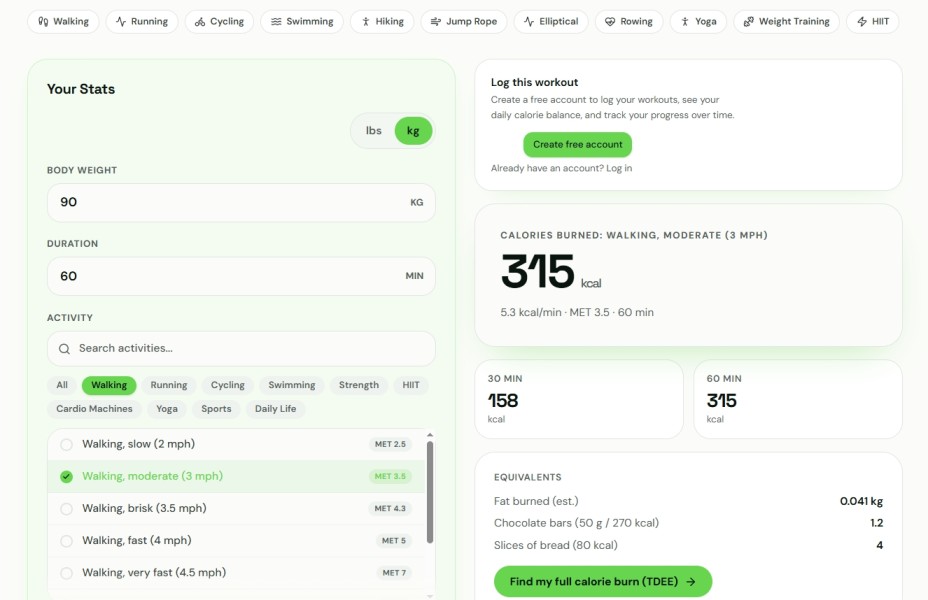
The tool also sits inside a full TDEE ecosystem rather than standing alone. Pairing exercise calorie burn with a full TDEE and macro calculation gives a more complete daily picture than a standalone burn number. Many competitor tools stop there.
Feature | Detail |
|---|---|
UI/UX Rating | 9.5 / 10 |
Key Highlights | 100+ activities across dedicated calculators, instant results, no sign-up required, directly connected to full TDEE and macro tools |
Calculators Available | Calories Burned Calculator |
2. Calculator.net Calories Burned Calculator
Calculator.net applies the standard three-factor MET formula, time multiplied by MET value and body weight, divided by 200. The platform also explains the broader calorie-balance equation behind weight change, giving context beyond the raw number.
As one of the largest general calculator platforms online, Calculator.net covers walking, running, and cycling as its core activities rather than an exhaustive exercise library. No registration is required, and the page loads quickly even on slower connections.
Feature | Detail |
|---|---|
UI/UX Rating | 7 / 10 |
Key Highlights | Standard MET formula, calorie-balance explanation included, no registration required |
Calculators Available | Calories Burned Calculator, BMI Calculator, Calorie Calculator, Macro Calculator |
3. Forbes Health Calories Burned Calculator
Forbes Health built its calculator using physical activity data sourced from Harvard Health. A panel including a physician, a registered dietitian, and ACE's senior director of science reviewed the methodology. This editorial review process is uncommon among free calorie-burn tools.
The tool sits within Forbes Health's broader weight-loss content vertical. It links directly to companion calculators covering total daily energy expenditure and general daily calorie needs. This gives the calories burned result somewhere to go rather than leaving it as an isolated number.
Feature | Detail |
|---|---|
UI/UX Rating | 8.5 / 10 |
Key Highlights | Harvard Health-sourced data, expert panel review, linked directly to Forbes Health's TDEE calculator |
Calculators Available | Calories Burned Calculator, TDEE Calculator, Calorie Calculator |
4. Kaiser Permanente Interactive Calorie Tool
This tool is licensed Healthwise health-encyclopedia content, which means the identical calculator also appears on Cigna, Columbia Doctors, and several other healthcare platforms.
This makes the tool better suited to someone newly building an activity habit than to someone tracking precise calorie math for a specific deficit. The medical-platform backing adds credibility, even though the calculator itself trades some precision for its broader wellness message.
Feature | Detail |
|---|---|
UI/UX Rating | 6.5 / 10 |
Key Highlights | Medical-platform credibility, simple activity-based estimates, strong messaging around everyday movement |
Calculators Available | Interactive Calorie Burn Tool (within Kaiser Permanente's broader health encyclopedia) |
5. METSCalculator.com
METSCalculator is a narrow, single-purpose tool built strictly around the MET formula: body weight in kilograms multiplied by MET value and activity time. It does not factor in age or sex, and the site states this limitation directly rather than implying false precision.
The site walks through a full worked example rather than just displaying a result. It shows exactly how a 70 kg person burns roughly 105 kcal from 30 minutes at 3 METs. This reference-style approach makes the underlying math fully visible rather than hidden behind a black-box calculation.
Feature | Detail |
|---|---|
UI/UX Rating | 6 / 10 |
Key Highlights | Pure MET-formula calculation, transparent about its own limitations, minimal no-frills interface |
Calculators Available | Calories Burned / METs Calculator (standalone, no companion suite) |
6. Omnicalculator Calories Burned Calculator
Omnicalculator pairs the standard MET formula with an unusually detailed explanation of where the formula comes from. This includes the oxygen-consumption math behind the 1-MET baseline, derived from oxygen uptake per kilogram of body weight per minute.
The calculator sits inside Omnicalculator's sports category alongside dozens of related tools, including a dedicated burpee calorie calculator and other activity-specific variants. This breadth makes it easy to explore related questions without leaving the platform.
Feature | Detail |
|---|---|
UI/UX Rating | 7.5 / 10 |
Key Highlights | Detailed formula derivation, part of a large general calculator ecosystem, clean modern interface |
Calculators Available | Calories Burned Calculator, part of Omnicalculator's Sports category |
7. Runbundle Running Calorie Calculator
Runbundle is built and maintained by a running coach, and the calculator reflects that specialist focus directly. It accounts for elevation, distinguishing uphill from downhill effort, which generic MET tables typically ignore entirely.
The site has a track record of regular updates, adding treadmill, hiking, and rowing calorie calculators over time based on user requests. For runners specifically, this specialist ecosystem offers more precision than a general-purpose MET tool built for every activity at once.
Feature | Detail |
|---|---|
UI/UX Rating | 8 / 10 |
Key Highlights | Elevation-adjusted calculation, running-coach authorship, part of a full running-specific tool suite |
Calculators Available | Running Calorie Calculator, Treadmill Calorie Calculator, Hiking Calorie Calculator, Cycling Calorie Calculator, Rowing Calorie Calculator |
8. Healthyeater.com Calories Burned Calculator
Healthyeater's tool covers more than 380 individual exercises, built by Ted Kallmyer, a certified macro coach, and tied into a broader human-coached nutrition platform. The calculator is positioned as a companion to the site's macro and TDEE calculators rather than a standalone utility.
Beyond the free calculators, Healthyeater also offers personalized macro coaching from a human nutrition coach. Most purely algorithmic competitors on this list offer no equivalent service layer. This combination of free tools and paid human guidance is a distinct model worth knowing about.
Feature | Detail |
|---|---|
UI/UX Rating | 7.5 / 10 |
Key Highlights | 380+ activity database, certified macro coach authorship, connected to a full nutrition coaching ecosystem |
Calculators Available | Calories Burned Calculator, TDEE Calculator, Macro Calculator, Body Recomposition Calculator |
9. Bodybuilding.com Calorie Burn Calculator
Bodybuilding.com's tool draws from the 2011 Compendium of Physical Activities, an 821-activity reference database that includes non-exercise tasks like housecleaning alongside structured training. The calculator itself covers over 100 common exercises and sports.
Sports and games get their own dedicated category, covering basketball, football, frisbee, golf, and similar activities alongside standard gym exercises. This breadth makes the tool relevant to athletes tracking game-day calorie burn, not just structured gym sessions.
Feature | Detail |
|---|---|
UI/UX Rating | 7 / 10 |
Key Highlights | Compendium-sourced MET data, covers 100+ exercises and sports, backed by a large fitness-brand tool ecosystem |
Calculators Available | Calorie Burn Calculator, TDEE Calculator, RMR Calculator, Macronutrient Calculator |
10. iCliniq Calorie Burn Calculator
iCliniq runs a medical Q&A platform, and its calculator content carries that same clinical review process. The tool itself uses a simpler activity-level multiplier rather than a detailed per-activity MET lookup, trading some precision for straightforward ease of use.
The tool sits within a broader iCliniq suite covering ideal body weight, adjusted body weight, and weight loss by target date. For users who want calculator output alongside the option to consult a doctor online, this medical-platform context adds a layer most fitness-only competitors cannot offer.
Feature | Detail |
|---|---|
UI/UX Rating | 6.5 / 10 |
Key Highlights | Medically reviewed platform, simple activity-level method, connected to broader weight-management tools |
Calculators Available | Calorie Burn Calculator, BMR and Calorie Intake Calculator, Weight Loss by Target Date Calculator |
How We Picked the Best Calories Burned Calculators?
A useful calories burned calculator does more than spit out a single number. It should show which formula or database it draws from, cover a meaningful range of activities, and present the result clearly enough to act on.
Four criteria were used to review and rank all 10 tools on this list.
Formula Transparency: Does the tool disclose whether it uses MET values, and from which database?
Activity Database Size: How many distinct activities and exercises does the tool actually cover?
Output Clarity: Is the result presented as a clear number, with context for what it means?
Companion Tools Available: Does the platform connect calorie burn to a broader calorie or macro picture?
Tools that hid their calculation method entirely, or required extensive registration before showing any result, were ranked lower than those offering immediate, transparent output.
What Is a MET and How Does It Affect Your Calorie Burn?
A MET, or Metabolic Equivalent of Task, measures how many times more energy an activity requires compared to sitting quietly. One MET equals roughly 3.5 mL of oxygen consumed per kilogram of body weight per minute. That translates to about 1 kcal per kilogram per hour.
Activities carry different MET values based on intensity. Walking sits around 3.3 METs, moderate cycling around 6, and running closer to 9.8. The same person burns roughly three times more calories running than walking for the same duration.
How Accurate Are Calories Burned Calculators?
MET-based calculators provide population-average estimates, not individually measured values. Real energy expenditure varies by fitness level, technique efficiency, and individual metabolic differences that no formula fully captures.
This does not make the estimates useless. It means the output should be treated as a reasonable planning figure, not an exact measurement, particularly when the result feeds into a broader calorie deficit calculation for weight loss.
Does Calorie Burn Differ Between Men and Women?
At identical body weight, men typically carry more lean muscle mass than women. Muscle burns more calories than fat tissue, even during the same activity. This means two people at the same weight can see somewhat different real-world calorie burn despite an identical MET-based estimate.
The TDEE calculator for women accounts for additional sex-specific factors beyond activity alone. Lean mass differences and life-stage adjustments are two a generic calories-burned tool does not address.
Should You Eat Back the Calories You Burn During Exercise?
This depends on how the exercise estimate was factored into the original calorie target. If a TDEE calculation already assumes a specific activity level, exercise calories are already built into that number. Eating them back on top would create an unintended surplus.
Checking the calorie deficit calculator confirms whether exercise is already included in a given target. That answer determines whether eating back burned calories makes sense.
Do Fitness Trackers Overestimate Calories Burned?
Wearable fitness trackers commonly overestimate calorie burn compared to MET-based calculations. Activities involving arm movement or variable intensity are especially hard for wrist-based sensors to measure precisely. Several calculator platforms reviewed in this list flag this discrepancy directly.
A MET-based calculator using a validated formula generally produces a more conservative, defensible estimate than a wearable device's proprietary algorithm. This matters most for planning tied to a specific calorie target.
How Does Calories Burned Fit Into Your Total Daily Energy Expenditure?
Exercise activity thermogenesis is one of four components that make up TDEE, alongside basal metabolic rate, non-exercise activity, and the thermic effect of food. A single workout's calorie burn is a contribution to that total, not the total itself.
Using a calories burned calculator alongside a full TDEE calculation gives a complete picture of daily energy balance. A single exercise session is a contribution, not the whole story.