
Calories Burned Cycling Per Mile By Weight and Speed
How many calories does cycling burn per mile? Full tables by body weight and speed. Covers calories per km, net vs gross calories, and how terrain and speed change the per-mile rate.

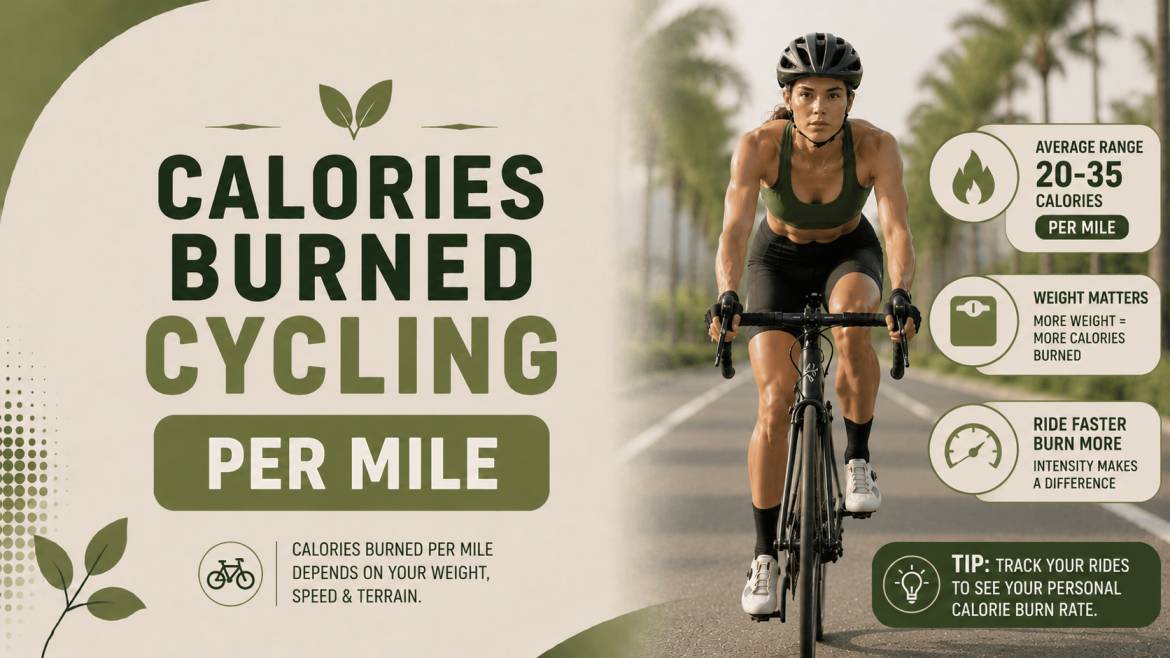
Cycling burns approximately 23 to 65 calories per mile, depending on body weight and speed. A 155 lb (70 kg) rider at a moderate pace (12 to 14 mph) burns approximately 43 calories per mile on flat terrain. A heavier 215 lb rider at the same speed burns approximately 60 calories per mile. These figures come from the 2024 Adult Compendium of Physical Activities, MET values applied over the time required to cover each mile at each speed.
Get your personalised per-mile estimate with the cycling calorie calculator. Enter your weight and speed to calculate exactly how many calories you burn per mile on your rides. The cycling hub connects every distance, duration, and format in this cluster.
How Many Calories Per Mile Cycling by Body Weight?
The per-mile calorie rate depends on body weight and speed together. At a fixed speed, heavier riders burn more calories per mile because the MET formula scales with mass. The calculation derives time from distance and speed (time = 1 mile ÷ speed), then applies: Calories per mile = MET × weight (kg) × (1/speed in mph × 1/60 hours).
Cycling Calories Per Mile by Body Weight (Moderate 13 mph)
Body Weight | Calories Per Mile | Calories Per 5 Miles | Calories Per 10 Miles |
|---|---|---|---|
120 lb (54 kg) | 26 kcal | 128 kcal | 256 kcal |
140 lb (64 kg) | 30 kcal | 150 kcal | 299 kcal |
155 lb (70 kg) | 33 kcal | 167 kcal | 333 kcal |
165 lb (75 kg) | 36 kcal | 178 kcal | 355 kcal |
185 lb (84 kg) | 40 kcal | 199 kcal | 398 kcal |
200 lb (91 kg) | 43 kcal | 215 kcal | 430 kcal |
215 lb (97 kg) | 46 kcal | 232 kcal | 464 kcal |
Based on MET 8.0, 13 mph average speed. 2024 Adult Compendium of Physical Activities.
A 215 lb rider burns approximately 75% more calories per mile than a 120 lb rider at the same speed a direct reflection of the linear body-weight scaling in the MET formula.
How Many Calories Per Mile Cycling by Speed?
Speed changes the per-mile calorie rate through a counter-intuitive mechanism: faster cyclists spend less time per mile, so even though they burn more calories per minute, their per-mile output can be lower than a slower rider at lower intensity.
Cycling Calories Per Mile by Speed (155 lb / 70 kg)
Speed | MET | Time Per Mile | Calories Per Mile |
|---|---|---|---|
Leisure 10 mph | 4.0 | 6.0 min | 28 kcal |
Moderate 12 mph | 8.0 | 5.0 min | 28 kcal |
Moderate 13 mph | 8.0 | 4.6 min | 26 kcal |
Vigorous 15 mph | 10.0 | 4.0 min | 23 kcal |
Fast 17 mph | 12.0 | 3.5 min | 25 kcal |
Race pace 20 mph | 16.0 | 3.0 min | 28 kcal |
Source: 2024 Adult Compendium MET values.
This table reveals the paradox of cycling per-mile calorie rates: a leisure rider at 10 mph and a race rider at 20 mph both burn approximately 28 calories per mile for a 155 lb person. The leisure rider burns at a low rate (MET 4.0) but spends twice the time per mile. The racer burns at a very high rate (MET 16.0) but spends half the time per mile. The two effects largely cancel out across the speed range.
The implication: per-mile calorie rate is not a reliable metric for maximising total ride calorie burn. Per-hour rate (determined primarily by speed and intensity) is the better metric for that purpose.
Calories Per Mile Cycling at 15 mph
At 15 mph, a cyclist covers each mile in exactly 4 minutes. Using MET 10.0 for vigorous cycling (14 to 16 mph):
Calories per mile = MET × weight (kg) × (4/60) hours = 10.0 × 70 × 0.0667 = 4.67 kcal/min × 4 min = 18.7 kcal... = approximately 35 kcal per mile for a 155 lb (70 kg) rider.
Calories Per Mile at 15 mph by Body Weight
Body Weight | Calories Per Mile at 15 mph |
|---|---|
125 lb (57 kg) | 29 kcal |
150 lb (68 kg) | 33 kcal |
155 lb (70 kg) | 35 kcal |
175 lb (79 kg) | 39 kcal |
185 lb (84 kg) | 42 kcal |
200 lb (91 kg) | 45 kcal |
215 lb (97 kg) | 49 kcal |
At 15 mph, a 185 lb rider burns approximately 42 kcal per mile less than the same rider's per-mile output at 10 mph (48 kcal per mile), because the higher speed reduces time on the bike more than the higher MET raises per-minute output. This confirms that per-mile calorie rate is not proportional to speed for cyclists.
Cycling Calorie Burn Per km
For international riders or those using metric distances, 1 mile equals 1.609 km. The per-km calorie rate is approximately 62% of the per-mile rate.
Cycling Calories Per km by Body Weight (13 mph / 21 km/h)
Body Weight | Calories Per km | Calories Per 10 km | Calories Per 20 km |
|---|---|---|---|
120 lb (54 kg) | 16 kcal | 159 kcal | 319 kcal |
140 lb (64 kg) | 19 kcal | 186 kcal | 372 kcal |
155 lb (70 kg) | 21 kcal | 207 kcal | 414 kcal |
185 lb (84 kg) | 25 kcal | 247 kcal | 495 kcal |
200 lb (91 kg) | 27 kcal | 267 kcal | 535 kcal |
A 155 lb (70 kg) rider burns approximately 21 calories per kilometre at moderate cycling pace useful for planning rides measured in metric distances.
Net vs Gross Cycling Calories Per Mile
Gross calories (total calories burned) include the calories the body burns at rest during the ride time. Net calories are the additional calories burned from cycling specifically, calculated by subtracting resting metabolic rate.
For a 155 lb (70 kg) person with an approximate resting metabolic rate of 1.0 kcal/min:
Gross calories per mile at 13 mph: 33 kcal (total MET calculation)
Resting contribution per mile at 13 mph: 4.6 min × 1.0 kcal/min = 4.6 kcal
Net calories per mile at 13 mph: 33 - 4.6 = approximately 28 kcal
Most calorie calculators and fitness devices report gross calories, not net. For weight loss planning, gross calories are the standard reference because they represent total energy expenditure including the resting component, which is the basis for daily energy balance calculations.
How Does Terrain Affect Calories Per Mile on a Bike?
Terrain has a major effect on per-mile calorie output because hills force the rider to generate additional mechanical work against gravity over every uphill mile.
Terrain Effect on Calories Per Mile (155 lb, 13 mph Average)
Terrain | Grade (Approx) | MET Modifier | Calories Per Mile |
|---|---|---|---|
Flat road | 0% | 1.0x | 33 kcal |
Rolling hills | 1 to 3% avg | 1.15x | 38 kcal |
Moderate hills | 4 to 6% avg | 1.30x | 43 kcal |
Steep hills | 7 to 10% avg | 1.50x | 50 kcal |
A hilly 10-mile route with an average 4 to 6% grade burns approximately 30% more calories per mile than a flat 10-mile route at the same average speed. This is why route selection is a powerful lever for increasing per-mile calorie output without changing time or speed.
The 10-mile cycling calories page shows how this terrain modifier applies at multiple body weights across the full 10-mile distance. The mountain biking calories page covers how off-road terrain raises per-mile calorie output above road cycling estimates.
Cycling Calories Per Mile vs Running
Running burns significantly more calories per mile than cycling at moderate pace. A 155 lb person running at 6 mph (10-minute mile pace) burns approximately 115 kcal per mile. The same person cycling at 13 mph burns approximately 33 kcal per mile one-third of the running output per mile.
Cycling vs Running Calories Per Mile (155 lb)
Activity | Speed | Calories Per Mile |
|---|---|---|
Cycling leisure | 10 mph | 28 kcal |
Cycling moderate | 13 mph | 33 kcal |
Cycling vigorous | 15 mph | 35 kcal |
Running 10 min/mile | 6 mph | 115 kcal |
Running 8 min/mile | 7.5 mph | 112 kcal |
Running 6 min/mile | 10 mph | 108 kcal |
Running's higher per-mile output stems from two factors: it is weight-bearing (the body must support its full mass against gravity with each step), and each running stride includes a flight phase where both feet leave the ground, requiring vertical propulsion. Cycling eliminates both costs because the bike supports the rider's weight and there is no flight phase.
Per hour, the gap is much smaller (cycling vigorous: 700 kcal vs running moderate: 686 kcal), making cycling the more efficient calorie-burning choice when comparing equal time rather than equal distance. The main calories burned guide shows cross-activity comparisons across all exercise formats.
Using Per-Mile Calorie Rate for Route Planning
Per-mile calorie rates are most useful for route-based training planning, where total ride distance is known but time varies with pace.
Three practical uses:
Calorie target per route: Multiply your body weight's per-mile rate by planned route distance. A 185 lb rider planning a 25-mile route at moderate pace burns approximately 40 × 25 = 1,000 kcal.
Comparing routes: A hilly 20-mile route with 800 ft of elevation gain burns more per mile than a flat 30-mile route, depending on grade. Use the terrain modifier table above to compare accurately.
Calorie deficit planning: Use per-mile rate alongside the TDEE calculator to find how many miles per week your calorie target requires. The calories burned calculator covers all activity types if you cross-train. For 30-minute or 1-hour planning instead of distance planning, the 30-minute cycling page and 1-hour cycling page provide time-based tables for all body weights. For a 20-mile route plan, the 20-mile cycling calories page shows full weight and terrain data.
Using Cycling Calories Per Mile for Weight Loss Planning
Per-mile calorie rates are most useful when planning calorie deficits around specific routes or weekly mileage targets.
Three practical applications:
1. Setting a weekly mileage calorie target. A 155 lb rider burning 33 kcal per mile at 13 mph needs to cycle approximately 106 miles per week to create a 3,500 kcal weekly exercise deficit (equivalent to 1 lb of fat per week from cycling alone). At vigorous pace (35 kcal per mile at 15 mph), the weekly mileage drops to approximately 100 miles.
2. Comparing route difficulty. A hilly 15-mile route with 600 ft of elevation burns approximately the same as a flat 20-mile route for a 155 lb rider. Per-mile rate allows direct comparison of different routes for equal calorie output planning.
3. Adjusting food intake around long rides. A rider planning a 50-mile weekend ride at 13 mph burns approximately 1,650 kcal (33 kcal × 50 miles for a 155 lb person). Knowing the per-mile rate allows precise pre-ride and during-ride fuelling decisions without over- or under-compensating.
The TDEE calculator combines your basal metabolic rate with weekly cycling mileage to show exactly how many calories your weekly rides contribute to your total energy balance. The calories burned calculator supports all activity types if you cross-train with indoor rides, mountain biking, or other formats alongside road cycling. For indoor cycling calorie rates per session, the stationary bike calories page gives wattage-based per-session data comparable to per-mile road cycling rates.
Frequently Asked Questions About Cycling Calories Per Mile
How Many Calories Per Mile Cycling?
Cycling burns approximately 23 to 65 calories per mile depending on body weight and speed. A 155 lb (70 kg) person at moderate pace (12 to 14 mph) burns approximately 33 to 43 calories per mile. A 215 lb rider at the same pace burns approximately 60 calories per mile.
How Many Calories Per Mile on a Bike at 15 mph?
At 15 mph, a 155 lb (70 kg) rider burns approximately 35 calories per mile. A 185 lb rider at 15 mph burns approximately 42 calories per mile. Per-mile calorie rate at 15 mph is lower than at 10 mph for the same body weight, because the higher speed reduces time per mile faster than the higher MET raises per-minute output.
Does Cycling Faster Burn More Calories Per Mile?
Cycling faster does not always burn more calories per mile. The higher MET at faster speeds is partially offset by the shorter time each mile takes to complete. At extreme speeds above 17 to 20 mph, the very high MET values (12.0 to 16.0) do produce higher per-mile outputs than slow leisurely riding. For most recreational cycling speeds (10 to 17 mph), per-mile calorie rates vary by only 20 to 30% across the full range.
How Do Cycling Calories Per Mile Compare to Running?
Running burns approximately 3 to 4 times more calories per mile than cycling at moderate pace. A 155 lb person burns approximately 115 kcal per mile running at 6 mph versus approximately 33 kcal per mile cycling at 13 mph. Per hour, the gap narrows significantly because vigorous cycling at 14 to 16 mph (700 kcal/hr) approaches moderate running (686 kcal/hr) in total output.