
Calories Burned Rowing by Weight and Time
Rowing burns 200 to 840 calories per hour depending on body weight and effort level. This hub covers MET-based calorie tables, rowing vs running, 500m and 2000m estimates, weight loss planning, and links to every duration-based child guide in this cluster.

Your body has a number. Let's find it.
We calculate the exact calorie target your body needs, built from your stats and goal, then track everything against it daily. Log meals, add workouts, set a weight goal, and watch your numbers update in real time. Check in weekly to see calories, water, and weight trend in one place.
No spreadsheets. No guessing. Just results.
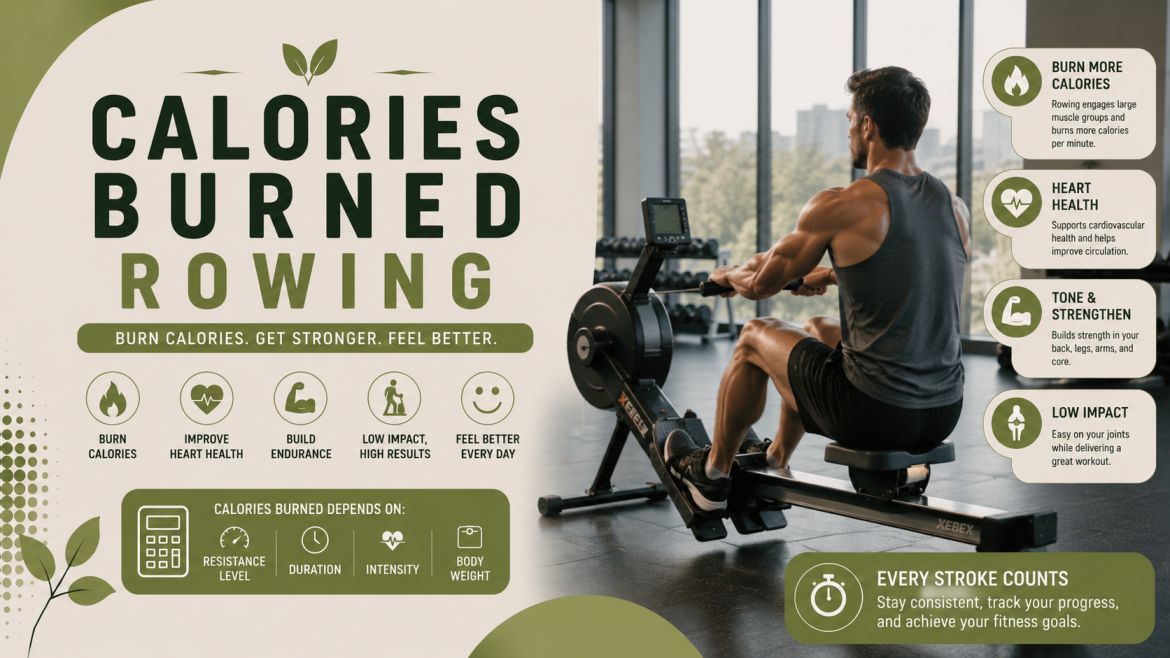
Rowing burns between 200 and 840 calories per hour for most adults. Body weight, stroke intensity, and effort level determine exactly where any session falls. A 154 lb (70 kg) person at moderate effort on a rowing machine burns approximately 490 calories per hour. At vigorous effort, the same person burns approximately 595 calories per hour.
Use the rowing calorie calculator to get a personalised estimate based on your weight, effort level, and session length.
The rowing machine is a full-body cardiovascular tool. Unlike running, cycling, or the elliptical, rowing engages both the upper and lower body simultaneously across each stroke cycle. Approximately 60% of the effort in each stroke comes from the legs and 40% from the back and arms. This bilateral demand raises the total muscle mass recruited per minute and drives calorie output above many single-plane cardio activities at comparable perceived effort.
This hub covers MET values by effort level, body weight calorie tables, rowing vs running comparisons, stroke rate and 500m calorie estimates, and links to every duration-specific child guide in this cluster.
How Many Calories Does Rowing Burn?
The MET (Metabolic Equivalent of Task) formula is the standard method for calculating rowing calorie output:
Calories = MET × body weight (kg) × duration (hours)
The 2024 Adult Compendium of Physical Activities assigns MET 3.5 to light stationary rowing, MET 7.0 to moderate effort, MET 8.5 to vigorous effort, and MET 12.0 to very vigorous or competitive rowing. For a 154 lb (70 kg) person at vigorous effort for one hour: 8.5 × 70 × 1 = 595 calories. At moderate effort: 7.0 × 70 × 1 = 490 calories.
For the full cross-activity calorie reference, see the calories burned calculator and the calories burned guide.
Rowing MET Values by Effort Level (2024 Compendium)
Effort Level | MET | Stroke Rate (approx.) | Description |
|---|---|---|---|
Light | 3.5 | 16 to 18 spm | Easy pace, full recovery between strokes |
Moderate | 7.0 | 20 to 22 spm | Steady effort, sustainable for 30 to 60 min |
Vigorous | 8.5 | 24 to 26 spm | Elevated heart rate, speaking difficult |
Very vigorous | 12.0 | 28 to 32 spm | Near-maximal effort, unsustainable for long duration |
spm = strokes per minute. Source: 2024 Adult Compendium of Physical Activities (Ainsworth et al.)
Moderate rowing at MET 7.0 already exceeds the output of brisk walking (MET 4.3), recreational cycling (MET 6.8), and hiking on flat terrain (MET 6.0). Very vigorous rowing at MET 12.0 matches running at approximately 7.5 mph in per-minute calorie output.
Rowing Machine Calories Burned by Body Weight
Body weight scales rowing calorie output linearly through the MET formula. Every kilogram of body weight adds proportional calories at the same effort level and session length.
Calories per Hour Rowing by Body Weight and Effort
Body Weight | Light (MET 3.5) | Moderate (MET 7.0) | Vigorous (MET 8.5) | Very Vigorous (MET 12.0) |
|---|---|---|---|---|
120 lb (54 kg) | 189 kcal | 378 kcal | 459 kcal | 648 kcal |
130 lb (59 kg) | 207 kcal | 413 kcal | 502 kcal | 708 kcal |
140 lb (64 kg) | 224 kcal | 448 kcal | 544 kcal | 768 kcal |
150 lb (68 kg) | 238 kcal | 476 kcal | 578 kcal | 816 kcal |
154 lb (70 kg) | 245 kcal | 490 kcal | 595 kcal | 840 kcal |
165 lb (75 kg) | 263 kcal | 525 kcal | 638 kcal | 900 kcal |
185 lb (84 kg) | 294 kcal | 588 kcal | 714 kcal | 1,008 kcal |
200 lb (91 kg) | 319 kcal | 637 kcal | 774 kcal | 1,092 kcal |
220 lb (100 kg) | 350 kcal | 700 kcal | 850 kcal | 1,200 kcal |
60-minute session. Source: 2024 Adult Compendium MET values.
A 220 lb person rowing vigorously for one hour burns 850 calories. A 120 lb person at the same effort burns 459 calories. The 85% gap between the two body weights reflects the direct linear scaling of the MET formula. At very vigorous effort, a 185 lb person crosses 1,000 calories per hour — one of the highest per-hour outputs available on a single cardio machine.
Rowing Machine Calories Per Minute
Per-minute calorie rates are the most practical reference for interval-based rowing workouts and short fixed-duration efforts.
Rowing Calories Per Minute by Body Weight
Body Weight | Light (MET 3.5) | Moderate (MET 7.0) | Vigorous (MET 8.5) | Very Vigorous (MET 12.0) |
|---|---|---|---|---|
130 lb (59 kg) | 3.4 kcal/min | 6.9 kcal/min | 8.4 kcal/min | 11.8 kcal/min |
154 lb (70 kg) | 4.1 kcal/min | 8.2 kcal/min | 9.9 kcal/min | 14.0 kcal/min |
185 lb (84 kg) | 4.9 kcal/min | 9.8 kcal/min | 11.9 kcal/min | 16.8 kcal/min |
220 lb (100 kg) | 5.8 kcal/min | 11.7 kcal/min | 14.2 kcal/min | 20.0 kcal/min |
A 154 lb person rowing vigorously burns approximately 9.9 calories per minute. At very vigorous pace, that rises to 14.0 calories per minute. These per-minute rates apply directly to any session length for precise calorie planning.
Calories Burned Rowing 20 Minutes
Twenty minutes is the most common short rowing session. It fits into time-limited workouts and serves as a complete HIIT finisher.
At moderate effort (MET 7.0), a 154 lb person burns approximately 163 calories in 20 minutes. At vigorous effort (MET 8.5), output rises to approximately 198 calories.
20-Minute Rowing Calories by Body Weight
Body Weight | Moderate (MET 7.0) | Vigorous (MET 8.5) | Very Vigorous (MET 12.0) |
|---|---|---|---|
130 lb (59 kg) | 138 kcal | 167 kcal | 236 kcal |
154 lb (70 kg) | 163 kcal | 198 kcal | 280 kcal |
185 lb (84 kg) | 196 kcal | 238 kcal | 336 kcal |
220 lb (100 kg) | 233 kcal | 283 kcal | 400 kcal |
For full weight-by-effort tables, a running comparison at 20 minutes, and beginner rowing output estimates, see the calories burned rowing 20 minutes guide.
Calories Burned Rowing 30 Minutes
Thirty minutes is the standard cardiovascular session benchmark for most gym-based rowing programs. At vigorous effort (MET 8.5), a 154 lb person burns approximately 298 calories. At moderate effort, output is approximately 245 calories.
30-Minute Rowing Calories by Body Weight
Body Weight | Moderate (MET 7.0) | Vigorous (MET 8.5) | Very Vigorous (MET 12.0) |
|---|---|---|---|
130 lb (59 kg) | 206 kcal | 251 kcal | 354 kcal |
154 lb (70 kg) | 245 kcal | 298 kcal | 420 kcal |
185 lb (84 kg) | 294 kcal | 357 kcal | 504 kcal |
220 lb (100 kg) | 350 kcal | 425 kcal | 600 kcal |
For full resistance-by-weight tables, stroke rate impact, female calorie estimates, and a comparison to 30 minutes of running, see the calories burned rowing 30 minutes guide.
Calories Burned Rowing 1 Hour
One hour on the rowing machine at vigorous effort is one of the highest single-session calorie outputs on a gym cardio machine. A 154 lb person at vigorous effort (MET 8.5) burns approximately 595 calories per hour. At very vigorous effort, that rises to 840 calories.
1-Hour Rowing Calories by Body Weight
Body Weight | Moderate (MET 7.0) | Vigorous (MET 8.5) | Very Vigorous (MET 12.0) |
|---|---|---|---|
130 lb (59 kg) | 413 kcal | 502 kcal | 708 kcal |
154 lb (70 kg) | 490 kcal | 595 kcal | 840 kcal |
185 lb (84 kg) | 588 kcal | 714 kcal | 1,008 kcal |
220 lb (100 kg) | 700 kcal | 850 kcal | 1,200 kcal |
For daily calorie deficit projections, vigorous vs moderate one-hour comparisons, and weight loss planning tables, see the calories burned rowing 1 hour guide.
Rowing Machine vs Running: Calorie Comparison
Rowing and running are frequently compared as full-body cardiovascular training options. Vigorous rowing at MET 8.5 sits below running at 6 mph (MET 9.8) but above running at 5 mph (MET 8.3) in per-minute calorie output.
Rowing vs Running: 30-Minute Calorie Comparison (154 lb / 70 kg)
Activity | MET | Calories / 30 Min |
|---|---|---|
Rowing, moderate effort | 7.0 | 245 kcal |
Running 5 mph (12-min mile) | 8.3 | 290 kcal |
Rowing, vigorous effort | 8.5 | 298 kcal |
Running 6 mph (10-min mile) | 9.8 | 343 kcal |
Rowing, very vigorous | 12.0 | 420 kcal |
Running 6.5 mph (9.2-min mile) | 11.0 | 385 kcal |
Vigorous rowing (MET 8.5) marginally outperforms running at 5 mph (MET 8.3) in 30-minute output for a 154 lb person. Very vigorous rowing at MET 12.0 exceeds running at 6.5 mph. The key structural advantage of rowing over running is the full upper-body engagement, which distributes fatigue more evenly and reduces lower-limb overuse injury risk over sustained training blocks.
For full running calorie tables across all paces, see the calories burned running guide.
What Factors Affect Rowing Machine Calorie Burn?
Six variables determine rowing calorie output beyond body weight and session length.
Stroke Rate
Stroke rate (strokes per minute, spm) is the most visible intensity variable on a rowing machine. Higher stroke rates at the same drag factor raise calorie burn per minute. A 154 lb person at 20 spm burns approximately 8.2 calories per minute at moderate effort. At 26 spm with vigorous effort, that rises to approximately 9.9 calories per minute.
Drag Factor and Damper Setting
The damper setting on a Concept2 rowing machine controls air resistance through the flywheel. Higher damper settings increase drag per stroke but do not necessarily increase calorie burn if stroke rate drops. Research from Concept2 confirms that optimal rowing efficiency typically occurs at damper setting 3 to 5 for most adult rowers. Calorie burn per minute is most influenced by power per stroke, not damper setting alone.
Drive Power and Force per Stroke
Force applied through the drive phase determines power per stroke. Two rowers at the same stroke rate burn different calories if one applies more force through the legs and back. Rowing monitors display watts — higher watts per stroke produce higher calorie burn independent of stroke rate.
Body Weight and Composition
Weight scales rowing output linearly. However, body composition also matters because lean mass produces higher peak force per stroke. This means two people at the same body weight but different muscle-to-fat ratios may burn different calories per stroke at the same perceived effort.
Session Format: Steady State vs Intervals
Steady-state rowing at moderate effort (MET 7.0) produces predictable per-minute output. Interval rowing alternating high-intensity pieces with rest produces higher peak MET during work intervals and adds EPOC (excess post-exercise oxygen consumption) in the 30 to 60 minutes after the session. Research published in the International Journal of Sports Physiology and Performance (Seiler and Tønnesson, 2009) found that polarised training models combining steady state with short high-intensity intervals produced superior cardiovascular adaptations compared to either format alone.
Rowing Technique
Poor technique reduces power transfer per stroke and lowers effective calorie burn per minute. Common errors include early arm pull, insufficient leg drive, and rushed recovery. Improved technique raises power per stroke at the same heart rate, which is why experienced rowers burn more calories per session at the same perceived effort than beginners at identical stroke rates.
Rowing Calories for Females
The MET formula does not apply different values for biological sex. A 130 lb woman and a 130 lb man rowing at identical effort and stroke rate burn the same MET-calculated calories. Sex affects calorie burn indirectly through differences in average body composition and lean mass at equivalent body weights.
30-Minute Rowing Calories for Common Female Body Weights (Vigorous Effort, MET 8.5)
Body Weight | Calories / 30 Min |
|---|---|
110 lb (50 kg) | 213 kcal |
120 lb (54 kg) | 230 kcal |
130 lb (59 kg) | 251 kcal |
140 lb (64 kg) | 272 kcal |
150 lb (68 kg) | 289 kcal |
160 lb (73 kg) | 311 kcal |
For any body weight not listed, multiply your weight in kilograms by 8.5 by 0.5 (for 30 minutes) to get the vigorous effort estimate.
Rowing vs. Elliptical and HIIT: Calorie Context
Rowing sits above the elliptical at comparable effort levels. Vigorous rowing at MET 8.5 exceeds vigorous elliptical use (MET 8.0) in per-minute output. The additional upper-body work in rowing accounts for this gap.
For elliptical calorie data at all effort levels, see the calories burned elliptical guide. For HIIT calorie output at comparable very-high intensities, see the calories burned HIIT guide.
Using Rowing Output for Weight Loss Planning
Rowing sessions contribute meaningfully to weekly calorie deficits across all effort levels.
Weekly Rowing Calorie Contribution (154 lb / 70 kg, Vigorous Effort)
Frequency | Duration | Per Session | Weekly Total |
|---|---|---|---|
3 × per week | 20 min | 198 kcal | 594 kcal |
3 × per week | 30 min | 298 kcal | 894 kcal |
5 × per week | 30 min | 298 kcal | 1,490 kcal |
Daily | 30 min | 298 kcal | 2,086 kcal |
5 × per week | 60 min | 595 kcal | 2,975 kcal |
Daily | 60 min | 595 kcal | 4,165 kcal |
Daily vigorous 30-minute rowing sessions produce approximately 2,086 calories of weekly exercise output for a 154 lb person. Combined with a 300 calorie daily dietary reduction (2,100 per week), that creates a total weekly deficit of approximately 4,186 calories, supporting approximately 1.2 lb of fat loss per week.
Use the TDEE calculator to establish your maintenance calorie level. The TDEE guide explains how exercise output and dietary adjustment combine to create a sustainable weekly deficit.
Rowing Calorie Benchmarks: 500m and 2,000m
Fixed-distance efforts are standard benchmarks in rowing training. The Concept2 online logbook and competitive events use 500m split times and 2,000m time trials as primary performance metrics.
500m Rowing Calorie Estimates by Effort (154 lb / 70 kg)
500m Split Time | Effort Level | Approx. Time | Calories Burned |
|---|---|---|---|
2:30 / 500m | Moderate | 2.5 min | ~25 kcal |
2:00 / 500m | Vigorous | 2.0 min | ~24 kcal |
1:45 / 500m | Very vigorous | 1.75 min | ~29 kcal |
1:30 / 500m | Elite / maximal | 1.5 min | ~34 kcal |
Per-minute rates applied to distance time. Calories increase with faster splits because higher power output raises effective MET.
A 2,000m effort at a 2:00/500m split takes approximately 8 minutes. For a 154 lb person at vigorous effort, that produces approximately 79 calories. At a 1:45/500m split (competitive recreational pace), the same person burns approximately 103 calories across the 7-minute effort.
The 2,000m row is the standard competitive distance in indoor rowing. It demands near-maximal sustained effort from most adults. The short duration limits total calorie output per effort but the high MET and elevated heart rate produce meaningful EPOC in the 30 to 60 minutes following the test.
For per-minute calorie rates across all effort levels and stroke rates, see the rowing machine calories per minute guide.
Frequently Asked Questions About Calories Burned Rowing
How Many Calories Does Rowing Burn?
Rowing burns approximately 245 to 840 calories per hour depending on body weight and effort. A 154 lb (70 kg) person at moderate effort (MET 7.0) burns approximately 490 calories per hour. At vigorous effort (MET 8.5), output rises to approximately 595 calories per hour. At very vigorous or competitive effort (MET 12.0), the same person burns approximately 840 calories per hour.
How Many Calories Does 30 Minutes of Rowing Burn?
A 154 lb (70 kg) person burns approximately 245 to 420 calories in 30 minutes of rowing. Moderate effort (MET 7.0) produces approximately 245 calories. Vigorous effort (MET 8.5) produces approximately 298 calories. Very vigorous effort (MET 12.0) reaches approximately 420 calories in 30 minutes.
Is Rowing Good for Weight Loss?
Rowing produces high calorie output per session across all effort levels. Three weekly vigorous 30-minute sessions burn approximately 894 calories per week for a 154 lb person. Research published in the Journal of Obesity (Donnelly et al., 2012) confirmed that moderate-to-vigorous aerobic exercise of 150 minutes or more per week produces consistent fat loss without dietary change. Three 30-minute rowing sessions meets that 90-minute weekly threshold and supports fat loss when combined with dietary management.
Does Rowing Burn More Calories Than Running?
Vigorous rowing at MET 8.5 burns approximately the same calories per 30 minutes as running at 5 mph (MET 8.3) for a 154 lb person (298 vs 290 calories). Very vigorous rowing at MET 12.0 exceeds running at 6.5 mph. Moderate rowing at MET 7.0 falls below most running paces. The calorie comparison depends on which effort level is sustained on each.
How Many Calories Does Rowing Burn Per Minute?
A 154 lb (70 kg) person burns approximately 8.2 calories per minute at moderate rowing effort, 9.9 calories per minute at vigorous effort, and 14.0 calories per minute at very vigorous effort. A 220 lb person at vigorous effort burns approximately 14.2 calories per minute.