
Calories Burned Running Per Mile: By Weight, Pace and the 100-Calorie Rule
How many calories do you burn running per mile? Full tables by body weight from 110 to 220 lb. Covers the 100-calorie rule, calorie burn rate per mile, net vs gross, per km, and running vs walking.

Your body has a number. Let's find it.
We calculate the exact calorie target your body needs, built from your stats and goal, then track everything against it daily. Log meals, add workouts, set a weight goal, and watch your numbers update in real time. Check in weekly to see calories, water, and weight trend in one place.
No spreadsheets. No guessing. Just results.
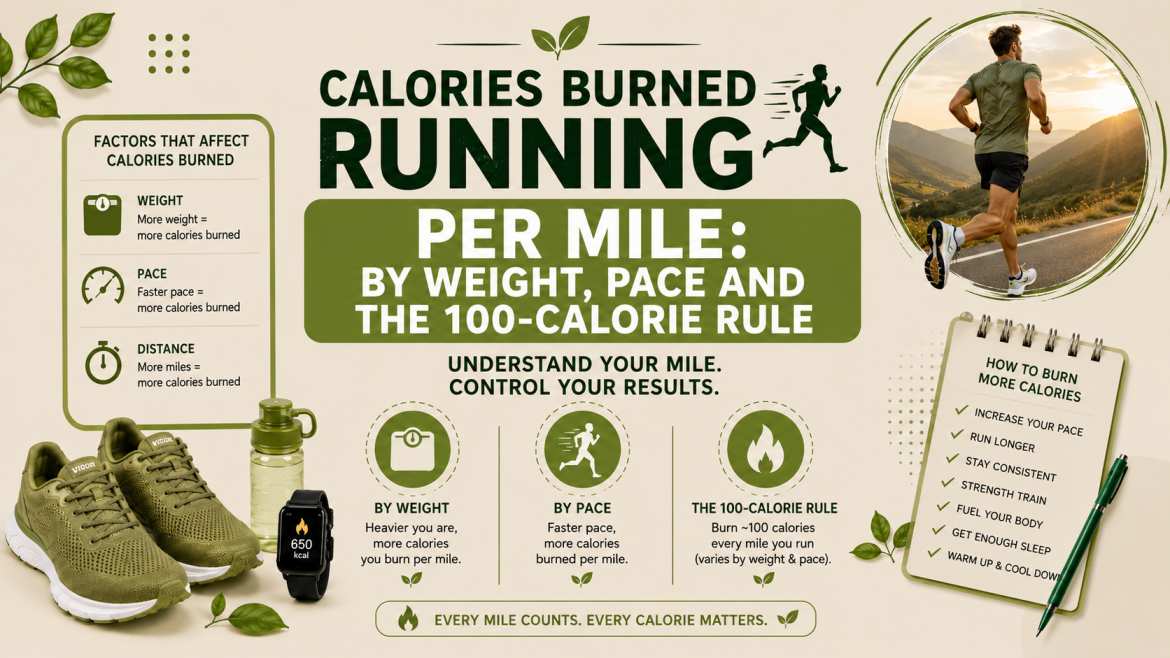
Running burns between 80 and 160 calories per mile depending on body weight. The calorie burn rate per mile running stays nearly constant regardless of pace because higher speeds carry higher MET values but cover the mile in less time. Body weight is the primary driver of running calories per mile at every speed.
Use the running calorie calculator for a personalized per-mile and session estimate. The full running hub at TDEE Calculator Kit covers every distance and time format in the cluster.
How Many Calories Per Mile Running by Body Weight?
The table below shows calories per mile run at 6 mph (MET 9.8) across the full body weight range. These are gross calories using the formula: Calories = MET × weight (kg) × time (hours) for 1 mile at pace.
Body Weight | Calories Per Mile | Calories Per km |
|---|---|---|
110 lb (50 kg) | 80 kcal | 50 kcal |
120 lb (54 kg) | 89 kcal | 55 kcal |
130 lb (59 kg) | 96 kcal | 60 kcal |
140 lb (64 kg) | 104 kcal | 65 kcal |
150 lb (68 kg) | 112 kcal | 70 kcal |
154 lb (70 kg) | 112 kcal | 70 kcal |
165 lb (75 kg) | 120 kcal | 75 kcal |
170 lb (77 kg) | 126 kcal | 78 kcal |
185 lb (84 kg) | 135 kcal | 84 kcal |
200 lb (91 kg) | 145 kcal | 90 kcal |
220 lb (100 kg) | 160 kcal | 99 kcal |
Source: MET 9.8 at 6 mph, 2024 Adult Compendium of Physical Activities.
How many calories burned per mile running 150 pounds: approximately 112 kcal per mile at 6 mph. The formula, 150 × 0.75 = 112.5 kcal per mile, confirms this for the 150 lb runner. The quick formula, body weight in pounds multiplied by 0.75, gives a gross calories per mile estimate: 150 × 0.75 = 112.5 kcal per mile, which aligns with the MET-based table.
What Is the Running 100 Calories Per Mile Rule?
The running 100 calories per mile rule is a simplified average that holds for runners weighing approximately 130 to 145 lb at moderate pace. Dr. Daniel Vigil, associate clinical professor at UCLA's David Geffen School of Medicine, confirmed the 100-calorie estimate in Healthline as a useful benchmark for mid-weight runners.
When the 100-Calorie Rule Applies
The 100-calorie per mile figure is accurate for these conditions:
Body weight is approximately 130 to 145 lb (59 to 66 kg)
Running pace is between 5 and 7 mph
Terrain is flat ground or flat treadmill
When the 100-Calorie Rule Underestimates
Runner Profile | Actual Calories Per Mile |
|---|---|
185 lb at 6 mph | 135 kcal (35% above rule) |
200 lb at 6 mph | 145 kcal (45% above rule) |
220 lb at 6 mph | 160 kcal (60% above rule) |
Any weight, 10% uphill grade | +50 to 60% above flat estimate |
Heavier runners consistently burn well above 100 calories per mile. For runners weighing 185 lb or more, using the 100-calorie rule underestimates output by 30 to 60 calories per mile, which accumulates to significant underreporting over longer runs.
MET Calories Per Mile Running: How the Formula Works?
MET (Metabolic Equivalent of Task) is the scientific unit behind all running calorie estimates. MET calories per mile running are calculated by applying the MET value for a given speed to the time spent covering one mile.
The formula is: Calories per mile = MET × weight (kg) × (minutes per mile / 60)
For a 154 lb (70 kg) runner at 6 mph (10 min/mile, MET 9.8): Calories per mile = 9.8 × 70 × (10/60) = 114 kcal
This closely matches the standard table value. The MET data comes from the 2024 Adult Compendium of Physical Activities (Herrmann et al.), the authoritative source used by the ACSM.
Calorie Burn Rate Per Mile Running at Different Paces
Pace barely changes calories per mile because the MET increase at higher speeds is offset by less time spent per mile.
Pace | Speed | MET | Min/Mile | Calories Per Mile (70 kg) |
|---|---|---|---|---|
Slow jog | 4 mph | 6.0 | 15.0 | 94 kcal |
Easy jog | 5 mph | 8.3 | 12.0 | 99 kcal |
Moderate run | 6 mph | 9.8 | 10.0 | 114 kcal |
Brisk run | 6.5 mph | 10.5 | 9.2 | 107 kcal |
Fast run | 7 mph | 11.0 | 8.6 | 105 kcal |
Race pace | 8 mph | 11.8 | 7.5 | 98 kcal |
Hard effort | 9 mph | 12.8 | 6.7 | 95 kcal |
Values at 70 kg on flat terrain.
Calories burned per mile jogging slow (4 mph) and running fast (9 mph) differ by only 21% for the same body weight. This confirms that distance and body weight dominate per-mile calorie output across all pace ranges.
Net Calories Per Mile Running vs Gross Calories
Net calories per mile running subtracts the resting metabolic rate (RMR) during the run time. Gross calories include RMR. The difference at typical running paces:
Pace | Min/Mile | Gross Cal/Mile (70 kg) | RMR Per Mile (~1 kcal/min) | Net Cal/Mile |
|---|---|---|---|---|
5 mph | 12 min | 99 kcal | 12 kcal | 87 kcal |
6 mph | 10 min | 114 kcal | 10 kcal | 104 kcal |
7 mph | 8.6 min | 105 kcal | 9 kcal | 96 kcal |
8 mph | 7.5 min | 98 kcal | 8 kcal | 90 kcal |
Net calories per mile running are approximately 8 to 13% lower than gross calories. For weight management, net calories represent the actual additional deficit created by running beyond what the body was already burning at rest.
Running Calories Per Mile vs. Walking: Full Comparison
Running calories per mile vs walking shows a smaller gap per unit of distance than most people assume.
Activity | Speed | Calories Per Mile (70 kg) | Time Per Mile |
|---|---|---|---|
Running | 6 mph | 114 kcal | 10 min |
Jogging | 5 mph | 99 kcal | 12 min |
Brisk walking | 4 mph | 88 kcal | 15 min |
Moderate walking | 3.5 mph | 78 kcal | 17 min |
Slow walking | 3 mph | 65 kcal | 20 min |
Running at 6 mph burns approximately 30% more calories per mile than brisk walking at 4 mph. The gap exists because running includes a flight phase where both feet leave the ground, requiring additional energy for landing and propulsion.
Per minute of exercise, the gap is far larger. Running 6 mph burns about 686 calories in 60 minutes; brisk walking 4 mph burns approximately 350 calories in 60 minutes.
How Many Calories Does Running Burn Per Kilometer?
Calories burned running per km follows the same weight-based formula as per-mile estimates, scaled for the shorter distance. The validated rule of thumb is approximately 1 kcal per kilogram of body weight per kilometer.
Body Weight | Calories Per km |
|---|---|
60 kg (132 lb) | 60 kcal |
70 kg (154 lb) | 70 kcal |
80 kg (176 lb) | 80 kcal |
90 kg (198 lb) | 90 kcal |
100 kg (220 lb) | 100 kcal |
The per-km rule is remarkably clean: multiply body weight in kg by 1 for an approximate gross calories per km. A 75 kg runner burns approximately 75 kcal per km, or 375 kcal for a 5K (5 km).
How Many Miles to Run to Burn 500 Calories?
Body Weight | Miles to Burn 500 kcal | Time at 6 mph |
|---|---|---|
130 lb (59 kg) | 5.2 miles | 52 min |
154 lb (70 kg) | 4.4 miles | 44 min |
185 lb (84 kg) | 3.7 miles | 37 min |
220 lb (100 kg) | 3.1 miles | 31 min |
Heavier runners reach 500 calories in fewer miles because their per-mile output is higher. A 220 lb person burns 500 calories in just 3.1 miles; a 130 lb person needs 5.2 miles for the same output.
For the specific 1-mile calorie breakdown by weight and pace, see calories burned running 1 mile.
Calories Per Mile Running: Male vs Female
Calories per mile running male vs female differ only because of typical body weight differences. The MET formula uses body weight in kilograms and assigns no sex-specific adjustment.
The average American male weighs approximately 200 lb (91 kg) and burns approximately 145 kcal per mile at 6 mph.
The average American female weighs approximately 170 lb (77 kg) and burns approximately 126 kcal per mile at 6 mph.
A male and female runner of identical weight and pace burn identical calories per mile. Any reported gap between male and female calorie burn per mile comes from weight, not sex.
Frequently Asked Questions About Calories Burned Running Per Mile
How Many Calories Per Mile Running at 150 Pounds?
A 150 lb (68 kg) runner burns approximately 112 calories per mile at 6 mph. At 5 mph the output drops slightly to approximately 100 calories per mile. At 8 mph the value is approximately 99 calories per mile, confirming that pace barely moves the per-mile number for a given body weight.
Is the “100 Calories Per Mile" Rule Accurate?
The 100-calorie rule is accurate for runners weighing 130 to 145 lb at moderate pace. For heavier runners, the actual per-mile burn is 20 to 60% higher. The more accurate formula is body weight in pounds × 0.75 for gross calories per mile.
What Is the Calorie Burn Rate Per Mile Running Uphill?
Running uphill at a 5% grade adds approximately 30 to 40% to the flat per-mile calorie burn. At 10% grade, the addition is 50 to 60%. A 154 lb runner who burns 114 kcal per flat mile burns approximately 148 to 160 kcal per uphill mile at 5 to 10% grade.