
Calories Burned Running vs. Swimming: Per Hour, Same Distance and by Weight
Does running or swimming burn more calories? Full running vs swimming comparison per hour, same distance, by stroke, and by weight. Covers fat loss, joint impact, 150 lb estimates, and weight loss.

Your body has a number. Let's find it.
We calculate the exact calorie target your body needs, built from your stats and goal, then track everything against it daily. Log meals, add workouts, set a weight goal, and watch your numbers update in real time. Check in weekly to see calories, water, and weight trend in one place.
No spreadsheets. No guessing. Just results.
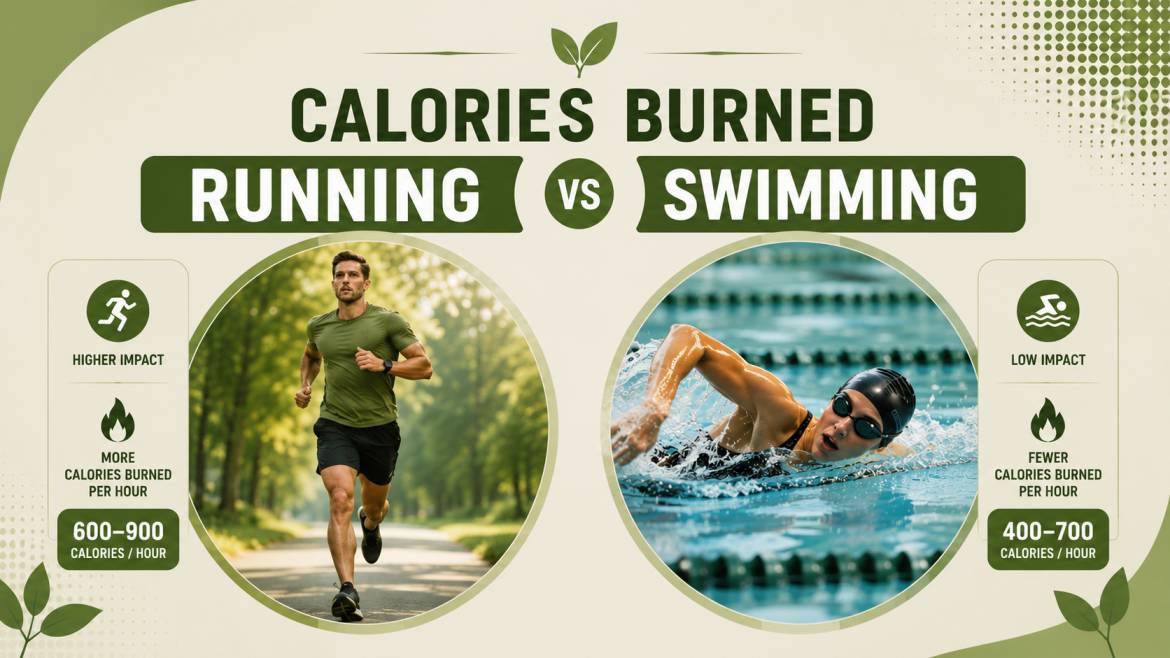
Running burns more calories than moderate swimming per hour, but vigorous swimming strokes can match or exceed running. A 154 lb (70 kg) person running at 6 mph burns approximately 686 calories per hour, versus approximately 490 calories per hour swimming moderate freestyle. Running vs swimming calories burned depend heavily on swim stroke and intensity.
Use the running calorie calculator to estimate your running output across pace and distance. The running calories hub links every running distance and time format. To compare both activities inside your daily budget, open the TDEE calculator.
This page covers running vs swimming calories per hour, over the same distance, by stroke, by weight, for fat loss, and by joint impact. Figures use MET data from the 2024 Adult Compendium of Physical Activities.
Does Swimming Burn More Calories Than Running?
Running burns more calories than moderate swimming, but vigorous swimming can out-burn running. The answer depends on stroke and intensity, not the activity alone. Running at 6 mph carries a MET of 9.8. Swimming MET values range from 5.8 for moderate freestyle to 13.8 for vigorous butterfly.
The per-hour comparison for a 154 lb person clarifies the spread:
Running 6 mph: approximately 686 kcal per hour
Moderate freestyle: approximately 490 kcal per hour, about 28% less
Vigorous freestyle: approximately 686 kcal per hour, matching running
Breaststroke: approximately 580 to 720 kcal per hour
Vigorous butterfly: approximately 840 to 965 kcal per hour, exceeding running
Is swimming or running better for burning calories depends on which stroke and effort the swimmer sustains. Moderate freestyle sits closer to brisk walking. Vigorous butterfly tops most running paces.
Swimming vs. Running Calories Per Hour
Swimming vs running calories per hour compare directly through MET values. The table shows hourly output for a 154 lb person across running paces and swimming strokes.
Activity | MET | Calories Per Hour (70 kg) |
|---|---|---|
Running 5 mph (jog) | 8.3 | 581 kcal |
Running 6 mph | 9.8 | 686 kcal |
Running 7.5 mph | 11.8 | 826 kcal |
Moderate freestyle | 5.8 | 406 kcal |
Vigorous freestyle | 9.8 | 686 kcal |
Breaststroke | 10.3 | 721 kcal |
Vigorous butterfly | 13.8 | 966 kcal |
Gross calories, 2024 Adult Compendium of Physical Activities.
Running at 6 mph burns approximately 686 kcal per hour, matching vigorous freestyle exactly. Breaststroke and butterfly exceed standard running paces. Moderate freestyle falls about 28% short. Swimming vs running calories per hour favor whichever activity is performed at higher intensity.
Swimming vs. Running Calories Same Distance
Swimming vs running calories same distance is hard to compare directly, because the activities use different distance scales. A useful comparison fixes time instead. Over 30 minutes for a 154 lb person:
Activity | Effort | Calories (30 Min, 70 kg) |
|---|---|---|
Running 6 mph | Moderate | 343 kcal |
Moderate freestyle | Moderate | 203 kcal |
Vigorous freestyle | Hard | 343 kcal |
Breaststroke | Moderate-hard | 360 kcal |
Butterfly | Vigorous | 483 kcal |
Over a fixed 30-minute session, vigorous freestyle matches running and butterfly exceeds it. Moderate freestyle burns about 40% less than running. Calories burned swimming vs jogging close at matched effort, because both raise heart rate similarly. The calories burned running 30 minutes page covers the running side.
Swim vs. Run Calorie Burn by Weight
Swim vs run calorie burn 150 pounds and other weights scale linearly, because both formulas multiply by body mass. The table compares 30 minutes of running at 6 mph against moderate freestyle.
Body Weight | Running 30 Min (6 mph) | Freestyle 30 Min (moderate) | Difference |
|---|---|---|---|
130 lb (59 kg) | 289 kcal | 171 kcal | +118 kcal |
150 lb (68 kg) | 333 kcal | 197 kcal | +136 kcal |
154 lb (70 kg) | 343 kcal | 203 kcal | +140 kcal |
185 lb (84 kg) | 412 kcal | 244 kcal | +168 kcal |
220 lb (100 kg) | 490 kcal | 290 kcal | +200 kcal |
Gross calories, moderate freestyle MET 5.8, running MET 9.8.
A 150 lb person burns approximately 333 kcal running 30 minutes, versus 197 kcal swimming moderate freestyle. Switching to vigorous freestyle closes the gap entirely. Heavier swimmers see a larger absolute difference, since both activities scale with body weight.
Running vs. Swimming for Fat Loss
Running vs swimming for fat loss favors whichever activity the person sustains longest with the highest weekly volume. Running burns more per minute at moderate effort. Swimming sustains longer with zero joint impact, which raises total weekly output for many people.
Swim or run for weight loss compares across a realistic week:
Running 3 miles, 5 days: approximately 1,690 kcal weekly for a 154 lb runner
Moderate freestyle 45 min, 5 days: approximately 1,520 kcal weekly for the same person
Vigorous freestyle 45 min, 5 days: approximately 2,570 kcal weekly, exceeding the running plan
Swimming vs running weight loss which is better depends on adherence and intensity. Water resistance and thermoregulation add to swimming burn, because water conducts heat 25 times faster than air. The calories burned running 3 miles page covers the running plan above.
Swimming vs. Running Joint Impact
Swimming vs running joint impact differs sharply, and this gap drives long-term calorie totals. Running is weight-bearing, loading knees, hips, and ankles on every stride. Swimming is near zero impact, with water supporting body weight.
The joint-impact difference shapes training capacity:
Running: higher per-minute burn, higher injury risk, limited daily frequency for many runners
Swimming: lower moderate-effort burn, near zero joint stress, sustainable at high frequency
Net effect: swimmers often log more total weekly sessions, raising cumulative calorie output
Swimming combines full-body muscle engagement with low joint load, which allows longer and more frequent sessions. Runners managing knee or hip stress often gain more total weekly burn by adding swim sessions. Open water swimming vs running calories add a thermoregulation premium in cold water, raising swim output further.
Frequently Asked Questions About Running vs. Swimming Calories
Does Swimming Burn More Calories Than Running?
Swimming burns more calories than running only at vigorous intensity. Moderate freestyle burns about 28% less per hour than running at 6 mph. Vigorous freestyle matches running, and butterfly exceeds it. A 154 lb person burns 686 kcal per hour running versus 406 kcal swimming moderate freestyle.
Is Swimming or Running Better for Weight Loss?
Both swimming and running support weight loss when weekly calorie deficit stays positive. Running burns more per minute at moderate effort. Swimming sustains longer with zero joint impact, often raising total weekly output. Adherence and intensity drive results more than the per-hour gap.
How Many Calories Does Swimming Burn vs Running at 150 Pounds?
A 150 lb person burns approximately 333 kcal running 30 minutes at 6 mph, versus 197 kcal swimming moderate freestyle. Switching to vigorous freestyle (MET 9.8) raises swimming to about 333 kcal, matching running for the same session.
Which Is Easier on the Joints, Running or Swimming?
Swimming is far easier on the joints than running. Water supports body weight, creating near zero joint impact. Running loads knees, hips, and ankles on every stride. Swimmers often train more frequently without overuse injury, raising cumulative weekly calorie burn.
Does Running or Swimming Burn More Calories Per Hour?
Running at 6 mph burns approximately 686 kcal per hour for a 154 lb person, matching vigorous freestyle. Breaststroke burns 580 to 720 kcal per hour, and butterfly reaches 840 to 965 kcal per hour. Moderate freestyle burns about 406 kcal per hour. For the running side, see calories burned running 1 hour or calories burned running per mile.