
Calories Burned Swimming Breaststroke By Weight, Pace and Duration
How many calories does breaststroke burn? Full tables by body weight and effort level. Covers moderate vs vigorous breaststroke, 30-minute estimates, weight loss calories, and breaststroke vs freestyle comparison.

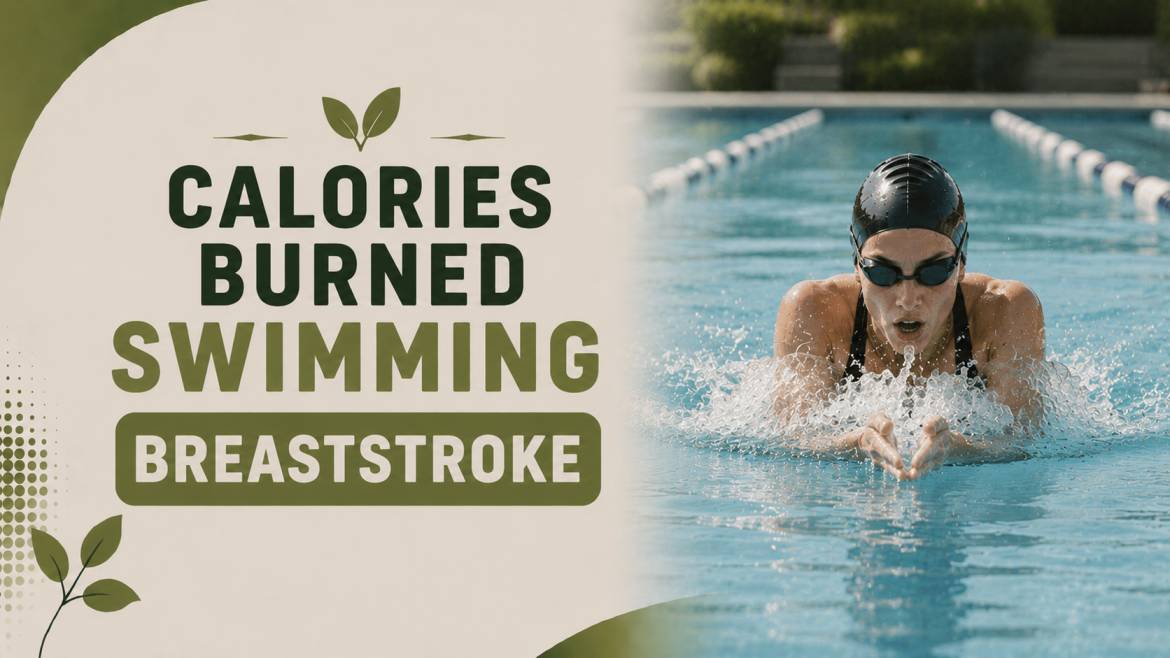
Breaststroke burns between 371 and 721 calories per hour for a 154 lb (70 kg) swimmer, depending on pace intensity. At moderate effort, the MET value is 5.3, producing 371 calories per hour. At a vigorous training pace, the MET rises to 10.3, producing 721 calories per hour for the same swimmer. Breaststroke has the widest calorie range of any common stroke because its mechanics change more dramatically between slow and fast effort than any other competitive stroke.
For a personalised breaststroke calorie estimate, the swimming calorie calculator applies MET values against your exact body weight and session length. The swimming calories hub covers every stroke and duration in one place.
Breaststroke is the most popular recreational swimming stroke worldwide. Its face-down position, simultaneous arm sweep, and frog kick make it accessible to beginners, recoverable at lower intensities, and surprisingly demanding at high effort. This makes breaststroke an effective tool for both long steady-state swims and high-calorie interval sessions.
How Many Calories Does Breaststroke Burn Per Hour?
Breaststroke calorie output per hour spans from 371 kcal at moderate effort to 721 kcal at vigorous effort for a 154 lb swimmer. This near-doubling of calorie output across effort levels occurs because vigorous breaststroke's frog kick eliminates the glide phase and sustains high muscular demand throughout the stroke cycle.
Breaststroke Calories Per Hour by Body Weight
Body Weight | Moderate (MET 5.3) | Vigorous (MET 10.3) |
|---|---|---|
120 lb (54 kg) | 286 kcal | 556 kcal |
140 lb (64 kg) | 339 kcal | 659 kcal |
150 lb (68 kg) | 360 kcal | 700 kcal |
154 lb (70 kg) | 371 kcal | 721 kcal |
165 lb (75 kg) | 398 kcal | 773 kcal |
185 lb (84 kg) | 445 kcal | 866 kcal |
200 lb (91 kg) | 482 kcal | 937 kcal |
215 lb (97 kg) | 515 kcal | 999 kcal |
Source: 2024 Adult Compendium of Physical Activities.
Breaststroke calorie burn at 200 pounds at vigorous effort reaches 937 calories per hour, approaching the output of butterfly swimming for a lighter swimmer. At 215 pounds, vigorous breaststroke breaks 999 calories per hour, making it one of the highest-calorie aquatic activities for heavier swimmers at high effort.
How Many Calories Does Breaststroke Burn in 30 Minutes?
Calories burned breaststroke in 30 minutes range from 143 to 500 kcal depending on body weight and effort level. At moderate pace for a 154 lb swimmer, 30 minutes of breaststroke produces 186 calories.
Breaststroke 30-Minute Calories by Body Weight
Body Weight | Moderate (MET 5.3) | Vigorous (MET 10.3) |
|---|---|---|
120 lb (54 kg) | 143 kcal | 278 kcal |
150 lb (68 kg) | 180 kcal | 350 kcal |
154 lb (70 kg) | 186 kcal | 361 kcal |
185 lb (84 kg) | 223 kcal | 433 kcal |
215 lb (97 kg) | 258 kcal | 500 kcal |
Calories burned swimming breaststroke 30 minutes at vigorous effort for a 154 lb swimmer: 361 kcal. This exceeds vigorous freestyle in 30 minutes (343 kcal for the same weight) because breaststroke's vigorous MET of 10.3 edges out vigorous freestyle's MET of 9.8.
Slow breaststroke calories burned in 30 minutes at 154 pounds sit at approximately 186 kcal, roughly the same as light cycling at 10 mph. Breaststroke at easy pace delivers a moderate calorie contribution suitable for recovery sessions or beginner swimmers building base fitness.
What Is the Breaststroke MET Value?
The 2024 Adult Compendium of Physical Activities assigns two distinct MET values to breaststroke, based on effort level:
Breaststroke Intensity | MET | Description |
|---|---|---|
Moderate (recreational) | 5.3 | Comfortable pace, glide present, conversation possible |
Vigorous (training) | 10.3 | Hard pace, minimal glide, breathing heavy |
The MET gap of 5.0 points between moderate and vigorous breaststroke is the largest within-stroke intensity gap of any competitive swimming stroke. For comparison, the gap between moderate and vigorous freestyle is 2.8 MET points (7.0 vs 9.8). This means the calorie reward for increasing breaststroke effort is proportionally larger than increasing pace in any other stroke.
Why Does Breaststroke Have Such a Wide Calorie Range?
The frog kick is the primary driver of breaststroke's calorie range. At easy pace, the frog kick includes a pronounced glide phase between each kick cycle. This glide temporarily reduces energy expenditure, lowering the effective MET.
At vigorous pace, three mechanical changes raise the MET significantly:
Glide elimination: The kick cycle becomes nearly continuous, removing the recovery phase that reduces energy demand at slow pace.
Increased kick frequency: More kick cycles per length raises the total muscular work per minute.
Higher drag resistance: Faster swimmers create more turbulence and drag per stroke, requiring additional force to maintain speed.
This explains why breaststroke calorie output is more pace-sensitive than freestyle. A breaststroke swimmer who increases their pace from easy to vigorous doubles their calorie output. A freestyle swimmer at the same pace increase adds approximately 40%.
Breaststroke vs Freestyle Calories: Full Comparison
Breaststroke and freestyle are the two most commonly compared strokes for calorie burn. The result changes depending on effort level.
Breaststroke vs Freestyle Calories Per Hour (154 lb / 70 kg)
Stroke | Intensity | MET | Calories Per Hour |
|---|---|---|---|
Breaststroke | Moderate | 5.3 | 371 kcal |
Freestyle | Moderate | 7.0 | 490 kcal |
Freestyle | Vigorous | 9.8 | 686 kcal |
Breaststroke | Vigorous | 10.3 | 721 kcal |
At moderate effort, freestyle burns 32% more calories per hour than breaststroke. At vigorous effort, the ranking reverses and vigorous breaststroke burns 5% more than vigorous freestyle. The crossover point occurs at approximately MET 9.8, where both strokes produce identical calorie output.
Recreational swimmers who swim breaststroke at comfortable pace will always produce lower hourly calorie output than swimmers doing moderate freestyle. Competitive swimmers doing hard breaststroke sets produce higher hourly output than most freestyle swimmers.
For the full freestyle comparison, see the freestyle swimming calories page.
Breaststroke Swimming for Weight Loss
Breaststroke supports weight loss through two distinct session types: long moderate sessions that accumulate calorie volume and short vigorous intervals that raise intensity and EPOC.
Long Moderate Breaststroke Sessions
A 154 lb swimmer covering 45 to 60 minutes of continuous moderate breaststroke burns approximately 278 to 371 calories per session. This approach suits swimmers who prefer sustained effort and want to build session duration before raising intensity.
Vigorous Breaststroke Intervals
Alternating 100-metre hard breaststroke sets with 30-second rest intervals raises the effective session MET above the moderate baseline. A 154 lb swimmer completing 10 x 100-metre breaststroke intervals at vigorous pace burns approximately 300 to 360 calories in a 25 to 30-minute active period, approaching the same total as a 60-minute moderate breaststroke session in half the active time.
Weekly Breaststroke Calorie Planning
Sessions Per Week | Duration | Pace | Per Session | Weekly Total |
|---|---|---|---|---|
3 sessions | 30 min | Moderate | 186 kcal | 558 kcal |
4 sessions | 45 min | Moderate | 278 kcal | 1,112 kcal |
5 sessions | 60 min | Moderate | 371 kcal | 1,855 kcal |
4 sessions | 45 min | Vigorous | 541 kcal | 2,164 kcal |
To see breaststroke output within your full daily energy balance, the TDEE calculator calculates your maintenance calories. The calories burned calculator covers all activity types if you mix breaststroke with other formats.
Muscles Worked in Breaststroke and How They Affect Calorie Burn
Breaststroke recruits a distinct set of muscle groups compared to other strokes, which explains its unique MET profile at different intensities.
The primary muscles engaged in breaststroke include:
Quadriceps: The frog kick's knee extension phase activates the quadriceps heavily, one of the body's largest muscle groups.
Hip flexors and adductors: The inward sweep of the legs during the frog kick requires sustained adductor activation throughout the kick cycle.
Pectorals and inner biceps: The wide arm pull from the catch position to chest-level engages the chest and inner arm muscles.
Core and lower back: Hip extension during the glide phase activates the erector spinae and lumbar stabilisers.
The quadriceps and adductor engagement explains why vigorous breaststroke produces higher MET than vigorous freestyle. These large leg muscle groups demand more oxygen and fuel per minute of activation than the smaller muscles recruited by freestyle's flutter kick.
For lap-based calorie counting across all strokes, see the swimming laps calories page. For backstroke as an alternative lower-intensity option, see the backstroke calories page.
Breaststroke Calorie Burn in Practice: Training Applications
Understanding breaststroke calorie output helps design sessions that match specific fitness goals. Three training formats apply breaststroke to different calorie targets.
Long Slow Distance Breaststroke
Long slow distance (LSD) breaststroke at moderate effort builds aerobic base and burns calories through extended duration. A 185 lb swimmer covering 3,000 metres of moderate breaststroke in approximately 90 minutes burns approximately 668 calories. This session format suits swimmers building initial fitness or recovering between harder training weeks.
Breaststroke Threshold Training
Threshold breaststroke sits at the boundary between moderate and vigorous effort: the swimmer can barely hold a conversation. At this intensity the effective MET approaches 7.0 to 8.0, producing calorie output closer to vigorous breaststroke than moderate. A 154 lb swimmer holding threshold breaststroke for 45 minutes burns approximately 300 to 340 calories.
High-Intensity Breaststroke Intervals
Vigorous breaststroke intervals at MET 10.3 produce the highest per-minute calorie output of any breaststroke format. A 154 lb swimmer doing 8 x 50-metre vigorous breaststroke sets with 20-second rests burns approximately 180 to 220 calories in a 20-minute active period. For the full breaststroke data across all session lengths and body weights, the 1-hour swimming calories page covers extended duration tables. For lap-based distance planning, the swimming laps page gives per-lap estimates at breaststroke pace.
Breaststroke Calorie Burn at Different Paces: A Practical Guide
Most breaststroke calorie tables use two MET values (moderate 5.3 and vigorous 10.3) as endpoints. Real swimming pace sits across a continuous spectrum between these endpoints. Understanding where your breaststroke pace falls helps produce more accurate calorie estimates than choosing between two fixed points.
A useful self-assessment at pool-side:
Talking comfortably between lengths: Moderate effort, approximately MET 5.0 to 5.5. Use the moderate 5.3 table values.
Short sentences between lengths, breathing elevated: Moderate-hard effort, approximately MET 7.0 to 8.0. Split the difference between moderate and vigorous table values.
Only a few words possible between lengths: Vigorous effort, approximately MET 9.0 to 10.3. Use the vigorous table values.
Unable to speak between lengths: Maximum effort, use MET 10.3 or above.
A 154 lb swimmer who honestly self-rates as moderate-hard breaststroke burns approximately 420 to 480 calories per hour, between the moderate (371 kcal/hr) and vigorous (721 kcal/hr) table values. This intermediate estimate is more realistic for most committed recreational swimmers than either endpoint.
How Accurate Are These Swimming Calorie Estimates?
MET-based swimming calorie estimates carry a margin of error of approximately 10 to 20% compared to laboratory measurements using indirect calorimetry (measuring oxygen consumption directly). The 2024 Compendium acknowledges this variability and recommends treating MET values as population-level planning averages rather than individual measurements.
Four factors cause individual swimmers to deviate from these table values:
Stroke technique: Efficient swimmers produce less drag and less wasted energy per metre than beginners at the same pace, reducing actual calories below the table estimate.
Individual metabolic rate: Resting metabolic rate varies by approximately 10% between individuals of the same weight, age, and sex due to genetic differences.
Rest interval inclusion: Tables assume continuous swimming. Sessions that include 10 minutes of rest over a 60-minute block should apply the MET to 50 minutes of active time.
Water temperature: Cold water below 20°C raises calorie output by 5 to 12% above standard table values; heated pools above 28°C produce output close to the published figures.
For the most accurate personal estimate, track session output over four to six weeks and compare against body weight trends. If weight is stable while eating at your TDEE, your actual swimming calorie output approximates the calculator figure. If weight is dropping faster or slower than expected, adjust the estimate accordingly.
Frequently Asked Questions About Calories Burned Breaststroke
How Many Calories Does Breaststroke Burn?
Breaststroke burns between 371 and 721 calories per hour for a 154 lb (70 kg) swimmer. At moderate effort (MET 5.3) the output is 371 kcal per hour. At vigorous training pace (MET 10.3) the same swimmer burns 721 kcal per hour. The difference between easy and vigorous breaststroke is larger than for any other stroke.
How Many Calories Does Breaststroke Burn in 30 Minutes?
A 154 lb (70 kg) swimmer burns approximately 186 calories in 30 minutes of moderate breaststroke. At vigorous pace the same person burns approximately 361 calories in 30 minutes. A 185 lb swimmer at moderate breaststroke burns approximately 223 calories per 30-minute session.
Is Breaststroke Good for Weight Loss?
Breaststroke contributes to weight loss by creating a calorie deficit over time. Five 60-minute moderate breaststroke sessions per week produces approximately 1,855 weekly calories for a 154 lb swimmer. At vigorous effort, four 45-minute sessions produces 2,164 weekly calories. Combined with a 200 to 300 kcal daily dietary reduction, regular breaststroke sessions support approximately 0.5 to 0.8 lb of weekly fat loss.
Does Breaststroke or Freestyle Burn More Calories?
At moderate effort, freestyle (MET 7.0) burns more calories than moderate breaststroke (MET 5.3), producing 490 vs 371 kcal per hour for a 154 lb swimmer. At vigorous effort, breaststroke (MET 10.3) edges out vigorous freestyle (MET 9.8), producing 721 vs 686 kcal per hour. The stroke that burns more calories depends entirely on which intensity each swimmer can sustain for a full session.
How Many Calories Does Slow Breaststroke Burn?
Slow breaststroke at easy recreational pace carries approximately MET 5.0 to 5.3, burning approximately 175 to 186 calories per 30 minutes for a 154 lb swimmer. At MET 5.3 for a full hour, slow breaststroke produces approximately 371 calories. Easy recreational breaststroke with a pronounced glide phase sits at the lower end of the moderate MET band.
How Long Does It Take to Burn 500 Calories Doing Breaststroke?
At moderate breaststroke (MET 5.3), a 154 lb swimmer burns 500 calories in approximately 81 minutes. At vigorous breaststroke (MET 10.3), the same swimmer reaches 500 calories in approximately 42 minutes. A 185 lb swimmer at moderate breaststroke burns 500 calories in approximately 67 minutes.
What Is a Good Breaststroke Calorie Target for Weight Loss?
A realistic breaststroke weight loss target for a 154 lb swimmer is 350 to 500 calories per session. Three 45-minute moderate breaststroke sessions per week produces approximately 834 weekly calories. Four 45-minute sessions at hard breaststroke pace produces approximately 2,164 weekly calories, supporting approximately 0.6 lb of weekly fat loss from swimming alone.
The tables and calorie estimates on this page use MET values from the 2024 Adult Compendium of Physical Activities, the standard reference for exercise energy expenditure used by exercise physiologists and fitness researchers globally. All estimates represent active swim time only and do not include rest intervals between sets.