
Calories Burned Swimming Backstroke By Weight, Pace and Duration
How many calories does backstroke swimming burn? Full tables by body weight and intensity. Covers backstroke MET values, 30-minute estimates, weight loss calories, and backstroke vs freestyle comparison.

Your body has a number. Let's find it.
We calculate the exact calorie target your body needs, built from your stats and goal, then track everything against it daily. Log meals, add workouts, set a weight goal, and watch your numbers update in real time. Check in weekly to see calories, water, and weight trend in one place.
No spreadsheets. No guessing. Just results.
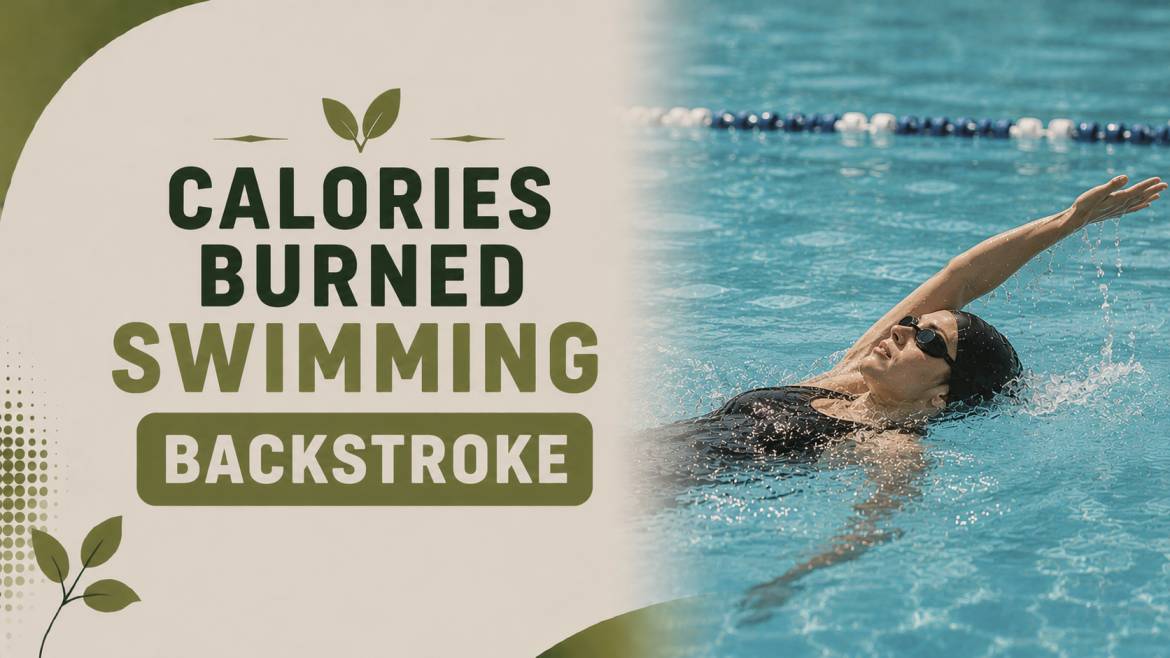
Backstroke swimming burns approximately 336 calories per hour for a 154 lb (70 kg) swimmer, based on the MET value of 4.8 from the 2024 Adult Compendium of Physical Activities. Backstroke produces the lowest calorie output of the four competitive strokes at matched effort levels, because the face-up body position allows continuous breathing without the resistance that elevates intensity in freestyle, breaststroke, and butterfly.
The swimming calorie calculator generates a personalised backstroke calorie estimate based on your weight and session duration. The swimming calories hub covers every stroke, duration, and intensity format in one place.
Backstroke's lower calorie output comes with a practical advantage: the breathing pattern is effortless throughout. Many swimmers sustain backstroke for longer sessions than any other stroke because respiratory effort never becomes the limiting factor. A swimmer who tires at 30 minutes of freestyle can often continue to 45 or 60 minutes of backstroke, producing greater total session calorie output despite the lower per-minute burn rate.
How Many Calories Does Backstroke Burn Per Hour?
Backstroke calorie output per hour is determined by body weight and the MET value of 4.8 assigned in the 2024 Adult Compendium of Physical Activities. This MET places backstroke between light cycling and moderate walking in hourly energy expenditure.
Backstroke Calories Per Hour by Body Weight
Body Weight | Calories Per Hour (MET 4.8) | Calories Per 30 Min |
|---|---|---|
120 lb (54 kg) | 259 kcal | 130 kcal |
140 lb (64 kg) | 307 kcal | 154 kcal |
150 lb (68 kg) | 326 kcal | 163 kcal |
154 lb (70 kg) | 336 kcal | 168 kcal |
165 lb (75 kg) | 360 kcal | 180 kcal |
185 lb (84 kg) | 403 kcal | 202 kcal |
200 lb (91 kg) | 437 kcal | 218 kcal |
215 lb (97 kg) | 466 kcal | 233 kcal |
Source: 2024 Adult Compendium of Physical Activities. MET 4.8.
A 200 lb swimmer doing backstroke for 1 hour burns 437 calories. The same swimmer at moderate freestyle (MET 7.0) burns 637 calories. Backstroke produces 31% fewer calories per hour than moderate freestyle at matched body weight. This gap is real but partly offset by backstroke's superior sustainability for longer sessions.
Backstroke MET Value Explained
The Metabolic Equivalent of Task (MET) for backstroke is 4.8, as recorded in the 2024 Adult Compendium of Physical Activities. MET represents the energy cost of an activity relative to resting metabolic rate. A MET of 1.0 equals the energy used while sitting quietly.
Backstroke at MET 4.8 places it in the following activity context:
Activity | MET | Reference |
|---|---|---|
Brisk walking (3.5 mph) | 4.3 | 2024 Compendium |
Backstroke swimming | 4.8 | 2024 Compendium |
Light cycling (10 mph) | 4.0 | 2024 Compendium |
Moderate breaststroke | 5.3 | 2024 Compendium |
Moderate freestyle | 7.0 | 2024 Compendium |
Backstroke's MET sits only 0.5 points above brisk walking. This means backstroke delivers moderate cardiovascular conditioning and calorie burn, similar to a brisk walk in terms of metabolic demand, but with the full-body muscle engagement of swimming.
How Many Calories Does Backstroke Burn in 30 Minutes?
A 154 lb (70 kg) swimmer burns approximately 168 calories in 30 minutes of backstroke. This is lower than 30 minutes of moderate freestyle (245 kcal) but comparable to 30 minutes of brisk walking at 3.5 mph (150 kcal) for the same body weight.
Backstroke 30-Minute Calories by Body Weight
Body Weight | Calories in 30 Min | Calories in 45 Min | Calories in 60 Min |
|---|---|---|---|
120 lb (54 kg) | 130 kcal | 194 kcal | 259 kcal |
150 lb (68 kg) | 163 kcal | 245 kcal | 326 kcal |
154 lb (70 kg) | 168 kcal | 252 kcal | 336 kcal |
185 lb (84 kg) | 202 kcal | 302 kcal | 403 kcal |
215 lb (97 kg) | 233 kcal | 350 kcal | 466 kcal |
Calories burned backstroke 30 minutes at 154 pounds: 168 kcal. A 45-minute backstroke session at the same weight burns 252 kcal, which exceeds 30 minutes of moderate freestyle for a lighter 120 lb swimmer. Duration extension is the most effective calorie lever for backstroke swimmers.
Backstroke vs Freestyle Calories: How Do They Compare?
Backstroke produces fewer calories per hour than moderate freestyle at every body weight. The MET gap of 2.2 points (4.8 vs 7.0) produces a 31% calorie difference per hour.
Backstroke vs Freestyle Calories Per Hour (154 lb / 70 kg)
Stroke | MET | Calories Per Hour | Difference vs Backstroke |
|---|---|---|---|
Backstroke | 4.8 | 336 kcal | baseline |
Moderate freestyle | 7.0 | 490 kcal | +154 kcal/hr |
Vigorous freestyle | 9.8 | 686 kcal | +350 kcal/hr |
A swimmer who trains 1 hour at backstroke instead of moderate freestyle loses approximately 154 calories of session output. Over five weekly sessions this gap totals 770 calories per week.
Three situations make backstroke the more practical choice despite its lower calorie output:
Shoulder recovery: Backstroke places the shoulders in external rotation throughout the pull, reducing the impingement risk associated with freestyle's internal rotation during the catch phase.
Breathing confidence: Beginner swimmers or those returning after illness find backstroke's continuous air access removes respiratory anxiety that limits intensity in other strokes.
Active recovery: Backstroke between hard freestyle or breaststroke sets allows continued movement and low calorie contribution during rest intervals.
For the full freestyle comparison, see the freestyle swimming calories page.
Backstroke for Weight Loss: Extended Session Strategy
Because backstroke produces lower calorie output per minute than freestyle or breaststroke, weight loss planning with backstroke works best through volume rather than intensity.
Backstroke Weight Loss Strategy: Volume Over Intensity
A 154 lb swimmer who swims backstroke 5 days per week for 45 minutes per session produces:
Per session: 252 kcal
Weekly total: 1,260 kcal
Monthly output: approximately 5,040 kcal
Monthly fat loss estimate: approximately 1.4 lb (without dietary changes)
Extending backstroke sessions from 30 to 60 minutes doubles weekly calorie output without requiring a change in stroke, pace, or intensity. This is the most accessible calorie increase available to backstroke swimmers.
Weekly Plan | Sessions | Duration | Weekly Calories |
|---|---|---|---|
Starter | 3 x week | 30 min | 504 kcal |
Standard | 4 x week | 45 min | 1,008 kcal |
Extended | 5 x week | 60 min | 1,680 kcal |
Mixed strokes | 3 backstroke + 2 freestyle | 45 min each | ~2,150 kcal |
Mixing backstroke sessions with higher-intensity strokes is the most effective weight loss approach. Three backstroke sessions for base fitness plus two moderate freestyle sessions per week produces approximately 2,150 weekly calories.
To connect backstroke output to your daily energy balance, the TDEE calculator shows your maintenance calorie target. The calories burned calculator handles mixed-activity weeks.
How Does Backstroke Compare to Breaststroke and Treading Water?
Backstroke burns fewer calories than breaststroke at all matched effort levels but more than moderate treading water. The comparison depends on whether the target is per-hour output or sustainable total session output.
Backstroke vs Breaststroke
Moderate backstroke at MET 4.8 burns 31% fewer calories per hour than moderate breaststroke at MET 5.3 for the same body weight. A 154 lb swimmer at moderate backstroke burns 336 kcal/hr versus 371 kcal/hr at moderate breaststroke.
The advantage of backstroke over breaststroke is sustainability. Many swimmers maintain backstroke for 60 to 90 minutes without rest, while breaststroke fatigue, particularly in the frog kick and hip flexors, limits continuous session length. A 90-minute backstroke session at MET 4.8 burns 504 calories for a 154 lb swimmer, which exceeds a 60-minute moderate breaststroke session (371 kcal) simply through extended duration.
Backstroke vs Treading Water
Moderate backstroke at MET 4.8 burns 37% more calories per hour than moderate treading water at MET 3.5. Backstroke provides continuous forward propulsion and full-body engagement that treading water cannot match at equivalent effort. For comparison, a 154 lb swimmer burns 336 kcal/hr at backstroke versus 245 kcal/hr at moderate treading water.
The treading water calories page covers the vigorous treading water range where output exceeds backstroke per hour.
Practical Session Design
Swimmers targeting weight loss through backstroke can maximise output by:
Extending sessions from 30 to 60 minutes (doubles calorie output)
Adding breaststroke sets in the final third of the session to raise average MET
Reducing rest intervals to keep active swim time above 85% of total session time
Muscles Worked in Backstroke
Backstroke engages a different muscle profile than the other competitive strokes, which explains its distinct calorie output and shoulder health characteristics.
Primary muscles activated in backstroke:
Latissimus dorsi: The lat pull during the underwater arm sweep is the primary power source in backstroke. This large back muscle drives most of the propulsive force.
Posterior deltoid: The shoulder's rear head extends the arm backward through the water and assists the lat pull throughout the stroke cycle.
Glutes and hamstrings: The flutter kick in backstroke activates the posterior chain with each downward kick phase.
Trapezoids: The mid and upper trapezoids stabilise the shoulder girdle during the recovery phase when the arm exits the water.
Backstroke's emphasis on the latissimus dorsi and posterior deltoid makes it complementary to freestyle, which loads the anterior deltoid and rotator cuff more heavily. Alternating backstroke and freestyle in the same session produces balanced shoulder loading while adding calorie variety across stroke types.
For lap-based tracking across strokes, see the swimming laps calories page. For the treading water comparison at even lower intensity, see the treading water calories page.
Backstroke for Rehabilitation and Low-Impact Exercise
Backstroke is the only competitive stroke that does not require the swimmer to submerge the face, making it the most accessible stroke for people who wear glasses in the pool, swimmers recovering from sinus conditions, and beginners who have not yet developed freestyle breathing timing.
From a calorie perspective, backstroke is the most sustainable low-impact aquatic exercise format available. Water supports approximately 90% of body weight throughout the session, removing joint stress from knees, hips, and ankles that accumulates during land-based walking or running. A 200 lb person who cannot walk at a brisk pace due to knee pain can sustain 60 minutes of backstroke and burn 437 calories without any lower-body impact.
Backstroke's shoulder mechanics also differ from freestyle in a way that matters for injury prevention. The backstroke arm recovery moves through external rotation, which avoids the shoulder impingement position (internal rotation above 90 degrees) that makes freestyle problematic for swimmers with rotator cuff issues. Swimmers working around shoulder injuries often maintain cardiovascular fitness through backstroke sessions while avoiding the stroke mechanics that caused the original injury.
For the full shoulder-safe calorie planning across all strokes, combining backstroke sessions with breaststroke (which also avoids the problematic freestyle shoulder position) provides calorie output between 336 and 721 kcal/hr depending on effort. See the breaststroke calories page for the breaststroke data.
How Accurate Are These Swimming Calorie Estimates?
MET-based swimming calorie estimates carry a margin of error of approximately 10 to 20% compared to laboratory measurements using indirect calorimetry (measuring oxygen consumption directly). The 2024 Compendium acknowledges this variability and recommends treating MET values as population-level planning averages rather than individual measurements.
Four factors cause individual swimmers to deviate from these table values:
Stroke technique: Efficient swimmers produce less drag and less wasted energy per metre than beginners at the same pace, reducing actual calories below the table estimate.
Individual metabolic rate: Resting metabolic rate varies by approximately 10% between individuals of the same weight, age, and sex due to genetic differences.
Rest interval inclusion: Tables assume continuous swimming. Sessions that include 10 minutes of rest over a 60-minute block should apply the MET to 50 minutes of active time.
Water temperature: Cold water below 20°C raises calorie output by 5 to 12% above standard table values; heated pools above 28°C produce output close to the published figures.
For the most accurate personal estimate, track session output over four to six weeks and compare against body weight trends. If weight is stable while eating at your TDEE, your actual swimming calorie output approximates the calculator figure. If weight is dropping faster or slower than expected, adjust the estimate accordingly.
Frequently Asked Questions About Calories Burned Backstroke
How Many Calories Does Backstroke Burn?
Backstroke burns approximately 336 calories per hour for a 154 lb (70 kg) swimmer, based on a MET value of 4.8 from the 2024 Adult Compendium of Physical Activities. A 185 lb swimmer at backstroke burns approximately 403 calories per hour. Backstroke produces the lowest calorie output of the four competitive strokes at matched effort and duration.
How Many Calories Does Backstroke Burn in 30 Minutes?
A 154 lb (70 kg) swimmer burns approximately 168 calories in 30 minutes of backstroke. A 185 lb swimmer at backstroke burns approximately 202 calories in the same 30 minutes. Extending the session to 45 minutes raises the output to 252 and 302 calories respectively.
Does Backstroke Burn More Calories Than Freestyle?
Backstroke burns fewer calories than freestyle at every intensity level and body weight. Moderate freestyle at MET 7.0 produces 490 calories per hour for a 154 lb swimmer versus backstroke's 336 calories at MET 4.8. Freestyle burns 46% more calories per hour than backstroke at the same body weight and matched effort.
Is Backstroke Good for Weight Loss?
Backstroke contributes to weight loss through accumulated session volume. Five 45-minute backstroke sessions per week produces 1,260 weekly calories for a 154 lb swimmer. This supports approximately 1.4 lb of monthly fat loss without dietary changes. Mixing backstroke with higher-intensity strokes like freestyle or breaststroke increases weekly calorie output while maintaining the shoulder recovery benefits backstroke provides.
How Many Calories Does Backstroke Burn Per Minute?
Backstroke burns approximately 5.6 calories per minute for a 154 lb (70 kg) swimmer at MET 4.8. A 185 lb swimmer burns approximately 6.7 calories per minute at backstroke. This per-minute rate is lower than most freestyle swimming but higher than brisk walking at approximately 5.0 calories per minute for the same body weight.
Is Backstroke Easier Than Freestyle?
Backstroke is easier than freestyle in terms of breathing because the face stays above water throughout the stroke cycle. This removes the respiratory challenge that limits many recreational freestyle swimmers. Backstroke does require spatial awareness and straight-line tracking, which some swimmers find disorienting without pool lane guidance. From a calorie perspective, backstroke is less demanding than freestyle at matched effort, with a MET of 4.8 versus 7.0 for moderate freestyle.
How Long Does It Take to Burn 500 Calories Doing Backstroke?
A 154 lb (70 kg) swimmer at backstroke (MET 4.8) burns 500 calories in approximately 89 minutes. A 185 lb swimmer reaches 500 calories in approximately 74 minutes at the same stroke and effort. For faster 500-calorie targets, switching to vigorous freestyle or vigorous breaststroke reduces the required session time significantly.
The tables and calorie estimates on this page use MET values from the 2024 Adult Compendium of Physical Activities, the standard reference for exercise energy expenditure used by exercise physiologists and fitness researchers globally. All estimates represent active swim time only and do not include rest intervals between sets.