
Calories Burned Swimming Freestyle Front Crawl Calorie Guide by Weight
How many calories does freestyle swimming burn? Full tables by body weight and pace. Covers moderate vs vigorous front crawl, 30-minute estimates, weight loss planning, and freestyle vs breaststroke comparison.

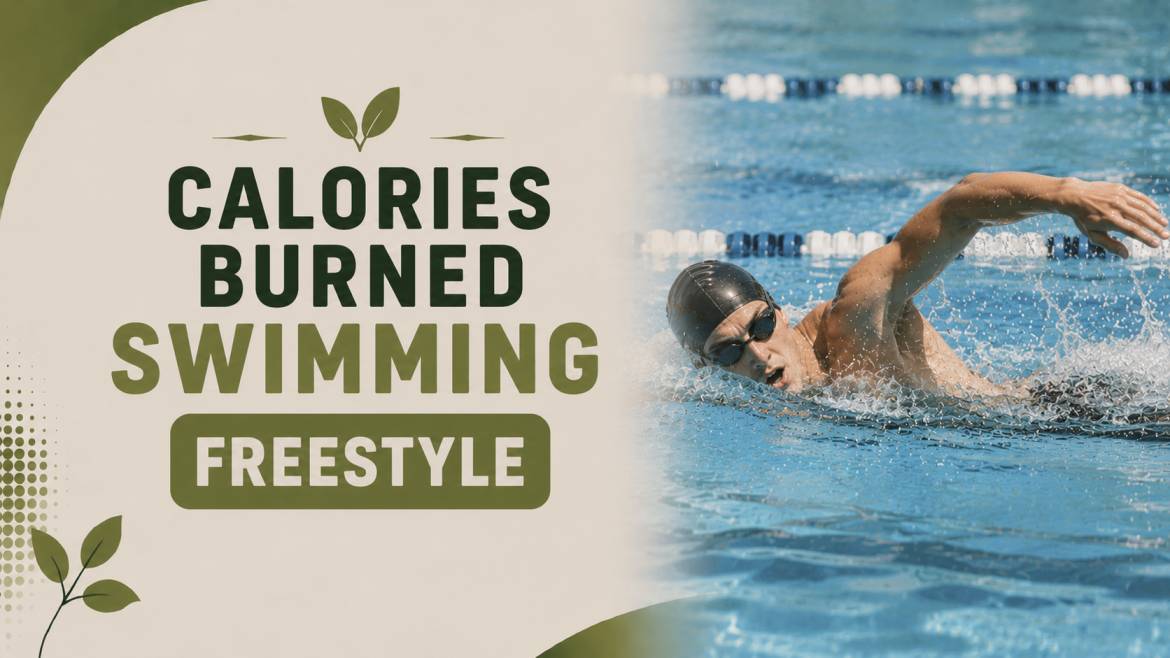
Freestyle swimming burns between 378 and 951 calories per hour depending on body weight and pace intensity. A 154 lb (70 kg) swimmer at moderate freestyle burns approximately 490 calories per hour, based on the MET value of 7.0 from the 2024 Adult Compendium of Physical Activities. At vigorous front crawl pace the same swimmer reaches approximately 686 calories per hour, using the vigorous freestyle MET of 9.8.
The swimming calorie calculator generates personalised freestyle estimates using your exact weight, pace, and session length. For the full swimming cluster covering every stroke, duration, and format, see the swimming calories hub.
Freestyle is the most common competitive and recreational stroke. Front crawl's combination of the flutter kick, high-elbow arm pull, and hip rotation recruits the full posterior chain, shoulders, core, and triceps simultaneously. This full-body engagement places freestyle among the highest-calorie cardio activities available at moderate intensity.
How Many Calories Does Freestyle Swimming Burn Per Hour?
Freestyle calorie output per hour depends primarily on body weight and pace intensity. The 2024 Compendium assigns two distinct MET values to freestyle: 7.0 for moderate pace and 9.8 for vigorous pace. This 40% MET gap produces a 196-calorie-per-hour difference for a 154 lb swimmer.
Freestyle Swimming Calories Per Hour by Body Weight
Body Weight | Moderate (MET 7.0) | Vigorous (MET 9.8) |
|---|---|---|
120 lb (54 kg) | 378 kcal | 529 kcal |
140 lb (64 kg) | 448 kcal | 627 kcal |
150 lb (68 kg) | 476 kcal | 666 kcal |
154 lb (70 kg) | 490 kcal | 686 kcal |
165 lb (75 kg) | 525 kcal | 735 kcal |
185 lb (84 kg) | 588 kcal | 823 kcal |
200 lb (91 kg) | 637 kcal | 892 kcal |
215 lb (97 kg) | 679 kcal | 951 kcal |
Source: 2024 Adult Compendium of Physical Activities.
A 200 lb swimmer at vigorous freestyle burns 892 calories per hour. That figure approaches the calorie output of running at 8 mph, which produces approximately 945 calories per hour for the same body weight. Freestyle at vigorous pace is one of the few recreational activities that reaches near-running calorie levels with zero joint impact.
How Many Calories Does Freestyle Swimming Burn in 30 Minutes?
Freestyle calories burned in 30 minutes follow the same formula as hourly output, halved. A 154 lb swimmer at moderate freestyle burns 245 calories in 30 minutes and 343 calories at vigorous pace in the same window.
Freestyle 30-Minute Calories by Body Weight
Body Weight | Moderate (MET 7.0) | Vigorous (MET 9.8) |
|---|---|---|
120 lb (54 kg) | 189 kcal | 265 kcal |
150 lb (68 kg) | 238 kcal | 333 kcal |
154 lb (70 kg) | 245 kcal | 343 kcal |
185 lb (84 kg) | 294 kcal | 412 kcal |
215 lb (97 kg) | 340 kcal | 476 kcal |
A 30-minute vigorous freestyle session at 185 pounds burns 412 calories. That exceeds a 30-minute moderate run at 6 mph for the same body weight (which produces approximately 343 calories), making vigorous freestyle a competitive option for high-calorie 30-minute sessions.
For the full 30-minute swimming breakdown across all strokes, see the 30-minute swimming calories page.
Freestyle Swimming Calories by Weight: What the Numbers Mean
The linear relationship between body weight and freestyle calorie burn has practical implications for weight loss planning.
A 120 lb swimmer and a 215 lb swimmer both do 1 hour of moderate freestyle. The 120 lb swimmer burns 378 kcal. The 215 lb swimmer burns 679 kcal. The weight difference produces a 301-calorie-per-hour gap, equivalent to an entire extra session of moderate walking.
This weight-scaling effect means:
Heavier swimmers get more calorie output per session at the same effort level.
As a swimmer loses weight, their calorie output per session decreases slightly at the same stroke and pace.
To maintain the same calorie output after losing weight, the swimmer needs to increase pace or session duration.
The 1-hour swimming calories page covers how this weight-scaling effect compounds across longer sessions and different stroke types.
Front Crawl MET Values: Moderate vs Vigorous
The MET (Metabolic Equivalent of Task) is the standardised unit for measuring exercise energy cost relative to resting metabolism. One MET represents the energy used at complete rest, approximately 1 kcal per kg per hour.
The 2024 Compendium assigns freestyle two MET codes:
Freestyle Intensity | MET Value | Description |
|---|---|---|
Moderate | 7.0 | Comfortable training pace, breathing elevated, conversation possible |
Vigorous | 9.8 | Hard training pace, breathing heavy, conversation difficult |
The moderate-to-vigorous MET jump of 2.8 points adds approximately 196 calories per hour for a 154 lb swimmer. For comparison, the MET gap between moderate running (6 mph, MET 9.8) and vigorous running (8 mph, MET 13.5) is 3.7 points. Freestyle's intensity range is narrower than running's, but the jump from moderate to vigorous still represents a meaningful calorie increase per session.
Freestyle vs Breaststroke: Which Burns More Calories?
The answer depends on pace intensity for both strokes. At moderate effort, freestyle (MET 7.0) burns more than moderate breaststroke (MET 5.3) for the same swimmer and duration.
Freestyle vs Breaststroke Calories Comparison (154 lb / 70 kg)
Stroke | Intensity | MET | Calories Per Hour | Calories in 30 Min |
|---|---|---|---|---|
Breaststroke | Moderate | 5.3 | 371 kcal | 186 kcal |
Freestyle | Moderate | 7.0 | 490 kcal | 245 kcal |
Breaststroke | Vigorous | 10.3 | 721 kcal | 361 kcal |
Freestyle | Vigorous | 9.8 | 686 kcal | 343 kcal |
At moderate effort, freestyle burns 32% more calories per hour than breaststroke. At vigorous effort, the ranking flips: vigorous breaststroke at MET 10.3 burns 5% more than vigorous freestyle at MET 9.8. The reversal occurs because vigorous breaststroke's simultaneous leg kick creates greater muscular demand than freestyle's flutter kick at the same high-effort intensity.
For competitive swimmers training at hard pace, vigorous breaststroke edges out vigorous freestyle in raw hourly calorie burn. For recreational swimmers who cannot sustain vigorous breaststroke for a full hour, vigorous freestyle is the more practical high-calorie choice. See the breaststroke calories page for the complete breaststroke breakdown.
Freestyle Swimming and Weight Loss
Freestyle swimming for weight loss produces consistent weekly calorie output because of its sustainability. A recreational swimmer can maintain moderate freestyle for 45 to 60 continuous minutes far more easily than butterfly or vigorous breaststroke.
Weekly Freestyle Swim Output (154 lb / 70 kg)
Sessions Per Week | Duration | Pace | Per Session | Weekly Total |
|---|---|---|---|---|
3 sessions | 30 min | Moderate | 245 kcal | 735 kcal |
4 sessions | 45 min | Moderate | 368 kcal | 1,472 kcal |
5 sessions | 60 min | Moderate | 490 kcal | 2,450 kcal |
4 sessions | 60 min | Vigorous | 686 kcal | 2,744 kcal |
Freestyle swimming weight loss calories accumulate most effectively through session frequency and duration rather than intensity alone, because moderate freestyle can be sustained indefinitely while vigorous freestyle requires recovery days.
Five 60-minute moderate freestyle sessions per week produces 2,450 weekly calories. At 3,500 kcal per pound of fat, this represents approximately 0.7 lb of weekly fat loss from swimming alone.
To see where freestyle swimming sits within your total daily energy balance, the TDEE calculator calculates your maintenance calories. For mixed activity weeks that include walking, running, or other formats, the calories burned calculator covers every activity type.
Freestyle Swimming Efficiency and Its Effect on Calorie Burn
Swim efficiency affects freestyle calorie output in a counterintuitive way. Beginners with poor technique burn approximately 10 to 15% more energy per length than efficient swimmers at the same apparent pace, because high drag forces the body to expend energy in non-propulsive directions.
As technique improves, the same pace requires less energy. This means:
A beginner completing 20 lengths of moderate freestyle burns more calories per session than an efficient swimmer at the same pace.
An experienced swimmer must either increase pace or add distance to maintain the same calorie output as they improve.
SWOLF score (stroke count plus time per length) is a practical measure of efficiency. A lower SWOLF at the same pace indicates better technique and lower energy waste per length.
The practical implication: swimmers who add technique coaching to their training should expect calorie output per session to decrease slightly as efficiency improves. Maintaining calorie targets requires progressively raising pace or adding volume as technique develops.
For lap-based calorie tracking that accounts for distance rather than time, the swimming laps calories page gives per-lap estimates using freestyle pace benchmarks. For backstroke as a lower-intensity recovery option, the backstroke calories page covers the full backstroke reference. The breaststroke calories page covers breaststroke as a higher-calorie alternative at vigorous effort.
Freestyle Swimming Calorie Burn in Open Water vs Pool
Open water freestyle burns approximately 5 to 12% more calories than pool freestyle at the same pace and duration, according to McArdle et al. (Exercise Physiology, 8th edition). Three factors drive this increase:
Water temperature: Open water below 20°C (68°F) activates thermogenesis to maintain core temperature. This thermoregulatory cost adds calories above pool estimates, which are measured in controlled temperature conditions.
Sighting: Open water swimmers regularly lift their heads to navigate. Each sighting disrupts the stroke's streamlined position, increasing drag and energy cost per length.
Current and chop: Surface chop and mild currents add lateral resistance to every stroke cycle. Even a small opposing current measurably raises energy expenditure per metre.
For practical planning, adding 8% to pool-based freestyle calorie estimates gives a reasonable open water approximation in cool conditions. Warm open water above 24°C (75°F) produces minimal additional calorie burn above pool estimates.
Freestyle Interval Training and Calorie Output
Interval training with freestyle raises the effective session MET above the steady moderate or vigorous MET because alternating maximum-effort intervals with short rests elevates post-interval oxygen demand. A swimmer who completes 10 x 100-metre freestyle sets at vigorous pace with 20-second rests burns more per session than a swimmer doing 1,000 metres of continuous moderate freestyle at the same body weight.
The swimming laps calories page converts freestyle interval volumes into distance-based calorie estimates. The backstroke calories page covers backstroke as a recovery stroke within freestyle-dominant interval sessions.
Freestyle Calorie Burn: Answering Common Swimmer Questions
Does breathing pattern affect freestyle calorie burn? Breathing every 2 strokes versus every 3 strokes changes oxygen delivery during each length but does not significantly alter the MET value at a given pace. The energy cost per minute is determined by the work done against water resistance, not by breathing frequency. Bilateral breathing (every 3 strokes) produces slightly lower oxygen debt per metre than unilateral breathing at the same pace for experienced swimmers.
Does wetsuit use change freestyle calories in open water? Wetsuits reduce hydrodynamic drag and provide buoyancy, allowing the same pace at lower energy cost. An efficient wetsuit can reduce open water freestyle calorie output by approximately 5 to 8% versus unassisted swimming at the same pace. This advantage is smaller than the 5 to 12% cold water calorie premium from thermogenesis, which wetsuits also reduce by insulating against cold.
How does salt water vs fresh water affect freestyle calories? Salt water provides approximately 2.5% more buoyancy than fresh water. This marginally reduces the energy required to maintain horizontal position, slightly lowering the calorie output per length at the same pace. The difference is small enough to be negligible in most calorie planning calculations.
For the definitive freestyle calorie reference across all body weights and pace intensities, the tables earlier in this article and on the swimming calories hub provide the most practical planning data available.
How Accurate Are These Swimming Calorie Estimates?
MET-based swimming calorie estimates carry a margin of error of approximately 10 to 20% compared to laboratory measurements using indirect calorimetry (measuring oxygen consumption directly). The 2024 Compendium acknowledges this variability and recommends treating MET values as population-level planning averages rather than individual measurements.
Four factors cause individual swimmers to deviate from these table values:
Stroke technique: Efficient swimmers produce less drag and less wasted energy per metre than beginners at the same pace, reducing actual calories below the table estimate.
Individual metabolic rate: Resting metabolic rate varies by approximately 10% between individuals of the same weight, age, and sex due to genetic differences.
Rest interval inclusion: Tables assume continuous swimming. Sessions that include 10 minutes of rest over a 60-minute block should apply the MET to 50 minutes of active time.
Water temperature: Cold water below 20°C raises calorie output by 5 to 12% above standard table values; heated pools above 28°C produce output close to the published figures.
For the most accurate personal estimate, track session output over four to six weeks and compare against body weight trends. If weight is stable while eating at your TDEE, your actual swimming calorie output approximates the calculator figure. If weight is dropping faster or slower than expected, adjust the estimate accordingly.
Frequently Asked Questions About Calories Burned Swimming Freestyle
How Many Calories Does Freestyle Swimming Burn?
Freestyle swimming burns between 378 and 951 calories per hour depending on body weight and intensity. A 154 lb (70 kg) person at moderate freestyle burns approximately 490 calories per hour. At vigorous pace the same swimmer burns approximately 686 calories per hour. Front crawl MET values are 7.0 for moderate and 9.8 for vigorous effort, sourced from the 2024 Adult Compendium of Physical Activities.
How Many Calories Does Front Crawl Swimming Burn in 30 Minutes?
Front crawl (freestyle) swimming for 30 minutes burns approximately 245 calories for a 154 lb (70 kg) person at moderate pace. At vigorous front crawl the 30-minute output rises to approximately 343 calories. A 185 lb swimmer at moderate front crawl burns approximately 294 calories in 30 minutes.
Does Freestyle Swimming Burn More Calories Than Breaststroke?
At moderate effort, freestyle (MET 7.0) burns more calories than moderate breaststroke (MET 5.3) for the same swimmer. Freestyle produces 32% more calories per hour at moderate intensity. At vigorous effort the ranking reverses: vigorous breaststroke (MET 10.3) burns slightly more than vigorous freestyle (MET 9.8), because the simultaneous leg kick in hard breaststroke demands more muscular work.
What Is the Freestyle Swimming MET Value?
The 2024 Adult Compendium of Physical Activities assigns MET 7.0 to moderate freestyle swimming and MET 9.8 to vigorous freestyle swimming. These values represent the energy cost of each intensity relative to resting metabolic rate. One MET equals approximately 1 kcal per kg per hour, so the calorie output for any swimmer equals their weight in kilograms multiplied by the MET value and session duration in hours.
How Many Calories Does Vigorous Freestyle Swimming Burn Per Minute?
Vigorous freestyle at MET 9.8 burns approximately 11.4 calories per minute for a 154 lb (70 kg) swimmer. A 185 lb swimmer at vigorous freestyle burns approximately 13.7 calories per minute. These per-minute rates are comparable to running at 6 mph for the same body weights, confirming that vigorous freestyle matches running in calorie output per minute.
How Many Calories Does Freestyle Swimming Burn for a 150-Pound Person?
A 150 lb (68 kg) person at moderate freestyle (MET 7.0) burns approximately 476 calories per hour and 238 calories in 30 minutes. At vigorous freestyle (MET 9.8), the same 150 lb person burns approximately 666 calories per hour and 333 calories in 30 minutes.
The tables and calorie estimates on this page use MET values from the 2024 Adult Compendium of Physical Activities, the standard reference for exercise energy expenditure used by exercise physiologists and fitness researchers globally. All estimates represent active swim time only and do not include rest intervals between sets.