
Weight Training Afterburn: EPOC Calories Explained
Weight training burns an additional 6 to 15% above session calories through EPOC lasting 24 to 38 hours after the workout. A 154 lb person burning 420 calories in a vigorous session adds approximately 25 to 63 post-workout calories. This guide covers EPOC science, duration by training format, and how to maximise afterburn.

Your body has a number. Let's find it.
We calculate the exact calorie target your body needs, built from your stats and goal, then track everything against it daily. Log meals, add workouts, set a weight goal, and watch your numbers update in real time. Check in weekly to see calories, water, and weight trend in one place.
No spreadsheets. No guessing. Just results.
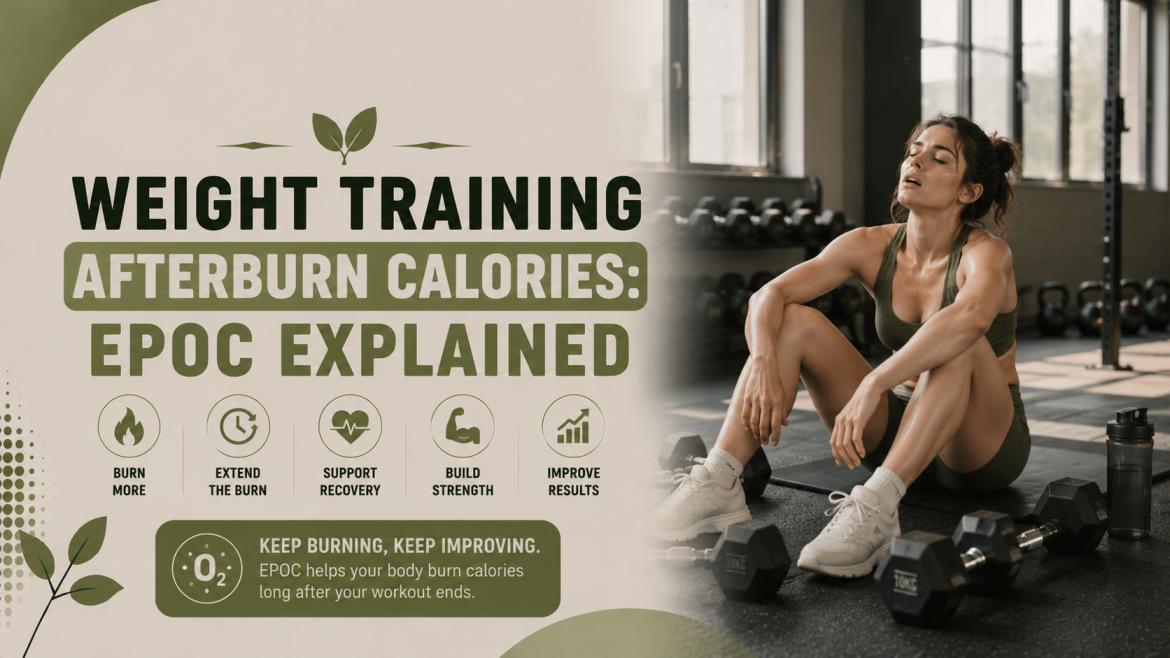
Weight training burns calories during the session and for up to 38 hours afterward through EPOC (excess post-exercise oxygen consumption). A 154 lb (70 kg) person burning 420 calories in a vigorous one-hour lifting session adds approximately 25 to 63 additional post-workout calories through EPOC in the following day. Vigorous weight training produces EPOC lasting 24 to 38 hours, compared to just 2 to 4 hours for steady-state cardio.
Use the weight training calorie calculator to get a personalised session calorie estimate, and add 6 to 15% for the EPOC contribution.
EPOC is the mechanism that most fundamentally differentiates weight training from cardio in long-term calorie economics. During a session, cardio burns more per minute. After a session, weight training burns more per recovery hour.
Over a week of consistent training, this post-workout advantage partially closes the per-session calorie gap between lifting and running. This article covers what EPOC is, how it is measured, EPOC magnitude and duration by training type, and practical strategies to maximise post-workout calorie burn.
What Is EPOC and How Does It Work?
EPOC is the elevated oxygen consumption that occurs after exercise above resting baseline levels. The term "afterburn" in fitness media refers to this same phenomenon. During exercise, the body depletes ATP stores, accumulates lactate, raises core temperature, and disrupts hormonal balance. EPOC represents the metabolic cost of restoring all these systems to their resting state.
For the full weight training hub covering all durations, formats, and cardio comparisons, see the calories burned weight training guide. For cross-activity comparisons, see the calories burned guide.
Physiological Processes Driving Post-Workout Calorie Burn
Weight training disrupts multiple metabolic systems simultaneously, each requiring energy to restore:
ATP and phosphocreatine restoration: Rebuilding depleted immediate energy stores (requires oxygen and calories)
Lactate clearance: Converting accumulated lactate back to glucose (Cori cycle, liver-dependent, energy-requiring)
Core temperature reduction: Returning body temperature to resting levels (each degree reduction has metabolic cost)
Hormonal normalisation: Reducing elevated cortisol, growth hormone, and catecholamine levels to baseline
Muscle protein synthesis: Repairing micro-damage to muscle fibres and synthesising new contractile proteins (largest EPOC driver after vigorous weight training)
Glycogen replenishment: Restoring depleted muscle glycogen from glucose (energy-requiring process lasting 24 to 48 hours)
EPOC Magnitude and Duration by Training Type
Research from Sports Medicine (Børsheim and Bahr, 2003) comprehensively reviewed EPOC across exercise types and found that resistance training produces the longest-lasting EPOC of any common exercise format.
EPOC Comparison by Training Format
Training Format | EPOC Magnitude | EPOC Duration | Extra Calories (154 lb, 60 min) |
|---|---|---|---|
Steady-state cardio (low intensity) | 3 to 5% | 30 to 60 min | +6 to 12 kcal |
Moderate running/cycling | 5 to 7% | 2 to 4 hours | +17 to 41 kcal |
Vigorous weight training | 6 to 15% | 24 to 38 hours | +25 to 63 kcal |
Circuit training | 6 to 15% | 12 to 24 hours | +34 to 84 kcal |
HIIT | 6 to 15% | 12 to 24 hours | +42 to 105 kcal |
Heavy powerlifting session | 8 to 18% | 24 to 48 hours | +20 to 50 kcal (shorter session) |
Source: Børsheim and Bahr (2003), Sports Medicine; LaForgia et al. (2006), Journal of Sports Sciences.
Vigorous weight training's EPOC of 24 to 38 hours significantly outlasts any cardio format. HIIT produces comparable magnitude but shorter duration (12 to 24 hours). Heavy powerlifting produces the highest percentage magnitude but over shorter sessions, so absolute additional calories are in a similar range to vigorous lifting.
EPOC Calorie Addition by Body Weight and Session Intensity
EPOC magnitude scales with session calorie output. A higher session output produces more absolute post-workout calories from EPOC at the same percentage magnitude.
EPOC Calorie Addition by Body Weight (Vigorous Weight Training, 60 Min, 10% EPOC)
Body Weight | Session Calories | EPOC Addition (10%) | 24-hr Total |
|---|---|---|---|
120 lb (54 kg) | 324 kcal | +32 kcal | ~356 kcal |
130 lb (59 kg) | 354 kcal | +35 kcal | ~389 kcal |
154 lb (70 kg) | 420 kcal | +42 kcal | ~462 kcal |
185 lb (84 kg) | 504 kcal | +50 kcal | ~554 kcal |
220 lb (100 kg) | 600 kcal | +60 kcal | ~660 kcal |
Vigorous weight training MET 6.0. EPOC estimated at 10% of session calories over 24 to 38 hours.
A 220 lb person burns approximately 60 additional calories from EPOC after a vigorous 60-minute lifting session. A 120 lb person burns approximately 32 additional calories. Both figures are modest per session but compound significantly over weeks and months of consistent training.
How to Maximise Post-Workout EPOC from Weight Training
Six training variables raise EPOC magnitude and duration:
Higher training volume: More total sets produce more muscle protein synthesis activation, extending EPOC duration
Compound exercise selection: Squats, deadlifts, and rows recruit more total muscle mass than isolation exercises, producing larger metabolic disruption
Higher relative intensity: Training at 75 to 85% of one-rep max produces more hormonal disruption and greater microtrauma than light lifting
Shorter rest periods: Reducing rest increases metabolic stress per session, raising EPOC magnitude
Progressive overload: Increasing load or volume over time continuously challenges the body's recovery systems, maintaining high EPOC response
Multi-joint supersets: Pairing antagonist exercises (e.g., bench press followed immediately by rows) elevates heart rate and metabolic demand above straight-set training
Research published in the European Journal of Applied Physiology (Haddock and Wilkin, 2006) found that resistance training with 30-second rest periods produced 53% more EPOC than the same workout with 3-minute rest periods. Rest period reduction is the most accessible EPOC lever for most trainees.
EPOC vs Long-Term Metabolic Rate: Understanding Both Effects
EPOC and long-term resting metabolic rate elevation are separate mechanisms. Both apply to weight training. EPOC is a temporary post-workout effect lasting 24 to 48 hours. Resting metabolic rate (RMR) elevation from lean mass gain is a permanent structural effect that compounds over months.
Each kilogram of lean muscle added through consistent lifting raises RMR by approximately 13 calories per day, per the American Council on Exercise. Gaining 3 kg of lean muscle over 6 months adds approximately 39 daily resting calories, or 273 per week. This runs indefinitely after the muscle is built, unlike EPOC which resets after each session.
For the session-level calorie comparison between lifting and cardio without EPOC, see the weight training vs cardio guide. For one-hour session calorie data with EPOC addition tables, see the calories burned lifting weights 1 hour guide. For 30-minute session EPOC estimates, see the calories burned weight training 30 minutes guide. Use the TDEE calculator to find your maintenance calories and incorporate both session and EPOC contributions into your weekly deficit plan.
EPOC Across a Training Week: Cumulative Effect
EPOC from weight training sessions stacks cumulatively across a training week. Each session's post-workout elevated metabolism adds to the total weekly calorie burn above and beyond session outputs.
Weekly EPOC Contribution by Training Frequency (154 lb / 70 kg, Vigorous Lifting, 60 Min, 10% EPOC)
Sessions per Week | Session Calories | EPOC per Session | Weekly Session Total | Weekly EPOC Total | Combined Weekly |
|---|---|---|---|---|---|
3 × per week | 420 kcal | 42 kcal | 1,260 kcal | 126 kcal | 1,386 kcal |
4 × per week | 420 kcal | 42 kcal | 1,680 kcal | 168 kcal | 1,848 kcal |
5 × per week | 420 kcal | 42 kcal | 2,100 kcal | 210 kcal | 2,310 kcal |
Five weekly vigorous one-hour sessions produce approximately 2,310 combined calories per week for a 154 lb person when EPOC is included. The EPOC contribution of 210 calories per week is the equivalent of approximately one additional 30-minute vigorous lifting session per week in extra calorie output.
Over 12 weeks, cumulative EPOC from five weekly vigorous sessions adds approximately 2,520 calories above session totals for a 154 lb person. At 3,500 calories per pound of fat, that EPOC contribution alone represents approximately 0.72 lb of additional fat loss over 12 weeks without changing diet or session structure.
The practical implication: EPOC is not a dramatic fat-burning effect on a per-session basis. Over months of consistent training, however, its cumulative contribution to the weekly deficit is meaningful and real. It rewards consistency more than intensity in any single session.
Does EPOC Vary by Age and Fitness Level?
Research from the American Journal of Physiology (Poehlman et al., 1991) found that EPOC magnitude does not significantly differ between trained and untrained individuals at the same relative exercise intensity. Both groups produce approximately 6 to 15% above session calories from EPOC after vigorous resistance training.
Age affects EPOC indirectly through changes in resting metabolic rate and hormonal response to exercise. Older adults (above 50) tend to have reduced testosterone and growth hormone responses to resistance training, which may slightly reduce the muscle protein synthesis component of EPOC. This is partially offset by the generally higher EPOC per session that older adults experience from the same relative training stress, because older muscle recovers more slowly and demands more metabolic energy.
For practical planning purposes, using 6 to 10% of session calories as an EPOC estimate is appropriate for adults of any age.
Frequently Asked Questions About Weight Training EPOC and Afterburn
How Many Calories Does Weight Training Burn After the Workout?
Post-workout EPOC from a vigorous one-hour lifting session adds approximately 6 to 15% above session calories over 24 to 38 hours. For a 154 lb (70 kg) person burning 420 session calories, EPOC adds approximately 25 to 63 additional calories in the following 38 hours. Research from Børsheim and Bahr (2003) confirmed weight training EPOC duration of 24 to 38 hours depending on training volume and intensity.
How Long Does EPOC Last After Weight Training?
Weight training EPOC lasts 24 to 38 hours after a vigorous session, according to research published in Sports Medicine (Børsheim and Bahr, 2003). High-volume sessions or those using heavy loads and short rest periods produce EPOC lasting closer to 38 hours. Light sessions with long rests produce EPOC lasting as little as 2 to 4 hours, similar to steady-state cardio.
Does Weight Training Burn More Calories After the Workout Than Running?
Weight training produces longer-duration EPOC (24 to 38 hours) than running (2 to 4 hours) at comparable magnitudes. For a 154 lb person, a vigorous 60-minute lifting session produces approximately 25 to 63 post-workout calories versus approximately 17 to 41 for a comparable run. Weight training's longer EPOC window adds more total post-session calories than running when the full 24 to 38 hours is measured.
Is the Afterburn Effect Real for Weight Training?
Yes. EPOC from weight training is well-supported by peer-reviewed research. Børsheim and Bahr (2003) in Sports Medicine found weight training EPOC lasting up to 38 hours. LaForgia et al. (2006) in the Journal of Sports Sciences confirmed EPOC magnitude of 6 to 15% above session calories for vigorous resistance training. The afterburn effect is real but modest in absolute calorie terms, adding 25 to 63 calories post-session for most adults.
How Do I Calculate My Post-Workout Calorie Burn from EPOC?
Multiply your session calorie estimate by 6 to 15% to estimate EPOC addition. For a conservative estimate, use 6 to 8%. For vigorous sessions with short rest periods and compound exercises, use 10 to 15%. A 154 lb person burning 420 calories in a vigorous session: 420 × 0.10 = 42 additional post-workout calories at the 10% estimate. Over five weekly sessions: 42 × 5 = 210 additional weekly calories from EPOC alone.