
Calories Burned Powerlifting by Weight and Session
Powerlifting burns 210 to 600 calories per hour depending on body weight and session volume. A 154 lb person burns approximately 245 to 420 calories per session depending on total work volume. This guide covers MET tables, squat/deadlift/bench press calorie estimates, powerlifting vs bodybuilding, and EPOC data.

Your body has a number. Let's find it.
We calculate the exact calorie target your body needs, built from your stats and goal, then track everything against it daily. Log meals, add workouts, set a weight goal, and watch your numbers update in real time. Check in weekly to see calories, water, and weight trend in one place.
No spreadsheets. No guessing. Just results.
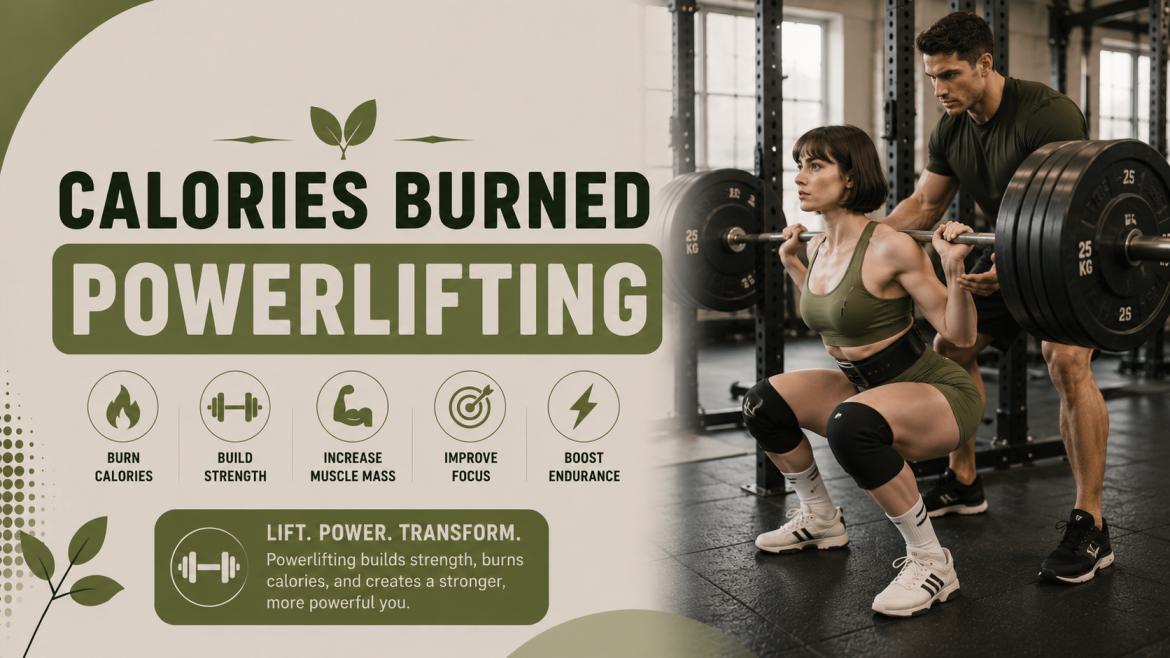
Powerlifting burns between 210 and 600 calories per session for most adults. Body weight and total training volume determine where any session lands. A 154 lb (70 kg) person doing a standard powerlifting session with competition lifts and long rest periods burns approximately 245 to 350 calories per hour. Higher-volume sessions with moderate accessory work push output toward 420 calories per hour.
Use the weight training calorie calculator to get a personalised session estimate based on your weight and training intensity.
Powerlifting is the sport of maximal strength in three lifts: squat, bench press, and deadlift. Training is characterised by heavy loads (85 to 97% of one-rep maximum), low rep counts (1 to 5 reps per set), and long rest periods (3 to 5 minutes between sets). This structure produces the highest mechanical tension per rep of any weight training format but the lowest per-hour calorie output due to extended rest. The calorie story in powerlifting lies primarily in EPOC and the long-term resting metabolic rate elevation from extreme lean mass and strength accrual.
Powerlifters typically train 3 to 4 days per week on a structured progression plan. Each session focuses on one or two of the competition lifts plus accessory exercises targeting supporting muscle groups. Session lengths typically run 90 minutes to 2 hours, including warm-ups and cool-down.
The combination of high mechanical tension and long total session length produces meaningful calorie output per session, even though per-active-minute burn is lower than vigorous continuous training formats. This article covers MET values, per-lift calorie estimates, powerlifting vs bodybuilding comparisons, and EPOC data specific to maximal-strength training.
How Many Calories Does Powerlifting Burn?
The 2024 Adult Compendium of Physical Activities assigns MET 6.0 to powerlifting and heavy strength training. Long rest periods (3 to 5 minutes) reduce the effective per-hour calorie output well below what vigorous continuous-effort training produces at the same MET value.
Effective calories per hour = MET × body weight (kg) × active fraction of the hour
For a 154 lb (70 kg) person at MET 6.0 with 5-minute rests and 2-minute sets: approximately 28% of the session hour is active lifting time. Effective per-hour output: 6.0 × 70 × 0.28 = 118 calories of active effort. Adding resting metabolic rate across the full session: 0.7 kcal/min × 60 min = 42 calories. Total per-hour gross estimate: approximately 160 to 210 calories per hour.
A fuller-volume powerlifting session with 4 to 5 exercises, warmup sets, and accessory work involving 40 to 50% active time produces approximately 245 to 350 calories per hour.
For the full weight training hub covering all lifting formats, EPOC data, and cardio comparisons, see the calories burned weight training guide. For cross-activity comparisons, see the calories burned guide.
Powerlifting Session Calorie Estimates by Session Structure (154 lb / 70 kg)
Session Type | Active Time % | Approximate MET | Calories / 90 Min Session |
|---|---|---|---|
Competition-style (heavy, long rest) | 20 to 30% | 6.0 | 175 to 245 kcal |
Standard training (moderate volume) | 30 to 40% | 6.0 | 245 to 330 kcal |
High-volume (5 to 6 exercises, accessories) | 40 to 50% | 6.0 | 330 to 420 kcal |
Powerbuilding (lifting + circuit accessories) | 50 to 60% | 7.0 | 420 to 560 kcal |
Source: 2024 Adult Compendium MET 6.0 for powerlifting. Active fraction estimates based on typical powerlifting programme rest periods.
Powerlifting Calories by Body Weight
Body weight scales per-session output proportionally across all session structures.
Standard Powerlifting Session Calories by Body Weight (90 Min, Moderate Volume)
Body Weight | Calories / Session (est.) |
|---|---|
120 lb (54 kg) | 189 to 270 kcal |
130 lb (59 kg) | 207 to 295 kcal |
150 lb (68 kg) | 238 to 340 kcal |
154 lb (70 kg) | 245 to 350 kcal |
165 lb (75 kg) | 263 to 375 kcal |
185 lb (84 kg) | 294 to 420 kcal |
200 lb (91 kg) | 319 to 455 kcal |
220 lb (100 kg) | 350 to 500 kcal |
90-minute moderate-volume session. MET 6.0 applied to estimated active fraction of session.
A 220 lb powerlifter doing a full moderate-volume session burns approximately 350 to 500 calories. A 130 lb powerlifter doing the same session burns approximately 207 to 295 calories.
Calories Burned in Squat, Deadlift, and Bench Press
Individual lift calorie estimates are difficult to calculate precisely because each set lasts only 10 to 30 seconds and the MET during maximal lifting is very high briefly. The per-set energy cost includes both the active lift and the immediate recovery phase.
Per-Set Calorie Estimates for Competition Powerlifts (154 lb / 70 kg, 3 Reps at 85% 1RM)
Lift | Muscles Recruited | Est. Calories per Working Set | Est. Calories per 5 Sets |
|---|---|---|---|
Back squat | Legs, glutes, core, upper back | 12 to 18 kcal | 60 to 90 kcal |
Deadlift | Full posterior chain, core | 14 to 20 kcal | 70 to 100 kcal |
Bench press | Chest, shoulders, triceps | 8 to 12 kcal | 40 to 60 kcal |
Overhead press | Shoulders, triceps, core | 8 to 12 kcal | 40 to 60 kcal |
Estimates based on brief maximal-effort exertion with 3 to 5 min rest between sets. Individual variation is high.
The deadlift burns the most calories per working set because it engages the largest total muscle mass of any single-exercise movement. Research published in the Journal of Strength and Conditioning Research (Escamilla et al., 2001) confirmed that the deadlift involves all major muscle groups in coordinated contraction, including spinal erectors, glutes, hamstrings, quadriceps, traps, and lats simultaneously.
Powerlifting vs Bodybuilding: Calorie Comparison
Powerlifting and bodybuilding differ fundamentally in rest period structure and rep range, which directly affects per-session calorie output.
Powerlifting vs Bodybuilding Session Comparison (154 lb / 70 kg, 90 Min)
Variable | Powerlifting | Bodybuilding (Hypertrophy) |
|---|---|---|
Typical rep range | 1 to 5 reps | 8 to 15 reps |
Rest periods | 3 to 5 min | 60 to 90 sec |
Effective active fraction | 20 to 35% | 40 to 55% |
Approx. session MET | 4.5 to 6.0 | 5.0 to 7.0 |
Estimated session calories | 245 to 350 kcal | 350 to 490 kcal |
Bodybuilding-style training (higher reps, shorter rests) burns approximately 40 to 60% more calories per session than competition powerlifting at the same total session length. The shorter rest periods in hypertrophy training keep metabolic rate elevated continuously, raising effective MET above the brief-maximal-effort powerlifting pattern.
Powerlifting EPOC: The Calorie Advantage After Heavy Lifting
Despite lower per-session calorie output, powerlifting produces significant EPOC because of the extreme mechanical stress placed on muscle tissue. Lifting at 85 to 97% of one-rep maximum creates substantial myofibrillar damage requiring energy-intensive repair over 24 to 72 hours.
Research published in Sports Medicine (Børsheim and Bahr, 2003) found that heavy resistance training at high relative intensities produced EPOC magnitudes of 8 to 18% above session calories, with duration extending up to 48 hours for very high-volume or very-heavy sessions. This is the highest EPOC percentage reported for any exercise format.
For a 154 lb person burning 300 calories in a moderate powerlifting session: EPOC at 12% adds approximately 36 additional post-workout calories over 48 hours. For a heavy high-volume session burning 420 calories, EPOC at 15% adds approximately 63 calories. For detailed EPOC science and how to maximise afterburn from weight training sessions, see the weight training afterburn EPOC guide.
Powerlifting and Weight Loss Planning
Powerlifting is not typically programmed primarily for fat loss because its low per-session direct calorie output limits its contribution to weekly deficits. The calorie case for powerlifting as a fat-loss tool relies on three factors:
EPOC magnitude: 8 to 18% above session calories over 24 to 48 hours post-session
Lean mass accrual: Powerlifting produces some of the greatest lean mass gains per training block, raising RMR by approximately 13 calories per day per kilogram of lean mass gained
Strength base: Higher absolute strength allows future training at higher absolute loads, increasing direct calorie burn from accessory work over time
For three weekly powerlifting sessions producing 300 calories each plus 12% EPOC: weekly contribution of approximately 3 × (300 + 36) = 1,008 calories.
For one-hour lifting session calorie data including vigorous general lifting that produces higher per-session output than powerlifting, see the calories burned lifting weights 1 hour guide. For calisthenics as a high-calorie bodyweight alternative, see the calories burned calisthenics guide. Use the TDEE calculator to establish your maintenance calorie level and plan the combined deficit from powerlifting and dietary adjustment.
Frequently Asked Questions About Powerlifting Calories
How Many Calories Does Powerlifting Burn?
A 154 lb (70 kg) person burns approximately 245 to 420 calories per 90-minute powerlifting session depending on volume and rest period structure. Competition-style training with long rests and low volume produces approximately 175 to 245 calories. Higher-volume sessions with accessory work produce approximately 330 to 420 calories. EPOC adds approximately 8 to 18% above session calories in the 24 to 48 hours following a heavy session.
Does Powerlifting Burn More Calories Than Regular Weight Training?
Standard powerlifting with long rest periods burns fewer direct calories per session hour than vigorous general weight training with shorter rests. A 154 lb person burns approximately 245 to 350 calories in a moderate powerlifting session versus approximately 420 calories in a vigorous one-hour general lifting session. However, powerlifting's EPOC magnitude (8 to 18%) is higher than vigorous general lifting (6 to 15%), partially closing the per-session gap over the following 48 hours.
How Many Calories Does a Squat Session Burn?
A 154 lb person performing 5 sets of squats at 85% of one-rep maximum burns approximately 60 to 90 calories across the working sets. A full squat-focused training session including warmup sets, working sets, and accessory leg exercises over 75 to 90 minutes burns approximately 200 to 350 calories depending on total volume and rest period length.
How Many Calories Does Deadlifting Burn?
The deadlift burns approximately 14 to 20 calories per working set for a 154 lb person at 85% of one-rep maximum. Over 5 working sets, that produces approximately 70 to 100 calories. A deadlift-focused session with warmup and accessory work over 60 to 90 minutes burns approximately 180 to 320 calories. The deadlift's high total muscle mass recruitment makes it the highest per-rep calorie lift among the three powerlifts.
Is Powerlifting Good for Weight Loss?
Powerlifting contributes to fat loss primarily through EPOC and long-term lean mass accrual rather than direct session calorie burn. Three weekly sessions contribute approximately 1,000 to 1,200 calories per week, including EPOC, for most adults. This is lower than vigorous cardio or circuit training but comes with the additional benefit of significant strength and lean mass gains that raise resting metabolic rate over a 6 to 12 month training block.
For people prioritising long-term metabolic health alongside fat loss, powerlifting's lean mass stimulus makes it a highly effective tool when combined with a modest dietary deficit and consistent training volume. Research from Westcott (2012) in the Journal of Strength and Conditioning Research confirmed that 10 weeks of resistance training at vigorous loads produced 1.8 kg of fat loss and 1.4 kg of lean mass gain without dietary change, demonstrating fat loss without the calorie-per-hour advantage that cardio provides.