
Lightly Active Multiplier (1.375) | TDEE for Light Exercise and Low-Activity Lifestyles
The lightly active multiplier is 1.375. Learn who it applies to, how it differs from sedentary, and how it changes your daily calorie needs in any TDEE formula.

Your body has a number. Let's find it.
We calculate the exact calorie target your body needs, built from your stats and goal, then track everything against it daily. Log meals, add workouts, set a weight goal, and watch your numbers update in real time. Check in weekly to see calories, water, and weight trend in one place.
No spreadsheets. No guessing. Just results.
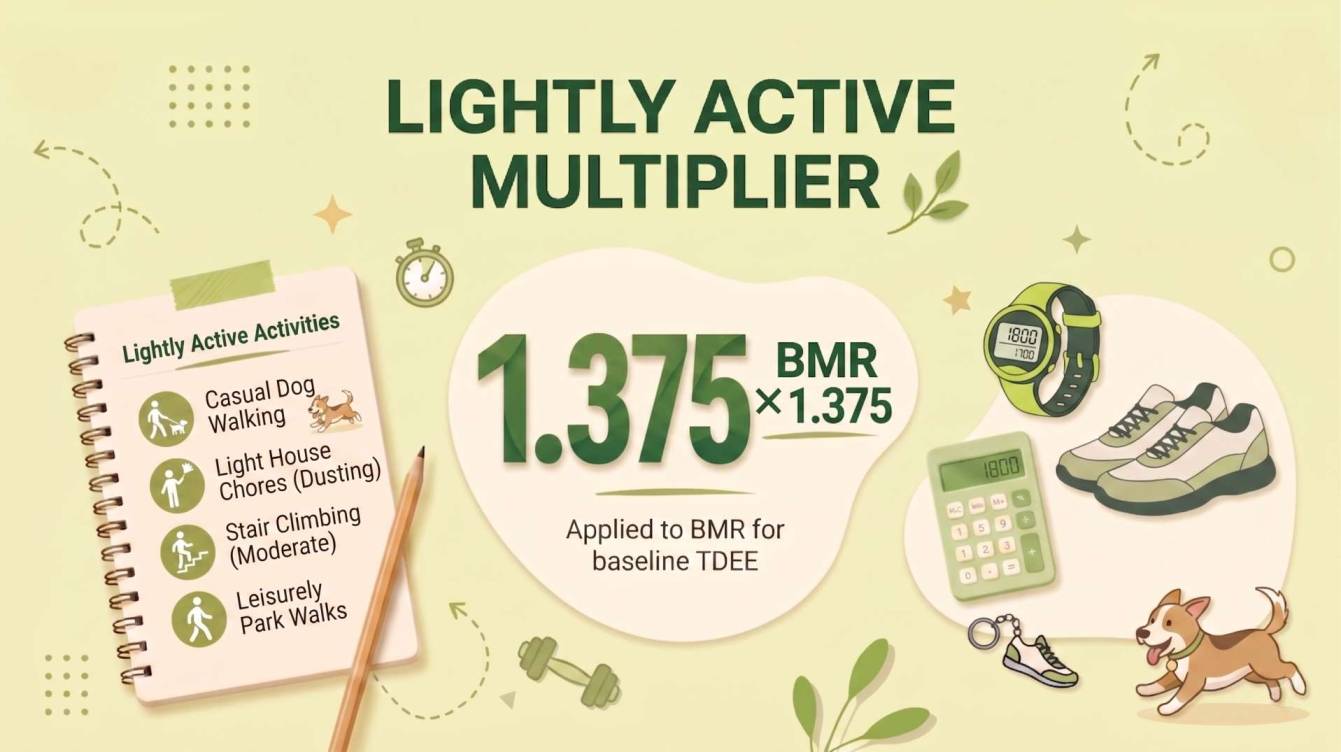
The lightly active multiplier is 1.375. It is the second level on the standard five-point activity scale used in TDEE calculations. It applies to people who do some exercise or maintain regular low-intensity movement, but do not train heavily or work physically demanding jobs.
This multiplier increases your Basal Metabolic Rate by 37.5% to estimate total daily energy expenditure. That increase accounts for both planned exercise and general daily movement, including walking, household tasks, and standing.
Lightly active is the most accurate level for a large portion of the population. It covers office workers who exercise two or three times per week, people who walk regularly, and anyone whose routine includes consistent low-to-moderate movement without intense training.
This article covers what the 1.375 multiplier means, who it fits, how it compares to adjacent levels, and how it applies across different TDEE formulas.
What the 1.375 Multiplier Represents
The 1.375 value is not arbitrary. It comes from research on energy expenditure in people with light physical activity patterns. Studies using doubly labeled water — the gold standard for measuring total energy expenditure — found that lightly active individuals burn roughly 37 to 38% more than their resting rate across a full day.
The multiplier packages that finding into a single usable number. It sits between the sedentary multiplier (1.2) and the moderately active multiplier (1.55), reflecting a meaningful but not intense level of physical engagement.
The Underlying Calculation
Every TDEE formula uses the same structure:
TDEE = BMR × Activity Multiplier
At the lightly active level:
TDEE = BMR × 1.375
Your BMR is calculated first using weight, height, age, and sex. The multiplier is then applied. The Mifflin-St Jeor equation, the Harris-Benedict formula, and the Katch-McArdle formula all use this same multiplier system.
Why the Value Is 1.375 and Not 1.4
The five-level multiplier scale was developed to space levels proportionally across the activity range. The gaps between levels are:
Sedentary to lightly active: +0.175
Lightly to moderately active: +0.175
Moderately to very active: +0.175
Very to extra active: +0.175
The even spacing reflects the intent to create a consistent increment per meaningful step up in activity. The actual values trace back to research by Roza and Shizgal (1984) and subsequent refinements that validated activity correction factors.
Who Is Lightly Active?
The lightly active category is wider than most people expect. It fits a large share of people who consider themselves "not very active" but do maintain consistent low-level movement.
Criteria for Lightly Active
You are lightly active if your week typically includes:
Light exercise or sport 1 to 3 days per week
Daily walks of 20 to 45 minutes, even without formal workouts
A job that involves some standing or light movement
A step count that regularly falls between 5,000 and 9,000
People in this category often include:
Office workers who go for daily lunch walks
People who attend yoga, pilates, or light gym sessions once or twice a week
Teachers, retail staff, or others who stand and move lightly during work
Parents of young children with consistent, active days
Who Is Not Lightly Active?
The lightly active multiplier does not fit two groups. Those below it are better served by the sedentary multiplier (1.2). Those above it belong in the moderately active category.
You are likely not lightly active if:
You exercise three to five days per week at moderate or high intensity
Your job involves physical labor for most of the working day
Your step count regularly exceeds 10,000
How the 1.375 Multiplier Works in TDEE Calculations
The multiplier is simple to apply once you have your BMR. Here is a worked example to show the real output.
Worked Example
A 40-year-old man, 178 cm tall, weighing 82 kg, with a lightly active lifestyle. Using the Mifflin-St Jeor equation:
Step | Value |
|---|---|
BMR (calculated) | 1,840 kcal |
Activity multiplier | × 1.375 (lightly active) |
TDEE result | 2,530 kcal/day |
That 2,530 kcal is his estimated maintenance intake. Eating below it creates a deficit. Eating above it creates a surplus.
What Changes Across BMR Formulas
Different BMR formulas produce different starting values. The multiplier stays fixed, but the output varies depending on which formula you use.
BMR Formula | Typical Output (same person) | TDEE at 1.375 |
|---|---|---|
Mifflin-St Jeor | ~1,840 kcal | ~2,530 kcal |
Harris-Benedict | ~1,880 kcal | ~2,585 kcal |
Katch-McArdle (with LBM) | Varies by lean mass | Depends on LBM input |
The Mifflin-St Jeor equation is the most validated for general populations. Harris-Benedict tends to run slightly high. Katch-McArdle is most useful when lean body mass is known.
Use the TDEE calculator to run these calculations automatically with your chosen formula and activity level.
Lightly Active vs. Sedentary and Moderately Active
Choosing between adjacent levels is where most errors happen. The lightly active level sits between two commonly confused boundaries.
Lightly Active vs. Sedentary
The key difference is deliberate movement. Sedentary means almost no intentional activity and very few daily steps. Lightly active means at least some intentional movement happens regularly, even if it is casual walking or a single weekly gym session.
The multiplier gap is 0.175. For a person with a BMR of 1,700 kcal, that translates to roughly 300 calories per day. Over a month, using the wrong level at this boundary equals about 1.2 kg of calorie error.
A practical test: if you would describe yourself as someone who "tries to keep moving" or "goes for walks most days," lightly active is almost certainly more accurate than sedentary.
Lightly Active vs. Moderately Active
The boundary here is exercise frequency and intensity. Lightly active covers one to three days of exercise per week at low-to-moderate effort. The moderately active multiplier (1.55) applies when exercise is regular, structured, and occurs three to five days per week at meaningful intensity.
If your exercise is occasional and low in effort, stay at 1.375. If you follow a regular training program, move to 1.55.
Real Calorie Numbers at the Lightly Active Level
Applying the 1.375 multiplier across a range of BMR values shows the practical scope of this level.
BMR (kcal) | TDEE at 1.375 (Lightly Active) |
|---|---|
1,200 | 1,650 kcal/day |
1,400 | 1,925 kcal/day |
1,600 | 2,200 kcal/day |
1,800 | 2,475 kcal/day |
2,000 | 2,750 kcal/day |
2,200 | 3,025 kcal/day |
These are maintenance calories for a lightly active person at each BMR level.
Comparing Sedentary vs. Lightly Active Side by Side
BMR | Sedentary TDEE (×1.2) | Lightly Active TDEE (×1.375) | Difference |
|---|---|---|---|
1,400 | 1,680 | 1,925 | +245 kcal |
1,700 | 2,040 | 2,338 | +298 kcal |
2,000 | 2,400 | 2,750 | +350 kcal |
Choosing sedentary when you are actually lightly active means your maintenance figure is 245 to 350 kcal too low. That creates an unintended deficit, which may feel acceptable at first but leads to fatigue, muscle loss, and eventually a metabolic slowdown.
Common Errors at the Lightly Active Level
Some of the most common errors while applying a lightly active level include:
Error 1: Counting Steps but Ignoring Intensity
Step count is a useful signal, but intensity matters too. Someone who walks 8,000 steps at a slow pace burns considerably less than someone who walks 6,000 steps at a brisk pace with elevation changes. Both may sit in the lightly active range, but their actual expenditure differs.
If your movement is mostly slow and flat, lean toward sedentary. If it involves brisk effort, lightly active is appropriate.
Error 2: Selecting Lightly Active for Weekend Activity
Some people are sedentary all week and active only on weekends. A single long hike or bike ride on a Saturday does not make someone lightly active. The activity level reflects your average across the full week, not your best day.
Error 3: Forgetting to Account for NEAT
NEAT stands for Non-Exercise Activity Thermogenesis. It covers all movement that is not formal exercise: fidgeting, household tasks, carrying shopping, and cooking. High NEAT can push someone from sedentary to lightly active without any gym time. If you are naturally restless and move around a lot at home, factor that in.
Error 4: Applying Lightly Active to Compensate for Diet Flexibility
Choosing a higher activity level to give yourself more calorie allowance is a common psychological trap. It produces an inflated maintenance figure, which makes calorie targets unreliable and undermines any goal.
Adjusting When Your Activity Level Changes
The lightly active multiplier is not permanent. Life changes regularly shift where people sit on the activity scale.
When to Move Up?
Move to the moderately active level (1.55) when you consistently exercise three to five times per week at real effort for four or more weeks.
When to Move Down?
Move to the sedentary level (1.2) when you stop regular movement for more than two weeks — due to injury, illness, or a change in routine.
Full Activity Scale Reference
Level | Multiplier | Guide |
|---|---|---|
Sedentary | 1.2 | |
Lightly Active | 1.375 | This page |
Moderately Active | 1.55 | |
Very Active | 1.725 | |
Extra Active | 1.9 |
For a full overview of how all five multipliers compare, see the activity multipliers page. To calculate your TDEE directly, use the TDEE calculator.