
Sedentary Activity Multiplier | What 1.2 Means for Your TDEE?
The sedentary activity multiplier is 1.2. Learn how it works in TDEE formulas, who qualifies as sedentary, and how it changes your daily calorie target.

Your body has a number. Let's find it.
We calculate the exact calorie target your body needs, built from your stats and goal, then track everything against it daily. Log meals, add workouts, set a weight goal, and watch your numbers update in real time. Check in weekly to see calories, water, and weight trend in one place.
No spreadsheets. No guessing. Just results.
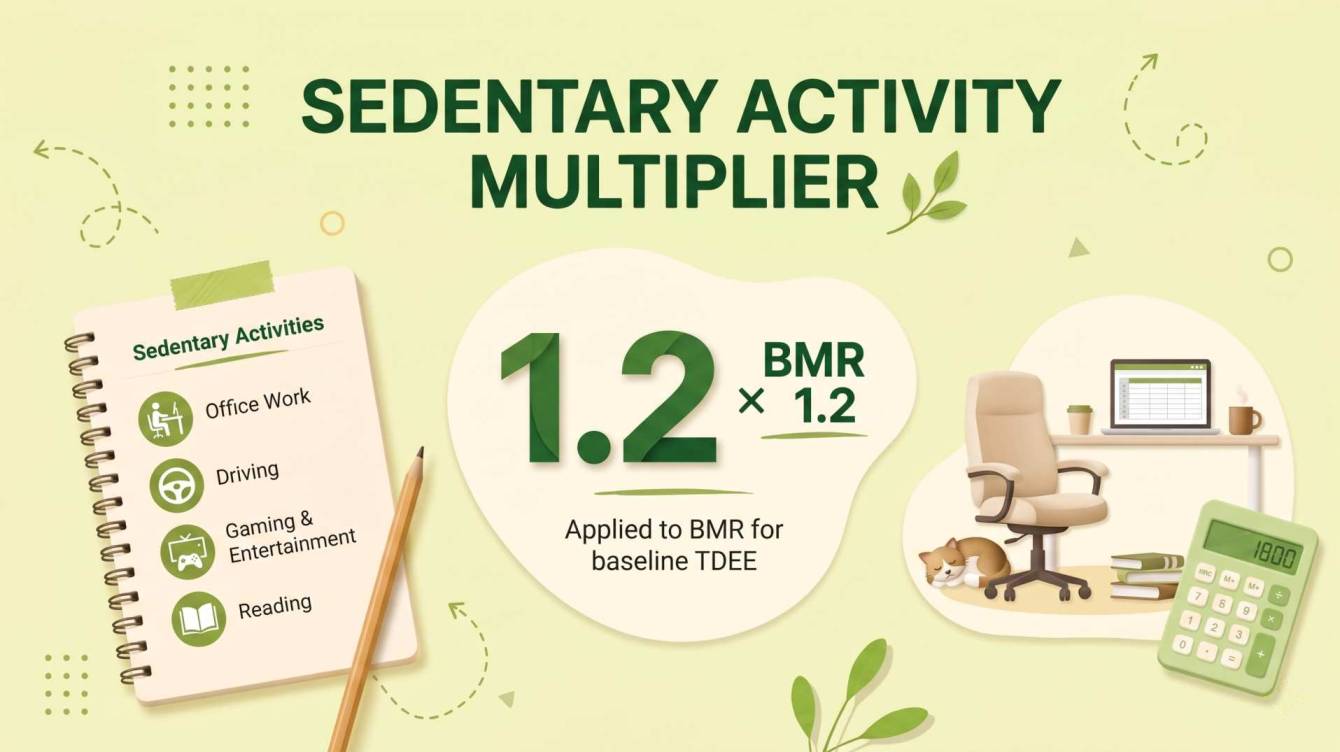
The sedentary activity multiplier is 1.2. It is the lowest value in the activity scale used by most TDEE formulas. Applying it means your daily calorie estimate reflects little to no structured exercise.
This multiplier works by scaling your Basal Metabolic Rate (BMR). Your BMR is the number of calories your body burns at complete rest. The sedentary multiplier raises that number by 20% to account for daily movement like standing, walking short distances, and light domestic activity.
Choosing the right multiplier matters more than most people expect. An incorrect activity level shifts your calorie target by 200 to 500 calories per day. Over weeks, that gap leads to stalled weight loss or unexpected weight gain. The sedentary level is the most commonly misapplied of all five multipliers.
This article explains exactly what the 1.2 multiplier means, who it applies to, how it interacts with different TDEE formulas, and when to move up to the next level.
What Does the Sedentary Multiplier Mean?
The word "sedentary" in this context has a specific technical meaning. It does not just mean "not athletic." It refers to a lifestyle where almost all daily movement is incidental and no structured physical activity occurs.
The number 1.2 is the standard multiplier assigned to this category. It comes from the work of researchers who studied how much total energy expenditure exceeds BMR across different activity patterns. Sedentary individuals burn approximately 20% more than their resting rate when all daily activity is accounted for.
The Formula Relationship
Every major TDEE formula uses a multiplier system. Your total daily energy expenditure is calculated as:
TDEE = BMR × Activity Multiplier
At the sedentary level, that becomes:
TDEE = BMR × 1.2
This applies regardless of which BMR formula you use. The Mifflin-St Jeor equation, the Harris-Benedict formula, and the Katch-McArdle formula all feed into the same multiplier scale.
Where Does the 1.2 Value Come From?
The original activity multiplier scale appeared in work tied to the Harris-Benedict revision by Roza and Shizgal (1984) and later refinements. The sedentary value was established by measuring total energy expenditure in people with desk-based jobs, minimal walking, and no regular exercise routine.
The scale was designed to be practical, not perfectly precise. Research shows individual variation of roughly ±10 to 15% even within the sedentary category.
Who Qualifies as Sedentary?
This is where most people make errors. The sedentary label fits a narrower group than most assume.
Sedentary Criteria
A sedentary lifestyle means:
A desk job or mostly seated daily work
No structured exercise during the week
Daily steps under approximately 5,000
Movement limited to short walks, light household tasks, and sitting
People who work from home and rarely leave the house often fit this category. So do individuals recovering from injury, those with mobility limitations, and office workers who commute by car and do not exercise.
Who Does NOT Qualify as Sedentary?
Many people select sedentary when they should not. You are likely not sedentary if:
You walk for 30 or more minutes most days
You do any structured gym, sports, or fitness activity during the week
Your job involves standing, moving, or light physical tasks
Your daily step count regularly reaches 7,000 or above
If any of these apply, the lightly active multiplier is a more accurate choice.
How the 1.2 Multiplier Works in TDEE Formulas?
The multiplier is the final step in every TDEE calculation. Your BMR is calculated first using weight, height, age, and sex. The activity multiplier is then applied to produce a usable daily calorie target.
Step-by-Step Example
Consider a 35-year-old woman, 165 cm tall, weighing 68 kg, with a sedentary lifestyle. Using the Mifflin-St Jeor equation:
Step | Value |
|---|---|
BMR (calculated) | 1,450 kcal |
Activity multiplier | × 1.2 (sedentary) |
TDEE result | 1,740 kcal/day |
That 1,740 kcal figure is the calorie amount at which her weight stays stable. To lose weight, she would eat below that number. To gain, she would eat above it.
Multiplier Values Across the Full Scale
The sedentary multiplier sits at the bottom of a five-level scale. All five values are:
Activity Level | Multiplier | Typical Profile |
|---|---|---|
Sedentary | 1.2 | Desk job, no exercise |
Lightly Active | 1.375 | Light exercise 1–3 days/week |
Moderately Active | 1.55 | Moderate exercise 3–5 days/week |
Very Active | 1.725 | Hard exercise 6–7 days/week |
Extra Active | 1.9 | Physical job + daily training |
Choosing one level too high adds roughly 200 to 300 calories to your daily estimate. Over a month, that error equals close to 1 kg of body weight.
Use the TDEE calculator to apply this multiplier automatically with any BMR formula.
Sedentary vs Lightly Active: Where Is the Line?
The boundary between sedentary and lightly active is the most consequential boundary on the scale. Most people who think they are sedentary sit right at this line.
The Key Distinction
Sedentary means no deliberate exercise and low daily movement. Lightly active means some intentional activity occurs at least once or twice per week, or daily step counts are consistently in the 5,000 to 7,500 range.
The difference in multiplier is 0.175 (from 1.2 to 1.375). For someone with a BMR of 1,600 kcal, that translates to 280 extra calories per day at the lightly active level.
Practical Test
Ask three questions about your typical week:
Do you walk or move for any deliberate purpose on most days?
Do you attend any gym, sport, or fitness class even once a week?
Does your work involve standing or light movement for more than two hours?
If you answer yes to even one question, you likely belong in the lightly active category rather than sedentary. See the lightly active multiplier guide for a full breakdown of that level.
Calories at the Sedentary Level: Real Numbers
Abstract multipliers become clearer when applied to real BMR values. The table below shows TDEE at the sedentary level across a range of BMR values.
BMR (kcal) | TDEE at 1.2 (Sedentary) |
|---|---|
1,200 | 1,440 kcal/day |
1,400 | 1,680 kcal/day |
1,600 | 1,920 kcal/day |
1,800 | 2,160 kcal/day |
2,000 | 2,400 kcal/day |
2,200 | 2,640 kcal/day |
These are maintenance calories. They represent the intake at which body weight remains stable for a sedentary individual with that BMR.
BMR Formula Differences
The calculated BMR that feeds into this multiplier varies by formula. The Mifflin-St Jeor equation is generally considered the most accurate for the general population. The Harris-Benedict formula tends to produce slightly higher BMR estimates, which means slightly higher TDEE outputs at the same multiplier.
For those with known lean body mass data, the Katch-McArdle formula often gives a more precise BMR. All three are compatible with the 1.2 sedentary multiplier.
Common Mistakes When Choosing the Sedentary Multiplier
The sedentary multiplier is both the most used and most misapplied level. Several errors come up repeatedly.
Mistake 1: Applying Sedentary Because You "Mostly" Sit
Office workers often select a sedentary lifestyle by default. A worker who sits for most of the day but walks to a bus stop, does a 20-minute walk at lunch, and cooks in the evening is not sedentary. They are likely lightly active.
Mistake 2: Ignoring Non-Exercise Activity
NEAT (Non-Exercise Activity Thermogenesis) covers all movement outside formal exercise. Fidgeting, standing, household tasks, and walking all count. High NEAT can push someone from sedentary to lightly active even without any gym attendance.
Mistake 3: Keeping Sedentary After Lifestyle Changes
People who start a new job, move homes, or begin any kind of activity routine often forget to update their activity level. If your daily routine has changed, your multiplier should be reviewed.
Mistake 4: Using Sedentary to Create a Larger Calorie Deficit
Some people deliberately pick a lower activity level to get a lower calorie target and lose weight faster. This is not how the multiplier should work. An inaccurate multiplier produces an inaccurate maintenance figure, which makes deficit calculations unreliable.
When to Recalculate Your Activity Level?
Activity levels change. A multiplier that was accurate six months ago may not reflect your current routine.
Triggers for Reassessment
Recalculate your activity level when any of the following happen:
You start or stop a regular exercise routine
Your job changes in ways that affect daily movement
You move from a walkable area to a car-dependent one, or vice versa
You recover from an injury or illness that limited movement
Your average daily step count changes by 2,000 or more steps
Reviewing your activity level every three to four months is a reasonable baseline habit. Use the activity multipliers overview to compare all five levels side by side.
Related Activity Levels
The sedentary level connects directly to the full five-level scale. As you become more active, the relevant multipliers are:
Lightly active (1.375) — light exercise 1 to 3 days per week
Moderately active (1.55) — moderate exercise 3 to 5 days per week
Very active (1.725) — intense training most days
Extra active (1.9) — physical labor plus structured training
Choosing correctly among these levels is the single most impactful decision in any TDEE calculation. A wrong multiplier is more disruptive to your calorie targets than using a slightly less accurate BMR formula.
For the most accurate result, calculate your BMR first with the formula that best fits your data, then apply the multiplier that reflects your honest weekly activity. The TDEE calculator handles both steps together.