
TDEE for Women vs. Men: What Actually Drives the Difference?
Discover what actually drives the TDEE gap between women and men. Covers lean mass, hormones, fat distribution, BMR formulas, weight loss rate differences, and how the gap narrows with age and changes across female life stages.

Your body has a number. Let's find it.
We calculate the exact calorie target your body needs, built from your stats and goal, then track everything against it daily. Log meals, add workouts, set a weight goal, and watch your numbers update in real time. Check in weekly to see calories, water, and weight trend in one place.
No spreadsheets. No guessing. Just results.
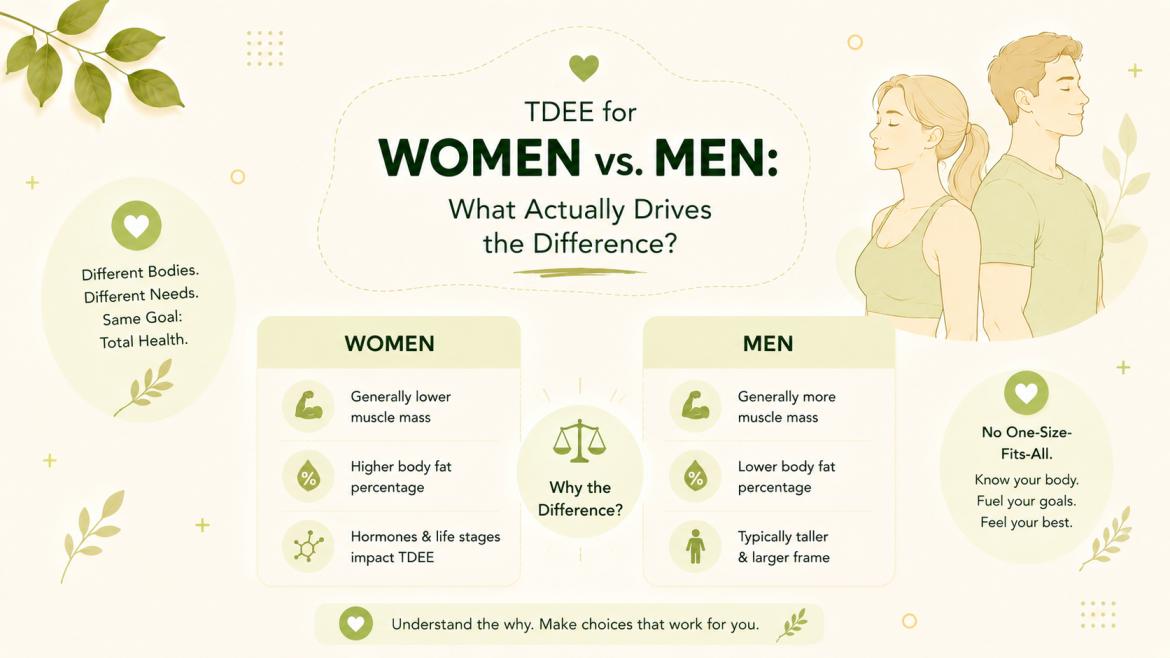
Women need fewer calories per day than men. At equivalent body weight, height, and activity level, a woman's Total Daily Energy Expenditure (TDEE) runs approximately 8 to 15% lower than a man's. The USDA 2020–2025 Dietary Guidelines for Americans reflect this difference directly: the calorie reference range for adult women is 1,600 to 2,400 calories per day, while the range for adult men is 2,000 to 3,000 calories per day across sedentary to active categories.
A regression equation published in the CALERIE study found that female sex reduces TDEE by approximately 338 calories per day at the same body weight compared to males. When adjusted for fat-free mass rather than total weight, the same data found a positive sex coefficient of 103 calories per day in women, suggesting that when lean mass is fully matched, a small metabolic advantage may exist for women.
Understanding what actually drives the TDEE gap, and under which conditions it narrows or disappears, gives both sexes a more accurate framework for calorie management. For a female-specific TDEE calculation that applies sex-specific inputs and formula constants, use the TDEE Calculator for Women.
How the BMR Formula Encodes the Sex Difference?
The most widely validated equation for estimating resting metabolic rate in healthy adults, the Mifflin-St Jeor equation, was identified by the American Dietetic Association as the most accurate predictive formula for non-athletic adults. It encodes the sex difference as a single constant at the end of the calculation.
Sex | Mifflin-St Jeor Formula |
|---|---|
Women | BMR = (10 × weight kg) + (6.25 × height cm) − (5 × age) − 161 |
Men | BMR = (10 × weight kg) + (6.25 × height cm) − (5 × age) + 5 |
The difference between the two constants is 166 calories per day. A 35-year-old woman and a 35-year-old man at the same height and weight will differ by exactly 166 calories per day in calculated BMR before any activity multiplier is applied.
That 166-calorie constant is not arbitrary. It represents the average caloric impact of two structural physiological differences: women carry a higher proportion of metabolically inactive essential body fat, and men carry proportionally greater skeletal muscle mass. Both of these differences are consistent and measurable across populations. For a full explanation of what TDEE measures and how all four of its components are structured, see the TDEE overview guide.
The Harris-Benedict, Katch-McArdle, and other formulas similarly encode sex-specific constants or use fat-free mass inputs that inherently capture the body composition gap. All of these formulas are explained in the TDEE formulas guide.
Driver 1. Lean Muscle Mass (The Primary Metabolic Differentiator)
The largest single driver of the female-male TDEE gap is the difference in absolute skeletal muscle mass.
Men carry approximately 36% greater absolute skeletal muscle mass than women of the same body weight, a difference produced by testosterone's direct effect on muscle protein synthesis. Testosterone activates androgen receptors in muscle cells, stimulating the production of contractile proteins and supporting hypertrophy. Average men carry approximately 30 to 40% more lean mass than women of comparable height and weight.
Research published in Lifestylephysicians.com confirms that men carry 30 to 40% more lean muscle mass than women due to testosterone's effects on muscle development, and that each pound of muscle burns approximately 5 to 6 calories per day at rest.
Translating this to TDEE:
Tissue Type | Approximate Resting Calorie Burn |
|---|---|
Skeletal muscle | 13 calories per kilogram per day |
Fat tissue | 4.5 calories per kilogram per day |
Organ tissue (combined average) | 200–440 calories per kilogram per day |
Muscle tissue burns nearly 3 times more calories per kilogram than fat tissue at rest. A man who carries 10 more kilograms of lean mass than a woman at the same total body weight burns approximately 130 additional calories per day from that difference alone. Across a full day with activity, this difference compounds.
When researchers control for fat-free mass and compare a man and woman with identical muscle quantities, the BMR gap nearly disappears. A 2025 study published by bmrcalculator.uk confirmed this directly: when researchers adjust for body composition and compare a man and woman with the same amount of muscle, the gender gap in metabolism is substantially reduced. This means the sex-based metabolic difference is largely a body composition difference, not an inherent cellular metabolic difference between male and female cells.
Driver 2. Essential Body Fat (The Necessary Metabolic Cost)
Women carry significantly more essential body fat than men. Essential body fat is the minimum fat mass required for normal physiological function. It differs by sex because women require fat stores to support hormone production, menstrual function, pregnancy, and lactation.
Category | Women | Men |
|---|---|---|
Essential body fat | 10–13% of body weight | 3–5% of body weight |
Athletic body fat | 14–20% | 6–13% |
Average fit adult body fat | 21–24% | 14–17% |
The higher essential fat percentage in women means that at the same total body weight, a woman has proportionally less lean tissue and more fat tissue than a man. Since fat tissue burns roughly one-third as many calories per kilogram as muscle at rest, a higher fat percentage directly reduces BMR per kilogram of total body weight.
Research from BodySpec confirms that premenopausal women typically have a greater proportion of subcutaneous adipose tissue, particularly in the gluteofemoral region (hips and thighs), while men generally accumulate more upper-body fat and a higher proportion of visceral adipose tissue (VAT). Visceral fat is more metabolically active in a harmful direction: it drives inflammation and insulin resistance while subcutaneous fat in the gluteofemoral region carries relatively lower metabolic risk.
Estradiol (estrogen) regulates fat distribution in women by directing storage to the hips and thighs. Research published in PMC confirms that premenopausal estrogen levels are positively associated with lean mass and negatively associated with fat mass in women, meaning high estrogen during reproductive years partially counteracts the fat-accumulating effect of higher essential fat requirements. When estrogen declines at menopause, fat redistribution shifts toward the abdomen, changing both body composition and metabolic risk profile.
Driver 3. Testosterone (Hormonal Architecture of the BMR Gap)
Testosterone is the primary hormonal driver of the lean mass advantage that produces higher male TDEE. Men's testosterone levels average 270 to 1,070 ng/dL, compared to 15 to 70 ng/dL in women. This 10 to 20-fold difference in circulating testosterone produces sustained anabolic signaling in male muscle tissue that women do not experience without exogenous intervention.
Research published in PMC from a population-based cross-sectional study of 6,655 participants using NHANES data confirmed that among men, testosterone is positively associated with lean body mass and negatively associated with fat mass, while among women, estradiol levels are positively associated with lean mass and negatively associated with fat mass. The hormonal architecture driving body composition is fundamentally different between the sexes.
The circadian pattern of hormonal cycling also differs between sexes. Male testosterone follows a 24-hour cycle with peak morning levels and a predictable daily rhythm. Female hormones follow a 28-day cycle with larger amplitude fluctuations and phase-specific effects on metabolism. These cycle-based fluctuations add a layer of monthly variability to female TDEE that has no male equivalent.
The Sex Difference in TDEE: Absolute Numbers by Age and Activity
The following table presents reference TDEE ranges for men and women across age groups and activity levels based on the USDA 2020–2025 Dietary Guidelines. These figures represent sedentary to active ranges at average height and weight for each decade.
Age Range | Women's TDEE Range | Men's TDEE Range | Average Gap |
|---|---|---|---|
19–30 | 1,800–2,400 kcal/day | 2,400–3,000 kcal/day | 600 kcal/day |
31–50 | 1,800–2,200 kcal/day | 2,200–2,800 kcal/day | 400–600 kcal/day |
51–60 | 1,600–2,200 kcal/day | 2,000–2,600 kcal/day | 400 kcal/day |
61–70 | 1,600–2,000 kcal/day | 2,000–2,600 kcal/day | 400–600 kcal/day |
71+ | 1,600–2,000 kcal/day | 2,000–2,600 kcal/day | 400–600 kcal/day |
The gap is widest in the 19–30 age range, when male and female hormonal differences are at their most pronounced. As both sexes age and lose lean mass, the absolute gap narrows somewhat in kilocalorie terms, though the percentage gap remains consistent because both sexes lose lean mass in parallel.
The full reference ranges for female calorie needs across all age groups are covered in the women's daily calorie guide.
How the TDEE Gap Changes Across the Female Lifespan?
The female-male TDEE gap is not constant. It narrows and widens across female life stages in predictable patterns.
Pregnancy: The Gap Temporarily Closes
Pregnancy is the life stage where the female-male TDEE gap narrows most significantly. The second trimester adds 340 calories per day above pre-pregnancy TDEE, and the third trimester adds 450 calories per day. A moderately active pregnant woman in her third trimester may have a TDEE of 2,500 to 2,800 calories per day, meeting or exceeding the TDEE of a moderately active man at equivalent body weight.
The specific trimester-by-trimester calorie additions are detailed in the TDEE during pregnancy guide.
Breastfeeding: The Gap Can Reverse
Breastfeeding adds 330 to 500 calories per day above pre-pregnancy TDEE for exclusive breastfeeding. A lightly active breastfeeding woman with a full lactation TDEE of 2,200 to 2,400 calories per day may equal or exceed the daily calorie burn of a moderately active man of similar body weight. Breastfeeding is the single female-specific TDEE component with no male equivalent and no parallel in male physiology.
The full lactation calorie calculation is in the TDEE while breastfeeding guide.
Menstrual Cycle: Monthly Fluctuation vs. Male Stability
Pre-menopausal women experience monthly TDEE fluctuations of 100 to 300 calories per day across the menstrual cycle. The luteal phase (days 15–28) raises TDEE through progesterone thermogenesis. The follicular phase (days 6–14) represents the monthly low. Men experience no equivalent monthly metabolic variation; male testosterone follows a 24-hour cycle rather than a 28-day cycle, producing day-to-day stability rather than monthly fluctuation.
This means the female-male TDEE comparison shifts depending on which menstrual phase a woman is in. At peak luteal phase, the gap between female and male TDEE is narrower than the monthly average calculation suggests. The cycle-phase effects on female TDEE are covered in the TDEE and the menstrual cycle guide.
Perimenopause: The Gap Widens Before Stabilizing
During perimenopause, erratic estrogen fluctuations reduce muscle retention signals and accelerate fat redistribution, lowering female TDEE by an estimated 100 to 150 calories per day compared to pre-perimenopausal baseline. Male testosterone declines more gradually, at approximately 1% per year after age 30, producing a smoother and less abrupt metabolic decline. The perimenopausal female TDEE reduction is more rapid and concentrated into a 4 to 10-year window, temporarily widening the relative metabolic gap between the sexes.
The perimenopausal TDEE adjustments are covered in the TDEE during perimenopause guide.
Menopause: The Steepest Female TDEE Decline
Full menopause reduces female TDEE by 100 to 300 calories per day compared to pre-menopausal baseline. Post-menopausal women who were formerly losing fat efficiently on a given calorie deficit frequently find the same deficit no longer works, because the effective TDEE has declined without a corresponding change in the calculator's output. Post-menopausal fat redistribution to the abdomen also increases visceral fat accumulation, worsening the insulin resistance that further reduces metabolic efficiency.
The post-menopausal TDEE framework is detailed in the TDEE after menopause guide.
How the Gap Changes with PCOS?
Polycystic ovary syndrome creates a third hormonal layer on top of baseline sex differences. Women with PCOS and insulin resistance have a measurably lower effective TDEE than standard formulas predict. Research published in Fertility and Sterility found that adjusted BMR was 1,445 kcal/day in all PCOS women compared to 1,868 kcal/day in matched controls, with women who had both PCOS and insulin resistance showing BMR of 1,116 kcal/day.
Women with PCOS have a TDEE gap below men that is wider than the standard female-male difference, because insulin resistance compounds the lean mass deficit already present in the female physiological baseline. The PCOS-specific metabolic adjustments are covered in the TDEE for women with PCOS guide.
Does the Gap Disappear When Adjusting for Body Composition?
Research from multiple sources suggests the female-male TDEE gap nearly disappears when fat-free mass is directly controlled. The CALERIE study equation confirms this: when body composition was included in the regression model, female sex produced a positive 103-calorie coefficient rather than the negative 338-calorie coefficient seen when only total body weight was used. The sign reversal indicates that at the same lean mass, women may actually burn slightly more calories than men.
The practical implication: the sex gap in TDEE is predominantly a body composition gap, not an inherent cellular metabolic gap. A woman who builds and maintains equivalent lean mass to a male peer narrows or closes the calorie difference almost entirely. This is why resistance training's effect on TDEE is consistently higher in practical terms for women than for men on a per-kilogram basis: the proportional body composition shift is larger.
Research published in ScienceDirect (2025) from a cross-sectional study using doubly-labeled water across 2,326 participants from nine countries found that adjusted TDEE was similar within age groups between females and males when body composition was controlled. The study confirmed that females demonstrate greater fat mass and lower fat-free mass with each age group compared to males, but that age influences changes in body composition and energy expenditure similarly between sexes.
Why Men Lose Weight Faster on the Same Calorie Deficit?
When men and women follow the same calorie deficit, men typically lose weight faster. Research published in Diabetes, Obesity and Metabolism covering 2,000 adults on a low-calorie diet found men lost an average of 26 pounds versus 22 pounds for women over 8 weeks. A systematic review from ScienceDirect (2022) found that 10 out of 11 reviewed studies reported men losing more weight than women on the same dietary approach.
Three mechanisms produce this difference:
Higher absolute TDEE produces larger effective deficits. When the same calorie target is applied to a higher male TDEE, the man's actual daily deficit is larger in absolute calories. A man at 2,600 calories per day TDEE eating 1,800 calories is at an 800-calorie daily deficit. A woman at 2,000 calories TDEE eating the same 1,800 calories is at only a 200-calorie deficit.
Men lose more visceral fat during dieting. Research published in PMC confirms that men mobilize more intra-abdominal fat during weight loss while women lose more subcutaneous fat. Visceral fat loss produces more pronounced and rapid improvements in metabolic markers, making male weight loss outcomes appear more dramatic in health screenings.
Women lose proportionally more lean mass during dieting. The PREVIEW study published in PMC covering 2,500 adults found that women lost twice as much fat-free mass as men as a percentage of total weight loss (31.4% vs. 16.1%) on the same low-energy diet protocol. Women's lower testosterone and estrogen's protective role in subcutaneous fat retention both contribute to this pattern.
This difference makes adequate protein intake (1.4 to 1.6 grams per kilogram per day) more critical for women during fat loss than for men on equivalent deficits.
The evidence-based deficit calculation approach for sustained fat loss without lean mass erosion is covered in the TDEE and fat loss guide.
How the Female-Male TDEE Gap Changes with Age
A cross-sectional study published in ScienceDirect (2025) using doubly-labeled water data from 2,326 participants found important patterns in how the sex-based TDEE difference evolves across the lifespan:
Females demonstrated greater fat mass and lower fat-free mass in every age group compared to males
In females, older adults had lower absolute TDEE than younger adults by 217 kcal/day (comparing 55–70 vs. 30–39 year olds)
In males, older adults had lower absolute TDEE than younger adults by 334 kcal/day (comparing 55–70 vs. 30–39 year olds)
Adjusted TDEE was similar within age groups between females and males
This data reveals an important nuance: men experience a steeper absolute TDEE decline from young to old adulthood (334 kcal/day) compared to women (217 kcal/day). This partly reflects the larger starting lean mass that men have to lose, as well as the more concentrated female lean mass loss concentrated around the menopause transition rather than distributed evenly across decades.
Practical Implications of the TDEE Gap for Women
Understanding the female-male TDEE gap helps women set realistic calorie targets and avoid the frustration of benchmarking weight loss outcomes against male results.
Do not benchmark against a male partner's results. A man eating 2,000 calories on a high-activity day may be at a significant deficit. The same woman at the same intake may be near maintenance or in a mild surplus, depending on her TDEE. The difference is physiological, not behavioral.
Resistance training has proportionally higher returns for women. Because women start with lower lean mass, adding 2 kilograms of muscle raises their TDEE by approximately 26 calories per day. More importantly, it shifts body composition in a direction that narrows the female-male TDEE gap and reduces the calorie management precision required.
Account for cycle-phase variation in weekly outcomes. The luteal phase raises female TDEE by 100 to 300 calories per day above the follicular baseline. Women assessing weekly progress should use 4-week averages to remove this monthly noise from trend data.
Protein targets are more critical for women during fat loss. Women lose proportionally more lean mass than men on the same deficit. Protein at 1.4 to 1.6 grams per kilogram per day protects lean mass during calorie restriction and preserves the TDEE that lean tissue supports.
TDEE Women vs. Men: Side-by-Side Reference Table
The following table compares key TDEE metrics for a representative woman and man at average height and weight for each sex, aged 35, moderately active.
Metric | Representative Woman | Representative Man |
|---|---|---|
Height | 5'5" (165 cm) | 5'10" (177 cm) |
Body weight | 140 lb (63.5 kg) | 175 lb (79 kg) |
Average body fat % | 24% | 16% |
Estimated lean mass | 108 lb (48.3 kg) | 147 lb (66.4 kg) |
Estimated BMR (Mifflin-St Jeor) | 1,355 kcal/day | 1,817 kcal/day |
TDEE at moderate activity (×1.55) | 2,100 kcal/day | 2,817 kcal/day |
Absolute TDEE gap | 717 kcal/day | — |
% TDEE gap | 25% | — |
The larger absolute gap in this example versus the 8 to 15% population average reflects the height and weight differences between reference adults of each sex. When body weight is held equal at the same number (for example, both at 140 pounds), the gap narrows to approximately 8 to 15%, consistent with the population estimate.
The BMR Calculator at TDEECalculatorKit.com computes sex-specific BMR using the Mifflin-St Jeor equation for both male and female inputs. The TDEE Calculator applies the full activity multiplier to produce a personalized daily calorie target for any individual.
Common Questions About TDEE Differences Between Women and Men
Why do men lose weight faster than women on the same diet?
Men typically have higher absolute TDEE, which means the same numerical calorie intake creates a larger actual deficit for men. Men also mobilize more visceral fat during weight loss, producing faster improvements in scale weight and metabolic markers. Women lose proportionally more lean mass on the same deficit, which slows the rate of fat loss and can reduce TDEE during the diet period.
Does the TDEE gap disappear if a woman builds a lot of muscle?
The gap narrows substantially. Research from the CALERIE study found that when fat-free mass is controlled, women may actually have a slight calorie advantage over men at identical lean mass. A highly muscular woman with low body fat can have a TDEE that meets or exceeds that of a less muscular man at the same body weight.
Why does the Mifflin-St Jeor formula give women 166 fewer calories than men?
The constant of minus 161 for women versus plus 5 for men encodes the average caloric impact of higher female essential body fat percentage and lower skeletal muscle mass. These body composition differences are consistent across healthy adult populations and produce an average BMR difference of 166 calories per day at identical age, height, and weight inputs.
Is a woman's metabolism inherently slower than a man's?
When adjusted for body composition, the answer is no. Research confirms that adjusted TDEE is similar between sexes when fat-free mass is controlled. The perceived metabolic slowness in women reflects the body composition difference rather than an inherent difference in cellular metabolic rate.
Do women need a bigger calorie deficit than men to lose the same amount of weight?
Women need a larger relative deficit (as a percentage of TDEE) to create the same absolute calorie gap as men, because their TDEE is lower. A 500-calorie deficit represents 20% of a 2,500-calorie male TDEE but 28% of a 1,800-calorie female TDEE. Women typically achieve better outcomes with moderate deficits of 200 to 300 calories per day below TDEE, supported by high protein intake and resistance training, rather than replicating the larger absolute deficits that work for men.
Summary: Key Facts About TDEE Differences Between Women and Men
The female-male TDEE gap is real, measurable, and well-documented across population studies. Its drivers are primarily body composition rather than inherent cellular metabolic differences.
Women need 1,600 to 2,400 calories per day; men need 2,000 to 3,000 calories per day at equivalent activity levels
The BMR gap is encoded as a 166-calorie difference in the Mifflin-St Jeor equation constants (minus 161 for women versus plus 5 for men)
Men carry approximately 36% more absolute lean muscle mass than women at equivalent body weight due to higher testosterone
Women carry 10 to 13% essential body fat compared to 3 to 5% for men, reducing metabolically active tissue per kilogram of body weight
When fat-free mass is directly controlled, adjusted TDEE is similar between sexes
The gap narrows during pregnancy (plus 340 to 450 kcal/day addition) and breastfeeding (plus 330 to 500 kcal/day addition)
Menopause widens the effective gap by reducing female TDEE by 100 to 300 kcal/day
Women lose proportionally more lean mass on the same calorie deficit, making protein targets (1.4 to 1.6 g/kg/day) more critical during fat loss
Building lean mass through resistance training is the most effective long-term strategy for women to narrow the metabolic gap