
TDEE While Breastfeeding: How Lactation Changes Women's Calorie Needs?
Find out how breastfeeding changes a woman's TDEE. Covers lactation calorie additions by stage, the energy cost of milk production, macronutrient targets, safe postpartum weight management, and how to calculate daily calorie needs while nursing.

Your body has a number. Let's find it.
We calculate the exact calorie target your body needs, built from your stats and goal, then track everything against it daily. Log meals, add workouts, set a weight goal, and watch your numbers update in real time. Check in weekly to see calories, water, and weight trend in one place.
No spreadsheets. No guessing. Just results.
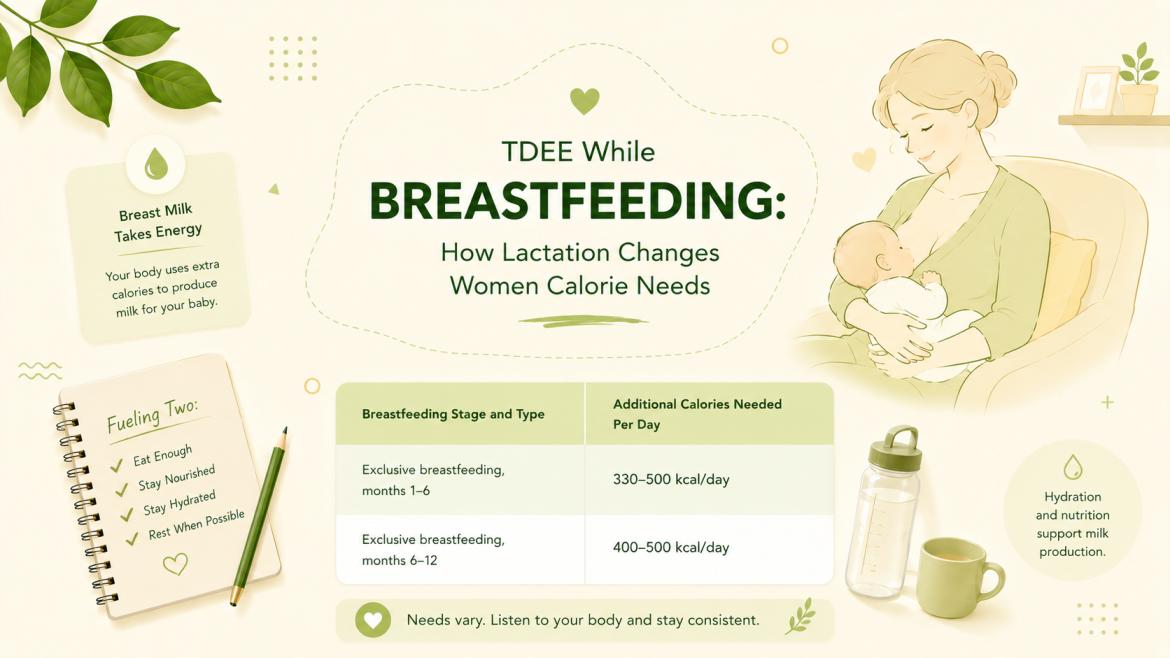
Breastfeeding is one of the most metabolically intensive biological processes a woman's body performs outside of pregnancy itself. Total Daily Energy Expenditure (TDEE) increases significantly during lactation because the body must produce all nutrients, fats, proteins, lactose, and immune factors contained in breast milk from dietary intake and stored fat reserves.
The 2020–2025 Dietary Guidelines for Americans published by the U.S. Department of Agriculture (USDA) recommend that well-nourished breastfeeding mothers consume 330 additional calories per day in the first 6 months postpartum and 400 additional calories per day after 6 months. Use the breastfeeding TDEE calculator to set your daily target by feeding mode and postpartum stage, since the standard +500 kcal addition only applies to full exclusive nursing.
These calorie additions apply on top of pre-pregnancy TDEE. Understanding the full picture of how lactation changes daily energy needs, and how maternal fat stores, breastfeeding exclusivity, and infant age modify those needs, gives nursing mothers an accurate starting point for nutrition decisions.
For a precise pre-lactation TDEE baseline, use the TDEE Calculator for Women at TDEE Calculator Kit.
The Energy Cost of Breast Milk Production
The total daily calorie burn from breastfeeding is not simply the calorie content of the milk produced. The body uses additional energy to run the metabolic processes involved in milk synthesis, hormonal regulation of lactation, and maintaining mammary gland function.
Research on breast milk production efficiency establishes that approximately 80% of the energy invested in lactation ends up in the milk itself, while 20% is consumed by the biological machinery of production. One ounce of breast milk contains approximately 20 calories.
The formula for estimating total lactation calorie burn is:
(Daily milk output in ounces × 20 calories per ounce) ÷ 0.8 = Total daily lactation calories burned
For a woman exclusively breastfeeding one infant and producing the average daily volume:
Average exclusive breastfeeding output: 24 to 25 ounces (approximately 725–750 mL) per day
Energy content of that milk: approximately 480–500 calories
Production overhead at 20%: approximately 120–125 calories
Total lactation energy expenditure: approximately 600–625 calories per day
This gross energy cost is partially offset by the approximately 200 calories per day that maternal fat stores, accumulated during pregnancy, contribute toward lactation in well-nourished women with adequate gestational weight gain. The net dietary addition required is therefore lower than the gross production cost.
The full framework for how pregnancy builds the maternal fat stores that support lactation is covered in the TDEE during pregnancy guide.
Breastfeeding Calorie Additions by Stage and Exclusivity
The extra calories needed during breastfeeding change based on three variables: the lactation stage (postpartum month), whether breastfeeding is exclusive or partial, and the size of the maternal fat reserve available to offset production costs.
Breastfeeding Stage and Type | Additional Calories Needed Per Day | Primary Guideline Source |
|---|---|---|
Exclusive breastfeeding, months 1–6 | 330–500 kcal/day | USDA DGA 2020–2025 |
Exclusive breastfeeding, months 6–12 | 400–500 kcal/day | USDA DGA 2020–2025 |
Partial breastfeeding (breast milk plus formula or solids) | 200–350 kcal/day | Proportional to milk volume |
Exclusively pumping | 330–500 kcal/day (same as nursing) | Research confirms identical energy cost |
Tandem nursing (two children) | 600–750 kcal/day | Proportional to doubled milk output |
The lower end of each range (330 kcal/day versus 500 kcal/day) reflects the contribution from pregnancy fat stores in women who gained adequate gestational weight. A woman who entered pregnancy at a healthy weight, gained 25 to 35 pounds during pregnancy, and retained most of that weight at delivery has fat stores providing approximately 200 calories per day toward lactation. Her dietary addition requirement is closer to 330 calories per day.
A woman with low pre-pregnancy fat stores, inadequate gestational weight gain, or who is actively managing postpartum weight will need the full 500 calories per day from diet to maintain milk production.
How to Calculate Breastfeeding TDEE?
Calculating lactation TDEE follows the same 3-step structure as standard TDEE calculation, with a fourth step adding the stage-specific lactation increment.
Step 1. Establish Current Postpartum BMR
Use current postpartum body weight rather than pre-pregnancy weight. Postpartum body weight reflects the body's actual current metabolic mass. The Mifflin-St Jeor equation for women is:
BMR = (10 × weight in kg) + (6.25 × height in cm) − (5 × age in years) − 161
The BMR Calculator at TDEECalculatorKit.com performs this step directly from age, height, weight, and sex.
Step 2. Apply the Activity Multiplier
Multiply BMR by the activity factor that reflects current postpartum daily movement, not pre-pregnancy activity level. Physical activity is typically lower in the early postpartum weeks due to recovery, disrupted sleep, and newborn care demands.
Activity Level | Multiplier | Postpartum Context |
|---|---|---|
Sedentary | 1.2 | Desk work or home care, minimal additional exercise |
Lightly Active | 1.375 | Regular walking, light daily activity, occasional postnatal exercise |
Moderately Active | 1.55 | Consistent postnatal exercise 3–5 days per week, active lifestyle |
Very Active | 1.725 | Physically demanding work or high-volume postnatal training |
Step 3. Add the Lactation Calorie Increment
Add the appropriate stage-specific lactation addition from the table above to the activity-adjusted TDEE.
Worked Example
A 29-year-old woman, 163 cm tall, current postpartum weight 72 kg, lightly active, exclusively breastfeeding at 3 months postpartum with adequate fat stores:
BMR = (10 × 72) + (6.25 × 163) − (5 × 29) − 161 = 720 + 1,019 − 145 − 161 = 1,433 calories
Base TDEE = 1,433 × 1.375 = 1,970 calories per day
Lactation addition (months 1–6, fat stores present): +330 calories
Total breastfeeding TDEE: 2,300 calories per day
If the same woman had minimal fat stores, the lactation addition rises to 500 calories, giving a total of 2,470 calories per day.
The TDEE formulas guide covers the full range of BMR equations and when each produces the most accurate estimate for postpartum women.
The 1,800-Calorie Minimum Floor During Lactation
Breastfeeding women should not drop below 1,800 calories per day. Multiple clinical sources, including KellyMom.com's lactation nutrition reference, the Kaloria breastfeeding calculator, and the thecalcs.com breastfeeding calculator, all set 1,800 calories as the minimum safe threshold for nursing mothers.
Below 1,800 calories per day, 3 risks arise:
Milk supply may decrease as the body reduces production to protect maternal energy balance under prolonged restriction
Micronutrient deficiency becomes difficult to prevent at total intakes below 1,800 calories, particularly for calcium, vitamin D, iodine, and vitamin B12
Maternal lean muscle mass erodes when total protein intake falls below the lactation-specific requirement, reducing postpartum metabolic rate
The American College of Sports Medicine and the USDA both set 1,200 calories per day as the minimum floor for non-lactating women. For lactating women, clinical guidelines from KellyMom and Kaloria raise this floor to 1,500 to 1,800 calories per day, with the upper end of this range recommended for most nursing mothers.
This minimum floor applies regardless of postpartum fat loss goals. Postpartum fat management is discussed in a later section with the appropriate clinical caveats.
Breastfeeding TDEE Reference Table
The following table presents total daily calorie targets across lactation stages for a woman of average postpartum weight (68 kg) at varying activity levels. These are full TDEE figures including the lactation addition.
Activity Level | Months 1–6 Exclusive | Months 6–12 Exclusive | Partial Breastfeeding |
|---|---|---|---|
Sedentary | 1,910–2,080 kcal/day | 1,980–2,080 kcal/day | 1,760–1,960 kcal/day |
Lightly Active | 2,130–2,300 kcal/day | 2,200–2,300 kcal/day | 1,980–2,180 kcal/day |
Moderately Active | 2,360–2,530 kcal/day | 2,430–2,530 kcal/day | 2,210–2,410 kcal/day |
Very Active | 2,600–2,770 kcal/day | 2,670–2,770 kcal/day | 2,450–2,650 kcal/day |
The lower figure in each range represents the estimate for women with adequate fat stores contributing approximately 200 calories per day toward lactation. The higher figure represents women meeting the full lactation energy cost from diet.
The full daily calorie reference ranges for all female life stages are covered in the women's daily calorie guide.
Macronutrient Targets During Breastfeeding
Calorie quantity determines whether lactation energy needs are met. Macronutrient distribution determines whether those calories deliver adequate milk quality, support maternal lean mass preservation, and prevent micronutrient deficiencies.
Protein During Breastfeeding
Protein requirements are higher during breastfeeding than during pregnancy. The Recommended Dietary Allowance (RDA) for protein increases by 25 grams per day during breastfeeding compared to the non-lactating baseline. Total protein targets during lactation are 1.1 to 1.3 grams per kilogram of body weight per day, with clinical nutrition research supporting 1.3 grams per kilogram per day for women managing postpartum body composition.
Protein serves 3 functions specific to lactation:
Milk protein synthesis: breast milk contains whey, casein, lactoferrin, and immunoglobulins, all requiring dietary protein precursors
Maternal lean mass preservation: the postpartum period carries risk of lean muscle loss when protein intake falls below requirement, particularly when calorie intake is also reduced
Metabolic rate maintenance: lean mass is the primary driver of resting metabolic rate; protecting it during lactation protects long-term TDEE
For a 70-kilogram breastfeeding woman, the protein target is approximately 77 to 91 grams per day. Distributing this across 3 to 4 meals at 25 to 30 grams per meal produces the best muscle protein synthesis response.
Fat During Breastfeeding
Dietary fat directly influences the fat composition of breast milk. While total milk volume is regulated primarily by infant demand, the fatty acid profile of the milk reflects maternal dietary fat intake. Omega-3 docosahexaenoic acid (DHA), essential for infant brain and retinal development, appears in breast milk in proportion to maternal DHA intake.
Key fat targets during lactation:
Total fat: 30–35% of total daily calories from whole food sources
Omega-3 DHA: 200–300 mg per day from fatty fish (salmon, sardines, trout) or algae-based supplements
Omega-3 EPA: additional cardiovascular benefit for the mother
The CDC specifically identifies DHA as one of two particularly important omega-3 fatty acids for infant brain development during breastfeeding, alongside EPA.
Carbohydrates During Breastfeeding
Carbohydrates should represent 45 to 55% of total calories during lactation. Lactose, the primary carbohydrate in breast milk, is synthesized in mammary tissue. Maternal carbohydrate intake does not directly determine milk lactose concentration, which remains relatively constant, but carbohydrates provide the primary glucose substrate for maternal energy balance.
Fiber intake targets remain 28 grams per day. Complex carbohydrates from whole grains, legumes, vegetables, and fruit provide both energy and micronutrients alongside fiber.
Critical Micronutrients During Breastfeeding
Breast milk is built directly from the nutrients a mother consumes. Micronutrient composition of breast milk is partially dependent on maternal status for several vitamins and minerals, making adequate intake essential for both maternal and infant health.
Micronutrient | Daily Target During Breastfeeding | Function in Lactation |
|---|---|---|
Calcium | 1,000 mg/day | Bone density; temporarily decreases during breastfeeding, recovers post-weaning |
Iodine | 290 µg/day | Infant thyroid development; significantly elevated from non-pregnant need |
Choline | 550 mg/day | Infant brain and nervous system development |
Vitamin D | 600 IU/day | Supplementation commonly needed; breast milk provides limited vitamin D |
Iron | 9 mg/day | Lower than pregnancy need due to amenorrhea reducing losses |
Omega-3 DHA | 200–300 mg/day | Infant brain and retinal development |
Vitamin B12 | 2.8 µg/day | Infant neurological development; deficiency risk in vegan/vegetarian mothers |
Bone mineral density temporarily decreases during breastfeeding due to calcium mobilization for milk production. This loss reverses after weaning in most women with adequate calcium intake. Women who breastfeed for 12 or more months without adequate calcium intake face a higher long-term risk of bone density reduction.
Continuing prenatal vitamins through the breastfeeding period covers most of these elevated requirements. Vitamin D supplementation is separately recommended for many breastfeeding women, as breast milk itself is a poor vitamin D source, and infant vitamin D supplementation is commonly recommended by pediatricians in the first year of life.
How Maternal Fat Stores Modify Lactation Calorie Needs?
Pregnancy-acquired fat stores are designed to offset part of the energy cost of lactation. The IOM estimates that maternal fat stores provide approximately 200 calories per day toward lactation in well-nourished women who gained appropriate gestational weight.
Research from KellyMom.com (citing Institute of Medicine data) confirms that maternal fat stores typically provide approximately 200 calories per day toward lactation. This contribution means that dietary calorie additions can be lower than the gross lactation energy cost without compromising milk production.
The three factors that determine how much fat store contribution is available are:
Pre-pregnancy BMI: women with higher body fat percentages entering pregnancy have more available fat stores for lactation
Gestational weight gain: women who gained within IOM recommendations (11.5–16 kg for normal weight women) stored approximately 2–5 kg of fat specifically for lactation energy needs
Postpartum weight status: women who lost most gestational weight before breastfeeding begins have fewer fat stores available and need higher dietary calorie additions
A review of 17 studies referenced by the Free Dieting Breastfeeding Calculator found that mean postpartum weight loss rates in the first 6 months are greater in well-nourished breastfeeding women (0.8 kg per month) compared to undernourished breastfeeding women (0.1 kg per month). Eating sufficiently above the floor enables both milk production and gradual fat mobilization simultaneously.
Breastfeeding TDEE Compared to Pregnancy TDEE
Breastfeeding requires more daily calories than pregnancy in most cases. The second trimester pregnancy addition is 340 calories per day and the third trimester addition is 450 calories per day, both above pre-pregnancy TDEE. The exclusive breastfeeding addition of 330 to 500 calories per day meets or exceeds these pregnancy additions.
Research from Coach Mark Carroll's nutrition team notes this directly: breastfeeding requires far more calories than pregnancy in aggregate. During pregnancy, the body stored fat specifically to fund the lactation period. Breastfeeding draws on that stored energy while simultaneously requiring sustained dietary support.
The transition from pregnancy to lactation is therefore a period of continuous elevated calorie need, not a return to pre-pregnancy intake. Women who reduce calories sharply at delivery, expecting to revert to pre-pregnancy eating habits, create a calorie deficit that can affect milk supply and maternal energy.
Postpartum Weight Management While Breastfeeding
The postpartum period raises questions about weight management alongside lactation support. The evidence base supports gradual postpartum fat loss during breastfeeding, with specific timing and magnitude guidelines.
When to Begin Postpartum Fat Loss?
Clinical guidance from multiple sources, including Macronutrients.com and Working Against Gravity, recommends waiting 6 to 8 weeks postpartum before creating a calorie deficit, for 2 reasons:
Milk supply establishes in the first 6 to 8 weeks; calorie restriction during this critical window risks interfering with supply establishment
The postpartum body needs 6 to 8 weeks to heal from delivery regardless of birth type
After 6 to 8 weeks, a modest calorie deficit of 300 to 500 calories per day below breastfeeding TDEE is clinically appropriate for healthy, well-nourished women. This produces postpartum fat loss of approximately 0.5 to 1 pound per week without compromising milk quality or volume, outside of severe protein-energy malnutrition.
Safe Postpartum Weight Loss Rate
Research from the Journal of Human Lactation confirms that moderate weight loss of approximately 0.5 kg per week between 4 and 20 weeks postpartum in lactating women with low environmental contaminant exposure did not increase contaminant concentration in breast milk. A randomized intervention cited by KellyMom showed that infants of initially overweight lactating mothers who lost an average of 0.5 kg per week grew normally.
The safe postpartum fat loss rate during breastfeeding is 0.5 to 0.7 kg (1 to 1.5 pounds) per week maximum. Faster rates risk lean mass loss, milk supply reduction, and micronutrient deficiency.
Calorie Floor During Postpartum Fat Loss
When creating a deficit during lactation, total intake must remain above 1,800 calories per day for most breastfeeding women, and above 1,500 calories per day for all. The deficit applies to breastfeeding TDEE, not to pre-pregnancy maintenance calories. For the worked example woman with a breastfeeding TDEE of 2,300 calories, a 300-calorie deficit places her at 2,000 calories per day, well above the 1,800-calorie floor.
The evidence-based approach to creating a calorie deficit, preserving lean mass, and avoiding metabolic adaptation during fat loss is covered in the TDEE and fat loss guide.
How Breastfeeding TDEE Relates to Other Female Life Stages?
Breastfeeding and the Menstrual Cycle
Breastfeeding suppresses ovulation through elevated prolactin, which inhibits the pulsatile release of gonadotropin-releasing hormone (GnRH). Many exclusively breastfeeding women experience lactational amenorrhea, the temporary absence of menstruation during lactation. Because the menstrual cycle is suppressed, the cycle-based TDEE fluctuations of 100 to 300 calories per day documented across cycle phases do not apply during exclusive breastfeeding. The cycle-phase calorie patterns described in the TDEE and the menstrual cycle guide resume once cycling returns after weaning.
Breastfeeding and PCOS
Women with polycystic ovary syndrome (PCOS) are often encouraged to breastfeed because lactation acutely improves insulin sensitivity. Research published in the journal Menopause confirms that lactating women display more favorable metabolic parameters including greater insulin sensitivity in the first 4 months postpartum compared to non-lactating women. For women with PCOS who have lower metabolic baselines from insulin resistance, the TDEE additions during lactation are applied on top of the already-adjusted PCOS baseline. The TDEE for women with PCOS guide covers the PCOS-specific baseline adjustments.
Breastfeeding and Perimenopause
Women who become pregnant and breastfeed during perimenopause apply the same lactation calorie additions as younger women. However, the perimenopausal metabolic decline, which typically begins reducing TDEE by 50 to 150 calories per day in the 40s, applies to the pre-lactation baseline on which additions are calculated. Post-weaning, the perimenopausal TDEE reduction becomes fully active again. The perimenopausal metabolic framework is covered in the TDEE during perimenopause guide.
Breastfeeding and Menopause
Full menopause, defined as 12 consecutive months without a period, stops the menstrual cycle permanently and reduces TDEE by 100 to 300 calories per day compared to pre-menopausal baseline. Breastfeeding temporarily reverses the calorie surplus generated by menopause-reduced TDEE by adding 330 to 500 calories per day in lactation energy cost. Once weaning occurs, TDEE returns to the post-menopausal baseline covered in the TDEE after menopause guide.
How Breastfeeding Changes TDEE Compared to Male Metabolism?
Breastfeeding temporarily eliminates the 8 to 15% TDEE gap between women and men at equivalent body weight. A lightly active breastfeeding woman with a full lactation TDEE of 2,300 calories per day meets or exceeds the TDEE of a moderately active man of equivalent height and weight. Lactation is a female-exclusive TDEE component with no male equivalent.
The structural differences between female and male TDEE across all ages and life stages, including the hormonal and body composition mechanisms driving the gap, are covered in the TDEE Women vs. Men comparison guide.
Common Questions About TDEE While Breastfeeding
Does pumping burn as many calories as nursing directly?
Yes, the energy cost of breast milk production is identical whether the milk is removed by nursing or by pump. The Omni Calculator Breastfeeding Calorie reference and multiple clinical sources confirm that calorie burn during pumping equals the calorie burn during nursing at equivalent milk volumes. The method of milk removal does not change the metabolic cost of milk synthesis.
Does breastfeeding automatically cause postpartum weight loss?
Breastfeeding increases calorie expenditure by 300 to 500 calories per day, which favors fat loss when dietary intake does not fully replace that expenditure. Research from the Danish National Birth Cohort found that women who breastfed fully for 6 months were below their pre-pregnancy weight by 6 months postpartum, while women who breastfed for less than 1 week were nearly 2 kg above pre-pregnancy weight at the same time point. However, breastfeeding does not guarantee weight loss. Compensatory increases in calorie intake can offset the lactation energy cost fully.
Does drinking more water increase milk supply?
No, research cited by KellyMom including a study of 210 postpartum mothers confirms that forcing fluid intake above thirst does not increase milk supply and may reduce it. Adequate hydration, approximately 3.1 liters of total daily fluid, supports milk production. Exceeding this through forced drinking provides no additional benefit.
How do I know if I am eating enough while breastfeeding?
The primary indicators are: stable milk volume and infant weight gain at scheduled pediatric appointments, maternal energy levels adequate for daily function, and body weight trending at or above the 1,800-calorie floor. Rapid postpartum weight loss exceeding 1.5 pounds per week, fatigue disproportionate to sleep disruption, and reduced milk supply are signals that calorie intake is insufficient. These warrant consultation with an obstetrician or lactation consultant.
Summary: Key Facts About Breastfeeding TDEE
Lactation adds a substantial and biologically necessary calorie increment above a woman's pre-pregnancy TDEE.
Exclusive breastfeeding adds 330 to 500 calories per day above pre-pregnancy TDEE, with the lower figure appropriate for women with adequate pregnancy fat stores
The gross energy cost of lactation is approximately 600 to 625 calories per day, maternal fat stores contribute approximately 200 calories per day toward this cost in well-nourished women
Partial breastfeeding adds 200 to 350 calories per day proportional to milk volume produced
The safe calorie floor during lactation is 1,800 calories per day for most breastfeeding women
Protein needs increase by 25 grams per day during breastfeeding, to 1.1 to 1.3 grams per kilogram per day
Postpartum fat loss is appropriate after 6 to 8 weeks postpartum at a rate of 0.5 to 0.7 kg per week maximum, using a 300 to 500 calorie deficit from breastfeeding TDEE
Lactational amenorrhea suppresses cycle-based TDEE fluctuations during exclusive breastfeeding
The TDEE overview guide covers the full structure of daily energy expenditure and how each component is calculated. The TDEE Calculator at TDEE Calculator Kit applies all inputs to produce a personalized daily calorie target. All nutrition decisions during breastfeeding should be reviewed with a qualified healthcare provider or registered dietitian, particularly for women with medical conditions, multiples, or history of insufficient milk supply.