
TDEE During Pregnancy: How Many Extra Calories Women Need by Trimester?
Find out how pregnancy changes your TDEE by trimester. Covers IOM calorie additions, BMI-based weight gain targets, macronutrient needs, and how to calculate your daily calorie target for each stage of pregnancy.

Your body has a number. Let's find it.
We calculate the exact calorie target your body needs, built from your stats and goal, then track everything against it daily. Log meals, add workouts, set a weight goal, and watch your numbers update in real time. Check in weekly to see calories, water, and weight trend in one place.
No spreadsheets. No guessing. Just results.
Pregnancy is one of the most metabolically demanding states the human body experiences. Total Daily Energy Expenditure (TDEE) increases across all three trimesters to support fetal growth, placental development, increased maternal blood volume, uterine and breast tissue expansion, and fat storage for lactation preparation.
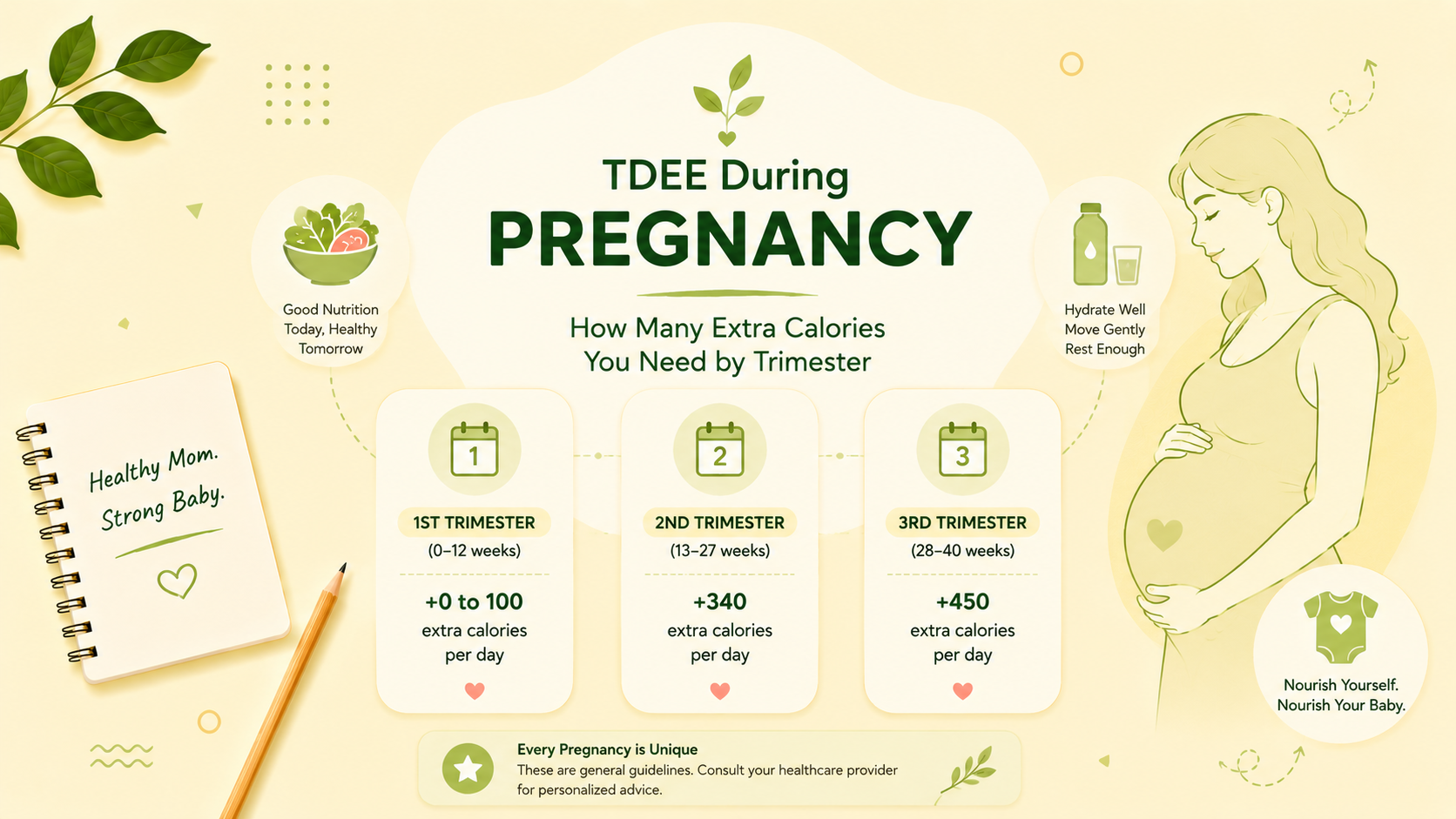
The 2009 Institute of Medicine (IOM) guidelines, which remain the clinical standard used by obstetricians and registered dietitians worldwide, establish that no extra calories are needed in the first trimester, 340 additional calories per day in the second trimester, and 450 additional calories per day in the third trimester. These additions apply on top of pre-pregnancy TDEE. The pregnancy TDEE calculator applies the correct IOM calorie addition for each trimester and shows your recommended weight gain range by pre-pregnancy BMI.
Research published in the National Academies of Sciences (2020) confirms that total energy expenditure begins to increase at approximately 13 weeks of gestation in a linear pattern related to gestational weight gain, reaching an increase of approximately 400 calories per day by the end of the third trimester. Pre-pregnancy body weight, BMI category, activity level, and whether a woman is carrying multiples all modify these baseline figures.
For a precise pre-pregnancy baseline before applying trimester-specific additions, use the TDEE Calculator for Women at TDEECalculatorKit.com.
What Is TDEE During Pregnancy and Why It Increases?
TDEE is the total number of calories a woman's body burns in a 24-hour period across all functions. It includes resting metabolic rate (BMR), physical activity, non-exercise activity thermogenesis (NEAT), and the thermic effect of food (TEF). During pregnancy, a fifth component is added: the energy cost of gestational tissue synthesis and fetal support.
The primary metabolic changes that raise TDEE during pregnancy are:
Fetal and placental tissue synthesis, which requires direct caloric input
Increased maternal blood volume, which raises cardiac output and the energy cost of circulation
Uterine and breast tissue growth, which adds metabolically active tissue requiring maintenance calories
Elevated basal body temperature from progesterone, raising resting calorie burn
Increased ventilatory effort as the diaphragm rises and tidal volume increases
A 2024 study published in the journal Science calculated the total reproductive cost of human pregnancy at approximately 50,000 extra calories over a full 9-month period. A separate analysis in Public Health Nutrition placed the figure at 77,675 extra calories when accounting for the full range of maternal tissue changes, distributed unevenly across trimesters.
The full explanation of how TDEE is structured and what drives each of its four base components is covered in the TDEE overview guide.
Pregnancy TDEE by Trimester: The IOM Calorie Addition Framework
The IOM's trimester-specific calorie additions provide the clinical baseline for pregnancy calorie targets. They represent the energy cost of gestational tissue growth beyond what a non-pregnant woman's body requires at the same activity level.
Trimester | Weeks | Additional Calories Per Day | Primary Energy Use |
|---|---|---|---|
First Trimester | Weeks 1–13 | 0–100 kcal/day | Embryo formation, placenta development begins, hormonal shifts |
Second Trimester | Weeks 14–27 | 340 kcal/day | Fetal organ development, blood volume expansion, maternal fat storage |
Third Trimester | Weeks 28–40 | 450 kcal/day | Rapid fetal growth, fetal fat deposition, lung and brain maturation |
The European Food Safety Authority (EFSA) publishes slightly different figures: 70 calories per day in the first trimester, 260 calories per day in the second, and 500 calories per day in the third. The Italian RDA places third trimester additions at 496 calories per day. These variations reflect different methodologies for measuring gestational energy costs but converge on the same practical range.
The modest first-trimester requirement surprises many women expecting a larger increase. The embryo and early fetus are tiny during weeks 1–13, and most of the energy-intensive maternal tissue changes are not yet operating at full scale. Fetal mass during the first trimester accounts for only a small fraction of total gestational weight gain.
How to Calculate Your Pregnancy TDEE by Trimester?
Calculating pregnancy calorie needs requires 3 steps: establish pre-pregnancy BMR, apply the appropriate activity multiplier to get pre-pregnancy TDEE, then add the trimester-specific calorie increment.
Step 1. Calculate Pre-Pregnancy BMR
The Mifflin-St Jeor equation, which the American Dietetic Association identifies as the most accurate formula for healthy adult women, calculates female BMR as:
BMR = (10 × weight in kg) + (6.25 × height in cm) − (5 × age in years) − 161
Use pre-pregnancy body weight for this calculation. The formula applies to the woman's baseline metabolic rate before gestational changes are added.
Step 2. Apply the Activity Multiplier
Multiply BMR by the activity factor that reflects activity level during pregnancy, not pre-pregnancy activity. Physical activity typically decreases as pregnancy progresses. Most women should select one tier lower than their pre-pregnancy activity multiplier, particularly in the second and third trimesters.
Activity Level | Multiplier | Description During Pregnancy |
|---|---|---|
Sedentary | 1.2 | Desk work, minimal walking, no structured exercise |
Lightly Active | 1.375 | Regular walking, prenatal yoga, light daily activity |
Moderately Active | 1.55 | Consistent prenatal exercise 3–5 days per week |
Very Active | 1.725 | Physically demanding work or high-volume prenatal training |
The American College of Obstetricians and Gynecologists (ACOG) and the World Health Organization (WHO) both recommend 150 minutes per week of moderate-intensity exercise during pregnancy unless contraindicated. Walking, swimming, and prenatal yoga are safe throughout pregnancy for most women.
Step 3. Add the Trimester-Specific Calorie Increment
Add 0 to 100 calories per day in the first trimester, 340 calories per day in the second trimester, and 450 calories per day in the third trimester to pre-pregnancy TDEE.
Worked Example
A 30-year-old woman, 165 cm tall, 65 kg pre-pregnancy weight, lightly active during pregnancy:
BMR = (10 × 65) + (6.25 × 165) − (5 × 30) − 161 = 650 + 1,031 − 150 − 161 = 1,370 calories
Pre-pregnancy TDEE = 1,370 × 1.375 = 1,884 calories per day
First trimester target: 1,884 + 0–100 = 1,884–1,984 calories per day
Second trimester target: 1,884 + 340 = 2,224 calories per day
Third trimester target: 1,884 + 450 = 2,334 calories per day
For the TDEE formulas guide explaining the full range of BMR equations including the Harris-Benedict and Katch-McArdle alternatives, see the detailed formulas reference at TDEECalculatorKit.com.
How Pre-Pregnancy BMI Modifies Calorie Targets?
Pre-pregnancy BMI directly affects both the calorie addition needed and the total gestational weight gain target. The IOM provides separate weight gain recommendations for each BMI category, which in turn adjusts how the trimester calorie additions apply.
IOM Gestational Weight Gain Targets by Pre-Pregnancy BMI
Pre-Pregnancy BMI Category | BMI Range | Recommended Total Weight Gain | Recommended Weekly Gain (2nd and 3rd Trimester) |
|---|---|---|---|
Underweight | Below 18.5 | 12.5–18 kg (28–40 lbs) | 0.44–0.58 kg/week |
Normal weight | 18.5–24.9 | 11.5–16 kg (25–35 lbs) | 0.35–0.50 kg/week |
Overweight | 25.0 – 29.9 | 7–11.5 kg (15–25 lbs) | 0.23–0.33 kg/week |
Obese | 30.0 and above | 5–9 kg (11–20 lbs) | 0.17–0.27 kg/week |
Twin pregnancy (normal weight) | 18.5–24.9 | 17–25 kg (37–54 lbs) | 0.59–0.72 kg/week |
Women entering pregnancy underweight need the highest calorie additions because they begin with lower fat stores and a higher requirement for gestational fat accumulation. Women entering pregnancy with obesity may not need the standard second and third trimester additions.
Research published in the Journal of Clinical Investigation (2019) and replicated in PMC (2025) found that pregnant women with obesity have lower actual energy expenditure than traditional models predict, and that fetal energy needs in this group can be met through mobilization of existing maternal fat mass without additional dietary calories above maintenance.
Twin Pregnancies
Twin pregnancies require approximately 600 additional calories per day in the second trimester and 750 additional calories per day in the third trimester above pre-pregnancy TDEE, compared to 340 and 450 for singleton pregnancies. These significantly higher additions reflect the growth demands of two fetuses, two placentas, and a greater increase in blood volume and uterine tissue.
First Trimester Calorie Needs: Weeks 1–13
The first trimester requires the smallest calorie addition of any pregnancy stage. The IOM standard is no additional calories above pre-pregnancy TDEE. Some clinicians recommend a modest addition of 50 to 100 calories per day to account for the energy cost of early hormonal changes and the beginning of placental development.
Why Appetite Often Falls in the First Trimester?
Nausea, vomiting, and food aversions are reported by up to 80% of pregnant women during the first trimester. These symptoms frequently reduce actual food intake below pre-pregnancy levels, meaning many women are naturally eating less during the period that requires the smallest calorie increase.
Gestational weight gain targets for the first trimester are modest: approximately 0.5 to 2 kg total for most BMI categories, and as little as 1 to 4 pounds for women of normal weight. The embryo and early fetus contribute minimal weight during this window.
Nutrient Priorities in the First Trimester
Calorie quantity matters less than nutrient quality in the first trimester. The critical nutrients during weeks 1–13 are:
Folate: 600 micrograms per day, supporting neural tube closure, which occurs by week 6
Iron: 27 milligrams per day, supporting rapidly expanding blood volume
Choline: 450 milligrams per day, supporting early brain and neural development
Iodine: 220 micrograms per day, essential for fetal thyroid function and neurological development
Second Trimester Calorie Needs: Weeks 14–27
The second trimester is when calorie additions become clinically significant. The IOM recommends 340 additional calories per day above pre-pregnancy TDEE throughout weeks 14–27. This figure reflects the accelerating pace of fetal organ development, maternal fat storage in preparation for lactation, and continued expansion of blood volume and uterine tissue.
What the 340-Calorie Addition Supports?
Research published by the National Academies of Sciences (2020) confirmed that the increase in total energy expenditure from 13 weeks onward is linear and tied to gestational weight gain. The energy demands of the second trimester include:
Fetal organ formation and skeletal development
Expansion of maternal blood volume, which peaks at 40–50% above pre-pregnancy volume
Deposition of maternal fat stores in subcutaneous tissue for lactation preparation
Growth of placental tissue and amniotic fluid volume
Appetite typically returns during the second trimester as nausea resolves. Most women find the second trimester the most comfortable for meeting increased calorie needs. The 340-calorie addition is roughly equivalent to adding one substantial snack per day: for example, Greek yogurt with fruit and mixed nuts, or whole grain toast with eggs and avocado.
Activity Level During the Second Trimester
Physical activity during the second trimester is generally well-tolerated. Most women can maintain a moderately active lifestyle with prenatal exercise 3–5 days per week through mid-second trimester. Activities should avoid lying flat on the back for extended periods after week 20, when the uterus can compress the inferior vena cava in this position.
Third Trimester Calorie Needs: Weeks 28–40
The third trimester requires the largest calorie addition: 450 additional calories per day above pre-pregnancy TDEE throughout weeks 28–40. The fetus gains approximately half its birth weight during the final trimester, and the energy cost of supporting this rapid growth, along with fetal fat deposition for thermoregulation and lung development, drives the highest gestational TDEE of any pregnancy stage.
What the 450-Calorie Addition Supports?
The third trimester calorie addition funds 3 primary biological processes:
Rapid fetal weight gain: the fetus grows from approximately 1 kg at week 28 to 3.2–3.5 kg at term
Fetal fat deposition: white adipose tissue development begins in earnest at week 28 and is essential for neonatal thermoregulation
Fetal brain and lung maturation: both processes require substantial fatty acid availability, particularly docosahexaenoic acid (DHA)
Research published in the journal Nutrients from the Italian Consensus Document on Maternal Diet placed the third trimester calorie addition at 496 calories per day, slightly above the IOM's 450, reflecting the higher caloric cost of fetal growth in the final weeks.
Activity Level During the Third Trimester
Physical activity typically decreases during the third trimester as body weight increases, center of gravity shifts, and fatigue from disrupted sleep accumulates. Most women transition to lower-impact activities: walking, swimming, prenatal yoga, and light resistance training. Activity multipliers for TDEE calculation should be reduced by one tier from second trimester levels for most women.
Pregnancy TDEE Reference Table by Calorie Level and Trimester
The following table presents total daily calorie targets across trimesters for a moderately active woman of normal pre-pregnancy weight. Adjust figures downward by one activity tier if activity has decreased, and apply BMI-based modifications from the weight gain section above.
Pre-Pregnancy TDEE | First Trimester Target | Second Trimester Target | Third Trimester Target |
|---|---|---|---|
1,700 kcal/day | 1,700–1,800 kcal/day | 2,040 kcal/day | 2,150 kcal/day |
1,900 kcal/day | 1,900–2,000 kcal/day | 2,240 kcal/day | 2,350 kcal/day |
2,100 kcal/day | 2,100–2,200 kcal/day | 2,440 kcal/day | 2,550 kcal/day |
2,300 kcal/day | 2,300–2,400 kcal/day | 2,640 kcal/day | 2,750 kcal/day |
These targets are maintenance estimates for a healthy singleton pregnancy. They do not represent calorie targets for weight loss. Calorie restriction during pregnancy is covered in the BMI-specific section above and applies only in medically supervised contexts.
The reference ranges for non-pregnant daily calorie needs across all female age groups and activity levels are covered in the women's daily calorie guide.
Macronutrient Targets During Pregnancy
Calorie quantity determines whether gestational weight gain falls within the IOM target range. Macronutrient distribution determines whether those calories adequately support fetal neurological development, maternal muscle preservation, and hormonal function.
Protein During Pregnancy
Protein requirements increase significantly from the second trimester onward. Whole-body protein turnover studies confirm that protein synthesis rates increase progressively across pregnancy to support fetal tissue growth, placenta formation, and preparation of maternal tissues for lactation.
Recommended protein intake during pregnancy:
Non-pregnant adult women: 0.8 grams per kilogram of body weight per day (RDA)
Pregnant women (second and third trimesters): 1.1 grams per kilogram of body weight per day (RDA)
Practical applied targets supported by clinical nutrition research: 75–100 grams per day total
An estimated 925 grams of protein accumulate in the body across a full pregnancy, deposited into the fetus, placenta, uterus, blood, and maternal breast tissue. This accumulation requires a consistent dietary protein supply beginning in the second trimester, when protein synthesis demand accelerates.
Good dietary protein sources during pregnancy include eggs, lean poultry, fish low in mercury, legumes, Greek yogurt, lentils, and tofu.
Fat During Pregnancy
Fat intake should represent approximately 30–40% of total calories during pregnancy. The most critical fat-specific targets are:
Omega-3 DHA: 200–300 mg per day from fatty fish, algae supplements, or fortified foods, supporting fetal brain and retinal development
Total fat intake: 40–60 grams per day from whole food sources
The Italian Consensus Document on Maternal Diet specifies that fat-soluble vitamins A, D, E, and K depend on adequate dietary fat for absorption. Women eating very low fat during pregnancy risk deficiencies in all four fat-soluble vitamins simultaneously.
Carbohydrates During Pregnancy
Carbohydrate intake should represent approximately 45–55% of total calories. Carbohydrates are the primary fuel for fetal metabolism. The fetus has no capacity to use fat as an energy source; glucose transported across the placenta is the main fetal energy substrate.
Fiber intake targets increase during pregnancy: 28 grams per day supports gastrointestinal motility, which slows under progesterone's effect, reducing constipation risk. Complex carbohydrates from whole grains, vegetables, legumes, and fruit provide both energy and fiber simultaneously.
Key Micronutrients to Support Pregnancy TDEE
The additional calorie additions during the second and third trimesters must deliver specific micronutrients alongside energy. Calorie-adequate diets low in key micronutrients can still produce adverse pregnancy outcomes.
Micronutrient | Daily Target During Pregnancy | Function |
|---|---|---|
Folate | 600 µg/day | Neural tube closure, DNA synthesis |
Iron | 27 mg/day | Blood volume expansion, fetal iron stores |
Calcium | 1,000 mg/day | Fetal bone and tooth formation |
Vitamin D | 600 IU/day | Calcium absorption, immune function |
Omega-3 DHA | 200–300 mg/day | Fetal brain and retinal development |
Choline | 450 mg/day | Brain development, neural tube protection |
Iodine | 220 µg/day | Fetal thyroid and neurological development |
Prenatal vitamins cover most of these micronutrient targets. Dietary sources are strongly preferred over supplements alone, as whole foods provide co-factors and synergistic nutrients that isolated supplements cannot replicate.
How Pregnancy TDEE Relates to Other Female Life Stages?
Pregnancy and the Menstrual Cycle
The menstrual cycle stops during pregnancy. The cycle-based TDEE fluctuations of 100–300 calories per day documented across the menstrual phases, covered in the TDEE and the menstrual cycle guide, do not apply during pregnancy. Pregnancy hormones, particularly human chorionic gonadotropin (hCG) and progesterone, fully suppress ovulation and the associated cyclic metabolic variation.
Pregnancy and Perimenopause
Pregnancy during perimenopause is biologically possible, particularly in early perimenopause before cycles become fully irregular. Women who become pregnant during perimenopause apply the same trimester-specific calorie additions as any pregnant woman. The TDEE during perimenopause guide covers the baseline metabolic adjustments applicable to women in this transition who are not pregnant.
Pregnancy and PCOS
Women with polycystic ovary syndrome (PCOS) who achieve pregnancy face a higher risk of gestational diabetes and gestational hypertension. The insulin resistance associated with PCOS compounds the physiological insulin resistance that occurs in the second half of pregnancy. Women with PCOS and pregnancy benefit from lower glycemic index carbohydrate sources and distributed protein intake to manage blood glucose. The baseline PCOS-specific metabolic adjustments are covered in the TDEE for women with PCOS guide.
Pregnancy and Breastfeeding
Breastfeeding immediately follows pregnancy and requires a separate calorie addition of 340 to 500 calories per day above pre-pregnancy intake. The Centers for Disease Control and Prevention (CDC) recommends 340 to 400 additional calories per day for well-nourished breastfeeding mothers. The detailed lactation calorie calculation, including adjustments for breastfeeding exclusivity, maternal fat stores, and infant age, is covered in the TDEE for breastfeeding women guide.
How Pregnancy TDEE Compares to Male TDEE?
Pregnancy represents the largest absolute TDEE increase of any female life stage, temporarily narrowing and in some cases eliminating the standard 8–15% calorie gap between female and male TDEE at equivalent body weight. A woman in the third trimester with a TDEE of 2,550 calories per day has a daily calorie requirement that meets or exceeds the TDEE of a moderately active man of similar height and pre-pregnancy weight. The structural differences in female and male TDEE outside of pregnancy are covered in the TDEE Women vs Men comparison guide.
Common Questions About TDEE During Pregnancy
Should I eat for two during pregnancy?
No. The additional calorie requirement during pregnancy is 0 extra calories in the first trimester, 340 per day in the second trimester, and 450 per day in the third trimester. For a woman with a pre-pregnancy TDEE of 2,000 calories, the third trimester target is 2,450 calories per day, representing a 22.5% increase, not a doubling of intake.
How does morning sickness affect pregnancy TDEE?
Morning sickness does not reduce the energy requirements of the developing embryo and fetus, but it does reduce a woman's ability to meet those requirements. First trimester nausea and vomiting are naturally coincident with the period of lowest additional calorie need. Women who lose weight during the first trimester due to hyperemesis gravidarum should work with their healthcare provider to restore nutritional status as food tolerance improves.
Does exercise during pregnancy change calorie targets?
Yes. Women who maintain structured exercise during pregnancy burn additional calories through exercise activity thermogenesis (EAT). These additional exercise calories should be added on top of the trimester-specific calorie additions, not treated as a replacement. An exercising pregnant woman at 30 weeks who burns 300 calories during a prenatal swim session needs approximately 2,550 + 300 = 2,850 calories that day.
How do I know if I am gaining the right amount of weight during pregnancy?
Regular prenatal appointments include weight monitoring. Tracking weekly weight gain against the IOM targets for your pre-pregnancy BMI category is the most practical method. Gaining consistently below or above the IOM range for multiple consecutive weeks warrants a conversation with an obstetrician or registered dietitian, as both insufficient and excessive gestational weight gain carry documented risks for maternal and neonatal outcomes.
What happens to TDEE after pregnancy ends?
TDEE decreases sharply at delivery as the caloric cost of fetal support, placental function, and expanded blood volume disappears overnight. If breastfeeding, 340–500 additional calories per day are added back to replace placental energy cost with lactation energy cost. Women who are not breastfeeding return to their pre-pregnancy TDEE baseline adjusted for postpartum body weight and activity level.
Summary: Pregnancy TDEE Calorie Additions by Trimester
Pregnancy calorie needs are determined by pre-pregnancy TDEE, trimester stage, pre-pregnancy BMI category, and whether the pregnancy is singleton or multiple.
First trimester: 0–100 additional calories per day above pre-pregnancy TDEE
Second trimester: 340 additional calories per day above pre-pregnancy TDEE (IOM standard)
Third trimester: 450 additional calories per day above pre-pregnancy TDEE (IOM standard)
Twin pregnancy: approximately 600 additional calories per day in the second trimester and 750 in the third
Women with pre-pregnancy obesity: individualized targets; standard additions may not apply
Total energy cost of pregnancy: approximately 50,000–77,000 extra calories across all three trimesters
The BMR Calculator at TDEECalculatorKit.com calculates the pre-pregnancy resting metabolic rate baseline. The TDEE Calculator applies the full activity multiplier to produce the pre-pregnancy TDEE to which trimester additions are applied.
All calorie targets during pregnancy should be reviewed with a qualified healthcare provider. Individual energy needs vary based on health status, pre-pregnancy body composition, pregnancy complications, and activity level throughout gestation.