
TDEE with PCOS: How Polycystic Ovary Syndrome Affects Calorie Needs?
PCOS affects 8 to 13% of women of reproductive age, and insulin resistance in this population is linked to measurably lower resting metabolic rate. This guide covers what the research shows, why standard calculators overestimate calorie needs, and how to build an accurate target around it.

Your body has a number. Let's find it.
We calculate the exact calorie target your body needs, built from your stats and goal, then track everything against it daily. Log meals, add workouts, set a weight goal, and watch your numbers update in real time. Check in weekly to see calories, water, and weight trend in one place.
No spreadsheets. No guessing. Just results.
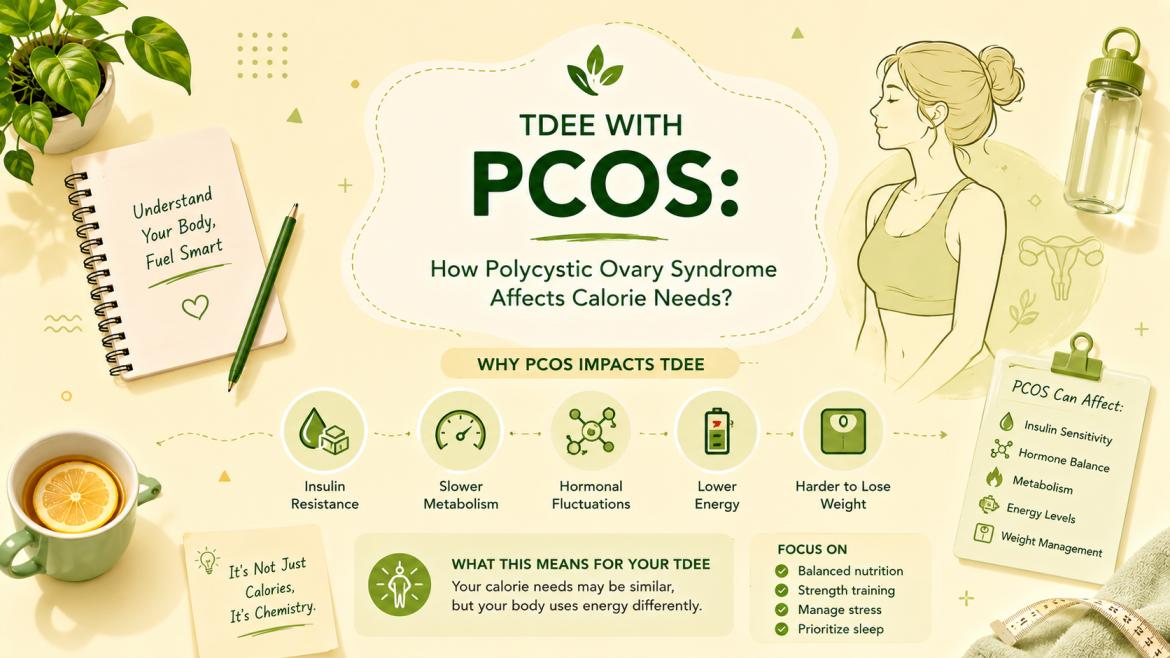
PCOS is the most common endocrine disorder in women of reproductive age, affecting an estimated 8 to 13% depending on population and diagnostic criteria. For many women with the condition, standard calorie formulas overestimate what their body actually needs.
Run the TDEE calculator for PCOS first to get a phenotype-adjusted starting point. Women with confirmed insulin resistance often have a true TDEE 5 to 10% below what an unadjusted formula predicts.
This guide covers what the research shows about PCOS and metabolic rate and why standard calculators miss the mark for this population. It also covers how to build calorie and macro targets that actually reflect it.
What Is PCOS and Why Does It Disrupt Metabolism?
PCOS is a heterogeneous condition with four recognized phenotypes under Rotterdam diagnostic criteria. Two mechanisms drive most of its effect on daily calorie needs: insulin resistance and hyperandrogenism.
How Common Is Insulin Resistance in PCOS?
Insulin resistance prevalence in PCOS ranges from 35 to 80%. Women who have both PCOS and obesity are affected more often than non-obese women with the condition. Roughly 75% of PCOS patients show some degree of insulin resistance, though it is not currently a diagnostic requirement.
Metabolic syndrome appears two to three times more often in women with PCOS than in women without it, at equivalent ages. Central obesity, elevated triglycerides, reduced HDL, and impaired fasting glucose all interact directly with TDEE and how the body partitions incoming energy.
How Does Insulin Resistance Reduce TDEE?
Insulin resistance is the mechanism most responsible for TDEE sitting below standard formula predictions in this population.
What Does This Do to Cellular Energy Use?
When insulin sensitivity is normal, cells efficiently pull glucose from the bloodstream for immediate use. When resistance is present, that transport is impaired, and glucose gets redirected toward fat storage instead, primarily as visceral fat around the abdomen.
Elevated insulin also binds directly to receptors on ovarian theca cells, stimulating testosterone production. It simultaneously reduces liver production of sex hormone-binding globulin, raising circulating free androgens further.
What Is HOMA-IR and Why Does It Matter Here?
HOMA-IR is the clinical measure used to quantify insulin resistance, with a value above 2.5 generally considered indicative of it. This threshold gives a concrete, testable marker rather than relying on symptoms alone.
Insulin resistance measurably slows fat loss progress at an identical calorie deficit, independent of the BMR question. The exact size of that slowdown varies by individual severity, which is why outcome tracking matters as much as the initial calculation.
Does Insulin Resistance Affect Muscle Mass Too?
Insulin resistance is associated with reduced lean muscle mass in PCOS, independent of total body weight. Since muscle burns roughly three times more per kilogram than fat at rest, less lean mass directly lowers BMR.
Protecting that lean mass matters more here than in a population without insulin resistance. A dedicated guide elsewhere on this site covers the specific protein targets and research behind protecting muscle during a PCOS deficit in depth.
How Does Hyperandrogenism Affect Metabolism?
Excess circulating androgens, including testosterone and androstenedione, define PCOS and independently affect metabolism beyond the insulin pathway alone.
Does It Change Where Fat Gets Stored?
Elevated androgens promote central fat deposition specifically. Roughly 30% of lean and 70% of obese PCOS patients show insulin resistance, with abdominal fat accumulation strongly associated with androgen excess in both groups.
This connects directly to a topic worth its own dedicated coverage. The full mechanism behind PCOS-related belly fat, including what current research does and does not confirm, sits in the PCOS belly fat guide.
Does It Affect Muscle-Building Potential?
Androgens have an anabolic effect on muscle in men. In PCOS, elevated androgens coexist with impaired insulin signaling, which undermines the muscle-building pathway androgens would otherwise support elsewhere.
Does It Raise Cortisol?
PCOS is associated with elevated cortisol output, partly driven by chronic hormonal stress from androgen excess and cycle irregularity. Elevated cortisol promotes muscle breakdown and visceral fat storage, compounding the effects already covered above.
How Much Does PCOS Actually Reduce BMR?
The research here shows real variability, and the honest picture requires looking at more than one study.
What Did the Most-Cited Direct Measurement Find?
A 2009 study in Fertility and Sterility measured BMR by indirect calorimetry in 91 women with PCOS and 48 matched controls. The differences found held after adjusting for age and BMI.
Group | Adjusted BMR |
|---|---|
Controls (No PCOS) | 1,868 kcal/day |
All PCOS Women | 1,445 kcal/day |
PCOS Without Insulin Resistance | 1,590 kcal/day |
PCOS With Insulin Resistance | 1,116 kcal/day |
Are These Findings Contested?
Later methodological reviews have questioned this widely cited study's large reported reductions. Confounding factors, including measurement conditions and participant selection, may not be fully accounted for.
A single heavily-cited study can shape perception more than the full evidence base actually supports. This is worth naming honestly rather than treating one dataset as the final word on PCOS metabolism.
What Does Doubly-Labeled Water Data Show?
A separate study used doubly-labeled water, the gold-standard method for measuring real-world total energy expenditure. It found TDEE of 2,661 ± 373 kcal/day in weight-stable PCOS women. Standard formulas performed within 4 to 6% of that measured figure.
This suggests standard formulas may be more accurate for total expenditure than the BMR-specific data implies. The conservative, honest interpretation: insulin resistance reliably predicts harder fat loss at a given deficit, but the exact magnitude of BMR reduction varies by severity, body composition, and phenotype.
Is There a PCOS-Specific TDEE Equation?
For women who have body composition data available, a research-derived equation offers a more direct estimate than weight-based formulas alone.
TDEE (kcal/day) = 438 − (1.6 × Fat Mass in kg) + (35.1 × Fat-Free Mass in kg) + (16.2 × Age in years)
This equation uses fat mass and fat-free mass directly, bypassing the total-weight inputs that inflate estimates for women with a higher fat-to-lean ratio. A DEXA scan or validated bioelectrical impedance reading is needed to apply it.
Without body composition data, the standard Mifflin-St Jeor equation remains the best general estimate. Selecting one activity tier below perceived effort, then verifying through 4-week outcome tracking, closes most of the remaining gap.
Why Do Standard Calculators Overestimate for PCOS?
Three specific mechanisms explain why a formula calibrated on general population data misses the mark here.
Does Body Composition Divergence Matter?
A woman with PCOS at a given body weight may carry a higher fat-to-lean ratio than the average woman assumed in population-derived formulas. Since fat burns far fewer calories per kilogram than muscle, her real BMR sits below the prediction even at identical total weight.
Does Activity Level Get Overestimated Too?
Fatigue from disrupted sleep, low mood from hormonal dysregulation, and reduced motivation for movement all commonly affect women with PCOS. These factors quietly lower incidental daily movement without ever showing up in an activity multiplier selection.
Selecting "moderately active" when true daily movement sits closer to "lightly active" creates a 200 to 250 calorie overestimate at average female BMR. This single miscalibration explains a meaningful share of stalled results on paper-correct plans.
Do Irregular Cycles Affect the Average Too?
Regular cycles produce a documented 100 to 300 calorie luteal-phase TDEE elevation, driven by a post-ovulation progesterone surge. Anovulatory cycles, common in PCOS, miss this elevation entirely, lowering the average monthly calorie burn below what a formula calibrated on typical cycling women predicts.
What Are Realistic Calorie Targets for PCOS?
Combining body composition data where available, conservative activity selection, and outcome tracking produces a more realistic target than formula output alone.
Activity Level | Without Insulin Resistance | With Insulin Resistance |
|---|---|---|
Sedentary | 1,500–1,650 kcal | 1,350–1,500 kcal |
Lightly Active | 1,700–1,900 kcal | 1,550–1,750 kcal |
Moderately Active | 1,850–2,100 kcal | 1,700–1,950 kcal |
Very Active | 2,050–2,300 kcal | 1,900–2,150 kcal |
These ranges are estimates, not fixed prescriptions. Individual needs still vary by age, height, body composition, and specific phenotype beyond insulin resistance status alone.
A minimum of 1,200 calories daily is a widely used floor for women with PCOS. Dropping below it for extended periods risks further slowing metabolic rate and worsening the cortisol elevation already common in this population. Sizing the deficit itself correctly matters just as much as the starting calorie target.
What Should Your Macros Look Like With PCOS?
Macronutrient composition affects insulin response, androgen levels, and hormonal function directly in this population, more than it does in most other metabolic contexts.
What About Carbohydrates and Glycemic Index?
High-glycemic carbohydrates produce larger post-meal glucose spikes and stronger compensatory insulin surges in women with insulin resistance. A low-glycemic dietary pattern has been shown to improve insulin sensitivity independent of weight change. A broader systematic review confirmed improvements in both metabolic and reproductive markers.
Total carbohydrate: roughly 35 to 45% of total calories
Prioritize low-glycemic sources: legumes, non-starchy vegetables, whole grains, berries
Reduce refined carbohydrates and added sugars
Distribute carbohydrate intake evenly across meals rather than in large single servings
What About Protein Targets?
Higher protein intake supports lean mass preservation, satiety, and favorable insulin secretion patterns during any calorie approach in this population.
Research specific to PCOS supports pushing toward 1.8 to 2.0 grams per kilogram of body weight, higher than general population guidance. The full research behind this target, including a trial where protein alone roughly tripled fat loss at an identical deficit, sits in the protein for PCOS guide.
What About Fat Targets?
Dietary fat around 30 to 40% of total calories supports hormone production and fat-soluble vitamin absorption. Omega-3s from fatty fish, walnuts, and flaxseed carry anti-inflammatory properties that partially counter the low-grade inflammation common in PCOS.
Should You Consider Insulin-Sensitizing Strategies Beyond Diet?
Diet and exercise are not the only levers available for improving the insulin resistance driving much of this metabolic picture.
Metformin remains the most commonly prescribed insulin-sensitizing medication for PCOS. A supplement with a substantial research base targets the same pathway through a different route.
The inositol and PCOS guide covers dosing and the metformin comparison.
Does Intermittent Fasting Fit Into a PCOS Plan?
Meal timing is a separate lever from macro composition, and PCOS-specific research on fasting has grown substantially in recent years.
A 2025 meta-analysis of 632 women with PCOS found measurable improvements in insulin sensitivity and testosterone with fasting protocols. The full protocol comparison and what the strongest evidence actually supports is covered in the intermittent fasting and PCOS guide.
What Do You Do If Weight Loss Stalls?
A stalled result on a correctly calculated plan is common enough in this population to deserve its own diagnostic process. An automatic calorie cut is rarely the right first response.
Water retention, under-logging, and low protein intake explain most stalls that look real but are not. The full step-by-step process for telling a genuine plateau from normal noise sits in the PCOS weight loss plateau guide.
How Does PCOS Interact With Other Life Stages?
PCOS does not exist in isolation from the broader hormonal changes women experience across their reproductive years.
What Happens With Irregular Cycles?
Anovulatory cycles remove the predictable luteal-phase calorie elevation covered earlier, making monthly average TDEE both lower and less predictable than in women with regular ovulation.
Does PCOS Change the Perimenopause and Menopause Transition?
Women with a PCOS history face an elevated risk of metabolic syndrome specifically when perimenopause begins, compounding an already-present metabolic baseline. The general hormonal mechanisms driving TDEE changes at this life stage still apply on top of that existing PCOS baseline.
What About Pregnancy and Breastfeeding?
Standard trimester-specific calorie additions still apply for women with PCOS who become pregnant, though pre-existing insulin resistance raises gestational diabetes risk further. Breastfeeding improves insulin sensitivity in most women generally, a benefit that still applies during lactation for women with PCOS.
How Do You Calculate a More Accurate TDEE With PCOS?
A four-step process produces a more reliable estimate than applying a standard calculator output directly.
Calculate a standard TDEE ceiling using the BMR calculator, selecting one activity tier below perceived effort
Apply a phenotype adjustment: reduce the estimate by 5 to 8% with confirmed insulin resistance (HOMA-IR above 2.5, or fasting insulin above 15 µIU/mL)
Eat at that adjusted number for a full 4 weeks, tracking a rolling weight average rather than single-day readings
Reassess every 8 to 12 weeks, since insulin sensitivity improvements from lifestyle change or medication raise real TDEE back toward the standard estimate over time
Frequently Asked Questions About TDEE and PCOS
Why Do I Gain Weight Even at a Calculated Deficit?
Three explanations cover most cases. Standard calculators often overestimate needs for this population, and insulin resistance redirects more carbohydrate toward storage. Water retention from hormonal fluctuation can also mask real fat loss for weeks.
Does PCOS Cause Permanent Metabolic Damage?
No. Insulin resistance in PCOS is a functional state, not permanent structural damage. Resistance training, low-glycemic eating patterns, moderate weight loss, and medical management all measurably improve insulin sensitivity over time.
Do Lean Women With PCOS Have the Same TDEE Reduction as Women With Obesity?
No. Classic research found lean women with PCOS often show insulin and metabolic markers similar to matched controls without the condition. Insulin resistance appears far more often in women with both PCOS and obesity.
Does Metformin Change TDEE in PCOS?
Metformin improves cellular glucose uptake and reduces compensatory insulin output. As insulin sensitivity improves over weeks to months, effective TDEE can rise modestly, sometimes requiring an upward adjustment to the calorie target.
For the complete picture of how TDEE itself is calculated before any PCOS-specific adjustment, see the full TDEE overview. All nutrition and medical decisions for PCOS should involve a qualified healthcare provider, since presentation varies significantly across phenotypes and individuals.