
How Women Menstrual Cycle Affects Their TDEE? Calorie Fluctuation Across Phases
Learn how each phase of the menstrual cycle changes a woman's TDEE. Covers resting metabolic rate shifts, progesterone thermogenesis, calorie needs by phase, food cravings, and weight fluctuation explained with research.

Your body has a number. Let's find it.
We calculate the exact calorie target your body needs, built from your stats and goal, then track everything against it daily. Log meals, add workouts, set a weight goal, and watch your numbers update in real time. Check in weekly to see calories, water, and weight trend in one place.
No spreadsheets. No guessing. Just results.
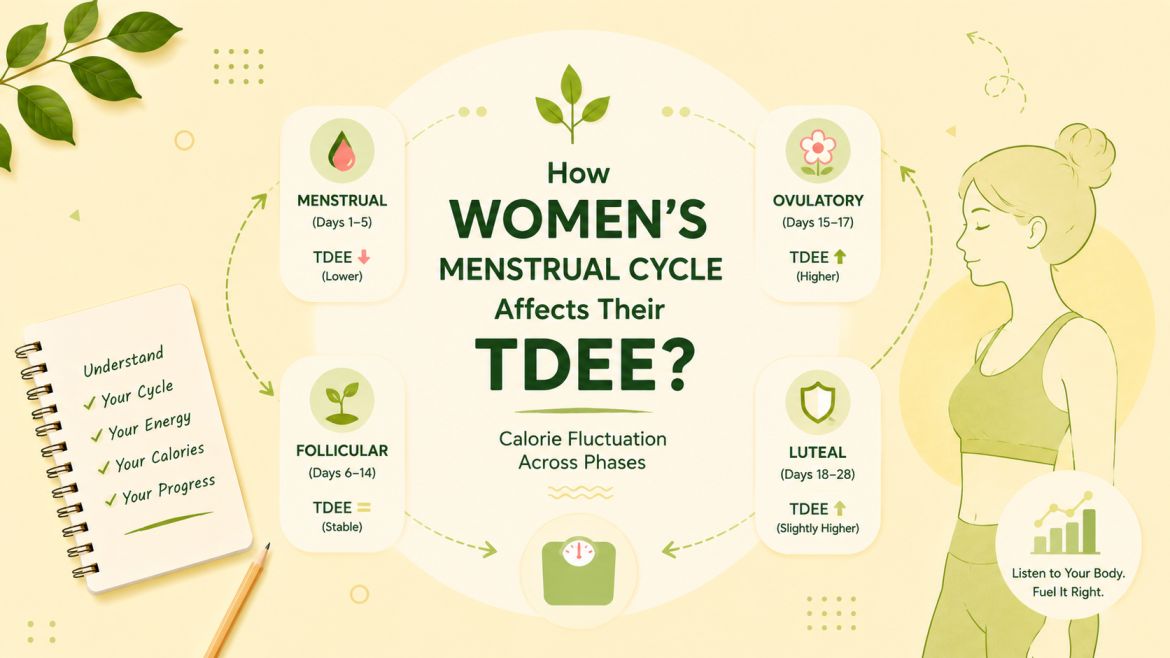
The menstrual cycle directly alters a woman's Total Daily Energy Expenditure (TDEE) across its four distinct hormonal phases. Resting metabolic rate, calorie burn, appetite, substrate utilization, and scale weight all shift in measurable and predictable patterns throughout the 28-day cycle.
A meta-analysis published in PLOS ONE (2020), covering 26 studies involving 318 women, found a small but statistically significant effect favoring increased resting metabolic rate during the luteal phase compared to the follicular phase (effect size = 0.33; 95% CI = 0.17, 0.49; p < 0.001). Studies using whole-room calorimetry have documented total energy expenditure varying by 5.6 to 7.5% between cycle phases in the same woman.
For most pre-menopausal women, these shifts translate to a real-world calorie fluctuation of 100 to 300 calories per day across the cycle. Standard TDEE calculators produce a single fixed number that represents a monthly average. Understanding how the cycle moves that number up and down by phase gives women far more accurate targets for nutrition and training.
Use the TDEE Calculator for Women to establish your baseline monthly average, then apply the phase-specific adjustments in this guide.
The Four Phases of the Menstrual Cycle
The menstrual cycle is a 28-day hormonal program coordinated by the hypothalamic-pituitary-ovarian (HPO) axis. The cycle divides into four phases, each defined by the dominant hormones active during that window.
Phase | Days (Typical) | Dominant Hormones | Key Metabolic Effect |
|---|---|---|---|
Menstrual Phase | Days 1–5 | Estrogen and progesterone both low | TDEE near monthly baseline; prostaglandin activity high |
Follicular Phase | Days 6–14 | Rising estradiol (estrogen) | Lowest TDEE of the cycle; insulin sensitivity peaks |
Ovulatory Phase | Day 14 (approx.) | Estrogen peak, LH surge | Brief TDEE elevation; energy often highest subjectively |
Luteal Phase | Days 15–28 | Progesterone dominant; estrogen secondary | TDEE 100–300 kcal above follicular baseline |
The average cycle ranges from 23 to 32 days. The follicular phase length is variable (can last 10 to 20 days), while the luteal phase has a more consistent duration of 9 to 17 days. Cycle length differences are almost entirely due to follicular phase variation. The luteal phase length stays relatively fixed across individual women.
Phase 1. The Menstrual Phase (Days 1–5) and TDEE
The menstrual phase begins on day 1 of bleeding, when both estrogen and progesterone have dropped to their monthly lows. This hormonal withdrawal triggers the shedding of the uterine lining (endometrium) through the action of prostaglandins, which are lipid signaling molecules that cause uterine contractions.
TDEE During Menstruation
Resting metabolic rate during the menstrual phase sits close to or slightly below the monthly baseline TDEE. The progesterone-driven thermogenic elevation from the preceding luteal phase has ended, so core body temperature returns to its lower follicular-phase set point.
Calorie burn from structured exercise can appear reduced during this phase for several reasons:
Prostaglandin-driven inflammation increases perceived exertion without increasing actual oxygen consumption
Iron loss from menstrual blood can reduce hemoglobin levels, reducing oxygen-carrying capacity in women with heavier cycles
Fatigue and disrupted sleep during menstruation reduce non-exercise activity thermogenesis (NEAT), the calorie burn from incidental daily movement
The net effect on TDEE during menstruation is approximately zero to minus 50 calories per day versus the monthly average, primarily through reduced NEAT rather than lower resting metabolic rate.
Food Cravings During Menstruation
Appetite during the early menstrual phase is driven by the final days of luteal-phase progesterone withdrawal. Cravings for carbohydrate-rich and fat-rich foods, particularly chocolate, sweets, and salty snacks, are highest in the late luteal and early menstrual phase. A 2016 randomized controlled trial published in the American Journal of Clinical Nutrition found that energy intake can increase by up to 165 kcal per day above the follicular-phase baseline during this window.
Iron-rich foods during menstruation serve a functional purpose. Blood loss removes iron, and replacing it through dietary sources such as red meat, leafy greens, and legumes reduces fatigue during this phase.
Phase 2. The Follicular Phase (Days 6–14) and TDEE
The follicular phase begins when the pituitary gland releases follicle-stimulating hormone (FSH), triggering follicular development in the ovaries. As follicles grow, they produce increasing amounts of estradiol (the primary form of estrogen). Estradiol levels rise gradually from days 6 through 14, peaking just before ovulation.
TDEE During the Follicular Phase
The follicular phase is the period of lowest resting metabolic rate within the monthly cycle. Research from the University of North Carolina published in the International Journal of Environmental Research and Public Health (2021) confirmed that hormonal changes across menstrual cycle phases affect energy substrate metabolism in exercising women, with the follicular phase showing greater carbohydrate oxidation and lower fat oxidation compared to the luteal phase.
Estradiol has 3 key metabolic effects during this phase:
Estradiol acts to decrease food intake by increasing the satiety hormone cholecystokinin (CCK) and suppressing the appetite-stimulating hormone ghrelin
Estradiol raises insulin sensitivity, improving glucose uptake into muscle cells and supporting carbohydrate utilization during exercise
Estradiol promotes anabolic (tissue-building) signaling, making this the phase with the greatest muscle protein synthesis response to resistance training
The net metabolic picture in the follicular phase: lower calorie burn at rest, higher insulin sensitivity, reduced appetite, and the highest capacity for strength adaptation.
Calorie Target During the Follicular Phase
Women whose goal is fat loss find the follicular phase most favorable for maintaining or slightly deepening a calorie deficit. Appetite suppression from rising estradiol makes eating at a deficit feel less effortful than during the luteal phase. A practical adjustment of minus 10% from calculated TDEE during the follicular phase aligns with the physiological calorie reduction during this window.
Phase 3. The Ovulatory Phase (Around Day 14) and TDEE
Ovulation occurs when a surge in luteinizing hormone (LH) triggers the release of a mature egg from the dominant follicle. Estradiol reaches its cycle peak in the late follicular phase just before ovulation, then declines sharply after the LH surge.
TDEE During Ovulation
The brief ovulatory window, typically spanning 2 to 3 days, represents a brief TDEE elevation driven by peak estradiol. Body temperature begins its post-ovulatory rise at this point, marking the transition from the follicular metabolic state to the luteal metabolic state.
Women commonly report feeling highest energy, best mood, and greatest exercise tolerance during the late follicular and ovulatory phase. Research published in the Journal of Applied Physiology (University of Oregon, 2026) found that hormonal fluctuations across the cycle do not change a woman's maximal exercise capacity, but they do alter how difficult that work feels. The ovulatory phase is the point where exercise feels easiest relative to actual output.
The ovulatory phase is short enough that a separate calorie adjustment is not typically needed. Transitioning from follicular-phase calorie targets to luteal-phase targets at approximately day 14 captures this phase within the luteal adjustment window.
Phase 4. The Luteal Phase (Days 15–28) and TDEE
The luteal phase begins immediately after ovulation. The ruptured follicle transforms into the corpus luteum, which produces large amounts of progesterone. Estradiol also remains elevated through mid-luteal phase before both hormones decline in the late luteal phase if fertilization does not occur.
The luteal phase is the primary driver of monthly TDEE fluctuation in pre-menopausal women.
How Progesterone Raises TDEE in the Luteal Phase?
Progesterone is a thermogenic hormone. It raises core body temperature by approximately 0.3 to 0.5 degrees Celsius post-ovulation. Research published in the journal Physiology (2020) measuring sleeping energy expenditure via metabolic chamber in 9 women found a significant increase in average core body temperature (+0.27°C) and energy expenditure (+6.9%) during the luteal phase compared to the follicular phase.
The mechanisms behind the luteal TDEE increase are:
Core temperature elevation increases the energy cost of all metabolic reactions (Q10 effect: biological reaction rates increase approximately 7–12% per 1°C temperature rise)
Progesterone shifts substrate metabolism toward fat oxidation and away from glycogen use at rest
Progesterone increases ventilatory drive, raising the rate of breathing and its associated energy cost
The combined estrogen-progesterone peak at mid-luteal phase produces the highest whole-body energy expenditure of the cycle
How Many Calories Does the Luteal Phase Add?
Multiple studies have measured the calorie difference between the luteal and follicular phases. The ranges documented in the research are:
Source | Reported Luteal Phase Calorie Increase |
|---|---|
Bisdee et al. (early calorimetry studies) | 8–16% higher TDEE than follicular phase |
Cambridge calorimetry study (whole-room) | 5.6–7.5% variation in total energy expenditure |
Meta-analysis (PLOS ONE, 2020; 26 studies, 318 women) | Small but significant RMR increase (ES = 0.33) |
Practical applied estimates (clinical range) | 100–300 kcal/day above follicular baseline |
The London Obesity Clinic (applied estimate) | 100–300 kcal/day increase in metabolic rate |
The 100–300 calorie per day range is the most consistently applicable figure across the research literature. For a woman with a monthly average TDEE of 2,000 calories, this means her luteal phase TDEE runs approximately 2,100 to 2,300 calories per day, while her follicular phase TDEE runs approximately 1,900 to 2,000 calories per day.
Appetite and Cravings in the Luteal Phase
Appetite is measurably higher during the luteal phase. Progesterone stimulates appetite by opposing the appetite-suppressing effect of estradiol. Serotonin levels also drop in the late luteal phase, driving cravings for carbohydrate-rich foods as a compensatory mechanism for serotonin production.
A study published in ScienceDirect (2016) found that in the luteal phase, ad libitum energy intake was up to 165 kcal higher per day than in the follicular phase, with the highest preference for sweet and fatty foods during this window. Calorie intake can increase by 12–38% from the follicular to the luteal phase when intake is unregulated.
The biological logic is consistent: higher calorie expenditure from progesterone thermogenesis drives a proportional increase in appetite. The hunger signal during the luteal phase is a real metabolic signal, not a discipline failure.
TDEE and the Full 28-Day Cycle: A Phase-by-Phase Reference
The following table provides practical TDEE adjustments for each phase for a woman with a monthly average TDEE of 2,000 calories. Adjust proportionally for your personal calculated baseline.
Cycle Phase | Days | TDEE Adjustment | Practical Calorie Target (2,000 kcal baseline) |
|---|---|---|---|
Menstrual Phase | 1–5 | 0 to −50 kcal/day | 1,950–2,000 kcal/day |
Follicular Phase | 6–14 | 0 to −100 kcal/day (lowest) | 1,900–2,000 kcal/day |
Ovulatory Phase | ~14 | +50 to +100 kcal/day | 2,050–2,100 kcal/day |
Luteal Phase | 15–28 | +100 to +300 kcal/day | 2,100–2,300 kcal/day |
These are not separate diet plans. They are adjustments to a single monthly baseline TDEE. The standard TDEE Calculator produces the monthly average; the adjustments in the table above represent how the daily number moves around that average across the cycle.
Why Scale Weight Fluctuates Across the Menstrual Cycle?
Scale weight changes throughout the menstrual cycle are not the same as fat mass changes. Understanding the source of each change prevents misinterpreting normal hormonal fluctuation as a failure of a nutrition plan.
The 4 Sources of Menstrual Cycle Weight Fluctuation
1. Water Retention from Estrogen: Estradiol rises during the late follicular phase and increases extracellular fluid, the water held outside cells, in tissues and blood volume. This can add 1 to 3 pounds of scale weight before ovulation.
2. Water Retention from Progesterone: Progesterone peaks in the mid-luteal phase and promotes sodium retention through its interaction with aldosterone receptors. Research published in Samphire Neuroscience (2026) confirmed that water retention affects 92% of people who menstruate during the luteal phase. Rising progesterone causes the body to store more water and glycogen, both of which add scale weight.
3. Glycogen Storage: Reduced insulin sensitivity during the luteal phase causes muscles to store higher glycogen concentrations. Each gram of glycogen is stored with approximately 3 grams of water. Higher glycogen storage adds 1 to 2 pounds of scale weight without changing fat mass.
4. Digestive Transit Slowing: Progesterone slows gastrointestinal motility. Food moves through the digestive tract more slowly during the luteal phase, meaning more food content is present in the gut at any given time. This adds transient scale weight that reverses once the menstrual phase begins and progesterone drops.
Average Scale Weight Fluctuation Across the Cycle
Research shows that gaining approximately 1 pound (0.5 kg) during the week before menstruation is common. The full range documented across studies is 1 to 5 pounds (0.5 to 2.3 kg), with the most common fluctuation being 1 to 3 pounds. This weight disappears within 2 to 4 days after menstruation begins.
Tracking body weight as a 4-week rolling average rather than daily readings removes cycle phase noise from weight trend data. A woman eating and training consistently may see daily scale readings that rise by 3 pounds pre-period and fall by 3 pounds post-period, while her 4-week average remains perfectly flat. Both outcomes indicate successful maintenance.
How the Menstrual Cycle Affects Exercise Performance and Calorie Burn from Training?
The menstrual cycle alters not just resting calorie burn but also the efficiency and output of exercise. The phase-specific effects on exercise are well-documented.
Follicular Phase: Highest Exercise Performance
The follicular and ovulatory phases represent peak exercise performance windows for most women. Estradiol has several anabolic and performance-supporting properties:
Estradiol promotes glycogen storage in muscle, supporting high-intensity performance
Estradiol reduces exercise-induced muscle damage and inflammation
Estradiol supports anabolic signaling, making follicular phase resistance training the most productive for muscle adaptation
Heat tolerance is higher because core body temperature is at its monthly low
Research from the University of Southern Denmark showed that women who timed the highest-volume strength training to the follicular phase gained more strength over a 16-week period than women who trained with equal volume but without cycle-based periodization.
Luteal Phase: Altered Substrate Use and Perceived Exertion
The luteal phase shifts substrate metabolism toward fat oxidation and away from glycogen. A study published in the European Journal of Applied Physiology found that at submaximal exercise intensities, women in the luteal phase showed greater dependence on fat as an energy source compared to the follicular phase, with no change in maximal exercise capacity (VO2peak).
The practical implications:
High-intensity interval training (HIIT) and heavy compound lifting feel harder in the luteal phase due to progesterone raising core temperature and ventilatory drive
Lower-intensity, longer-duration aerobic training is metabolically favorable in the luteal phase because fat oxidation is elevated
Perceived exertion runs higher than actual physiological output, meaning women may unconsciously reduce training volume without an objective external marker
Progesterone also promotes protein breakdown in the luteal phase. Maintaining protein intake at 1.6 to 2.2 grams per kilogram of body weight per day counteracts this catabolic pressure during the second half of the cycle.
How the Menstrual Cycle Affects Macronutrient Needs?
The shift in energy substrate metabolism across cycle phases creates phase-specific macronutrient requirements alongside the overall calorie adjustments.
Follicular Phase Macronutrient Profile
During the follicular phase, carbohydrate metabolism is prioritized. Insulin sensitivity is highest, meaning carbohydrates are efficiently directed to muscle glycogen rather than fat storage. A carbohydrate-forward diet during this phase supports both exercise performance and body composition.
Recommended macronutrient distribution during the follicular phase:
Protein: 1.6–2.0 g/kg/day
Carbohydrates: 45–55% of total calories
Fat: 25–35% of total calories
Luteal Phase Macronutrient Profile
During the luteal phase, fat oxidation is elevated at rest and during exercise. Insulin sensitivity declines, meaning carbohydrates are directed toward storage more readily than in the follicular phase. Protein breakdown also increases under progesterone's influence.
Recommended macronutrient distribution during the luteal phase:
Protein: 1.8–2.2 g/kg/day (elevated to counteract progesterone-driven protein catabolism)
Carbohydrates: 35–45% of total calories (moderately reduced to match reduced insulin sensitivity)
Fat: 30–40% of total calories (elevated to match the higher fat oxidation rate)
A randomized controlled trial published in the American Journal of Clinical Nutrition (2016) tested a diet program called Menstralean that allowed an additional 200 calories per day as dark chocolate during the luteal phase, alongside an increased fat content. The program produced significantly greater weight loss over 6 months compared to a standard repeating-weekly diet, confirming that phase-matched calorie and macronutrient adjustment outperforms one-size-fits-all calorie targets.
Cycle Syncing for Calorie and Nutrition Targets
Cycle syncing refers to adjusting calorie intake, macronutrient distribution, and training volume to align with each phase of the menstrual cycle. The scientific basis for cycle syncing is the documented phase-specific variation in TDEE, insulin sensitivity, substrate metabolism, and appetite.
The following framework applies cycle syncing principles to calorie targeting. All calorie targets are expressed as a percentage of monthly average TDEE to make them applicable to any individual baseline.
Follicular Phase Strategy (Days 6–14)
Calorie target: TDEE minus 5–10% for fat loss goals; TDEE for maintenance; TDEE plus 5% for muscle gain
Training focus: Prioritize high-intensity exercise, progressive overload resistance training, and skill-based activities
Nutrition focus: Carbohydrate-forward fueling to support high-intensity work; lighter meals align naturally with reduced appetite
Luteal Phase Strategy (Days 15–28)
Calorie target: TDEE for fat loss goals (do not apply a deficit during the luteal phase because the baseline TDEE is already elevated); TDEE plus 10% for maintenance; TDEE plus 15% for muscle gain
Training focus: Moderate-intensity training, aerobic cardio, yoga, and walking-based NEAT; reduce peak intensity training in the late luteal phase
Nutrition focus: Higher protein intake to counteract progesterone-driven catabolism; complex carbohydrates to manage serotonin-related cravings; magnesium-rich foods (dark leafy greens, legumes, nuts) to reduce PMS symptoms
Menstrual Phase Strategy (Days 1–5)
Calorie target: TDEE for all goals; this is a recovery and reset phase
Training focus: Low-intensity movement; walking, stretching, gentle yoga
Nutrition focus: Iron-rich foods to replace menstrual blood loss; anti-inflammatory foods to manage prostaglandin activity
How Contraceptive Hormones Alter Cycle-Based TDEE Patterns?
Hormonal contraceptives, including oral contraceptive pills (OCPs), hormonal intrauterine devices (IUDs), implants, and patches, suppress the natural hormonal fluctuations of the menstrual cycle. The metabolic effects of hormonal contraceptives on TDEE differ from those of natural cycles.
Key Contraceptive Effects on Metabolism
Combined oral contraceptive pills containing synthetic estrogen and progestin suppress ovulation and flatten the natural estradiol and progesterone peaks. The phase-specific TDEE variations described in this guide apply primarily to women with natural, unmedicated cycles (eumenorrheic women).
Women on combined OCPs typically experience:
Reduced luteal-phase TDEE elevation because the progesterone peak is suppressed or blunted
Lower amplitude of appetite fluctuation across the cycle
Smaller scale weight fluctuations because water retention patterns differ with synthetic progestin versus endogenous progesterone
Reduced insulin sensitivity at baseline in some studies, though this varies by formulation
Progestin-only contraceptives and hormonal IUDs produce variable effects depending on the degree of ovulation suppression. Some women on progestin-only methods retain partial natural cycle patterns; others have full cycle suppression.
Women on hormonal contraceptives should use their standard TDEE as a fixed monthly target rather than applying phase-specific adjustments, because the hormonal framework that drives those adjustments is partially or fully suppressed.
How the Menstrual Cycle Interacts with Other Female TDEE Factors?
The menstrual cycle is one of several female-specific factors that modify TDEE beyond standard calculator estimates. Understanding how cycle-based variation interacts with other life stage factors gives a more complete picture.
Menstrual Cycle and PCOS
Women with polycystic ovary syndrome (PCOS) often have irregular or absent cycles. Anovulatory cycles (cycles without ovulation) do not produce the luteal-phase progesterone surge that drives TDEE elevation. For women with PCOS and irregular cycles, the predictable phase-based TDEE adjustments described here do not apply in the same way. Individualized tracking of appetite, energy, and weight trends over 4 to 8 weeks provides more reliable data. The TDEE for women with PCOS guide covers PCOS-specific metabolic adjustments.
Menstrual Cycle and Perimenopause
As women approach perimenopause, cycle regularity decreases and the hormonal amplitude of each phase becomes less predictable. Estradiol output from the ovaries declines and progesterone production becomes inconsistent. The result is that the clean 100–300 calorie luteal-phase increase that characterizes regular cycles becomes erratic and eventually absent. See the TDEE for women in perimenopause article for how the transition alters these patterns.
Menstrual Cycle and Pregnancy
Pregnancy produces the largest TDEE increase of any female life stage, adding 340 calories per day in the second trimester and 450 calories per day in the third trimester. The menstrual cycle stops during pregnancy. The TDEE for pregnant women guide covers trimester-specific calorie requirements in full.
Menstrual Cycle and Breastfeeding
Breastfeeding adds 340 to 500 additional calories per day above pre-pregnancy intake. Ovulatory cycles typically do not resume until breastfeeding frequency reduces. The TDEE for breastfeeding women guide covers lactation-specific calorie needs and the point at which the cycle typically resumes.
Menstrual Cycle TDEE and Weight Loss: What the Research Shows?
The question of whether women can lose fat consistently across all cycle phases has a research-based answer: yes, but the efficiency and subjective experience of fat loss differ across phases.
A 6-month randomized controlled trial published in the American Journal of Clinical Nutrition (2016) found that a weight-loss program adapted to the menstrual cycle increased total weight loss compared to a standard repeating-weekly program. Women following the cycle-adapted program lost significantly more weight over 6 months than the control group, despite consuming more calories in the luteal phase.
The mechanism: accepting the luteal-phase calorie increase as a legitimate metabolic need, rather than fighting it, produces better long-term adherence and prevents the overeating rebound that follows extreme luteal-phase restriction.
For women whose goal is fat loss, the practical application is:
Apply a moderate deficit (250–300 kcal below TDEE) during the follicular phase when appetite suppression makes the deficit easy to maintain
Eat at or near TDEE during the luteal phase, allowing appetite to be met without aggressive restriction
Track 4-week average weight, not daily weight, to remove cycle-phase noise from trend data
Expect and accept the 1–3 pound pre-period scale increase as water retention, not fat gain
The full reference ranges for daily calorie targets by goal, activity level, and age are covered in the women's daily calorie needs guide.
How the Menstrual Cycle Compares to Other TDEE Variables?
Placing cycle-phase TDEE variation in context helps calibrate how much attention it deserves relative to other factors.
Variable | Daily TDEE Impact |
|---|---|
Menstrual cycle phase (luteal vs follicular) | +100 to +300 kcal/day |
Activity level (sedentary vs moderately active) | +300 to +500 kcal/day |
Muscle mass gain (2 kg lean mass added) | +26 kcal/day at rest |
Menopause transition | −100 to −300 kcal/day |
PCOS with insulin resistance | −5 to −8% of total TDEE |
Age decade decline (20s vs 50s) | −200 to −400 kcal/day |
Cycle-phase variation produces a meaningful daily calorie shift, second only to activity level in terms of practical impact on day-to-day calorie needs. It is larger than the metabolic effect of adding 2 kilograms of muscle, and comparable in magnitude to the menopause-related metabolic decline.
For a comparison of how female and male TDEE differ structurally across all variables, see the TDEE Women vs. Men comparison article.
Common Questions About the Menstrual Cycle and TDEE
Does the menstrual cycle actually raise BMR?
Yes, the meta-analysis in PLOS ONE (2020) covering 26 studies and 318 women found a statistically significant small increase in resting metabolic rate during the luteal phase compared to the follicular phase. A 2020 study published in Physiological Reports using a metabolic chamber found a 6.9% increase in sleeping energy expenditure in the luteal phase. The effect is real but small enough that individual variation is high.
Why am I so hungry before my period?
Progesterone dominance in the luteal phase suppresses estradiol's appetite-inhibiting effect. Serotonin levels also decline in the late luteal phase, driving cravings for carbohydrate-rich foods as a compensatory mechanism. The calorie need is genuinely higher during this phase, making the hunger signal physiologically accurate rather than arbitrary.
Does calorie tracking become inaccurate during the menstrual cycle?
Standard TDEE calculators produce a fixed monthly average. That fixed number underestimates actual calorie needs by 100–300 per day during the luteal phase and overestimates needs by a similar margin during the follicular phase. Using the monthly TDEE average as a baseline and applying phase-specific adjustments produces more accurate day-to-day targets.
Does the menstrual cycle affect how many calories are burned during exercise?
Research from the University of Oregon (2026) published in the Journal of Applied Physiology found that maximal exercise capacity (VO2max) does not change across cycle phases. What changes is the perceived effort at the same absolute workload. This means that the actual calories burned during a given workout remain approximately constant, but the subjective difficulty varies, with the luteal phase feeling harder at the same output.
Why does weight go up before a period even when eating the same?
The pre-period weight increase is water retention from progesterone's sodium-retaining effect, glycogen storage driven by reduced insulin sensitivity, and slowed gastrointestinal transit from progesterone's effect on gut motility. Research confirms this temporary weight gain affects 92% of menstruating women. The weight returns to baseline within 2 to 4 days after menstruation begins.
Key Takeaways: Menstrual Cycle and TDEE
The menstrual cycle creates documented, predictable calorie fluctuations across its four phases.
TDEE is lowest during the follicular phase (days 6–14) and highest during the luteal phase (days 15–28)
The luteal phase adds approximately 100–300 calories per day above the follicular phase baseline
Progesterone drives the luteal TDEE elevation through core temperature increase and raised energy expenditure (+6.9% sleeping energy expenditure in controlled calorimetry studies)
Scale weight fluctuates by 1–5 pounds across the cycle from water retention and glycogen storage, not fat mass changes
Women on hormonal contraceptives with suppressed ovulation do not experience the same phase-specific TDEE variations
Cycle-adapted calorie strategies that accept the luteal-phase calorie increase produce better fat loss outcomes over 6 months than fixed weekly targets
For the monthly average TDEE baseline to which these phase adjustments apply, the BMR Calculator at TDEECalculatorKit.com provides the resting metabolic rate foundation. The complete explanation of how TDEE is structured and what drives each of its components is covered in the TDEE overview guide.