
Moderately Active Multiplier (1.55) | TDEE for Regular Exercise 3–5 Days a Week
The moderately active multiplier is 1.55. Find out who qualifies, how it's applied in TDEE calculations, and how it compares to lightly active and very active levels.

Your body has a number. Let's find it.
We calculate the exact calorie target your body needs, built from your stats and goal, then track everything against it daily. Log meals, add workouts, set a weight goal, and watch your numbers update in real time. Check in weekly to see calories, water, and weight trend in one place.
No spreadsheets. No guessing. Just results.
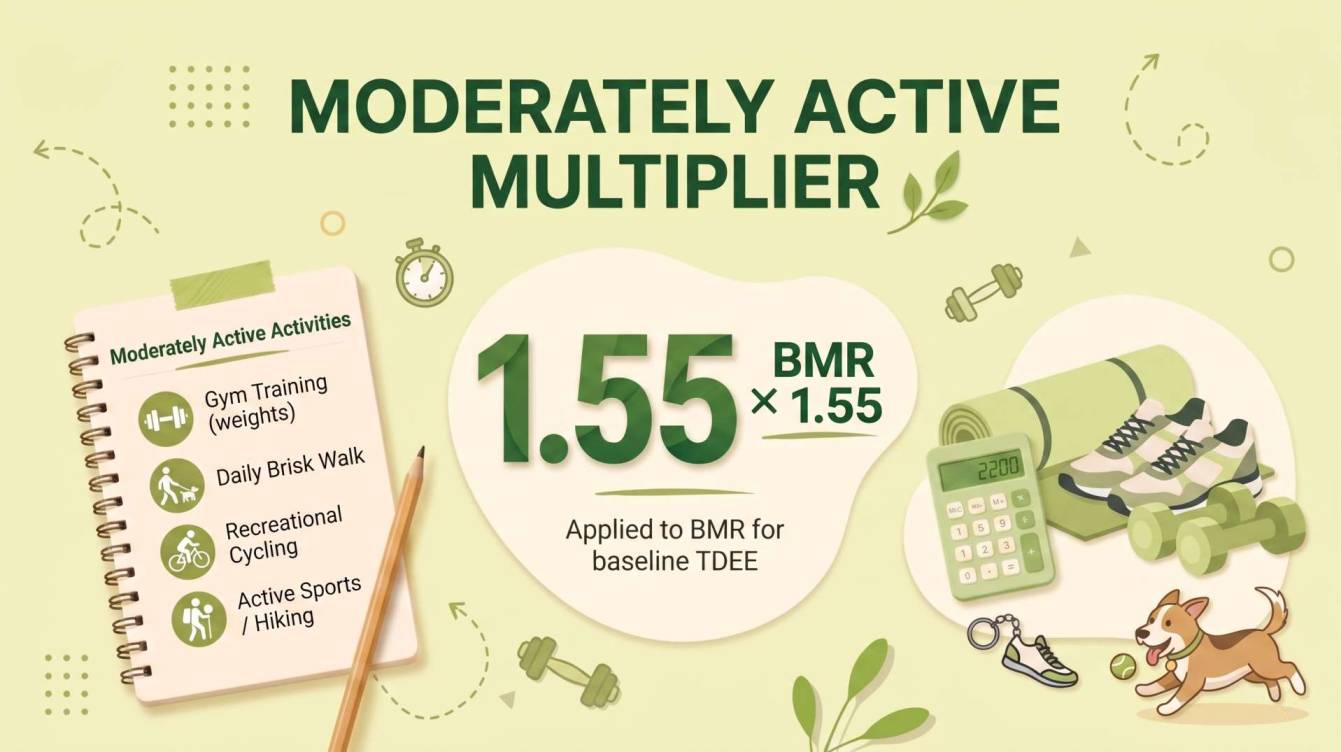
The moderately active multiplier is 1.55. It is the middle value on the five-level activity scale used in TDEE calculations. It applies to people who exercise with real consistency — typically three to five days per week at a meaningful intensity level.
This multiplier raises your Basal Metabolic Rate by 55% to estimate total daily energy expenditure. That increase reflects both structured exercise and the additional background movement that comes with an active lifestyle.
The 1.55 level is where many dedicated gym-goers and fitness-focused individuals belong. It sits squarely between the lightly active multiplier (1.375) and the very active multiplier (1.725), and it is the most commonly used level among people who follow structured training programs.
This article explains what 1.55 means in practice, who it fits, how it behaves across different TDEE formulas, and how to tell whether you should move up or down.
What Does the 1.55 Multiplier Mean?
The 1.55 figure is a correction factor applied to BMR. It captures the combined calorie cost of structured workouts, daily non-exercise movement, and the slight metabolic elevation that consistent training produces.
Research on energy expenditure in moderately trained individuals consistently finds total daily expenditure around 50 to 60% above resting rate. The 1.55 multiplier sits at the center of that range, making it a reliable estimate for consistent but not elite-level exercisers.
The Core Formula
TDEE is always calculated as:
TDEE = BMR × Activity Multiplier
At the moderately active level:
TDEE = BMR × 1.55
This applies regardless of which BMR formula you use. The Mifflin-St Jeor equation, the Harris-Benedict formula, and the Katch-McArdle formula all feed into the same multiplier scale.
Where 1.55 Sits on the Full Scale?
Activity Level | Multiplier |
|---|---|
Sedentary | 1.2 |
Lightly Active | 1.375 |
Moderately Active | 1.55 |
Very Active | 1.725 |
Extra Active | 1.9 |
Moving from lightly active to moderately active adds 0.175 to the multiplier. For a person with a 1,800 kcal BMR, that step up adds 315 calories to the daily estimate.
Who Is Moderately Active?
The moderately active category fits people who train regularly without being competitive athletes or doing physical labor for a living.
Criteria for Moderately Active
You are moderately active if your typical week includes:
Moderate to vigorous exercise on 3 to 5 days
Workout sessions lasting 45 to 75 minutes
Activities like weight training, running, cycling, swimming, or team sports
A step count typically in the 8,000 to 12,000 range
Common profiles that fit this level:
Someone following a 4-day gym program (push/pull/legs or similar)
A person who runs three times a week and walks on other days
A cyclist who rides four evenings per week
A regular class-goer attending fitness sessions most weekdays
Important Distinction: Consistency Matters
The word "moderately" in this level does not describe workout difficulty. It describes frequency and consistency. Someone who does very hard workouts two days per week is not moderately active. Someone who does moderate effort workouts four days per week is.
The multiplier reflects average weekly energy expenditure. Consistency across the week matters more than peak intensity on any single day.
How the 1.55 Multiplier Works in TDEE Formulas?
The multiplier is always the final step. BMR is established first, and then the multiplier scales it up.
Worked Example
A 28-year-old woman, 163 cm, 62 kg, training four days per week with cardio and weights.
Step | Value |
|---|---|
BMR (Mifflin-St Jeor) | 1,395 kcal |
Activity multiplier | × 1.55 (moderately active) |
TDEE result | 2,162 kcal/day |
This 2,162 kcal is her maintenance intake. Eating 300 to 500 kcal below this supports steady fat loss. Eating 250 to 500 calories above supports muscle gain.
Comparing BMR Formulas at This Multiplier
Different BMR equations produce slightly different starting values. The multiplier stays the same, but the TDEE output shifts.
BMR Formula | Example BMR | TDEE at 1.55 |
|---|---|---|
Mifflin-St Jeor | 1,395 kcal | 2,162 kcal |
Harris-Benedict | 1,430 kcal | 2,217 kcal |
Katch-McArdle (LBM-based) | Varies | Varies |
The Mifflin-St Jeor equation is widely validated as the most accurate for general adult populations. Harris-Benedict runs slightly high. Katch-McArdle is most accurate when lean body mass is measured directly.
Run your calculation using the TDEE calculator to get a precise output for your body and activity level.
Moderately Active vs. Lightly Active and Very Active
Choosing between the three middle levels is where most calibration errors occur. Each boundary has a distinct meaning.
Moderately Active vs. Lightly Active
The lightly active level (1.375) applies when exercise is occasional — one to three sessions per week at low-to-moderate effort. Moderately active applies when training is structured and consistent at three or more days per week.
The calorie difference between these two levels is meaningful. For a BMR of 1,700 kcal:
Level | TDEE |
|---|---|
Lightly Active (×1.375) | 2,338 kcal |
Moderately Active (×1.55) | 2,635 kcal |
Difference | +297 kcal |
Underestimating and using lightly active when you actually train four days per week creates a 297-calorie shortfall in your maintenance figure. This makes any calorie surplus for muscle gain harder to achieve and can blunt training recovery.
Moderately Active vs Very Active
The very active level (1.725) applies to daily hard training or very demanding physical output six to seven days per week. Moderately active is for people who train hard but still take two or more rest days.
If you train intensely but have clear rest days and do not have a physically demanding job, moderately active is usually the correct level, not very active.
Real TDEE Numbers at the Moderately Active Level
The table below shows maintenance calories at the moderately active level across a range of BMR values.
BMR (kcal) | TDEE at 1.55 (Moderately Active) |
|---|---|
1,200 | 1,860 kcal/day |
1,400 | 2,170 kcal/day |
1,600 | 2,480 kcal/day |
1,800 | 2,790 kcal/day |
2,000 | 3,100 kcal/day |
2,200 | 3,410 kcal/day |
These are maintenance values. They represent the calorie intake at which body weight stays stable for a moderately active person at each BMR.
Cross-Level Comparison for a BMR of 1,800 kcal
Activity Level | Multiplier | Daily TDEE |
|---|---|---|
Sedentary | 1.2 | 2,160 kcal |
Lightly Active | 1.375 | 2,475 kcal |
Moderately Active | 1.55 | 2,790 kcal |
Very Active | 1.725 | 3,105 kcal |
Extra Active | 1.9 | 3,420 kcal |
The jump from sedentary to moderately active is 630 kcal per day for this BMR. Selecting the wrong end of the scale when you are actually moderately active would mean eating 630 calories below your true maintenance — a significant sustained deficit with no intentional strategy behind it.
How Exercise Type Affects Multiplier Accuracy?
The 1.55 multiplier is an average across exercise types. Some training styles burn more than others at the same frequency. This affects how accurate the estimate is for your specific routine.
Higher-Expenditure Activities
These types of exercise push actual expenditure toward the upper range of the moderately active band:
High-intensity interval training (HIIT) with short rest periods
Long-distance running or cycling sessions (60+ minutes)
Heavy compound resistance training with dense programming
Competitive team sports (football, basketball, hockey)
Lower-Expenditure Activities
These may push actual expenditure toward the lower end of the moderately active band:
Light resistance training with long rest intervals
Yoga, pilates, or flexibility-focused sessions
Walking-based workouts at a relaxed pace
Short gym sessions under 30 minutes
In practice: if most of your exercise falls into the lower-expenditure category and you train three days per week, you may be closer to lightly active. If most of your training is high-expenditure at four or five days per week, you may approach the very active range.
The 1.55 multiplier works best when your training is a genuine mix — some intensity, some volume, consistent frequency.
When to Reassess Your Activity Level?
The moderately active multiplier should be reviewed when your training changes significantly.
Triggers to Move Up to Very Active
Move to the very active level (1.725) when:
You start training six or seven days per week consistently
You add a physically demanding job to your existing training routine
You begin a sport or program with daily practice sessions
Triggers to Move Down to Lightly Active
Move to the lightly active level (1.375) when:
You drop below three training sessions per week for more than two to three weeks
You take a planned deload or recovery period
An injury or illness significantly reduces your activity
Triggers to Move Down to Sedentary
Move to the sedentary level (1.2) if a serious injury or medical condition stops nearly all movement for a sustained period.
Reassess your multiplier any time a major training change persists for more than three weeks. Calorie targets built on the wrong activity level compound over time. A 300-calorie daily error becomes 9,000 calories per month.
See the full activity multipliers overview to compare all five levels. Use the TDEE calculator to apply your updated multiplier immediately.