
How Many Calories Should I Eat to Lose Weight?
Daily calorie needs for weight loss depend on your TDEE, activity level, age, sex, and body composition rather than a fixed calorie target. Creating a sustainable calorie deficit, prioritizing nutrient-dense foods, and recalculating your calorie intake as your weight changes help support steady, long-term fat loss.

Your body has a number. Let's find it.
We calculate the exact calorie target your body needs, built from your stats and goal, then track everything against it daily. Log meals, add workouts, set a weight goal, and watch your numbers update in real time. Check in weekly to see calories, water, and weight trend in one place.
No spreadsheets. No guessing. Just results.
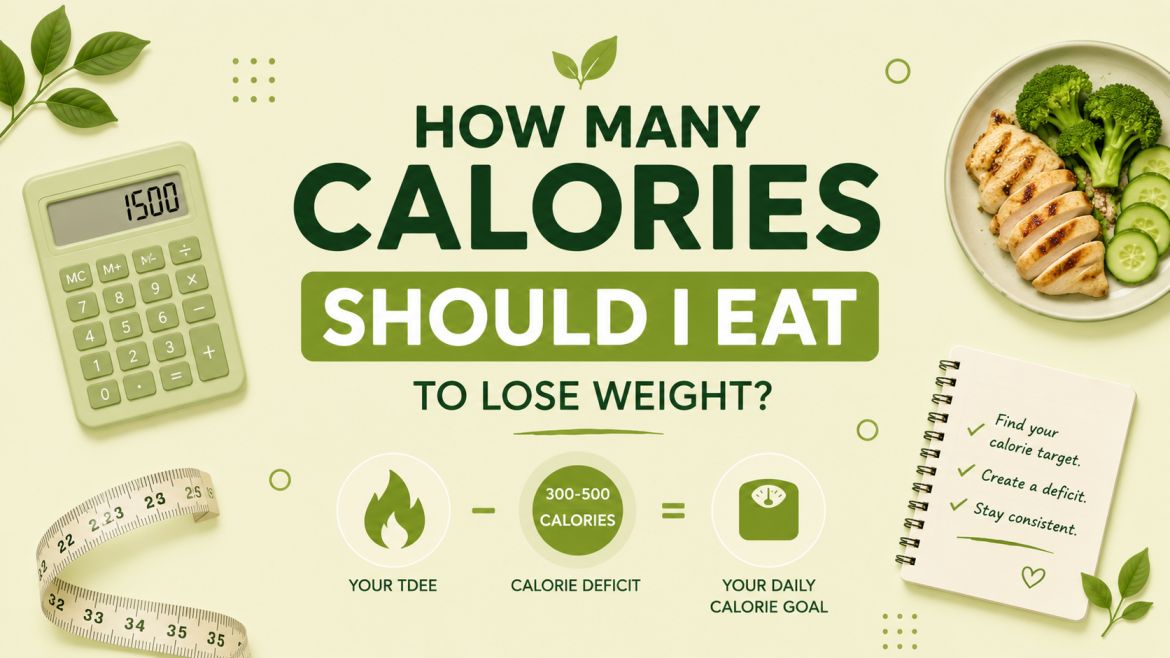
How many calories should I eat to lose weight? The answer is your Total Daily Energy Expenditure (TDEE) minus a target deficit. For a 500-calorie daily deficit producing 1 lb of fat loss per week, the daily calorie intake for weight loss equals TDEE minus 500. A moderately active woman with a TDEE of 2,100 calories needs approximately 1,600 calories per day to lose 1 lb per week. A moderately active man with a TDEE of 2,700 calories needs approximately 2,200 calories per day at the same rate.
This number is personal. Using a generic 1,200-calorie diet without knowing your TDEE either creates an excessive deficit that causes muscle loss or a deficit too small to produce results. The correct approach starts with your actual TDEE. The TDEE Calculator for Weight Loss calculates your personal daily calorie target based on your stats and goal.
How Many Calories a Day to Lose Weight?
Daily calorie targets for weight loss vary by sex, body weight, height, age, and activity level. No universal number applies to all adults. How many calories to lose 1 pound a week is always 500 fewer than TDEE per day, since one pound of stored fat equals approximately 3,500 calories.
Calories to lose 2 pounds a week requires a 1,000-calorie daily deficit, only sustainable when TDEE is high enough that the resulting intake stays above 1,500 calories for men or 1,200 for women. General ranges based on TDEE research:
Group | Typical TDEE Range | 500 kcal Deficit Target | 1 lb/week Loss Rate |
|---|---|---|---|
Sedentary woman | 1,600-1,900 kcal | 1,100-1,400 kcal | Risk of too low intake |
Moderately active woman | 1,900-2,300 kcal | 1,400-1,800 kcal | Safe range |
Sedentary man | 2,000-2,400 kcal | 1,500-1,900 kcal | Safe range |
Moderately active man | 2,400-2,900 kcal | 1,900-2,400 kcal | Safe range |
Very active man | 3,000-3,500 kcal | 2,500-3,000 kcal | Comfortable range |
The minimum safe daily intake is 1,200 calories for women and 1,500 calories for men. Eating below these thresholds causes nutrient deficiencies, muscle catabolism, and metabolic slowdown. If your TDEE minus 500 calories falls below the minimum, use a 250-calorie deficit instead and accept a slower 0.5 lb/week rate.
How to Calculate How Many Calories You Need to Lose Weight?
Three steps determine your personal weight loss calorie target.
Step 1: Calculate Your BMR
Use the Mifflin-St Jeor formula, the most accurate BMR equation for most adults per a 2005 meta-analysis in the Journal of the American Dietetic Association.
Men: BMR = (10 x weight in kg) + (6.25 x height in cm) - (5 x age) + 5
Women: BMR = (10 x weight in kg) + (6.25 x height in cm) - (5 x age) - 161
Example: 30-year-old woman, 75 kg, 165 cm
BMR = (10 x 75) + (6.25 x 165) - (5 x 30) - 161 = 750 + 1,031 - 150 - 161 = 1,470 kcal
Step 2: Multiply by Activity Factor to Get TDEE
Activity Level | Multiplier |
|---|---|
Sedentary (desk job, no exercise) | 1.2 |
Lightly active (exercise 1-3 days/week) | 1.375 |
Moderately active (exercise 3-5 days/week) | 1.55 |
Very active (exercise 6-7 days/week) | 1.725 |
Extremely active (physical job + daily exercise) | 1.9 |
Continuing the example: TDEE = 1,470 x 1.55 = 2,279 kcal
Step 3: Subtract Your Deficit
500-calorie deficit: 2,279 - 500 = 1,779 kcal/day (1 lb/week)
300-calorie deficit: 2,279 - 300 = 1,979 kcal/day (0.6 lb/week)
The Calorie Deficit Calculator runs this calculation with your stats and target date, showing both the daily intake number and the projected weeks to goal weight.
Calories to Lose Weight by the Numbers: What the Research Says
Understanding the calorie math behind weight loss prevents unrealistic expectations and common errors.
The 3,500-Calorie Rule
One pound of stored fat contains approximately 3,500 calories. A daily deficit of 500 calories accumulates to 3,500 calories per week, corresponding to 1 lb of fat loss. This is the basis of standard deficit recommendations.
A 2019 paper in the International Journal of Obesity noted that the 3,500-calorie rule overestimates actual fat loss for large goals because, as body weight decreases, TDEE decreases proportionally. This is why recalculating calorie targets every 5 to 10 lbs lost produces more accurate results than setting a fixed number at the start.
Minimum Calorie Floors
Research cited by Harvard Health Publications establishes that:
Women need a minimum of 1,200 calories per day to meet basic nutrient requirements
Men need a minimum of 1,500 calories per day for the same reason
Very Low Calorie Diets (VLCD) below 800 calories per day require medical supervision and are not appropriate for self-directed weight loss
How Calorie Needs Change as You Lose Weight?
Every 4.5 kg (10 lbs) of body weight lost reduces TDEE by approximately 60 to 100 calories per day. A person starting at 200 lbs and reaching 170 lbs burns 180 to 300 fewer calories per day at the lower weight. Failing to recalculate means what was a 500-calorie deficit becomes a 200 to 300-calorie deficit, slowing progress significantly.
How Many Calories a Day Should a Woman Eat to Lose Weight?
Women have a lower average TDEE than men at equivalent body weights due to lower average muscle mass and sex-specific hormonal differences. A sedentary 30-year-old woman at 68 kg (150 lbs) has a TDEE of approximately 1,700 to 1,900 calories. A moderately active woman at the same weight has a TDEE of approximately 2,000 to 2,200 calories.
The calorie target for weight loss for most women ranges from 1,400 to 1,800 calories per day, depending on TDEE. Calorie intake based on body weight for women roughly translates to 10 to 12 calories per pound of body weight for fat loss pace, a 150 lb woman needs approximately 1,500 to 1,800 calories per day. Women with lower TDEE (under 1,800 kcal/day) should use a 250-calorie deficit rather than 500 to avoid dropping below the 1,200-calorie floor.
Hormonal cycles affect weight loss patterns. During the luteal phase of the menstrual cycle, progesterone elevates BMR by approximately 100 to 300 calories and increases hunger. Scale weight also rises by 1 to 3 lbs due to water retention. These fluctuations do not indicate fat gain and normalize in the follicular phase.
How Many Calories Should a Man Eat to Lose Weight?
Men typically have higher TDEE than women due to greater average muscle mass and sex hormones. A sedentary 35-year-old man at 90 kg (200 lbs) has a TDEE of approximately 2,200 to 2,500 calories. A moderately active man at the same weight has a TDEE of approximately 2,700 to 3,000 calories.
How many calories a man needs to lose weight depends on TDEE, but safe daily targets generally range from 1,800 to 2,500 calories. The minimum safe calories per day for men is 1,500, falling below this triggers muscle catabolism and metabolic suppression. Men with higher TDEE (above 2,500 kcal/day) can sustain a 750 to 1,000-calorie deficit more comfortably than men with lower TDEE.
How to set a calorie goal for weight loss as a man: calculate TDEE using the Mifflin-St Jeor formula, subtract 500 calories for a 1 lb/week rate, and verify the result stays above 1,500 calories per day. Recalculate every 5 to 10 lbs as TDEE decreases with body weight.
What to Eat Within Your Calorie Target?
The composition of the calorie budget determines body composition outcomes and hunger levels. Two people eating identical calorie totals but different foods experience different rates of muscle retention and satiety.
High-priority food strategies within a calorie target include:
Prioritize protein at every meal: Protein requires more energy to digest than carbohydrates or fat (thermic effect of 20-30% versus 5-10%). A meal with 35 to 40 g of protein also suppresses ghrelin (hunger hormone) more effectively than an equivalent-calorie carbohydrate meal.
Build plates around volume: Non-starchy vegetables (broccoli, spinach, cucumber, bell peppers) deliver 20 to 40 calories per cup. Filling half the plate with these vegetables increases meal volume without increasing calorie density.
Log food with a tracking app: Research from the American Journal of Preventive Medicine (2008) found that people who tracked food daily lost twice as much weight as non-trackers in a 6-month study of 1,685 participants. Does calorie counting work for weight loss? This study and dozens of subsequent trials confirm that it does, provided tracking includes weighing food rather than estimating portions.
Limit liquid calories: Beverages contribute calories without triggering the satiety response of solid food. Alcohol, juice, and sweetened coffee are the most common sources of untracked calorie intake.
Using the Food Calorie Counter to log meals against your daily target builds the awareness needed to stay consistently below TDEE.
How to Stay Within Your Calorie Target?
Staying within a daily calorie target requires strategies that reduce friction and decision fatigue.
Five approaches that research supports for consistent adherence:
Meal prepping 3 to 4 days of food at once reduces spontaneous high-calorie decisions during hunger or time pressure
Tracking calories before eating (pre-logging planned meals) prevents the mindset of eating first and accounting later
Keeping protein between 30 and 35% of total calories reduces hunger more effectively than equal calories from carbohydrates or fat
Eating at consistent times regulates ghrelin cycles and reduces unpredictable hunger spikes
Sleeping 7 to 9 hours per night suppresses ghrelin and prevents the 270-calorie average intake increase associated with sleep restriction
For those losing weight in a shorter time frame, specific guidance is available in the losing weight in a week article, though realistic expectations differ from sustained month-long plans.
Adjusting Calories as You Progress
A static calorie target produces diminishing results over time because TDEE drops as body weight falls. Knowing how many calories should I eat to lose weight is not a one-time calculation, it is a number that changes with body weight, and recalculating at every 5 to 10 lb milestone maintains consistent progress. Calorie needs for weight loss also differ by age: adults over 50 typically burn 100 to 200 fewer calories per day than adults in their 30s at equivalent body weight and activity levels, meaning the calorie target must account for this biological reality.
If weight stalls for 2 consecutive weeks at a maintained calorie target, two adjustments restore progress:
Reduce daily calories by 100 to 150 (tighten the deficit)
Add 1,000 to 2,000 daily steps (increase NEAT without formal exercise)
Combining both adjustments produces a 200 to 350-calorie correction while avoiding aggressive calorie cutting that triggers metabolic adaptation. The TDEE Calculator can be recalculated at the new weight to generate the updated target.
Frequently Asked Questions About Calories to Lose Weight
How Many Calories a Day Should a Woman Eat to Lose Weight?
A moderately active woman between ages 26 and 50 needs approximately 2,000 calories per day to maintain weight. To lose 1 lb per week, the target drops to 1,500 calories per day. Women over 50 typically need around 1,800 maintenance calories and 1,300 to lose 1 lb/week. Women under 30 and those more active may maintain at 2,200 and lose at 1,700. The safest approach is to calculate personal TDEE rather than using a population average, since individual variation is wide.
How Many Calories Should a Man Eat to Lose Weight?
The average moderately active man between ages 26 and 50 needs approximately 2,400 to 2,600 calories per day to maintain weight. A 500-calorie deficit places the daily target at 1,900 to 2,100 calories for 1 lb/week fat loss. Men with higher muscle mass or more physical activity have higher TDEEs and can sustain larger deficits.
The minimum safe intake for men is 1,500 calories per day. Men over 50 generally have lower TDEE due to muscle mass decline and need to recalculate accordingly.
Is 1,200 Calories a Day Enough to Lose Weight?
1,200 calories per day creates a calorie deficit for most adults and produces fat loss, but it is at the lower limit of safe intake for women. Harvard Health and most clinical guidelines cite 1,200 calories as the minimum for women to meet basic nutritional needs. At this intake, micronutrient coverage becomes difficult without a deliberate food quality focus.
For men, the minimum is 1,500 calories. Eating at 1,200 calories is more likely to cause muscle loss, fatigue, and metabolic adaptation than a more moderate 1,500 to 1,800 calorie target.
Should I Eat Back Exercise Calories?
If you calculated TDEE including your activity level, no, those exercise calories are already factored into your TDEE. Eating them back would eliminate the deficit. If you used a sedentary TDEE and then exercised on top of that, eating back 50 to 75% of exercise calories is appropriate. The common mistake is double-counting activity by choosing an active TDEE multiplier and then adding exercise burn on top, which inflates the perceived calorie budget and eliminates the deficit entirely.
What Happens if You Eat Too Few Calories?
Eating too few calories, below 1,200 for women or 1,500 for men, triggers several counterproductive responses. NEAT drops by 100 to 400 calories per day as the body unconsciously reduces movement. Thyroid output decreases, slowing metabolic rate. Muscle catabolism increases as the body uses lean tissue for fuel. Ghrelin rises, and leptin falls, making hunger harder to manage.
University Hospitals clinical dietitian Emily Cooper notes that when metabolism suppresses significantly, the fix is to slowly increase calories by 100 per day over 1 to 2 weeks (reverse dieting) to rebuild metabolic rate before re-entering a deficit.
Does It Matter When You Eat Your Calories?
Total daily calorie intake matters more than timing for fat loss. Eating the same calories at night versus morning does not independently change fat storage for most people. Timing does affect two practical outcomes: late-night eating is associated with greater total daily intake because it occurs in low-satiety, high-reward environments; and distributing protein across 3 to 4 meals produces better muscle retention than concentrating calories in 1 or 2 meals. Circadian research also suggests that eating earlier in the day aligns better with metabolic rhythm, but total calories remain the primary driver.