
Weight Loss Plateau: Why It Happens and How to Break Through
A weight loss plateau occurs when metabolic adaptation closes your calorie deficit. Learn why the scale stops moving, how NEAT drops, and evidence-based strategies to break through a plateau.

Your body has a number. Let's find it.
We calculate the exact calorie target your body needs, built from your stats and goal, then track everything against it daily. Log meals, add workouts, set a weight goal, and watch your numbers update in real time. Check in weekly to see calories, water, and weight trend in one place.
No spreadsheets. No guessing. Just results.
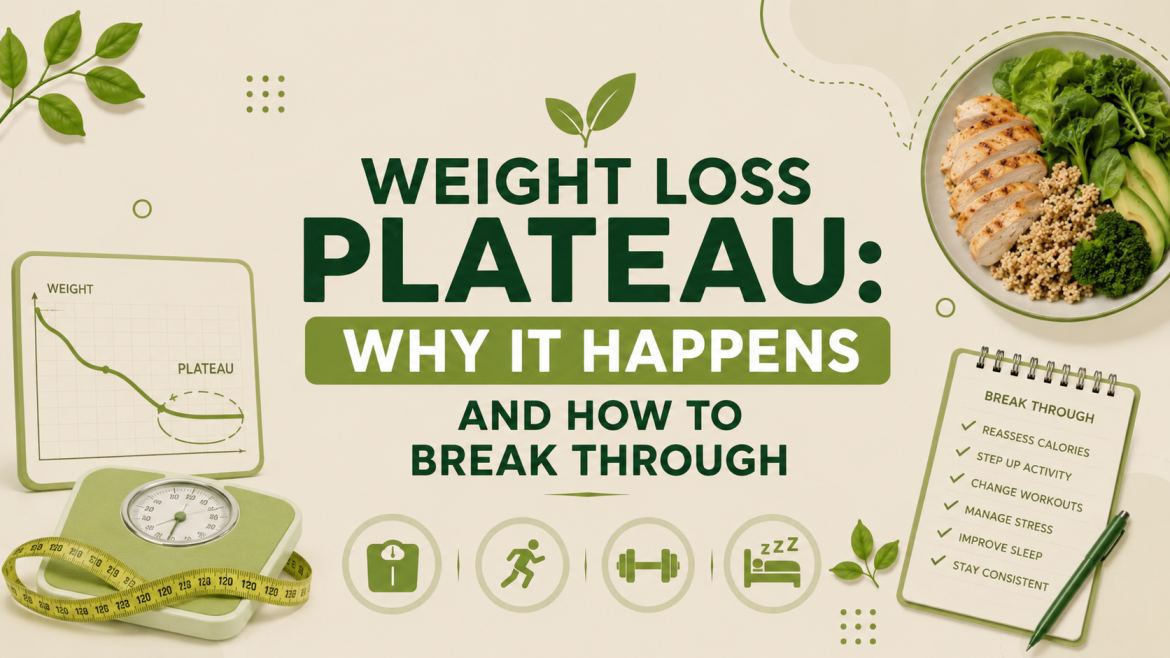
A weight loss plateau is a period of 3 or more consecutive weeks where body weight does not change despite maintaining a calorie deficit. It is not caused by a broken metabolism or starvation mode. It is caused by metabolic adaptation: the body's systematic response to sustained caloric restriction.
The weight loss plateau occurs because losing weight changes both sides of the energy balance equation. Your body now weighs less (requiring fewer calories to move) and it actively lowers resting metabolic rate, non-exercise activity thermogenesis (NEAT), and hormone-driven hunger thresholds to recover the deficit. Eating in a deficit and not losing weight anymore is the defining signal that metabolic adaptation has caught up with your calorie intake.
For a full understanding of the calorie deficit mechanics that drive fat loss and plateau, see the calorie deficit to lose weight guide. To understand the rate at which weight loss naturally slows over months, review the weight loss timeline. When a plateau is confirmed, the first action is always to recalculate using the TDEE weight loss calculator at your current body weight.
Why Did I Stop Losing Weight? The 4 Biological Causes?
Why you stopped losing weight has 4 measurable biological explanations:
1. Your TDEE Has Decreased
As you lose weight, your body requires fewer calories to perform the same movements. A person who drops from 200 to 180 pounds burns approximately 100 to 150 fewer calories per day at rest. The deficit that produced 1 pound per week at 200 pounds may produce no deficit at 180 pounds without adjusting calorie intake.
2. Adaptive Thermogenesis Has Reduced Your BMR
Research shows that after a 10% reduction in body weight, total energy expenditure drops by approximately 15% beyond what weight alone predicts. This is adaptive thermogenesis: the body becomes more metabolically efficient, performing the same functions with less caloric fuel.
3. NEAT Has Dropped Unconsciously
Non-exercise activity thermogenesis (NEAT) encompasses all movement outside formal exercise: fidgeting, standing, walking, and posture adjustments. During sustained caloric restriction, the body unconsciously reduces NEAT to conserve energy. NEAT drops during dieting can account for a 100 to 400 calorie reduction in daily expenditure without any conscious change in behavior.
4. Dietary Tracking Has Become Less Accurate Over Time
Portion creep is documented across long-term diet adherence studies. People who track accurately in week one often undercount by 200 to 400 calories in months two and three due to eyeballing portions, forgetting small additions, and normalizing higher-calorie choices.
What Is Metabolic Adaptation and How Does It Cause a Plateau?
Metabolic adaptation is the physiological process by which the body reduces total energy expenditure in response to sustained caloric restriction. It goes beyond the expected calorie reduction from weighing less.
Research published in 2025 confirms that after losing 20 pounds, the body's TDEE may drop by 400 calories rather than the expected 200 calories from body weight reduction alone. The additional 200-calorie drop represents metabolic adaptation, not weight change.
Metabolic adaptation operates through 4 pathways:
Reduced basal metabolic rate (BMR), the calories burned at complete rest
Reduced thermic effect of food (TEF) as smaller meals require less digestion energy
Reduced NEAT through unconscious movement suppression
Hormonal shifts that increase hunger and reduce satiety signals
This is why a person can plateau without changing a single behavior. The deficit disappears not because they changed something, but because the body adapted around what they were already doing.
How Long Does a Weight Loss Plateau Last?
A weight loss plateau lasts 2 to 8 weeks in most cases. A true plateau persists for at least 3 consecutive weeks of unchanged weight on a consistent tracking protocol. A single week of scale stability is not a plateau. Daily fluctuations of 2 to 5 pounds from water, sodium, and hormones are normal.
Plateau Duration | Likely Cause | Recommended Action |
|---|---|---|
1 to 2 weeks | Normal fluctuation | Continue current plan, increase data collection |
3 to 4 weeks | Mild metabolic adaptation | Reduce intake by 150 to 200 calories or increase NEAT |
5 to 8 weeks | Significant adaptation | Recalculate TDEE, consider diet break, add resistance training |
Over 8 weeks | Possible caloric surplus or major tracking error | Audit full caloric intake with food scale for 7 days |
Should I Recalculate My TDEE at a Plateau?
Yes. Recalculating TDEE at a plateau is the most direct solution for plateaus caused by body weight reduction. Most people do not adjust their calorie target as they lose weight. A person who calculated their TDEE at 200 pounds has a meaningfully higher target than the TDEE at 185 pounds.
How to recalculate accurately:
Use the TDEE calculator with your current body weight, not your starting weight
Subtract 500 calories from the new TDEE to restore the deficit
Confirm the new target is not below minimum safe intake (1,200 calories for women, 1,500 for men)
If the new target would fall below safe thresholds, increase physical activity to expand the deficit from the expenditure side rather than restricting intake further.
What Is a Refeed Day vs. a Diet Break?
A refeed day and a diet break are two structured strategies to counteract metabolic adaptation. They differ in duration and hormonal effect.
Refeed Day
A refeed day is 1 day at maintenance calories, with carbohydrate intake increased to near maintenance levels. It temporarily elevates leptin (the satiety hormone), reduces cortisol, and replenishes glycogen. A refeed day does not undo fat loss. One day at maintenance halts fat loss for 24 hours but does not reverse accumulated progress.
Diet Break
A diet break is 1 to 2 weeks at full maintenance calories. Research shows that diet breaks reduce metabolic adaptation more effectively than continuous restriction. A structured diet break of 2 weeks after every 8 to 12 weeks of dieting reduces total adaptation and improves long-term fat loss outcomes compared to continuous restriction without breaks.
Strategy | Duration | Best For | Effect on Adaptation |
|---|---|---|---|
Refeed Day | 1 day | Psychological relief, glycogen restore | Mild, temporary |
Diet Break | 1 to 2 weeks | Breaking a 4 to 8 week plateau | Moderate, measurable |
How Does NEAT Drop During a Weight Loss Plateau?
NEAT stands for Non-Exercise Activity Thermogenesis, and it represents 15 to 30% of total daily calorie expenditure. During sustained caloric restriction, the brain suppresses unconscious movement to conserve energy. This suppression happens without awareness. The NEAT guide covers every mechanism and activity category in detail.
A person who walks 8,000 steps per day at the start of their diet may drift toward 5,000 to 6,000 steps after 8 to 12 weeks due to reduced unconscious movement, slower walking pace, and more sitting.
Evidence from a 2025 analysis shows:
NEAT drops unconsciously during a calorie deficit can reduce daily expenditure by 100 to 400 calories
This drop can completely close a 300 to 500 calorie deficit without any change in food intake
Consciously increasing NEAT by 1,000 to 2,000 daily steps offsets this reduction and restores forward progress
Practical strategies to restore NEAT during a plateau:
Set a daily step goal of 8,000 to 10,000 and use a tracker to enforce it
Use a standing desk for 2 to 3 hours of the workday
Add a 10-minute post-meal walk to each meal, generating 200 to 300 extra calories of daily expenditure
Diet Break to Break Plateau: The Evidence-Based Strategy?
A diet break to break a plateau has clinical support. Research from the MATADOR study compared continuous caloric restriction to intermittent restriction (2 weeks on, 2 weeks at maintenance). The intermittent group lost more fat and experienced less metabolic adaptation despite spending the same total number of weeks in a deficit.
The MATADOR protocol for breaking a plateau:
Identify the plateau: 3+ weeks of no weight change on consistent tracking
Eat at maintenance calories (TDEE without deficit) for 2 weeks. Use the maintenance calorie calculator to find your exact maintenance target.
Resume the deficit after the break, using the calorie deficit calculator to set the new target
Track progress for 2 to 3 weeks before evaluating whether the plateau is resolved
The 2-week maintenance period does not cause fat gain in controlled conditions. Small scale increases (1 to 2 pounds) reflect glycogen refilling, not fat accumulation.
Weight Loss Stall Reasons: 6 Most Common Causes?
Weight loss stall reasons fall into 6 categories:
Caloric intake has crept up: Portions normalized over time, and actual intake exceeds perceived intake by 200 to 500 calories
TDEE has decreased with weight loss: The original deficit no longer exists at the new body weight
Adaptive thermogenesis has reduced BMR: The body is burning fewer calories at rest than predicted
NEAT has declined unconsciously: Daily movement has dropped without awareness
Hormonal factors: Elevated cortisol from stress or poor sleep, or thyroid dysfunction, can impair fat mobilization
Water retention masking fat loss: Increased inflammation, hormonal fluctuation, or high sodium intake can mask ongoing fat loss on the scale
Before making aggressive changes, audit food intake with a digital food scale for 7 days. Many plateaus resolve by identifying a 200 to 400 calorie daily tracking error.
For plateaus that persist despite accurate tracking, see how to lose 50 pounds for long-haul deficit management strategies. Review macros for weight loss to confirm protein is high enough to prevent muscle loss during the plateau period.
Frequently Asked Questions About Weight Loss Plateaus
How long should I wait before calling it a true plateau?
A weight loss plateau requires at least 3 consecutive weeks of no scale change on a consistent tracking protocol. One or two weeks of stability is normal fluctuation from water, hormones, and glycogen variation.
Does eating more sometimes break a plateau?
Yes. A structured diet break at maintenance calories for 1 to 2 weeks reduces metabolic adaptation and can restart fat loss. This is different from overeating. A maintenance-level refeed, not a surplus, is the correct approach.
Can I break a plateau without cutting more calories?
Yes. Increasing NEAT by 1,000 to 2,000 steps per day, adding a resistance training session per week, or taking a 2-week diet break can restore the deficit without cutting food intake further.
Will recalculating TDEE always fix a plateau?
Recalculating TDEE addresses plateaus caused by weight-driven TDEE reduction. If metabolic adaptation is the primary cause, recalculating alone may not be sufficient. Combining TDEE recalculation with increased protein intake, a diet break, and NEAT restoration addresses all four plateau mechanisms simultaneously.
What is the postpartum plateau and is it different?
A postpartum weight loss plateau follows the same mechanisms as a standard plateau but is complicated by hormonal shifts from breastfeeding, postpartum cortisol levels, and sleep deprivation. The same strategies apply, with adjusted calorie targets to account for lactation demands.
Does poor sleep cause a weight loss plateau?
Yes. Sleep under 7 hours elevates cortisol, which suppresses fat mobilization and promotes water retention. It also reduces NEAT by increasing fatigue-driven sedentary behavior. See sleep and weight loss for the full mechanism.