
How to Lose 50 Pounds? TDEE-Based Long-Term Plan and Timeline
Learn how to lose 50 pounds safely using TDEE and calorie deficit. Includes realistic timeline, TDEE recalculation schedule, diet phase structure, and loose skin guidance.

Your body has a number. Let's find it.
We calculate the exact calorie target your body needs, built from your stats and goal, then track everything against it daily. Log meals, add workouts, set a weight goal, and watch your numbers update in real time. Check in weekly to see calories, water, and weight trend in one place.
No spreadsheets. No guessing. Just results.
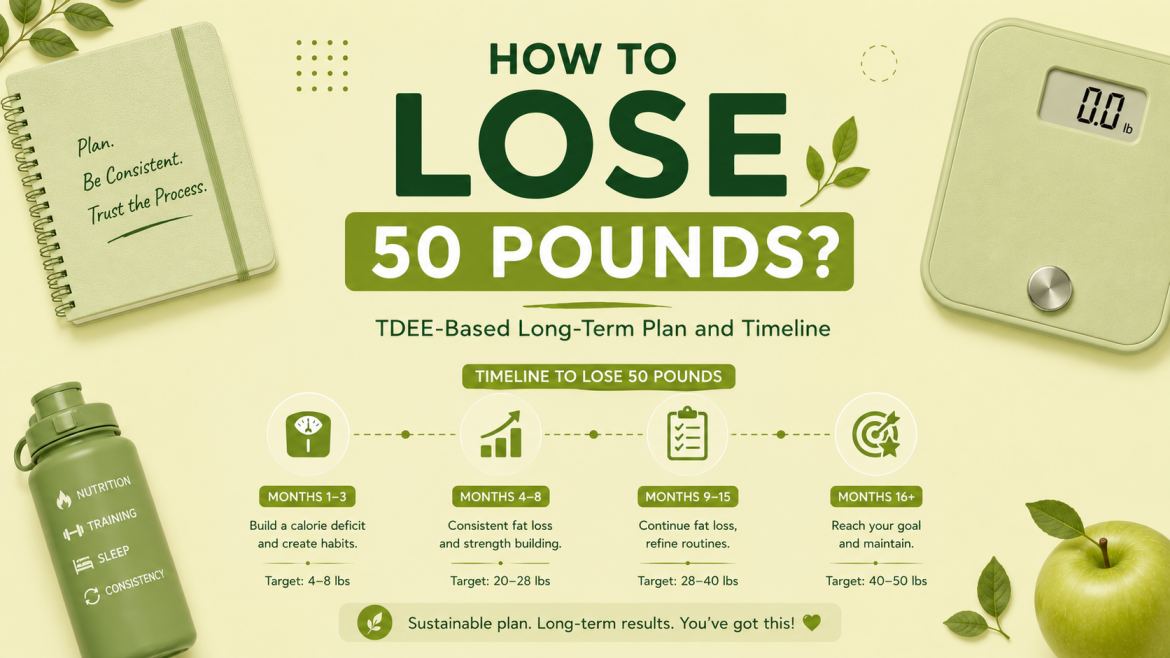
Losing 50 pounds requires a total calorie deficit of 175,000 calories. At a 500-calorie daily deficit, this takes approximately 50 weeks. At 750 calories per day, the same goal takes roughly 33 weeks. A 50-pound fat loss journey is long enough to require 4 to 5 TDEE recalculations, at least 2 to 3 planned diet breaks, and a phased structure that prevents metabolic adaptation from stalling progress mid-journey. Knowing your Total Daily Energy Expenditure (TDEE) is the single most important starting point.
This guide covers the calorie deficit to lose 50 pounds, a realistic timeline table at 4 deficit sizes, how metabolism changes losing 50 pounds, how often to recalculate TDEE losing 50 lbs, and how to address loose skin after 50 pound weight loss. Use the TDEE calculator for weight loss to set your first calorie target before starting.
What Does Losing 50 Pounds Require?
Losing 50 pounds of true body fat requires a total calorie deficit of 175,000 calories. One pound of stored fat contains approximately 3,500 calories of energy. At a sustained daily deficit of 500 calories, the full goal takes 350 days. At 750 calories per day, approximately 233 days.
A 50-pound journey is fundamentally different from a 10 or 20-pound cut. The goal requires a phased approach because the body the person starts with is significantly different from the body that finishes. TDEE drops substantially over 50 pounds, and the strategies that produce fat loss in phase 1 become progressively less effective without structured recalibration.
For the complete guide on how to lose weight with TDEE, including all four components of daily calorie burn, the full framework is covered in detail there.
How 50-Pound Weight Loss Compares to Shorter Goals?
Goal | Total Deficit Required | Minimum Timeline at 500 cal/day | TDEE Recalculations Needed |
|---|---|---|---|
10 pounds | 35,000 calories | 10 weeks | 0 to 1 |
20 pounds | 70,000 calories | 20 weeks | 1 to 2 |
30 pounds | 105,000 calories | 30 weeks | 2 to 3 |
50 pounds | 175,000 calories | 50 weeks | 4 to 5 |
What Is the Calorie Deficit to Lose 50 Pounds?
The calorie deficit to lose 50 pounds is 175,000 calories total. At 500 calories per day, this is reached in 350 days. At 750 calories per day, 233 days. At 1,000 calories per day, approximately 175 days.
The key distinction for a 50-pound cut is that the starting TDEE and the finishing TDEE differ by 250 to 400 calories per day. A person who starts at 250 pounds with a TDEE of 2,800 calories may have a TDEE of 2,400 to 2,500 calories at 200 pounds. Using the original calorie target throughout the journey means the effective deficit gradually narrows from 500 calories to 100 to 200 calories, explaining why progress stalls without recalculation.
Worked example, 45-year-old man, 115 kg, 178 cm, lightly active:
Starting BMR = (10 x 115) + (6.25 x 178) - (5 x 45) + 5 = 2,192 kcal
Starting TDEE = 2,192 x 1.375 = 3,014 calories
750-calorie deficit target: 2,264 calories per day
Use the calorie deficit calculator to run your own numbers and recalculate at every 10-pound checkpoint.
How Long Does It Take to Lose 50 Pounds?
How long does it take to lose 50 pounds depends on the daily deficit and whether TDEE is updated at each 10-pound interval. A realistic timeline for 50 pound weight loss is 33 to 50 weeks at a 500 to 750-calorie daily deficit, including 2 to 3 planned diet breaks.
Timeline table for a 175,000-calorie total deficit:
Daily Deficit | Weekly Loss | Time to Lose 50 Pounds | Diet Breaks Needed |
|---|---|---|---|
250 cal/day | ~0.5 lb | 100 weeks | 4 to 5 |
500 cal/day | ~1 lb | 50 weeks | 3 to 4 |
750 cal/day | ~1.5 lbs | ~33 weeks | 2 to 3 |
1,000 cal/day | ~2 lbs | ~25 weeks | 2 to 3 |
At a 750-calorie deficit, losing 50 pounds in 6 months (approximately 26 weeks) is possible for adults who start with high body weight and TDEE, maintain protein at the full target throughout, and recalculate consistently. For most adults starting at average TDEE levels, the realistic timeline is 33 to 40 weeks.
How to Lose 50 Pounds in 3 Months?
How to lose 50 pounds in 3 months requires a daily deficit of approximately 1,917 calories. For most adults, this places daily intake at or below BMR, which is not sustainable and causes significant lean mass loss, hormonal disruption, and metabolic damage. The scale may drop 30 to 40 pounds in 3 months, but a significant portion comes from water, glycogen, and lean tissue rather than fat.
The realistic maximum fat loss in 3 months at 2 pounds per week is 24 to 26 pounds. A safe and effective 50-pound goal requires 33 to 50 weeks.
How to Lose 50 Pounds in 6 Months?
How to lose 50 pounds in 6 months (approximately 26 weeks) requires a daily deficit of approximately 960 calories. For an adult with a starting TDEE of 2,800 calories, this means eating approximately 1,840 calories per day. This is achievable but requires strict protein adherence, resistance training throughout, and TDEE recalculation at 5 checkpoints (every 10 pounds lost).
How Metabolism Changes Losing 50 Pounds?
How metabolism changes losing 50 pounds is the most important biological factor in long-term fat loss success. Three categories of metabolic change accumulate over a 50-pound journey:
1. BMR Reduction from Lower Body Weight
Each pound of body weight lost reduces BMR by approximately 5 to 8 calories per day. Over 50 pounds, the cumulative BMR reduction is 250 to 400 calories per day. A person who starts with a TDEE of 2,800 calories finishes with a TDEE closer to 2,400 to 2,550 calories, a 250 to 400-calorie-per-day reduction even without any metabolic adaptation.
2. Metabolic Adaptation Beyond Weight Loss
Beyond simple BMR reduction, metabolic adaptation further suppresses TDEE by 10 to 15% below predicted values after 12+ weeks of sustained caloric restriction. Research in the American Journal of Clinical Nutrition confirms this additional adaptation in long-term dieters. For a person with a 2,800 starting TDEE, this is an additional 280 to 420 calorie suppression.
3. NEAT Suppression
Non-Exercise Activity Thermogenesis drops by 100 to 300 calories per day during extended restriction. The body reduces unconscious movement, fidgeting, posture adjustments, spontaneous walking, to preserve energy.
This is why the 50 pounds fat loss plateau is nearly universal at some point in a long journey. The plateau signals that TDEE has decreased enough to erase the original deficit, not that progress has stopped.
How Often to Recalculate TDEE Losing 50 Lbs?
How many times to recalculate TDEE losing 50 lbs is every 10 pounds lost, producing 4 to 5 recalculations over the full journey. Each recalculation uses current body weight in the Mifflin-St Jeor equation to produce an updated BMR, which is multiplied by the current activity level to produce a new TDEE.
Recalculation schedule:
Checkpoint | Body Weight (example: starting at 115 kg) | Action |
|---|---|---|
Start | 115 kg | Calculate TDEE, set first deficit target |
10 lbs lost | 110.5 kg | Recalculate TDEE, reset daily target |
20 lbs lost | 106 kg | Recalculate TDEE, take diet break |
30 lbs lost | 101.5 kg | Recalculate TDEE, reset target |
40 lbs lost | 97 kg | Recalculate TDEE, take diet break |
50 lbs lost | 92.5 kg | Final recalculation for maintenance target |
Using the TDEE calculator at each checkpoint takes under 2 minutes and prevents the gradual deficit erosion that stalls most long-term fat loss attempts.
Diet Breaks for Long-Term Fat Loss
Diet breaks for long-term fat loss are planned periods of 1 to 2 weeks at maintenance calories, scheduled approximately every 8 to 10 weeks of active caloric restriction. A 2019 study in Obesity found that participants who took structured 2-week diet breaks every 2 weeks of dieting lost more fat than those who restricted continuously over the same period.
For a 50-pound journey, plan for 2 to 3 diet breaks:
After Phase 1 (8 to 10 weeks): First diet break at approximately 10 to 12 pounds lost. Recalculate TDEE from new weight before resuming.
After Phase 2 (another 8 to 10 weeks): Second diet break at approximately 20 to 25 pounds lost. Second TDEE recalculation.
Optional Phase 3 Break (if motivation or adherence is dropping): Third break at approximately 35 to 40 pounds lost before the final phase.
For the mechanics of why diet breaks work and how metabolic adaptation is reversed, the weight loss plateau guide covers NEAT restoration and leptin recovery in detail.
Loose Skin After 50-Pound Weight Loss
Loose skin after 100 pound weight loss is well-documented, but loose skin after 50-pound weight loss depends on 4 factors: age, speed of loss, genetics, and hydration throughout the cut.
Age: Skin elasticity decreases with age. Adults over 40 are more likely to experience loose skin than those under 30 after the same amount of fat loss.
Speed of loss: Rapid weight loss gives skin less time to contract. Losing 50 pounds over 50 weeks allows more skin adaptation than losing the same amount over 25 weeks.
Hydration: Adequate hydration (2 to 3 liters of water per day) supports collagen synthesis and skin elasticity during extended fat loss.
Resistance training: Building lean mass underneath the skin reduces the visible appearance of loose skin by adding volume to replace the lost fat tissue.
Most adults who lose 50 pounds at a safe rate (0.5 to 1 lb per week) through diet and resistance training experience less significant loose skin than those who lose the same amount rapidly. For context on what to expect at even larger losses, the how to lose 100 pounds guide covers loose skin and body composition outcomes at the 100-pound scale.
The 50-Pound Weight Loss Plan: Phase Structure
A structured 50 pound weight loss plan divides the journey into phases with checkpoints, preventing the plateau stalls and motivation drops that derail most long-term fat loss attempts.
Phase | Duration | Goal Weight Range | Key Action |
|---|---|---|---|
Phase 1 | Weeks 1 to 10 | Starting weight to -12 lbs | Establish deficit, hit protein daily, resistance train |
Break 1 | Weeks 11 to 12 | Maintain current weight | Eat at maintenance, recalculate TDEE |
Phase 2 | Weeks 13 to 22 | -12 to -25 lbs | Apply new target, continue training |
Break 2 | Weeks 23 to 24 | Maintain current weight | Second maintenance period, recalculate TDEE |
Phase 3 | Weeks 25 to 35 | -25 to -40 lbs | Third recalculation, prepare for final phase |
Phase 4 | Weeks 36 to 45 | -40 to -50 lbs | Final phase, 50 pound target reached |
What to Eat When Losing 50 Pounds: Sample Day?
A sample day at 1,900 calories for a 240-pound adult targeting a 700-calorie daily deficit (TDEE approximately 2,600 calories):
Meal | Food | Calories | Protein |
|---|---|---|---|
Breakfast | 3-egg scramble with spinach, half cup black beans, 1 slice whole-grain toast | 450 kcal | 38 g |
Lunch | 200 g grilled chicken over mixed greens, half cup chickpeas, olive oil and lemon dressing | 520 kcal | 52 g |
Snack | 200 g Greek yogurt (0% fat), 1 cup mixed berries | 165 kcal | 20 g |
Dinner | 180 g salmon, 250 g roasted vegetables (broccoli, courgette, peppers), 80 g brown rice | 540 kcal | 40 g |
Snack | 30 g mixed nuts | 180 kcal | 5 g |
Daily total | 1,855 kcal | 155 g protein |
This structure delivers approximately 1.45 g/kg protein for a 107 kg adult, within the 1.6 to 2.2 g/kg preservation range. As body weight drops toward 90 kg over the journey, protein grams stay approximately the same while the g/kg ratio rises. For the full calorie target and safe minimum floors by sex, the how many calories to eat to lose weight guide covers the calculation framework. For protein specifically and daily gram targets by body weight, the how much protein for weight loss guide covers the full recommendation. For the full macro split, the macros for weight loss guide provides the complete ratio targets.
Exercise Progression Across a 50-Pound Journey
Exercise during a 50-pound fat loss journey serves two purposes: increasing the weekly calorie burn and protecting lean mass. The approach must evolve by phase because fitness capacity changes significantly over 33 to 50 weeks.
Phase | Exercise Focus | Frequency | Weekly Calorie Burn Target |
|---|---|---|---|
Phase 1 (weeks 1 to 10) | Daily walking + 2 resistance sessions/week | Low-to-moderate intensity | 1,500 to 2,000 additional kcal/week |
Phase 2 (weeks 13 to 22) | Walking + 3 resistance + 1 cardio session | Moderate intensity | 2,000 to 2,500 kcal/week |
Phase 3 (weeks 25 to 35) | 3 resistance + 2 cardio sessions | Moderate-to-high intensity | 2,500 to 3,000 kcal/week |
Phase 4 (weeks 36 to 45) | Maintain phase 3 structure | Do not increase intensity further | 2,500 to 3,000 kcal/week |
Walking 8,000 to 10,000 steps per day adds approximately 300 to 400 calories of NEAT-adjacent burn daily without triggering the NEAT suppression that structured exercise can cause. Steps are the highest-use low-effort activity for a 50-pound journey. For those unable to follow a formal exercise program, the how to lose weight without exercise guide covers the diet-only approach and outcomes.
Non-Scale Progress Tracking for a 50-Pound Goal
The scale is an unreliable daily feedback source over a 33 to 50-week journey. Body weight fluctuates by 2 to 5 pounds per day from water, sodium, hormonal cycles, and digestive contents. Tracking non-scale metrics alongside weight prevents false-negative feedback that leads to abandonment.
Track these metrics every 2 weeks:
Waist circumference (at the navel, on an exhale)
Hip circumference
Upper arm circumference
Resting heart rate (lower resting HR indicates improving cardiovascular fitness)
Progress photos (same time of day, same lighting, same pose)
A waist measurement dropping 0.5 to 1 inch per month with a stalled scale is a sign that body composition is improving, fat is being replaced by lean mass, not a sign that the plan is failing. If age-related factors are affecting progress, the how to lose weight after 40 guide covers the specific metabolic adjustments for midlife weight loss. For monthly planning within the phases, the how to lose weight in a month guide covers 30-day rate and structure.
5 Common Mistakes That Derail a 50-Pound Fat Loss Goal
Skipping TDEE Recalculations: Losing 50 pounds without updating the calorie target is like navigating with a map of a different city. Each 10-pound checkpoint requires a new TDEE calculation. Failing to recalculate turns a 500-calorie deficit into a 200-calorie deficit by month 6.
Not Scheduling Diet Breaks: Continuous restriction for 33 to 50 weeks without planned breaks accelerates metabolic adaptation, NEAT suppression, and lean mass loss. Treating diet breaks as failure rather than planning them as tools is the most common long-term fat loss mistake.
Extreme Deficits Early in the Journey: A 1,500-calorie daily deficit at the start of a 50-pound cut may seem to accelerate results, but it triggers rapid metabolic adaptation, muscle loss, and a plateau that arrives at weeks 8 to 10 rather than weeks 16 to 20. A 500 to 750-calorie deficit produces better body composition outcomes over the full timeline.
Using the Scale as the Only Progress Metric: The scale does not distinguish fat from water, muscle, or bone. A month with zero scale movement but a 1-inch waist reduction is a successful month. Relying solely on the scale produces discouragement at every water retention event.
Abandoning the Plan at the First Plateau: The first plateau at approximately weeks 8 to 12 is a sign the body has adapted, not that the plan has failed. Recalculate, take a diet break, and resume. Most people who abandon 50-pound goals do so at this first plateau.
How to Maintain 50 Pounds of Weight Loss?
Maintenance after a 50-pound loss requires a deliberate transition. The body finishing a 33 to 50-week deficit has a TDEE 250 to 400 calories lower than at the start. The body also has reduced leptin, elevated ghrelin, and accumulated NEAT suppression.
Reverse dieting schedule: Add 100 to 150 calories per week to the final deficit intake until the weekly average weight stabilizes for 3 consecutive weeks. For someone finishing at 1,800 calories, the maintenance target is approximately 2,100 to 2,300 calories, reached over 3 to 5 weeks.
After achieving stable maintenance weight:
Weigh weekly and calculate a 4-week rolling average
Maintain protein at 1.4 to 1.6 g/kg (reduced from the 1.6 to 2.2 g/kg used during the cut)
Keep resistance training at 2 sessions per week minimum: the single strongest predictor of long-term weight maintenance across all studies
Set a return-to-deficit trigger: A 5-pound increase above goal weight held for 2 consecutive weeks returns to a 250-calorie deficit for 4 to 6 weeks
Other Fat Loss Goal Guides in This Series
Every guide in this series uses the same TDEE-based calorie deficit framework. The total calorie deficit required and the realistic timeline differ by goal amount. Use the table below to find the guide that matches your target.
Goal Guide | Total Calorie Deficit | Realistic Timeline |
|---|---|---|
17,500 calories | 2.5 to 5 weeks | |
35,000 calories | 5 to 10 weeks | |
70,000 calories | 13 to 20 weeks | |
105,000 calories | 20 to 30 weeks | |
350,000 calories | 50 to 80 weeks |
All timelines assume a 500 to 750-calorie daily deficit with TDEE recalculated at every 10-pound checkpoint. Faster timelines are possible at higher deficits for adults with a high starting TDEE.
Frequently Asked Questions
How long does it realistically take to lose 50 pounds?
Losing 50 pounds of fat realistically takes 33 to 50 weeks at a daily deficit of 500 to 750 calories. At 750 calories per day with consistent TDEE recalculation and 2 planned diet breaks, the timeline is approximately 33 to 38 weeks. At 500 calories per day, approximately 50 weeks.
What calorie deficit is needed to lose 50 pounds?
A total calorie deficit of 175,000 calories produces 50 pounds of fat loss. At 500 calories per day, this takes 350 days. At 750 calories per day, 233 days. The daily target equals starting TDEE minus chosen deficit, recalculated at every 10-pound checkpoint.
How does metabolism change over a 50-pound weight loss?
TDEE decreases by 250 to 400 calories per day over a 50-pound journey from BMR reduction at lower body weight. Metabolic adaptation adds a further 10 to 15% suppression. NEAT decreases by 100 to 300 calories per day during extended restriction. Total TDEE reduction by the end of a 50-pound cut is approximately 400 to 700 calories per day compared to the starting value.
Will I have loose skin after losing 50 pounds?
Loose skin risk after a 50-pound loss depends on age, speed of loss, and genetics. Losing 50 pounds over 33 to 50 weeks at a safe rate significantly reduces loose skin compared to rapid loss. Resistance training throughout the journey replaces fat volume with lean mass, reducing visible loose skin.
How often should I recalculate my TDEE over 50 pounds?
Recalculate TDEE every 10 pounds lost, producing 4 to 5 recalculations over the full journey. Each recalculation uses current body weight in the Mifflin-St Jeor equation. Failing to recalculate allows the effective deficit to narrow to the point of stalling progress.