
How to Lose 5 Pounds? Calorie Deficit, Timeline, and Steps
Learn how to lose 5 pounds using your TDEE and a calorie deficit. Includes timeline table, the last 5 pounds strategy, how to lose 5 lbs fast, and a diet-only plan.

Your body has a number. Let's find it.
We calculate the exact calorie target your body needs, built from your stats and goal, then track everything against it daily. Log meals, add workouts, set a weight goal, and watch your numbers update in real time. Check in weekly to see calories, water, and weight trend in one place.
No spreadsheets. No guessing. Just results.
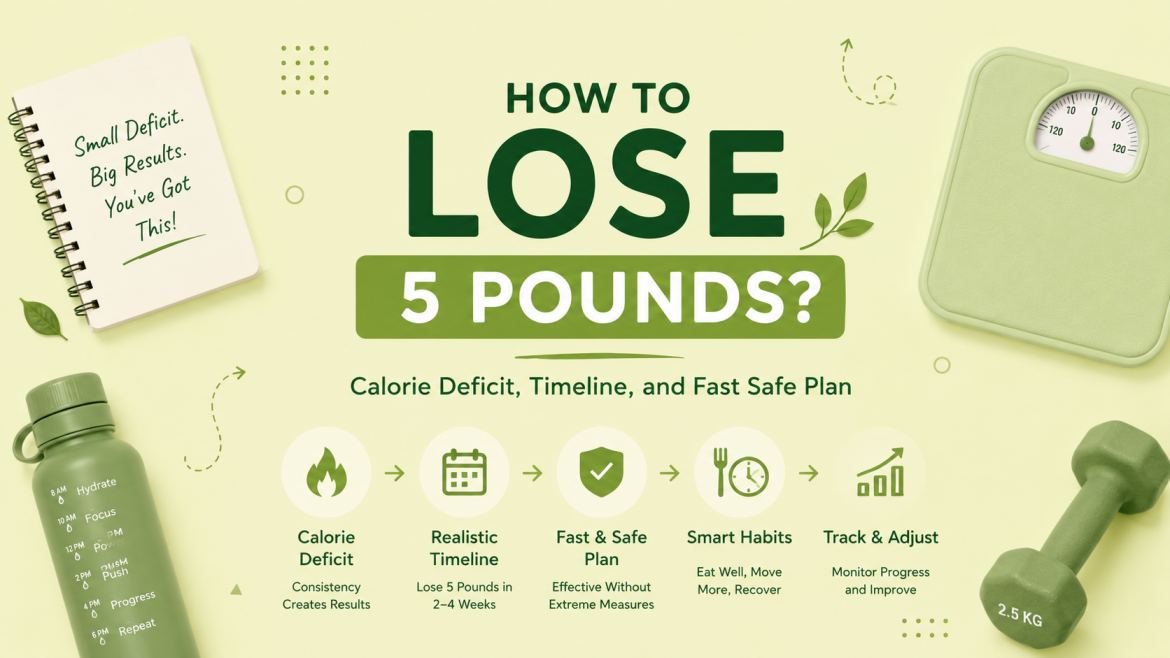
Losing 5 pounds requires a total calorie deficit of 17,500 calories. At a 500-calorie daily deficit, this takes approximately 2.5 weeks of true fat loss. At 250 calories per day, the same goal takes 10 weeks. Because 5 pounds is a small absolute amount of fat, much of what appears on the scale in the first week comes from glycogen and water depletion rather than actual fat tissue. Understanding your Total Daily Energy Expenditure (TDEE) is the first step to targeting real fat and not just water weight.
This guide covers the calorie deficit to lose 5 pounds, a full timeline table, how to lose 5 pounds in a week and whether it is achievable, why the last 5 pounds are so hard, and how to lose 5 lbs fast without muscle loss. Use the TDEE calculator for weight loss to get your personal calorie target before adjusting your intake.
What Does Losing 5 Pounds Actually Mean?
Losing 5 pounds of true fat requires a total calorie deficit of 17,500 calories. At a 500-calorie daily deficit, the pure math says 35 days. In practice, most adults lose 5 pounds on the scale within 2.5 to 5 weeks because early water weight loss from glycogen depletion adds to the initial scale drop.
Not all 5-pound scale drops represent 5 pounds of fat. In week one of any caloric deficit or low-carb approach, glycogen stores empty and 3 to 4 grams of bound water leave the body for every gram of glycogen depleted. A person can see a 3 to 5 pound scale drop in 5 to 7 days without losing meaningful fat tissue.
For the complete framework on how to lose weight with TDEE, including all four components of daily calorie burn (BMR, NEAT, EAT, TEF), the full guide covers the mechanics in detail.
Fat Loss vs. Scale Weight for a 5-Pound Goal
Approach | Timeline | True Fat Lost | What Else Drops |
|---|---|---|---|
500 cal/day deficit | 2.5 to 5 weeks | 2 to 5 lbs | Water from glycogen in week 1 |
Low-carb for 1 week | 5 to 7 days | 0.5 to 1 lb | 3 to 4 lbs water and glycogen |
250 cal/day deficit | 10 weeks | 5 lbs | Minimal water after week 1 |
5 pound weight loss in one week from water weight is common but does not represent body fat reduction. True fat loss of 5 pounds takes a minimum of 2.5 weeks at the maximum safe deficit of 1,000 calories per day.
What Calorie Deficit Do You Need to Lose 5 Pounds?
The calorie deficit to lose 5 pounds is 17,500 calories total. The daily deficit determines the timeline. A 500-calorie daily deficit reaches the total in 35 days. A 250-calorie deficit takes 70 days.
How many calories to cut to lose 5 pounds depends on your TDEE and the calorie floor you are working above. For a sedentary adult with a TDEE of 1,800 calories, a 500-calorie cut produces an intake of 1,300 calories, approaching but not below BMR. For an active adult with a TDEE of 2,600 calories, a 500-calorie cut produces 2,100 calories, a comfortable and sustainable target.
Worked TDEE example:
A 28-year-old woman, 65 kg, 165 cm, lightly active:
BMR = (10 x 65) + (6.25 x 165) - (5 x 28) - 161 = 1,370 kcal. TDEE = 1,370 x 1.375 = 1,884 calories.
A 500-calorie deficit puts her target at 1,384 calories. At this intake, she reaches the 17,500-calorie total deficit in 35 days, producing 5 pounds of true fat loss in 5 weeks.
For the full calorie target framework including safe minimums by sex, the how many calories to eat to lose weight guide covers every scenario.
How to calculate your daily target:
Step 1: Find your TDEE using the TDEE calculator
Step 2: Subtract 250 to 500 calories from that number
Step 3: Set that number as your daily calorie target and track against it consistently
Step 4: Use the calorie deficit calculator to confirm the timeline
Timeline table for 17,500 calories total deficit:
Daily Deficit | Weekly Loss | Time to Lose 5 Pounds | Notes |
|---|---|---|---|
250 cal/day | ~0.5 lb | 10 weeks | Slowest, suits those near BMR floor |
500 cal/day | ~1 lb | 5 weeks | Standard, most sustainable |
750 cal/day | ~1.5 lbs | ~3.5 weeks | Aggressive, needs high protein |
1,000 cal/day | ~2 lbs | ~2.5 weeks | Maximum safe rate, short-term only |
How Long Does It Take to Lose 5 Pounds?
How long to lose 5 pounds depends on the daily deficit maintained consistently and the starting body composition. 5 pound weight loss how long realistically is 2.5 to 10 weeks depending on deficit size. For someone already lean (below 20% body fat for men, below 28% for women), 5 pounds takes longer because the body becomes more conservative with fat release as it approaches its set point.
For broader context on how 5 pounds fits into a longer weight loss goal, the how long does it take to lose weight guide covers every major goal amount with deficit-size comparisons.
How to Lose 5 Pounds in a Week?
How to lose 5 pounds in a week is one of the most searched questions in fat loss. The factual answer is that 5 pounds of true fat loss in 7 days requires a daily deficit of 2,500 calories. That level exceeds the BMR of most adults and would cause significant muscle breakdown.
What is achievable in one week is a 3 to 5 pound scale drop from glycogen depletion and water loss, particularly on a low-carbohydrate diet or a significant calorie cut. This type of loss is not fat loss. It reverses within 2 to 4 days of returning to normal eating. To understand exactly what happens in the first week of any diet, the how much weight can you lose in a week guide covers the physiology in full.
How to Lose 5 Pounds in 2 Weeks?
How to lose 5 pounds in 2 weeks requires a daily deficit of 1,250 calories. For an adult with a TDEE of 2,400 calories, this means eating 1,150 calories per day from diet alone, below the safe minimum for most women. A more practical approach is combining a 750-calorie dietary cut with 500 calories of daily exercise, which creates the 1,250-calorie deficit without pushing food intake below safe floors.
At this pace, weeks 1 and 2 will produce approximately 2 to 2.5 pounds of true fat loss and 2 to 3 pounds of water weight for a total scale drop of 4 to 5 pounds.
How to Lose 5 Lbs Fast Without Losing Muscle?
How to lose 5 lbs fast means applying the maximum safe deficit while protecting lean mass. Even at 5 pounds, an aggressive short-term cut without protein prioritization pulls measurable lean mass from the body.
The 3 requirements for fast 5-pound fat loss that preserves muscle:
Protein Target: 1.6 to 2.2 grams per kilogram of body weight per day throughout the entire cut
Resistance Training: Maintaining 2 sessions per week signals the body to preserve muscle even at a high deficit
Deficit Ceiling: No more than 1,000 calories below TDEE per day on any sustained basis
For the protein calculation and how macronutrients affect body composition during a deficit, the how much protein for weight loss guide provides the full target by body weight and training status.
Lose 5 Pounds Without Exercise: What to Expect?
Losing 5 pounds without exercise is achievable through diet alone. The 17,500-calorie deficit comes entirely from food reduction. For a sedentary adult with a TDEE of 1,800 calories, a 500-calorie cut brings intake to 1,300 calories per day, near but not below BMR.
Diet-only fat loss produces the same total fat loss as diet-plus-exercise over the same calorie deficit, but with a higher proportion of lean mass in the loss. Without exercise stimulus, the body has less reason to protect muscle tissue. Protein intake at the top of the range (2.2 g/kg) partially compensates for the absence of resistance training.
For the full sedentary approach and body composition outcomes, the how to lose weight without exercise guide covers diet-only fat loss in detail.
Sample Day of Eating for a 5-Pound Goal
A sample day at 1,450 calories (for a woman with a TDEE of 1,850 to 1,950 targeting a 400 to 500-calorie deficit):
Meal | Food | Calories | Protein |
|---|---|---|---|
Breakfast | 2 eggs + 2 egg whites, 1 slice whole-grain toast, 1 cup black coffee | 280 kcal | 24 g |
Lunch | 150 g grilled chicken, 2 cups mixed greens, 1 tbsp olive oil, lemon | 360 kcal | 40 g |
Snack | 170 g Greek yogurt (0% fat) | 100 kcal | 17 g |
Dinner | 150 g white fish, 150 g roasted vegetables, 80 g quinoa | 420 kcal | 35 g |
Snack | 1 small apple, 15 g almond butter | 185 kcal | 4 g |
Daily total | 1,345 kcal | 120 g protein |
For the full macro breakdown and how protein, fat, and carbohydrate ratios affect fat loss, the macros for weight loss guide provides complete ratio targets.
3-Week Action Plan to Lose 5 Pounds
A 3-week structured plan produces 3 to 5 pounds of true fat loss at a 500 to 750-calorie daily deficit:
Week | Daily Calorie Target | Protein Target | Exercise | Expected Loss |
|---|---|---|---|---|
Week 1 | TDEE minus 500 | 1.6 g/kg bodyweight | 2 resistance sessions + daily walks | 1 to 1.5 lbs (includes water) |
Week 2 | Same as week 1 | Same | Same structure | 1 to 1.5 lbs fat |
Week 3 | Recalculate if scale has not moved | Same | Add one extra 20-min cardio session | 0.75 to 1.5 lbs fat |
Week 1 scale drops faster than weeks 2 and 3 because glycogen and water leave the body before fat loss fully takes over. A 2 to 3 pound drop in week 1 followed by 1 to 1.5 pounds per week in weeks 2 and 3 is a normal and successful pattern.
Common Mistakes When Trying to Lose 5 Pounds
Confusing Sodium and Water Retention for Fat: A high-sodium meal the night before can add 2 to 4 pounds of temporary water weight to the scale by morning. This is not fat gain and not a failure. Compare your weight as a weekly average, not a daily number.
Expecting 5 Pounds in 1 Week: A 5-pound scale drop in 7 days is almost entirely water and glycogen. True fat loss of 5 pounds takes a minimum of 2.5 weeks at a 1,000-calorie daily deficit. Chasing the fast number leads to crash approaches that reverse immediately.
Eating Back Exercise Calories: Fitness trackers overestimate burn by 20 to 90%. Eating back the full reported burn erases the deficit entirely. Eat back a maximum of 50% of tracked exercise calories if hunger demands it.
Not Tracking Liquid Calories: A single specialty coffee drink (flavored latte, frappuccino) averages 350 to 500 calories. One glass of wine averages 120 to 150 calories. These are invisible to most people who are "eating clean" but not losing weight.
For the full guide on how belly fat specifically responds to a 5-pound calorie deficit, the how to lose belly fat guide explains why spot reduction does not work and what systemic calorie deficit produces. For tracking a 5-pound goal against a monthly target, the how to lose weight in a month guide covers 30-day rate expectations.
Why Is Losing the Last 5 Pounds so Hard?
Why losing the last 5 pounds is so hard is a physiological reality documented in fat loss research. The "last 5 pounds" refers specifically to the final remaining fat before reaching a goal body weight or body fat percentage. At this stage, 3 mechanisms converge to resist further loss.
Last 5 pounds body fat percentage context: For men, the last 5 pounds typically occurs at 10 to 15% body fat. For women, it occurs at 18 to 22% body fat. At these percentages, the body defends remaining fat stores more aggressively because essential fat (around organs and in cell membranes) represents a survival reserve.
The 3 physiological barriers at the last 5 pounds:
Lower Absolute TDEE: A leaner, lighter body burns fewer calories per day. The original calorie target may no longer create any meaningful deficit.
NEAT Suppression: Non-Exercise Activity Thermogenesis drops by 100 to 300 calories per day during prolonged restriction, further narrowing the effective deficit.
Hormonal Resistance: Leptin levels drop sharply as body fat approaches the lower threshold. Ghrelin rises. Appetite increases precisely when fat stores are most reluctant to release.
Hitting a weight loss plateau at the last 5 pounds is expected. A TDEE recalculation at current body weight and a 1-week diet break at maintenance are the two most evidence-based responses. For those pursuing the very last few pounds, the how to lose 10 pounds guide covers the specific strategies for closing out stubborn goals.
5-Pound Weight Loss Results: What Changes
A 5-pound fat loss is small in absolute terms but produces visible and measurable changes at the right starting point. At a starting weight of 130 to 160 pounds, 5 pounds represents 3 to 4% of body mass, a visible change in the face and waist.
Documented changes from a 5-pound fat loss include:
Waist Circumference: Average reduction of 0.5 to 1 inch in adults with abdominal fat
Scale Weight: 5 pounds of fat occupies approximately 2.5 times the volume of 5 pounds of muscle: a noticeable change in body shape even at small amounts
Blood Pressure: Small but measurable reductions in systolic pressure, particularly in overweight individuals
Clothing Fit: A 5-pound fat loss typically moves the body toward the lower end of the current clothing size
If the goal is larger, the how to lose 20 pounds guide covers the longer journey with TDEE recalculation scheduling and diet break strategy.
Other Fat Loss Goal Guides in This Series
Every guide in this series uses the same TDEE-based calorie deficit framework. The total calorie deficit required and the realistic timeline differ by goal amount. Use the table below to find the guide that matches your target.
Goal Guide | Total Calorie Deficit | Realistic Timeline |
|---|---|---|
35,000 calories | 5 to 10 weeks | |
70,000 calories | 13 to 20 weeks | |
105,000 calories | 20 to 30 weeks | |
175,000 calories | 33 to 50 weeks | |
350,000 calories | 50 to 80 weeks |
All timelines assume a 500 to 750-calorie daily deficit with TDEE recalculated at every 10-pound checkpoint. Faster timelines are possible at higher deficits for adults with a high starting TDEE.
Frequently Asked Questions
How long does it take to lose 5 pounds of fat?
Losing 5 pounds of true body fat takes 2.5 to 10 weeks depending on the daily deficit. At a 500-calorie daily deficit, the 17,500-calorie total is reached in 35 days (5 weeks). At a 1,000-calorie deficit, the same goal takes approximately 17 to 18 days. A realistic timeline including the initial water weight drop is 2.5 to 5 weeks for most adults.
Can you lose 5 pounds in a week?
A 5-pound scale drop in one week is possible but represents primarily water and glycogen loss, not fat. True fat loss of 5 pounds in 7 days requires a 2,500-calorie daily deficit, which is at or above BMR for most adults and causes significant muscle breakdown. Real fat loss at safe rates produces 0.5 to 1.5 pounds per week.
Why are the last 5 pounds so hard to lose?
The last 5 pounds resist loss because of reduced TDEE at a lighter body weight, NEAT suppression from prolonged restriction, and hormonal adaptation (lower leptin, higher ghrelin) that increases appetite as body fat approaches lower thresholds. Recalculating TDEE at current weight and using a 1-week maintenance break are the most effective interventions.
How many calories do I need to cut to lose 5 pounds?
To lose 5 pounds of fat, the total calorie deficit required is 17,500 calories. At 500 calories per day, this is reached in 35 days. At 250 calories per day, 70 days. The daily cut equals your TDEE minus your target intake.
What is the fastest safe way to lose 5 pounds?
The fastest safe approach is a 750 to 1,000-calorie daily deficit combined with protein intake at 1.6 to 2.2 g/kg and resistance training 2 to 3 times per week. At 1,000 calories per day, 5 pounds of fat takes approximately 17 to 18 days. Scale weight may appear to drop faster in week 1 due to glycogen and water loss.