
How to Lose 20 Pounds? Calorie Deficit, Timeline, and Plan
Learn exactly how to lose 20 pounds using your TDEE and a calorie deficit. Includes a timeline table at 4 deficit sizes, muscle preservation tips, and a step-by-step plan.

Your body has a number. Let's find it.
We calculate the exact calorie target your body needs, built from your stats and goal, then track everything against it daily. Log meals, add workouts, set a weight goal, and watch your numbers update in real time. Check in weekly to see calories, water, and weight trend in one place.
No spreadsheets. No guessing. Just results.
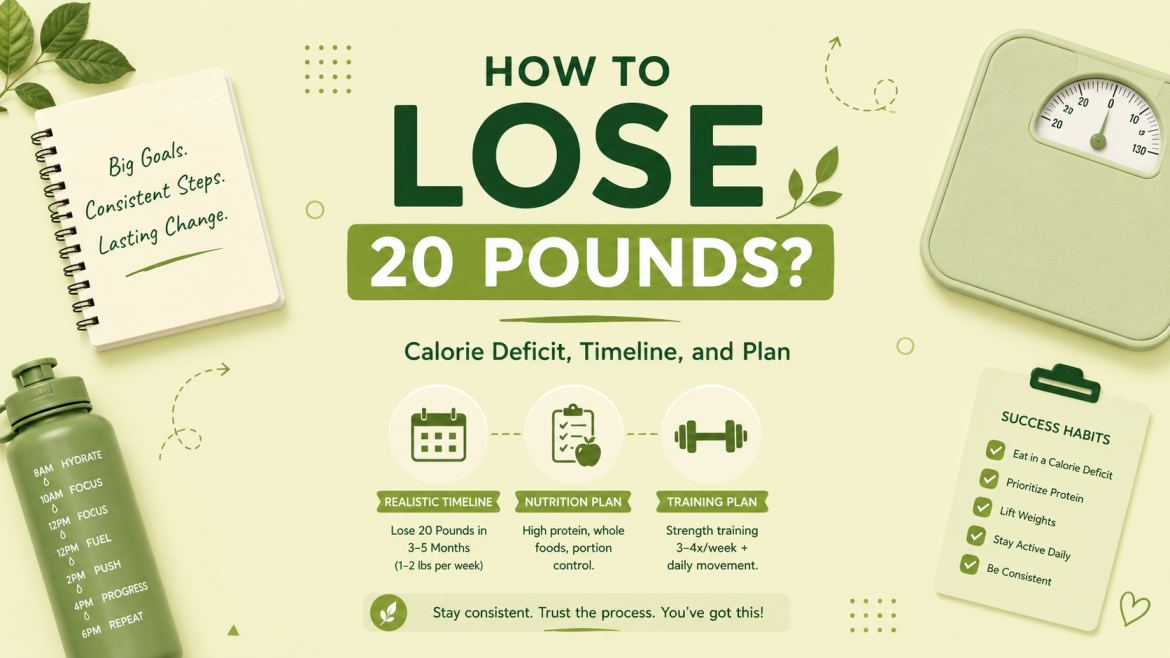
Losing 20 pounds requires a total calorie deficit of 70,000 calories. At a 500-calorie daily deficit, this takes approximately 20 weeks. At 750 calories per day, the same 20 pounds take roughly 13 weeks. The foundation of any reliable 20-pound fat loss plan is knowing your Total Daily Energy Expenditure (TDEE), the number of calories your body burns each day across all activity.
This guide covers the calorie deficit to lose 20 pounds, a full timeline table at 4 deficit sizes, how to lose 20 pounds in a month and whether it is safe, a step-by-step plan for muscle preservation, and why 20-pound fat loss requires TDEE recalculation mid-journey. Use the TDEE calculator for weight loss to find your personal calorie target before starting.
What Does Losing 20 Pounds Actually Require?
Losing 20 pounds of true body fat requires burning 70,000 calories more than consumed over the full fat loss phase. That figure comes from the established rule that 1 pound of stored fat holds approximately 3,500 calories of energy. At a daily deficit of 500 calories, the timeline is 20 weeks. At 1,000 calories per day, the timeline drops to 10 weeks but approaches the safety ceiling most clinical guidelines set.
Body weight is not identical to body fat. At the start of any caloric deficit, the first 3 to 7 days produce a fast scale drop from glycogen and water loss. Each gram of glycogen stored in muscle and liver cells binds 3 to 4 grams of water. A 20-pound goal that begins with a 4 to 5 pound first-week drop is normal, those pounds are mostly water, not fat.
For the complete framework on how to lose weight with TDEE, including all four components of daily calorie burn, the full guide covers the mechanics in detail.
Water Weight vs. Fat Loss in a 20-Pound Journey
Understanding the composition of weight loss prevents discouragement when the scale slows after week two.
Phase | Scale Drop Source | True Fat Lost | Notes |
|---|---|---|---|
Week 1 | Glycogen + water | 0.5 to 1 lb | Fast drop is not fat |
Weeks 2 to 8 | Mostly fat | 1 to 1.5 lbs/week | Steady at moderate deficit |
Weeks 9 to 20 | Fat + some metabolic slowdown | 0.5 to 1 lb/week | TDEE recalculation needed |
The scale drop rate slows after weeks 6 to 8 for two reasons: glycogen water is already gone, and metabolic adaptation reduces TDEE by 100 to 200 calories below the original calculation.
What Is the Calorie Deficit to Lose 20 Pounds?
The calorie deficit to lose 20 pounds is 70,000 calories total. This deficit is applied daily against your TDEE. A 500-calorie daily deficit creates a weekly shortfall of 3,500 calories, producing approximately 1 pound of fat loss per week. Reaching 20 pounds at this rate takes 20 weeks.
The total deficit does not change based on how the calories are removed. Cutting food intake by 400 calories and burning 100 calories through activity creates the same 500-calorie deficit as cutting food by 500 calories with no exercise. The split matters for body composition, exercise preserves lean mass, but not for the math.
How to Calculate Your TDEE for a 20-Pound Cut?
TDEE uses the Mifflin-St Jeor equation as its starting point. The equation produces Basal Metabolic Rate (BMR), which is then multiplied by an activity factor.
Mifflin-St Jeor Formula:
Men: BMR = (10 x weight kg) + (6.25 x height cm) - (5 x age) + 5
Women: BMR = (10 x weight kg) + (6.25 x height cm) - (5 x age) - 161
Activity Multipliers:
Activity Level | Description | Multiplier |
|---|---|---|
Sedentary | Desk work, minimal movement | 1.2 |
Lightly Active | Light exercise 1 to 3 days/week | 1.375 |
Moderately Active | Exercise 3 to 5 days/week | 1.55 |
Very Active | Hard training 6 to 7 days/week | 1.725 |
Extra Active | Physical job plus daily training | 1.9 |
A 30-year-old man weighing 90 kg, 178 cm tall, moderately active:
BMR = 1,930 kcal. TDEE = 1,930 x 1.55 = 2,992 calories. A 500-calorie deficit puts his daily target at 2,492 calories. Use the TDEE calculator to get your own number with full precision.
Why You Must Recalculate TDEE at 10 Pounds Lost?
A critical difference between a 10-pound and 20-pound fat loss journey is that TDEE drops measurably mid-way through. Losing 10 pounds reduces TDEE by 50 to 100 calories per day. If the original calorie target is not updated at the halfway point, the effective deficit narrows from 500 to roughly 400 to 450 calories. Over the remaining 10 weeks, this difference adds 2 to 4 weeks to the timeline.
Recalculate TDEE when 10 pounds have been lost and reset the daily calorie target from the new, lower body weight. The calorie deficit calculator makes this recalculation instant.
How Long Does It Take to Lose 20 Pounds?
How long to lose 20 pounds depends on the size of the daily deficit and whether TDEE is updated mid-journey. The table below shows realistic timelines at 4 deficit sizes for a 70,000-calorie total goal:
Daily Deficit | Weekly Loss | Time to Lose 20 Pounds | Muscle Risk |
|---|---|---|---|
250 cal/day | ~0.5 lb | 40 weeks | Very low |
500 cal/day | ~1 lb | 20 weeks | Low with adequate protein |
750 cal/day | ~1.5 lbs | ~13 weeks | Moderate without resistance training |
1,000 cal/day | ~2 lbs | ~10 weeks | Higher, requires strict protein intake |
A realistic timeline to lose 20 pounds for most adults is 13 to 20 weeks at a 500 to 750-calorie daily deficit. The CDC defines 1 to 2 pounds per week as the safe fat loss range. Men typically reach this goal 15 to 20% faster than women at the same deficit percentage due to higher lean mass and TDEE.
For how 20 pounds fits into a broader weight loss journey, the how long does it take to lose weight guide compares timelines at every major goal amount.
How to Lose 20 Pounds in 3 Months?
How to lose 20 pounds in 3 months (approximately 12 weeks) requires a daily deficit of roughly 835 calories. For an adult with a TDEE of 2,400 calories, this means eating approximately 1,565 calories per day from diet alone, or combining a 500-calorie dietary cut with 300 to 335 calories of daily exercise.
3 months is an achievable but demanding timeline. The 3 key requirements are:
Protein at 1.6 to 2.2 g/kg Body Weight To prevent muscle loss at the higher deficit
Resistance Training 3 Times Per Week To preserve lean mass and protect BMR
TDEE Recalculation at Week 6 When 10 pounds have been lost and the original target is no longer accurate
Is Losing 20 Pounds in a Month Safe?
Is losing 20 pounds in a month safe? Losing 20 pounds of true fat in one month requires a daily deficit of approximately 2,333 calories. For most adults, this would mean eating at or below BMR, which causes significant muscle loss, hormonal disruption, and metabolic adaptation. The scale can drop 20 pounds in a month, but 8 to 12 of those pounds are water and glycogen, not fat.
Most sports dietitians and the Academy of Nutrition and Dietetics define 1 to 2 pounds per week as the maximum safe sustained fat loss rate. A 20-pound scale drop in 30 days is possible but represents mostly dehydration and glycogen depletion rather than fat loss.
How to Lose 20 Lbs Fast Without Losing Muscle?
How to lose 20 lbs fast while preserving lean mass requires 4 non-negotiables working together. The two main causes of muscle loss during an aggressive deficit are inadequate protein and the absence of resistance training stimulus.
Protein Target: 1.6 to 2.2 grams per kilogram of body weight per day
Resistance Training: 2 to 3 sessions per week minimum to maintain anabolic stimulus
Deficit Ceiling: No more than 1,000 calories below TDEE on any sustained basis
Sleep: 7 to 9 hours per night: a University of Chicago study found dieters on 5.5 hours of sleep lost 55% less body fat than those sleeping 8.5 hours at the same calorie intake
The 20-Pound Weight Loss Plan: Week-by-Week Structure
A structured 20 pound weight loss plan prevents the most common failure points, plateau discouragement and muscle loss in the back half of the journey.
Phase | Weeks | Focus | Action |
|---|---|---|---|
Phase 1 | 1 to 6 | Establish deficit and habits | Set calorie target at TDEE minus 500-750, hit protein daily |
Phase 2 | 7 to 12 | Maintain consistency | Expect a plateau around week 6; do not cut further yet |
Recalculation | At 10 lbs lost | Update TDEE | Recalculate from new body weight, reset calorie target |
Phase 3 | 13 to 20 | Final 10 pounds | Apply recalculated target; add diet break at week 14 if needed |
What to Eat When Losing 20 Pounds: Sample Day?
A sample day at 1,700 calories (suitable for a woman with a TDEE of 2,200 or a man with a TDEE of 2,700 using a 500 to 1,000-calorie deficit):
Meal | Food | Calories | Protein |
|---|---|---|---|
Breakfast | 3 scrambled eggs, 1 cup spinach, 1 slice whole-grain toast | 380 kcal | 28 g |
Lunch | 150 g grilled chicken breast, large mixed salad, 1 tbsp olive oil | 420 kcal | 45 g |
Snack | 150 g Greek yogurt (0% fat), 1 cup berries | 160 kcal | 18 g |
Dinner | 150 g salmon, 200 g roasted broccoli, 100 g brown rice | 520 kcal | 38 g |
Snack | 30 g mixed nuts | 180 kcal | 5 g |
Daily total | 1,660 kcal | 134 g protein |
This day delivers protein at approximately 1.8 g/kg for a 75 kg adult, above the 1.6 g/kg minimum for muscle preservation. Adjust rice, bread, and fat quantities up or down to match your specific calorie target. For the full macro ratio framework, the macros for weight loss guide provides the complete split by goal and body weight.
Calorie Tracking During a 20-Pound Cut
Calorie tracking is the most reliable method for staying inside the deficit required to lose 20 pounds over 13 to 20 weeks. Research consistently shows that self-monitoring food intake is the single strongest predictor of weight loss success across all dietary approaches.
The 2 tools that produce the most accurate tracking results:
Food Scale (grams): Weighing food eliminates the 25 to 50% underestimation error from volumetric measures. Calorie-dense foods (nuts, oils, nut butters) require gram-level precision.
Calorie Tracking App: MyFitnessPal, Cronometer, and Lose It maintain databases of over 1 million foods with verified macro entries. Use these to log every meal within 30 minutes of eating.
For the complete breakdown of how many calories to eat to lose weight including safe floors by sex, that guide covers daily targets in full detail.
Common Mistakes When Trying to Lose 20 Pounds
Most people who are not losing 20 pounds despite consistent effort are making one or more of these measurable errors.
Using a Stale TDEE: Every 5 to 10 pounds of body weight lost reduces TDEE by 25 to 80 calories per day. Eating the same calorie target from week 1 through week 20 means the effective deficit narrows to near zero by the final phase. Recalculate at the 10-pound mark without exception.
Eating Back All Exercise Calories: Fitness trackers overestimate calorie burn by 20 to 90%. A treadmill reporting 400 calories burned may reflect 220 calories of true expenditure. Eating back the full reported number eliminates most of the deficit.
Not Weighing Food: Estimating portions by eye underreports intake by 25 to 50% on average, documented in multiple dietary recall studies. A food scale closes this gap.
Cutting Too Aggressively at the Start: A 1,000-calorie daily deficit produces faster early results but accelerates metabolic adaptation, increases muscle loss risk, and produces a harder plateau in weeks 8 to 12. A 500 to 750-calorie deficit produces better body composition outcomes over 20 weeks.
Skipping Protein: Calorie counting without protein tracking produces weight loss that includes significant lean mass. A 20-pound scale drop with inadequate protein means losing 4 to 7 pounds of muscle alongside the fat.
How to Lose 20 Pounds Without Exercise?
How to lose 20 pounds without exercise is achievable through diet alone, the 70,000-calorie total deficit comes entirely from food reduction. For a sedentary adult with a TDEE of 1,800 to 2,000 calories, a 500-calorie daily cut produces the standard 1-pound weekly loss rate. The diet-only approach carries a higher risk of lean mass loss compared to combining diet with resistance training.
3 diet-only strategies for a 20-pound cut:
Weigh All Food in Grams: Volumetric estimations underreport calorie intake by 25 to 50% on average. A food scale is the most reliable tool for accurate calorie tracking.
Prioritize Protein at Every Meal: 1.6 g/kg body weight minimum preserves muscle despite the absence of resistance training stimulus.
Remove Liquid Calories First: Sodas, fruit juices, alcohol, and specialty coffee drinks average 150 to 450 calories each with no satiety value.
For the full sedentary calorie calculation and body composition trade-offs, the how to lose weight without exercise guide covers the diet-only approach in detail.
Why Is Losing the Last 10 of 20 Pounds Harder?
The final 10 pounds of a 20-pound journey are consistently harder than the first 10. Three physiological mechanisms converge during the back half of any fat loss phase:
Reduced TDEE at Lower Body Weight: A 10-pound lighter body burns 50 to 100 fewer calories per day. The original deficit has narrowed without any change in eating behavior.
NEAT Suppression: Non-Exercise Activity Thermogenesis drops by 100 to 300 calories per day during sustained restriction, as the body reduces unconscious movement to conserve energy.
Leptin and Ghrelin Shifts: Leptin (satiety hormone) decreases as body fat drops. Ghrelin (hunger hormone) increases. Appetite rises at the exact point where adherence is most demanding.
The solution is recalculation, not further restriction. Hitting a weight loss plateau at the 10-pound mark is a signal to update your TDEE, not to cut more calories. A 1 to 2 week diet break at maintenance calories restores leptin, reduces NEAT suppression, and prepares the body for the final phase.
20 Pound Weight Loss Results: What Changes
A 20-pound fat loss produces measurable improvements across multiple health markers. Research from the National Institutes of Health shows that a 10% reduction in body weight produces statistically significant changes in metabolic health. For a 200-pound adult, 20 pounds represents exactly a 10% reduction.
Documented results from a 20-pound fat loss include:
Blood Pressure: Average systolic reduction of 6 to 10 mmHg in overweight adults
Fasting Glucose: Drops of 3 to 7 mg/dL in insulin-resistant individuals
Joint Load: 20 pounds of fat loss reduces knee joint load by approximately 80 pounds during walking (4 pounds of joint force per pound of body weight lost)
Waist Circumference: Average reduction of 2 to 4 inches in adults with central adiposity
LDL Cholesterol: Average reduction of 8 to 15 mg/dL from a 20-pound fat loss
20 lb weight loss before and after changes are visible to most people, particularly in the face, waist, and upper body. At starting weights below 200 pounds, 20 pounds represents 10 to 15% of body mass, a change visible in how clothes fit within 6 to 8 weeks.
If the goal extends beyond 20 pounds, the how to lose 30 pounds guide covers the multi-phase structure required for longer fat loss journeys, including diet break timing and progressive TDEE updates. For those earlier in their journey, how to lose 10 pounds provides the foundation plan.
How to Maintain Weight After Losing 20 Pounds?
Maintaining 20 pounds of fat loss requires a transition from a caloric deficit to maintenance calories. Going from a 500-calorie deficit directly to untracked eating causes rapid regain in most adults.
The recommended transition is a reverse diet: increase daily calorie intake by 100 to 150 calories per week until body weight stabilizes. For a woman who has been eating 1,700 calories during the cut, the target maintenance intake is approximately 2,100 to 2,300 calories. Adding 100 to 150 calories per week reaches that target in 3 to 5 weeks without a significant weight bounce.
After reaching maintenance:
Weigh yourself weekly (not daily) and take a 4-week rolling average to separate true weight changes from water fluctuation
Keep protein at maintenance levels (1.4 to 1.6 g/kg is sufficient at maintenance, reduced from the 2.0 to 2.2 g/kg used during the cut)
Continue resistance training at 2 sessions per week minimum: this is the single strongest predictor of long-term weight maintenance
For context on the next goal, the how to lose 30 pounds guide covers the multi-phase structure for longer journeys. If age is a factor in maintaining progress, the how to lose weight after 40 guide covers the specific metabolic adjustments needed for adults in midlife. For tracking progress by month during both the cut and maintenance, the how to lose weight in a month guide covers 30-day rate and structure.
Other Fat Loss Goal Guides in This Series
Every guide in this series uses the same TDEE-based calorie deficit framework. The total calorie deficit required and the realistic timeline differ by goal amount. Use the table below to find the guide that matches your target.
Goal Guide | Total Calorie Deficit | Realistic Timeline |
|---|---|---|
17,500 calories | 2.5 to 5 weeks | |
35,000 calories | 5 to 10 weeks | |
105,000 calories | 20 to 30 weeks | |
175,000 calories | 33 to 50 weeks | |
350,000 calories | 50 to 80 weeks |
All timelines assume a 500 to 750-calorie daily deficit with TDEE recalculated at every 10-pound checkpoint. Faster timelines are possible at higher deficits for adults with a high starting TDEE.
Frequently Asked Questions
How long does it realistically take to lose 20 pounds?
Losing 20 pounds of fat realistically takes 13 to 20 weeks at a daily deficit of 500 to 750 calories. At 500 calories per day, the timeline is 20 weeks. At 750 calories per day, the same 20 pounds take approximately 13 weeks. Adding a TDEE recalculation at the 10-pound mark prevents the plateau that stalls most people in weeks 8 to 12.
What calorie deficit is needed to lose 20 pounds?
A total calorie deficit of 70,000 calories produces 20 pounds of fat loss. At a 500-calorie daily deficit, this takes 140 days (20 weeks). At 750 calories per day, 93 days (roughly 13 weeks). Subtract your daily calorie target from your TDEE to confirm the daily deficit.
Is losing 20 pounds in a month safe?
Losing 20 pounds of true fat in one calendar month is not safe. Doing so requires a daily deficit of 2,333 calories, which places intake at or below BMR for most adults. This causes muscle catabolism, hormonal disruption, and metabolic damage. A 20-pound scale drop in 30 days is mostly water and glycogen, not fat.
Will I lose muscle losing 20 pounds?
Muscle loss risk during a 20-pound cut is manageable with 2 inputs: protein intake of 1.6 to 2.2 grams per kilogram of body weight per day, and resistance training 2 to 3 times per week. Without both, a portion of the 20-pound loss comes from lean mass rather than fat.
How does TDEE change during a 20-pound weight loss?
TDEE decreases by 50 to 100 calories per day at the 10-pound mark and by a further 50 to 100 calories at 20 pounds. A person who starts with a TDEE of 2,400 calories will have a TDEE of approximately 2,200 to 2,300 calories after losing 20 pounds. Recalculating at the halfway point prevents the plateau that results from a narrowing deficit.