
How to Lose 100 Pounds? TDEE Plan, Realistic Timeline, and Phase Guide
Planning to lose 100 pounds? This guide explains how to build a realistic, TDEE-based weight loss plan with safe calorie deficits, phased milestones, diet breaks, and practical strategies to preserve muscle while achieving long-term fat loss.

Your body has a number. Let's find it.
We calculate the exact calorie target your body needs, built from your stats and goal, then track everything against it daily. Log meals, add workouts, set a weight goal, and watch your numbers update in real time. Check in weekly to see calories, water, and weight trend in one place.
No spreadsheets. No guessing. Just results.
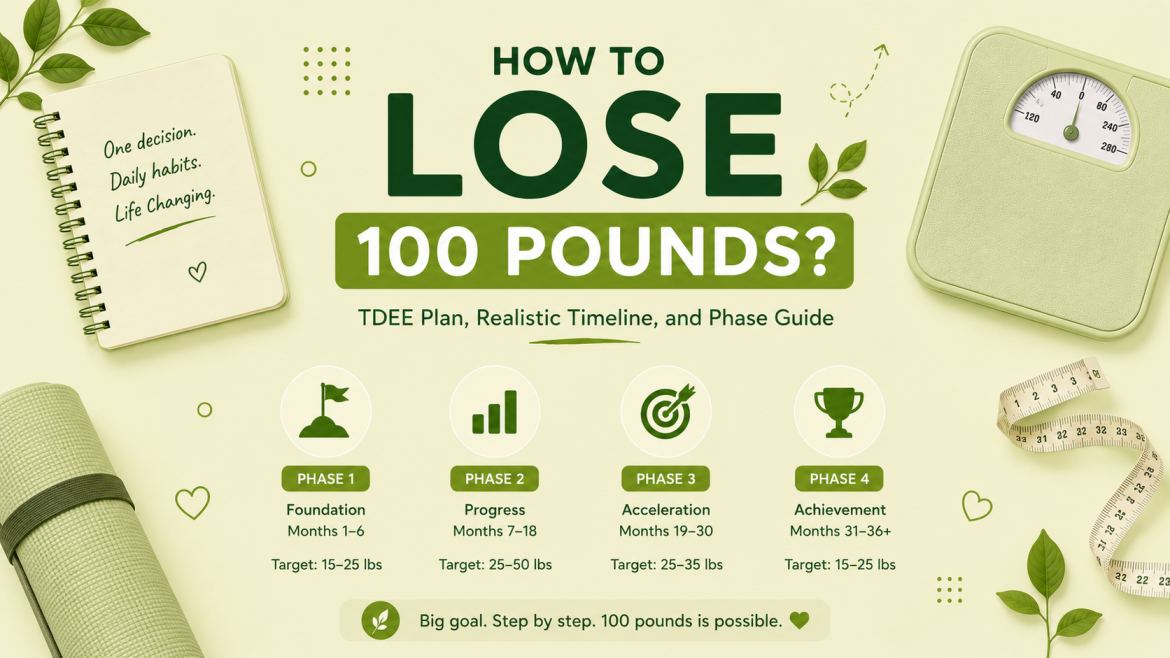
Losing 100 pounds requires a total calorie deficit of 350,000 calories. At a 750-calorie daily deficit, this takes approximately 467 days (66 weeks). At 1,000 calories per day, approximately 350 days (50 weeks). A 100-pound fat loss journey is a multi-year commitment that requires 8 to 10 TDEE recalculations, 4 to 6 planned diet breaks, and a phased structure built around metabolic adaptation management. Knowing your Total Daily Energy Expenditure (TDEE) is not optional, it is the only accurate starting point for a goal this size.
This guide covers the 100-pound weight loss plan structure, a realistic timeline at 4 deficit sizes, how to lose 100 pounds safely without destroying muscle, loose skin after 100-pound weight loss, the psychology of long-term fat loss, and how to stay motivated while losing 100 pounds. Use the TDEE calculator for weight loss to set your starting calorie target.
What Losing 100 Pounds Actually Requires?
Losing 100 pounds requires a total calorie deficit of 350,000 calories. At 1 pound per week (500-calorie daily deficit), this takes 100 weeks (approximately 2 years). At 1.5 pounds per week (750-calorie deficit), approximately 66 weeks (16 months). At the clinical ceiling of 2 pounds per week (1,000-calorie deficit), approximately 50 weeks.
A 100-pound goal is long enough that the body at the end of the journey has a TDEE 500 to 800 calories per day lower than at the start. The strategies, calorie targets, and deficit sizes that work in phase 1 must be updated multiple times throughout the journey. Without this recalibration, the same calorie intake that produced 1.5 pounds per week in the first 3 months will produce zero loss by month 12.
For the foundational framework on how to lose weight with TDEE, including the four components of daily calorie burn and how the deficit mechanism works, the guide covers the starting principles before it adds the long-term structure.
How 100 Pounds Compares to Other Goals?
Goal | Total Deficit | Minimum Weeks at 750/day | TDEE Recalculations |
|---|---|---|---|
20 pounds | 70,000 calories | 13 weeks | 1 to 2 |
50 pounds | 175,000 calories | 33 weeks | 4 to 5 |
100 pounds | 350,000 calories | 66 weeks | 8 to 10 |
What Is the Calorie Deficit to Lose 100 Pounds?
The calorie deficit to lose 100 pounds is 350,000 calories total. This number is fixed. The daily deficit determines whether the journey takes 50 weeks or 100 weeks, but the total energy removed from the body is the same regardless of pace.
At high starting body weights (typically 250 to 350 pounds), the starting TDEE is correspondingly high, which makes larger deficits possible without dropping below safe calorie floors. An adult weighing 300 pounds with a moderately active lifestyle may have a TDEE of 3,200 to 3,600 calories. A 1,000-calorie deficit produces a target of 2,200 to 2,600 calories, well above BMR and safe to sustain.
Worked example, 38-year-old woman, 140 kg, 168 cm, lightly active:
BMR = (10 x 140) + (6.25 x 168) - (5 x 38) - 161 = 2,129 kcal
TDEE = 2,129 x 1.375 = 2,927 calories
750-calorie deficit target: 2,177 calories per day
At 50 lbs lost (body weight 117 kg): TDEE reduces to approximately 2,600 calories, recalculate and reset target
Use the calorie deficit calculator at each 10-pound checkpoint throughout the journey.
Realistic Timeline for 100-Pound Weight Loss
A realistic timeline for 100-pound weight loss at a safe rate is 50 to 80 weeks, depending on starting TDEE, deficit size, and diet break frequency.
Timeline table for a 350,000-calorie total deficit:
Daily Deficit | Weekly Loss | Time to Lose 100 Pounds | Diet Breaks Needed |
|---|---|---|---|
500 cal/day | ~1 lb | ~100 weeks | 6 to 8 |
750 cal/day | ~1.5 lbs | ~66 weeks | 4 to 6 |
1,000 cal/day | ~2 lbs | ~50 weeks | 4 to 5 |
1,250 cal/day | ~2.5 lbs | ~40 weeks | 3 to 4, only for high starting TDEE |
How to Lose 100 Pounds in 6 Months?
How to lose 100 pounds in 6 months requires a daily deficit of approximately 1,944 calories. For most adults, this places calorie intake well below BMR, causing significant muscle loss, hormonal disruption, severe fatigue, and metabolic damage. The scale can drop 50 to 70 pounds in 6 months, but 30 to 40% of that loss comes from lean tissue and water rather than fat.
How to lose 100 pounds safely requires a timeline of 12 to 18 months for most adults. This pace preserves lean mass, allows skin adaptation, and builds the sustainable habits that prevent regain.
How to Lose 100 Lbs Fast?
How to lose 100 lbs fast while maintaining health and lean mass means targeting the higher end of the safe deficit range, 750 to 1,000 calories per day, at the beginning of the journey when TDEE is highest, then reducing the deficit proportionally as body weight decreases.
An adult starting at 280 pounds with a TDEE of 3,200 calories can safely sustain a 1,000-calorie deficit at an intake of 2,200 calories. At 220 pounds, the TDEE may be 2,700 calories, and the same intake of 2,200 calories now represents a 500-calorie deficit.
How to Lose 100 Pounds Safely: The Phase Structure?
A 100-pound weight loss plan built around phases prevents the metabolic stalls, muscle loss, and motivational crashes that derail most long-term fat loss attempts.
Recommended phase structure:
Phase | Duration | Goal | Key Actions |
|---|---|---|---|
Phase 1 | Weeks 1 to 10 | First 15 lbs | Set starting deficit, establish protein target, begin resistance training |
Break 1 | Weeks 11 to 12 | Hold weight | Eat at maintenance, recalculate TDEE from current weight |
Phase 2 | Weeks 13 to 24 | Next 15 to 18 lbs | Apply new calorie target, continue training |
Break 2 | Weeks 25 to 26 | Hold weight | Second maintenance period, TDEE recalculation |
Phase 3 | Weeks 27 to 38 | Next 15 lbs | Third recalculation applied |
Break 3 | Weeks 39 to 40 | Hold weight | Third maintenance period |
Phase 4 | Weeks 41 to 55 | Next 15 lbs | Fourth recalculation applied |
Break 4 | Weeks 56 to 57 | Hold weight | Fourth maintenance period |
Phase 5 | Weeks 58 to 70 | Final 10 to 20 lbs | Fifth recalculation, final phase |
What to Eat When Losing 100 Pounds: Sample Day?
A sample day at 2,000 calories for a 300-pound adult targeting a 900-calorie daily deficit (TDEE approximately 2,900 calories):
Meal | Food | Calories | Protein |
|---|---|---|---|
Breakfast | 4-egg scramble with spinach and mushrooms, 1 slice whole-grain toast | 430 kcal | 36 g |
Lunch | 220 g grilled chicken thigh, 2 cups mixed greens, half a cup of lentils, olive oil | 580 kcal | 56 g |
Snack | 200 g cottage cheese (low-fat), 1 cup strawberries | 190 kcal | 26 g |
Dinner | 200 g lean beef mince (5%), 200 g roasted sweet potato, 250 g steamed broccoli | 620 kcal | 45 g |
Snack | 1 banana, 30 g peanut butter | 290 kcal | 8 g |
Daily total | 2,110 kcal | 171 g protein |
Protein sits at approximately 1.25 g/kg for a 136 kg starting adult, below the optimal 1.6 g/kg but above the minimum floor for preservation. As weight drops toward 100 kg (220 lbs), the same gram quantity provides 1.7 g/kg, within the optimal range.
For the calorie target calculation by sex and starting weight, the how many calories to eat to lose weight guide provides the complete framework. For the macro split across all 3 macronutrients, the macros for weight loss guide covers the full ratio structure.
Exercise Progression Across a 100-Pound Journey
A 100-pound fat loss journey spans 12 to 18 months. Exercise capacity changes dramatically across that timeline. The approach in month 1 must be fundamentally different from month 12.
Phase | Exercise Focus | Frequency | Notes |
|---|---|---|---|
Months 1 to 3 | Walking + 1 to 2 light resistance sessions | 5 walks/week + 2 gym/week | Joint stress is high at starting weight, avoid high-impact |
Months 4 to 6 | Walking + 2 to 3 resistance sessions | 5 walks/week + 3 gym/week | Increase resistance load as fitness improves |
Months 7 to 9 | Resistance + 2 low-impact cardio (cycling, swimming) | 3 resistance + 2 cardio/week | At 50 lbs lost, joints tolerate more activity |
Months 10 to 12 | Full resistance program + varied cardio | 3 to 4 sessions/week | Increase intensity, not volume |
Months 12+ | Maintenance-level activity | 3 sessions/week | Protect the weight lost |
At high starting body weights, joint stress from running is a significant injury risk. Walking, cycling, rowing, and swimming produce equivalent caloric burn with far less joint load. Low-impact cardio is not a compromise, it is the correct tool for the first 6 months of a 100-pound journey. For those whose mobility or joint health makes any structured exercise difficult, the how to lose weight without exercise guide covers the diet-only approach and body composition outcomes.
Medical Check-in Schedule for a 100-Pound Goal
A 100-pound fat loss at the caloric deficits required is a significant physiological event. Routine medical monitoring during the journey catches complications before they become problems and confirms the loss is coming from fat rather than lean mass and bone density.
Recommended medical check-in schedule:
Checkpoint | What to Check | Why |
|---|---|---|
Before starting | Blood panel (glucose, HbA1c, lipids, thyroid, vitamin D), BMI, blood pressure | Establish baseline; identify conditions that affect calorie targets |
At 25 lbs lost | Blood pressure, fasting glucose, and weight trend review | Assess improvement in metabolic markers |
At 50 lbs lost | Full blood panel, kidney function, bone density if over 40 | At the midpoint, confirm lean mass retention, check electrolytes |
At 75 lbs lost | Blood pressure, lipids, HbA1c | Confirm cardiovascular improvements |
At the goal weight | Full blood panel, body composition scan | Establish a new baseline for maintenance |
Non-Scale Progress Metrics for a 100-Pound Journey
Over a 12 to 18-month journey, the scale will stall repeatedly. Tracking non-scale metrics prevents the discouragement that causes abandonment at every plateau.
Metrics to track every 2 weeks:
Waist circumference at the navel on an exhale
Hip and thigh circumference
Resting heart rate (declining resting HR indicates improving cardiovascular fitness)
Walking distance or pace at the same effort level
Energy level and sleep quality (self-rated on a 1 to 10 scale)
Progress photos at the same time of day and lighting
A waist decreasing 1 inch per month with a scale plateau is successful fat loss. Visceral fat (around the organs) releases before subcutaneous fat in most adults, producing measurable waist reduction before the scale reflects the change. For belly fat specifically and why it often appears to change last on the scale, the how to lose belly fat guide covers the distinction between visceral and subcutaneous fat loss.
For the mechanics of diet breaks and metabolic adaptation management at each phase, the weight loss plateau guide covers NEAT suppression, leptin restoration, and the specific interventions that restart stalled fat loss.
How Many Times to Recalculate TDEE Losing 100 Lbs?
Recalculate TDEE every 10 pounds lost, producing 8 to 10 recalculations over a 100-pound journey. Each recalculation uses the current body weight in the Mifflin-St Jeor equation. Skipping recalculations is the primary reason 6-month plateau periods develop in long-term fat loss.
What changes at each recalculation:
Daily calorie target decreases by 25 to 60 calories per 10 pounds lost
Protein target (in grams) decreases slightly as body weight decreases
The activity multiplier may change if the training level has changed
The TDEE calculator accepts updated body weight, height (stable after initial entry), age, and activity level at each checkpoint.
Loose Skin After 100-Pound Weight Loss
Loose skin after 100 pound weight loss is common and expected, particularly in adults over 30 and those who lose weight rapidly. Skin is an organ that adapts to body size over time. When body fat decreases faster than skin contracts, loose folds form in areas of high fat storage, typically the abdomen, inner thighs, upper arms, and chest.
4 factors that influence loose skin severity:
Speed of loss: Losing 100 pounds over 16 to 20 months allows significantly more skin adaptation than losing the same amount over 8 to 10 months.
Age: Skin collagen production decreases by approximately 1% per year after age 20. Adults over 40 experience more loose skin than younger adults at the same rate of loss.
Resistance training: Building lean mass replaces fat volume under the skin, reducing the visible degree of loose skin in all major areas.
Hydration and nutrition: Collagen synthesis requires adequate vitamin C, zinc, and protein. Deficiencies during the cut increase the risk of loose skin.
Surgical skin removal (body contouring) after a 100-pound weight loss is common. Most plastic surgeons recommend waiting 12 to 18 months after reaching goal weight before surgery, as skin continues to contract during the maintenance period.
Psychology of Long-Term Fat Loss: Staying Motivated
Psychology of long-term fat loss is an evidence-based field with specific strategies for maintaining motivation over a 50 to 80-week journey. The research consistently identifies 3 mechanisms that distinguish people who complete 100-pound goals from those who abandon them.
How to Stay Motivated Losing 100 Pounds?
How to stay motivated losing 100 pounds over 12 to 18 months requires systems, not willpower. Willpower is a finite resource. The following 3 approaches replace willpower dependence with structural support:
Milestone-Based Tracking: Set explicit milestones every 10 pounds (every TDEE recalculation checkpoint). Celebrate each milestone as a separate completed goal. The psychology of visible progress prevents the "all or nothing" thinking that causes abandonment.
Non-Scale Metrics: Weight fluctuates by 2 to 5 pounds daily from water, sodium, and hormonal cycles. Tracking waist circumference, clothing fit, and fitness performance metrics (resting heart rate, strength levels, walking endurance) prevents false-negative feedback from normal scale variation.
Planned Maintenance Periods: Diet breaks, scheduled in advance, remove the psychological cost of "breaking the diet." Knowing a planned maintenance week is coming in 6 weeks reduces the psychological fatigue of indefinite restriction.
For context on what the same TDEE-based approach produces at the 50-pound scale, the how to lose 50 pounds guide covers the 4-phase structure for that goal. For breaking plateaus during the journey, the how long does it take to lose weight guide covers weight loss rate expectations at every stage.
100-Pound Weight Loss Results: What Changes
100-pounds of weight loss before and after changes are among the most significant body change outcomes documented in medical literature.
Documented health improvements from 100-pound fat loss include:
Type 2 Diabetes: Remission rates of 50 to 80% in people with obesity-related type 2 diabetes following a 100-pound fat loss
Blood Pressure: Average systolic reductions of 15 to 25 mmHg, often allowing medication reduction or elimination
Joint Health: Each pound lost reduces knee joint load by approximately 4 pounds during walking: a 100-pound loss reduces load by 400 pounds per step
Sleep Apnea: Significant improvement or full resolution in most cases of obesity-related obstructive sleep apnea
Cardiovascular Risk: Meaningful reductions in LDL cholesterol, triglycerides, and inflammatory markers across all major cardiovascular risk categories
These outcomes are not guaranteed by weight loss alone, they depend on the composition of the loss (fat vs lean mass), the maintenance of physical activity, and adherence to the maintained weight over 12 to 24 months after the goal is reached.
5 Common Mistakes That Derail a 100-Pound Fat Loss Goal
Starting Too Aggressively: A 1,500-calorie deficit from day one at 300 pounds produces fast early results and a plateau by month 3 with significant lean mass loss. A 700 to 1,000-calorie deficit at a sustainable level produces better body composition and adherence across 12 to 18 months.
Not Recalculating TDEE: A person who starts at 300 pounds and never recalculates TDEE is using a target built for a 300-pound body by the time they weigh 220 pounds. At that point, the original calorie intake may be maintenance, not a deficit. Recalculate every 10 pounds without exception.
Measuring Progress Only by Scale Weight: The scale does not separate fat, water, muscle, and bone. A month with zero scale movement but declining waist circumference is a successful month. Abandoning a working plan because of a 2-week scale plateau is the primary cause of failure at the 100-pound scale.
Skipping All Diet Breaks: Dieting continuously for 12 months without planned breaks guarantees metabolic adaptation severe enough to require extreme restriction to maintain any deficit. Planned breaks at every phase transition restore the conditions for continued fat loss.
Treating the Goal as One 100-Pound Goal Instead of Ten 10-Pound Goals: A 100-pound target creates psychological overwhelm. Treating each 10-pound checkpoint as a complete goal: celebrated, recalculated, and reset: produces the same mathematical outcome with dramatically better adherence.
How to Maintain 100 Pounds of Weight Loss?
Maintaining 100 pounds of fat loss is harder than losing it. The body at the goal weight has a TDEE 500 to 800 calories lower than at the start, with chronically suppressed leptin, elevated ghrelin, and a nervous system conditioned to conserve energy.
The 3 requirements for sustained maintenance:
Reverse diet over 6 to 10 weeks: Add 100 calories per week to the final deficit intake until weight stabilizes at the goal for 3 consecutive weeks. Jumping immediately to estimated maintenance calories causes a 5 to 10 pound water and glycogen rebound that feels like fat gain but is not.
Maintain resistance training at 2 sessions per week minimum: Every study on long-term weight maintenance identifies continued resistance training as the strongest single predictor of keeping the weight off. Muscle mass supports the elevated TDEE required to stay at the lower weight.
Monitor with a re-entry trigger: A 5-pound increase above the maintenance weight held for 2 weeks returns to a 250 to 300-calorie deficit for 4 to 6 weeks. Early re-entry prevents the gradual creep that turns 5 pounds back into 20.
For those continuing into midlife maintenance, the how to lose weight after 40 guide covers the hormonal and metabolic adjustments that affect maintenance in that age group. For the monthly structure of a maintenance check, the how to lose weight in a month guide covers 30-day calorie structures applicable to re-entry cuts.
Other Fat Loss Goal Guides in This Series
Every guide in this series uses the same TDEE-based calorie deficit framework. The total calorie deficit required and the realistic timeline differ by goal amount. Use the table below to find the guide that matches your target.
Goal Guide | Total Calorie Deficit | Realistic Timeline |
|---|---|---|
17,500 calories | 2.5 to 5 weeks | |
35,000 calories | 5 to 10 weeks | |
70,000 calories | 13 to 20 weeks | |
105,000 calories | 20 to 30 weeks | |
175,000 calories | 33 to 50 weeks |
All timelines assume a 500 to 750-calorie daily deficit with TDEE recalculated at every 10-pound checkpoint. Faster timelines are possible at higher deficits for adults with a high starting TDEE.
Frequently Asked Questions
How long does it realistically take to lose 100 pounds?
Losing 100 pounds of fat realistically takes 50 to 80 weeks at a daily deficit of 750 to 1,000 calories, with consistent TDEE recalculation at every 10-pound checkpoint and 4 to 6 planned diet breaks. At the safe clinical ceiling of 2 pounds per week, the minimum timeline is approximately 50 weeks.
How to lose 100 pounds safely?
Losing 100 pounds safely requires a daily deficit no larger than 1,000 to 1,250 calories (proportionate to starting TDEE), protein intake at 1.6 to 2.2 g/kg throughout the journey, resistance training 2 to 3 times per week, 8 to 10 TDEE recalculations over the full journey, and 4 to 6 planned diet breaks to prevent cumulative metabolic adaptation.
How often should I recalculate TDEE losing 100 pounds?
Recalculate TDEE every 10 pounds lost, producing 8 to 10 total recalculations. Each recalculation uses current body weight in the Mifflin-St Jeor equation to produce an updated calorie target. Failing to recalculate allows the effective deficit to narrow to near zero by the halfway point.
Will I have loose skin after losing 100 pounds?
Loose skin after a 100-pound loss is common, especially in adults over 30 who lose weight quickly. Losing weight over 16 to 20 months, maintaining resistance training throughout, and staying adequately hydrated all reduce severity. Most surgeons recommend waiting 12 to 18 months after reaching goal weight before considering body contouring surgery.
How do you stay motivated for a 100-pound weight loss goal?
Staying motivated over a 12 to 18-month journey requires milestone-based tracking at every 10 pounds, non-scale progress metrics (waist circumference, clothing fit, fitness performance), and scheduled diet breaks that prevent the psychological fatigue of indefinite restriction. Willpower-based approaches consistently fail at this timescale while structural systems consistently succeed.