
Macros for Weight Loss: The Best Ratio of Protein, Carbs, and Fat
Learn the best macro ratios for fat loss, how to calculate protein, carbs, and fat grams from your TDEE, and why hitting your protein target matters more than any other number.

Your body has a number. Let's find it.
We calculate the exact calorie target your body needs, built from your stats and goal, then track everything against it daily. Log meals, add workouts, set a weight goal, and watch your numbers update in real time. Check in weekly to see calories, water, and weight trend in one place.
No spreadsheets. No guessing. Just results.
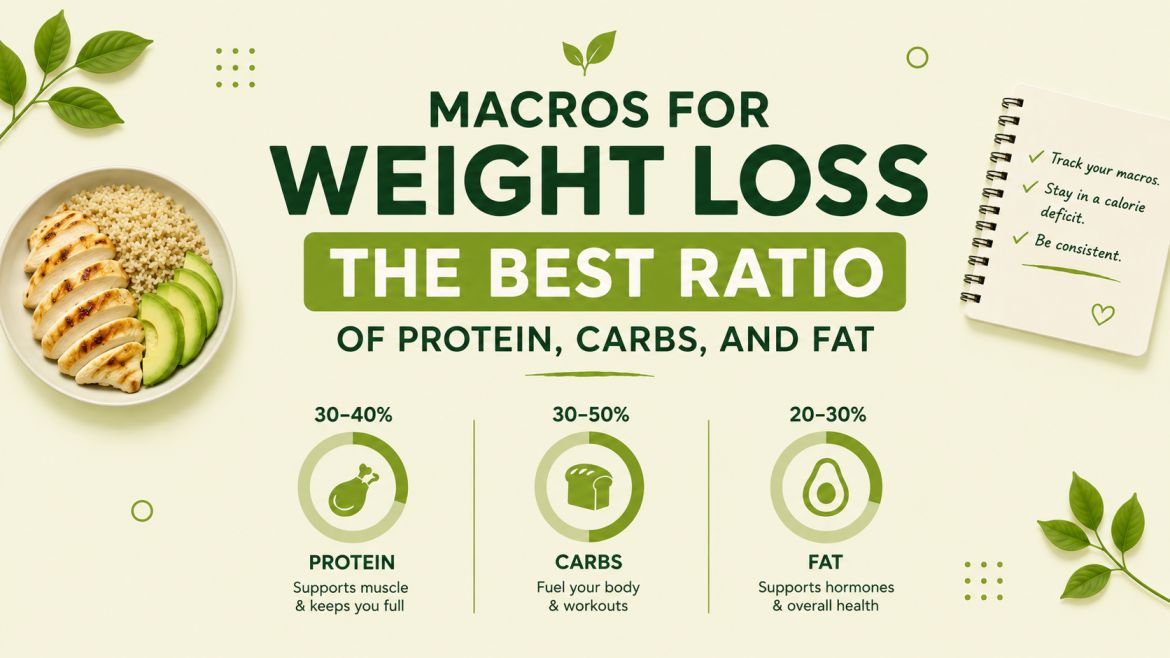
Macros for weight loss refers to the distribution of protein, carbohydrates, and fat within a daily calorie target. Total calorie intake determines whether fat loss occurs. The protein fat carb ratio for weight loss determines body composition quality during that fat loss: how much of the weight lost comes from fat versus muscle.
The single most impactful macro adjustment for weight loss is increasing protein intake. Research consistently shows that higher protein diets during a calorie deficit preserve lean mass, reduce hunger, and maintain a higher metabolic rate throughout the diet. The carbohydrate-to-fat split matters less and depends largely on individual food preference and training demands.
For the full weight loss picture, macros for weight loss work alongside a calorie deficit calculated from your TDEE. The TDEE Calculator generates your daily calorie burn, which is the starting point before setting any macro targets with calculator.
What Are Macros and Why Do They Matter for Weight Loss?
Macronutrients (macros) are the three calorie-containing nutrients in food: protein, carbohydrates, and fat. Each provides energy at a different caloric density and produces different hormonal and metabolic responses.
Macronutrient | Calories Per Gram | Primary Function | Satiety Score |
|---|---|---|---|
Protein | 4 kcal/g | Muscle repair, enzyme production, hormone synthesis | Highest |
Carbohydrate | 4 kcal/g | Primary fuel for brain and muscle, glycogen storage | Moderate |
Fat | 9 kcal/g | Hormone production, fat-soluble vitamin absorption | High (delayed) |
The 2015-2020 Dietary Guidelines for Americans establish the Acceptable Macronutrient Distribution Ranges (AMDR) as: protein 10 to 35%, carbohydrates 45 to 65%, and fat 20 to 35% of total calories. These ranges are broad by design. For weight loss, protein targets sit at the upper range of the AMDR, while carbohydrate and fat distribution depends on personal preference and exercise type.
What Is the Best Macro Ratio for Fat Loss?
No single macro ratio produces fat loss independent of calorie deficit. A person eating 40% protein, 40% carbs, and 20% fat in a 200-calorie surplus gains weight. A person eating 40% carbs, 30% protein, and 30% fat in a 500-calorie deficit loses fat.
The best macro ratio for fat loss in a calorie deficit is:
Starting ratio: 30% protein / 40% carbs / 30% fat (the 40/30/30 macro split)
This split is evidence-supported, practical to follow, and works across different food preferences. It forms the basis of flexible dieting and IIFYM (If It Fits Your Macros) approaches, which allow any food as long as the daily macro targets are hit. The macro split for cutting (fat loss) leans slightly higher in protein and lower in fat compared to maintenance splits. Adjustments from the 40/30/30 baseline:
If hunger is persistently high: increase protein to 35%, reduce carbs to 35%
If training involves heavy lifting 4+ times per week: increase carbs to 45%, reduce fat to 25%
If low-carb eating is preferred: reduce carbs to 25%, increase fat to 40%, keep protein at 35%
A 2024 review in Healthline confirmed that while macro ratio does not independently drive fat loss, higher protein intakes consistently produce better body composition outcomes during a calorie deficit, regardless of where the remaining calories come from.
How to Calculate Macros for Weight Loss?
Calculating macros requires four steps: find TDEE, set the deficit, choose the ratio, and convert to grams.
Step 1: Find Your Daily Calorie Target
TDEE minus deficit equals daily calorie target. Use the Calorie Deficit Calculator to generate this number based on your stats and goal weight.
Example: TDEE 2,200 kcal, 500-calorie deficit
Daily calorie target = 2,200 - 500 = 1,700 kcal
Step 2: Set Protein Target (Most Important Step)
Set protein first because it is the least flexible macro during fat loss. Research from NASM recommends 1.6 to 2.2 g/kg body weight for individuals in a calorie deficit, with the higher end for those who train with weights.
Example: 75 kg person, 1.8 g/kg protein
Protein = 75 x 1.8 = 135 grams = 540 calories (135 x 4)
Step 3: Allocate Remaining Calories to Fat and Carbs
Subtract protein calories from total to find calories for fat and carbs.
Remaining calories: 1,700 - 540 = 1,160 kcal
Distribute remaining 1,160 calories using the 50/50 (fat/carbs) starting point:
Fat: 580 kcal / 9 = 65 grams
Carbs: 580 kcal / 4 = 145 grams
Step 4: Daily Macro Targets (Summary)
Macro | Grams | Calories | % of Total |
|---|---|---|---|
Protein | 135 g | 540 kcal | 32% |
Fat | 65 g | 585 kcal | 34% |
Carbohydrates | 145 g | 580 kcal | 34% |
Total | 1,705 kcal | 100% |
Why Is Protein the Most Important Macro for Fat Loss?
Protein performs 4 critical functions during a calorie deficit that no other macro replicates.
Muscle Preservation
A 2015 study comparing 1.0 g/kg versus 2.3 g/kg protein during a calorie deficit found that the low-protein group lost 1.6 kg of muscle mass while the high-protein group lost only 0.3 kg. Preserving muscle mass protects BMR throughout the diet and improves body composition at goal weight.
Higher Satiety
Protein increases satiety hormones (peptide YY, GLP-1) and reduces ghrelin more effectively than carbohydrates or fat. A 2014 study published in the American Journal of Clinical Nutrition found that increasing protein from 15% to 30% of calories reduced daily calorie intake by 441 calories spontaneously, without any explicit calorie restriction instruction.
Higher Thermic Effect
The thermic effect of food (TEF) is the calorie cost of digesting each macro. Protein has a TEF of 20 to 30%, meaning 100 calories of protein costs 20 to 30 calories to digest. Carbohydrates cost 5 to 10%. Fat costs 0 to 3%. A high-protein diet burns 50 to 100 more calories per day through digestion alone.
Metabolic Rate Protection
Higher protein intake suppresses the drop in resting metabolic rate associated with calorie restriction. A 2012 study in the Journal of the American Medical Association found that very low-fat, low-protein diets reduced total energy expenditure by 423 calories per day more than high-protein, low-carb diets over a 4-week period.
How Many Grams of Protein Per Day for Weight Loss?
Protein targets for weight loss depend on body weight and training status.
Population | Protein Target (g/kg body weight) | Example: 75 kg person |
|---|---|---|
Sedentary adult in deficit | 1.2 - 1.5 g/kg | 90 - 113 g/day |
Active adult in deficit | 1.6 - 2.0 g/kg | 120 - 150 g/day |
Resistance training in deficit | 2.0 - 2.4 g/kg | 150 - 180 g/day |
Lean individual (< 15% BF male) | 2.2 - 2.7 g/kg | 165 - 203 g/day |
These targets sit well above the USDA Recommended Daily Allowance of 0.8 g/kg, which represents the minimum to prevent deficiency, not the amount needed to preserve muscle during weight loss. The article on protein intake for weight loss covers individual protein calculations in full detail.
What Role Do Carbohydrates Play in Weight Loss?
Carbohydrates are not required for fat loss. Fat loss occurs at all carbohydrate intake levels provided a calorie deficit exists. Carbohydrates do, however, support several important functions during a fat loss phase.
Functions of carbohydrates during weight loss:
Fuel intense exercise sessions (muscle glycogen is the primary fuel for weight training and high-intensity cardio)
Support brain function and mood (the brain uses 120 g of glucose per day as its primary fuel)
Maintain fiber intake for gut health and satiety (dietary fiber from vegetables, legumes, and whole grains slows gastric emptying)
Prevent cortisol elevation that occurs with very low carbohydrate intake during high training volumes
The optimal carbohydrate range for weight loss is 35 to 50% of total calories, adjusted based on training intensity and personal preference. Individuals who perform 4+ hours of training per week benefit from the higher end. Sedentary individuals may prefer the lower end, where fat provides more of the non-protein energy.
Low carb vs low fat for fat loss: research consistently shows that when protein and total calories are matched, both approaches produce equivalent fat loss. The winning approach is whichever is more sustainable for the individual. Low carb tends to reduce hunger more in the short term due to ketosis and appetite suppression from ketones. Low fat tends to allow higher carbohydrate intake, which supports exercise performance better.
Carb cycling for fat loss involves alternating higher-carb days (matched to training sessions) with lower-carb days (on rest days). This keeps total weekly carbs and calories controlled while using carbohydrate timing to fuel workouts and accelerate recovery.
What Role Does Fat Play in Weight Loss?
Dietary fat is not the primary driver of body fat gain. Excess total calories are. Fat is an essential macro with critical roles that cannot be eliminated without health consequences.
Minimum fat intake during weight loss: 0.3 g per pound of body weight (or 20% of total calories). Dropping below this threshold impairs:
Sex hormone production (testosterone, estrogen)
Absorption of fat-soluble vitamins (A, D, E, K)
Cell membrane integrity and cognitive function
Gallbladder function (very low fat diets increase gallstone risk)
Fat also contributes to satiety with a delayed effect. High-fat meals slow gastric emptying, producing sustained fullness 2 to 3 hours after eating. This effect makes fat a useful macro for controlling hunger in moderate amounts, though the high calorie density (9 kcal/g versus 4 kcal/g for protein and carbs) requires portion awareness.
Common Macro Mistakes During Weight Loss
Over-prioritizing carb and fat ratios while under-hitting protein: Missing the protein target by 30+ grams per day over weeks significantly increases muscle loss. A high protein macro plan for weight loss sets protein first (30 to 35% of calories), then fills the remaining budget with carbs and fat in whatever split feels most sustainable.
Does macro split matter if calories are the same? For scale weight loss, no. For body composition (fat vs muscle ratio at goal weight), yes. Identical calories at 10% protein vs 35% protein produce significantly different amounts of lean mass retention over a 12-week deficit. The protein percentage is the one macro variable that materially changes fat loss outcomes.
Setting macros without knowing TDEE: Macro percentages on a calorie intake that is too high or too low produce incorrect gram targets. Always set total calories from TDEE first before converting to macros.
Tracking percentages instead of grams: Percentages shift as total calories change. Track grams. 135 g of protein is 135 g regardless of what percentage that represents on a given day.
Eliminating entire food groups: Neither fat nor carbohydrates need to be eliminated for fat loss. Both support performance, health, and adherence to the diet. Sustainable macro splits include all three macros in meaningful amounts.
The Macro Calculator generates protein, carb, and fat gram targets based on your TDEE, body weight, and goal, removing the manual calculation step.
Tracking Macros: Practical Steps
Macro tracking produces the most accurate results when food is weighed and logged consistently. Three approaches in order of accuracy:
Food scale + tracking app: Weighing food in grams and logging in MyFitnessPal or Cronometer is the most accurate method. Research shows this approach reduces calorie intake estimation error from 30-50% to under 10%.
Portion estimation: Using hand-based portions (palm = protein serving, fist = carb serving, thumb = fat serving) is less precise but practical for social eating and travel. Accuracy is approximately 75 to 80% of food scale tracking.
Meal templates: Preparing the same 5 to 8 meals repeatedly removes the need to recalculate macros daily. Once the template meals are logged accurately once, they can be reused without re-tracking.
Macro tracking does not need to continue indefinitely. 4 to 8 weeks of accurate tracking builds food awareness that most people can sustain intuitively thereafter.
Frequently Asked Questions About Macros for Weight Loss
Do Macros Matter More Than Calories for Weight Loss?
Calories matter more than macros for whether fat loss occurs. Macros matter for the quality of that fat loss. A person in a calorie deficit loses weight regardless of macro ratio. What macros determine is how much of the weight lost comes from fat versus muscle. Higher protein intake during a deficit consistently produces better body composition outcomes, more fat lost, less muscle lost, than lower protein intakes at the same total calories. The macro split only matters once total calories are correct.
Should I Count Macros or Calories?
Either approach produces fat loss when adhered to consistently. Counting macros has one practical advantage: it forces protein tracking, which most calorie counters ignore. Research shows that people tracking macros eat more protein on average than those tracking calories alone, which results in better muscle retention and greater satiety per calorie. For beginners, tracking calories first establishes portion awareness. Adding macro targets (especially protein goals) is the logical second step once calorie tracking feels comfortable.
What Are the Best Macros for Losing Belly Fat?
No macro ratio specifically targets belly fat. Visceral fat (abdominal fat) responds to total calorie deficit, not macro manipulation. That said, high protein intake (30 to 35% of calories) combined with a calorie deficit produces proportionally greater loss of visceral fat than low protein deficits, based on a 2017 study in Obesity Reviews. Reducing refined carbohydrates and liquid calories also reduces abdominal fat accumulation independent of total calorie changes, but this effect operates through calorie reduction rather than macro specificity.
How Do I Track Macros While Eating Out?
Restaurant meals are the hardest to track because portion sizes and preparation methods vary widely. Three practical strategies help. First, pre-log the restaurant meal using the app's restaurant database or generic entries before you eat, not after. Second, apply the "protein anchor" method: order a dish with a clear protein source, estimate that protein portion, and build the rest of the meal estimate around it.
Third, use a conservative calorie estimate (add 20 to 30% to app estimates for restaurant meals) since research shows people consistently underestimate restaurant calorie content by 175 to 500 calories per meal.
Is a High-Protein Low-Carb Diet Better for Weight Loss?
High-protein low-carb diets produce faster initial weight loss than standard diets due to glycogen depletion (which releases water) and a greater thermic effect. Long-term fat loss outcomes are equivalent when total calories are matched between diets, based on multiple randomized controlled trials.
The primary reason high-protein diets outperform standard protein diets in research is not the carb reduction itself but the protein increase. People who increase protein while keeping carbs moderate lose just as much fat as those who increase protein and reduce carbs simultaneously.
What Happens if You Hit Your Calorie Goal but Miss Your Protein Target?
Missing the protein target while meeting calorie goals increases lean muscle loss during the deficit. Research comparing 1.0 g/kg versus 2.3 g/kg protein at identical calorie deficits found that the low-protein group lost 1.3 kg more muscle over 4 weeks. More muscle loss means a lower TDEE after the diet, making future fat loss harder. The practical priority order is: 1) total calories, 2) protein target, 3) carb and fat distribution. Hitting protein first, then filling the remaining calorie budget with carbs and fat, produces the best body composition outcomes.