
How to Lose 30 Pounds? Calorie Deficit, Realistic Timeline, and Plan
Learn how to lose 30 pounds using TDEE-based calorie deficit. Includes timeline table, TDEE recalculation schedule, diet break strategy, and muscle preservation tips.

Your body has a number. Let's find it.
We calculate the exact calorie target your body needs, built from your stats and goal, then track everything against it daily. Log meals, add workouts, set a weight goal, and watch your numbers update in real time. Check in weekly to see calories, water, and weight trend in one place.
No spreadsheets. No guessing. Just results.
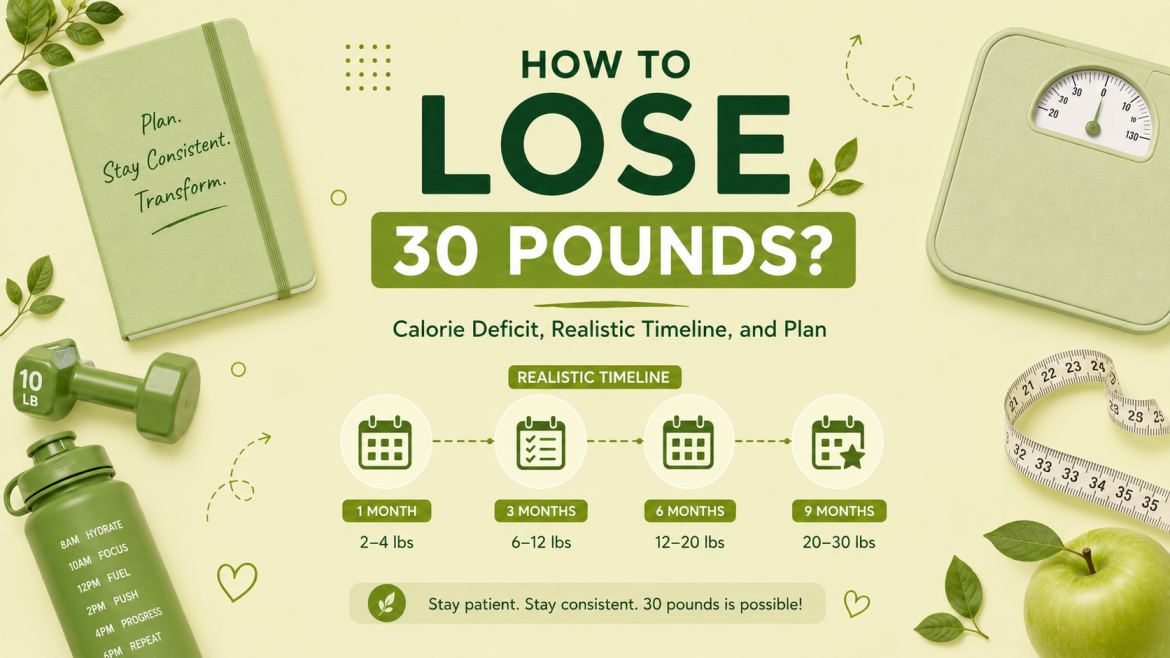
Losing 30 pounds requires a total calorie deficit of 105,000 calories. At a 500-calorie daily deficit, this takes approximately 30 weeks. At 750 calories per day, the same goal takes roughly 20 weeks. A 30-pound fat loss journey is long enough to require at least 2 TDEE recalculations and at least 1 planned diet break. Understanding your Total Daily Energy Expenditure (TDEE) before starting sets the only accurate foundation for this goal.
This guide covers the calorie deficit to lose 30 pounds, a timeline table at 4 deficit sizes, how does TDEE change as you lose 30 pounds, how to avoid muscle loss losing 30 lbs, and when to use a diet break during 30 pound fat loss. Use the TDEE calculator for weight loss to establish your starting calorie target.
What Does a 30-Pound Fat Loss Actually Require?
A 30-pound fat loss requires removing 105,000 calories from your energy balance over the duration of the cut. One pound of stored body fat contains approximately 3,500 calories. Multiplied by 30, the total deficit required is fixed regardless of how fast or slow the journey proceeds.
What changes with speed is the daily deficit size, the risk to lean mass, and the degree of metabolic adaptation. Faster cuts produce faster scale movement but require more precise nutrition and greater NEAT suppression management. Slower cuts allow better adherence and lower muscle loss risk but require sustained consistency over 6 to 8 months.
For the full guide on how to lose weight with TDEE, including the four components of daily calorie burn and how to set up the deficit from scratch, that guide covers the complete framework.
How 30-Pound Weight Loss Breaks Down Over Time?
A 30-pound journey does not progress at the same rate from start to finish. The body adapts progressively as fat mass decreases.
Phase | Weeks | Expected Weekly Loss | Key Event |
|---|---|---|---|
Phase 1 | 1 to 8 | 1 to 1.5 lbs | Initial fat loss, glycogen water lost in week 1 |
Phase 2 | 9 to 16 | 0.75 to 1 lb | First TDEE recalculation at 10 lbs lost |
Phase 3 | 17 to 24 | 0.5 to 0.75 lb | Second recalculation at 20 lbs; consider diet break |
Phase 4 | 25 to 30 | 0.5 lb | Final 10 lbs, hardest phase, NEAT suppression peaks |
What Is the Calorie Deficit to Lose 30 Pounds?
The calorie deficit to lose 30 pounds is 105,000 calories total. The daily deficit determines the timeline. At 500 calories per day, the total is reached in 210 days (30 weeks). At 750 calories per day, in 140 days (20 weeks).
The deficit is always calculated from your current TDEE, not from a fixed calorie number. TDEE is calculated using the Mifflin-St Jeor equation applied to your current body weight, height, age, and activity level.
How Many Calories to Lose 30 Pounds?
How many calories to lose 30 pounds depends on two numbers: your starting TDEE and your chosen deficit size. The formula is: Daily Calorie Target = TDEE - Daily Deficit.
Worked example for a 40-year-old woman, 80 kg, 163 cm, lightly active:
BMR = (10 x 80) + (6.25 x 163) - (5 x 40) - 161 = 1,458 kcal
TDEE = 1,458 x 1.375 = 2,005 calories
500-calorie deficit target: 1,505 calories per day
At 10 pounds lost (body weight 75.5 kg): recalculate BMR and TDEE, new target approximately 1,470 calories
Use the calorie deficit calculator to run these numbers with your own stats at each recalculation point.
Timeline table for a 105,000-calorie total deficit:
Daily Deficit | Weekly Loss | Time to Lose 30 Pounds | Notes |
|---|---|---|---|
250 cal/day | ~0.5 lb | 60 weeks | Very conservative, suits those close to BMR floor |
500 cal/day | ~1 lb | 30 weeks | Standard, most sustainable approach |
750 cal/day | ~1.5 lbs | ~20 weeks | Requires protein prioritization and resistance training |
1,000 cal/day | ~2 lbs | ~15 weeks | Near ceiling, only suitable with high starting TDEE |
How Long Does It Take to Lose 30 Pounds?
How long to lose 30 pounds depends on the starting TDEE, the deficit size, and whether TDEE is updated at each 10-pound interval. A realistic timeline for 30 pound weight loss at a 500 to 750-calorie daily deficit is 20 to 30 weeks, accounting for 2 TDEE recalculations and a potential 1 to 2 week diet break.
30 pounds fat loss in 6 months (24 weeks) requires a daily deficit of approximately 730 calories. This is achievable for most adults who start with a TDEE above 1,800 calories, maintain protein intake at 1.6 g/kg or above, and recalculate TDEE at each 10-pound interval.
For context on how 30 pounds compares to shorter and longer goals, the how long does it take to lose weight guide covers every major fat loss goal with deficit-size comparisons.
How to Lose 30 Pounds in 3 Months?
How to lose 30 pounds in 3 months (approximately 13 weeks) requires a daily deficit of approximately 1,154 calories. For an adult with a TDEE of 2,400 calories, this means eating roughly 1,246 calories per day from diet alone, below the safe floor for most women and near the floor for most men.
Losing 30 pounds in 3 months is not realistic through safe fat loss alone. At 2 pounds per week (the clinical ceiling), 3 months produces approximately 24 to 26 pounds. The remaining 4 to 6 pounds would require extending the plan into a fourth month. A more practical timeline is 20 weeks at 750 calories per day.
How to Lose 30 Pounds in 2 Months?
How to lose 30 pounds in 2 months requires a daily deficit of approximately 1,750 calories. For most adults, this would mean eating below BMR, causing significant muscle catabolism and metabolic adaptation. The scale can drop 20 to 25 pounds in 8 weeks, but a substantial portion represents water and glycogen loss rather than fat.
How Does TDEE Change as You Lose 30 Pounds?
How TDEE changes as you lose 30 pounds is the most important concept separating successful 30-pound cuts from stalled ones. Each pound of body weight lost reduces BMR by approximately 5 to 8 calories per day. Over 30 pounds, the cumulative TDEE reduction is 150 to 240 calories per day.
This reduction is why the original deficit narrows progressively without any change in eating behavior. A person who starts with a 500-calorie deficit at 200 pounds may have only a 300-calorie deficit by the time they reach 170 pounds, using the same daily calorie target.
TDEE recalculation schedule for a 30-pound journey:
At 10 pounds lost: Recalculate TDEE from new body weight. Reset daily target.
At 20 pounds lost: Recalculate again. Consider a 1 to 2 week diet break before the final phase.
At plateau (2+ weeks of no loss): Recalculate immediately regardless of pounds lost.
The TDEE calculator allows recalculation in under 60 seconds at each checkpoint.
How to Lose 30 Lbs Fast Without Losing Muscle?
How to lose 30 lbs fast while preserving lean mass requires 4 simultaneous inputs. Muscle loss during an aggressive cut is not caused by the deficit itself, it is caused by inadequate protein and insufficient resistance training stimulus.
Protein Target: 1.6 to 2.2 grams per kilogram of body weight per day throughout the full 20 to 30 week journey
Resistance Training: 2 to 3 sessions per week at all phases: not just early weeks
Diet Breaks: 1 to 2 weeks at maintenance every 8 to 10 weeks of dieting restores leptin and prevents NEAT from suppressing further
Sleep: 7 to 9 hours per night: cortisol from sleep deprivation accelerates lean mass breakdown during caloric restriction
Diet Break During 30 Pound Fat Loss
A diet break during 30 pound fat loss is a planned period of 1 to 2 weeks at maintenance calories, scheduled approximately every 8 to 10 weeks of active deficit. Research published in the International Journal of Obesity found that participants who took 2-week diet breaks every 2 weeks of dieting lost more fat and less muscle than those who dieted continuously.
Diet breaks are not the same as cheat days. A diet break means eating at full TDEE (maintenance calories) for the planned period. Weight may increase by 1 to 3 pounds during the break from glycogen and water restoration, but this is not fat gain.
For more on how metabolism adapts during extended cuts, the weight loss plateau guide covers metabolic adaptation and how to manage NEAT suppression.
The 30-Pound Weight Loss Plan: Phases and Actions
A structured 30 pound weight loss plan prevents the 3 most common failure points: plateau frustration at weeks 6 to 8, TDEE staleness past 10 pounds, and lean mass loss from prolonged restriction without breaks.
Phase structure:
Phase 1 (Weeks 1 to 8): Set calorie target at TDEE minus 500 to 750 calories. Hit protein target daily at 1.6 to 2.2 g/kg. Expect fast scale drop in week 1 from glycogen water.
Diet Break (Weeks 9 to 10): Eat at maintenance. Recalculate TDEE from 10-pound lighter weight. Reset daily target before Phase 2.
Phase 2 (Weeks 11 to 18): Apply recalculated calorie target. Continue resistance training. Expect slower rate of 0.75 to 1 lb/week.
Diet Break (Weeks 19 to 20): Second maintenance period. Recalculate TDEE from 20-pound lighter weight.
Phase 3 (Weeks 21 to 30): Final 10 pounds. Apply third recalculated target. Expect the slowest phase: 0.5 to 0.75 lb/week is normal and expected.
What to Eat When Losing 30 Pounds: Sample Day?
A sample day at 1,600 calories (suitable for a woman with a TDEE of 2,100 or a man with a TDEE of 2,350 at a 500 to 750-calorie deficit):
Meal | Food | Calories | Protein |
|---|---|---|---|
Breakfast | 2 eggs + 4 egg whites scrambled, 1 cup oats with berries | 420 kcal | 35 g |
Lunch | 180 g canned tuna, 2 cups mixed salad, 100 g chickpeas, lemon dressing | 390 kcal | 46 g |
Snack | 200 g cottage cheese (low-fat), sliced cucumber | 170 kcal | 24 g |
Dinner | 180 g lean beef mince (5% fat), 150 g roasted sweet potato, 200 g green beans | 490 kcal | 38 g |
Snack | 1 medium apple, 20 g almonds | 175 kcal | 4 g |
Daily total | 1,645 kcal | 147 g protein |
Protein sits at approximately 1.85 g/kg for a 79 kg adult, above the 1.6 g/kg minimum for lean mass preservation across a 20 to 30-week journey. For the complete calorie target calculation by sex and activity level, the how many calories to eat to lose weight guide provides the full framework. For the macro split beyond protein, the macros for weight loss guide covers the fat and carbohydrate targets by deficit size.
Exercise During a 30-Pound Fat Loss Journey
Exercise is not required to lose 30 pounds, but it significantly changes the composition of the loss. Without resistance training, an estimated 25 to 40% of weight lost comes from lean mass rather than fat. With resistance training 2 to 3 times per week, lean mass loss drops to 10 to 15% of total weight lost.
Recommended exercise structure by phase:
Phase | Type | Frequency | Goal |
|---|---|---|---|
Phase 1 (weeks 1 to 8) | Resistance training + daily walking | 3x/week + 8,000 steps/day | Build the habit, protect lean mass |
Phase 2 (weeks 11 to 18) | Resistance + 1 to 2 cardio sessions | 3x resistance + 2x cardio/week | Increase weekly calorie burn |
Phase 3 (weeks 21 to 30) | Resistance + daily movement focus | 3x/week + 10,000 steps/day | Compensate for NEAT suppression |
Cardio burns calories but does not protect lean mass. Resistance training does both. Running 5 km burns approximately 300 calories. Skipping that run and eating 300 fewer calories produces the same deficit, but the resistance training session cannot be replaced by diet alone. For those pursuing weight loss with minimal or no gym access, the how to lose weight without exercise guide covers the diet-only approach and its body composition trade-offs.
Calorie Tracking for a 30-Pound Goal
A 30-week journey with untracked eating is a 30-week journey with unpredictable results. Calorie tracking is the highest-use single behavior change for fat loss, documented repeatedly in clinical literature.
3 tools in order of accuracy:
Food scale (grams): Eliminates the 25 to 50% portion underestimation error. Non-negotiable for tracking cooking oils, nut butters, and cheese.
Calorie app (MyFitnessPal, Cronometer): Provides running daily totals and flags when protein or calorie targets are off track.
Weekly photo + waist measurement: Tracks body composition changes that the scale obscures. Take every 2 weeks at the same time of day.
Common Mistakes That Stall a 30-Pound Fat Loss Goal
Not Recalculating TDEE at Each 10-Pound Mark: The single most common reason for a plateau at weeks 12 to 16 is eating at a calorie target set for a heavier body. Recalculation is not optional: it is the mechanism.
Taking Diet Breaks Without Recalculating: A diet break restores leptin and NEAT, but returning to the pre-break calorie target after a break erases the benefit. Always recalculate TDEE from current weight before resuming the deficit.
Excessive Cardio Without Resistance Training: Adding more cardio to break a plateau increases calorie burn temporarily but triggers further NEAT suppression. Resistance training protects BMR in ways that cardio does not.
Treating the First 10 Pounds as the Template: The body at 30 pounds lighter has different needs than at the start. Food choices, protein targets, and exercise load that worked in phase 1 require adjustment by phase 3.
Under-eating Protein in Phases 2 and 3: Protein needs remain high throughout the full journey, not just at the start. The body is most at risk of lean mass catabolism in the later phases when body fat percentage is lower and the defense of remaining fat is stronger.
How to Maintain 30 Pounds of Weight Loss?
After losing 30 pounds, the body has a TDEE 150 to 240 calories lower than at the start. Jumping from a deficit calorie target directly to intuitive eating causes immediate weight regain in most people.
Reverse dieting produces the safest transition: add 100 calories per week to the deficit intake until body weight stabilizes at the new lower weight for 3 consecutive weeks. For someone eating 1,600 calories in the final phase, this means targeting 1,900 to 2,100 calories as a maintenance range, reached over 3 to 5 weeks.
After reaching maintenance, weigh weekly and take a 4-week rolling average. A 3-pound increase above the goal weight held for 2 consecutive weeks is the trigger to return to a 250 to 300-calorie deficit for 4 to 6 weeks before returning to maintenance. For those continuing beyond 30 pounds, the how to lose 50 pounds guide covers the extended multi-phase structure.
If the journey is happening after age 40, the how to lose weight after 40 guide addresses the metabolic adjustments specific to midlife. For planning by month rather than phase, the how to lose weight in a month guide covers 30-day calorie and rate structures.
Other Fat Loss Goal Guides in This Series
Every guide in this series uses the same TDEE-based calorie deficit framework. The total calorie deficit required and the realistic timeline differ by goal amount. Use the table below to find the guide that matches your target.
Goal Guide | Total Calorie Deficit | Realistic Timeline |
|---|---|---|
17,500 calories | 2.5 to 5 weeks | |
35,000 calories | 5 to 10 weeks | |
70,000 calories | 13 to 20 weeks | |
175,000 calories | 33 to 50 weeks | |
350,000 calories | 50 to 80 weeks |
All timelines assume a 500 to 750-calorie daily deficit with TDEE recalculated at every 10-pound checkpoint. Faster timelines are possible at higher deficits for adults with a high starting TDEE.
Frequently Asked Questions
How long does it realistically take to lose 30 pounds?
Losing 30 pounds of fat realistically takes 20 to 30 weeks at a daily deficit of 500 to 750 calories. At 500 calories per day with 2 TDEE recalculations, the total timeline is approximately 30 weeks. At 750 calories per day, approximately 20 weeks plus 2 to 4 weeks of planned diet breaks.
What calorie deficit is needed to lose 30 pounds?
A total calorie deficit of 105,000 calories produces 30 pounds of fat loss. At 500 calories per day, this takes 210 days. At 750 calories per day, 140 days. The daily target equals TDEE minus the chosen deficit, recalculated at each 10-pound interval.
How to avoid muscle loss while losing 30 pounds?
Preventing muscle loss during a 30-pound cut requires protein intake of 1.6 to 2.2 grams per kilogram of body weight per day, resistance training 2 to 3 times per week throughout all phases, and avoiding deficits larger than 1,000 calories per day for extended periods.
When should I take a diet break during a 30-pound cut?
Take a diet break after every 8 to 10 weeks of active deficit. For a 30-pound journey, plan for 2 diet breaks: one at approximately 10 pounds lost and one at approximately 20 pounds lost. Each break lasts 1 to 2 weeks at full maintenance calories.
Can I lose 30 pounds in 3 months?
Losing 30 pounds in 3 months requires a daily deficit of approximately 1,154 calories, which is at or below the safe calorie floor for most adults. At the clinical ceiling of 2 pounds per week, 3 months produces 24 to 26 pounds, not 30. A more realistic 30-pound goal timeline is 20 weeks at 750 calories per day.