
Calories Burned: Weight Training vs Cardio
Cardio burns more calories per session than weight training at equal durations. But weight training's 24 to 38-hour EPOC and long-term muscle-driven metabolic increase close the gap. This guide covers MET comparisons, 30-min and 60-min session outputs, EPOC differences, and which is better for fat loss.

Your body has a number. Let's find it.
We calculate the exact calorie target your body needs, built from your stats and goal, then track everything against it daily. Log meals, add workouts, set a weight goal, and watch your numbers update in real time. Check in weekly to see calories, water, and weight trend in one place.
No spreadsheets. No guessing. Just results.
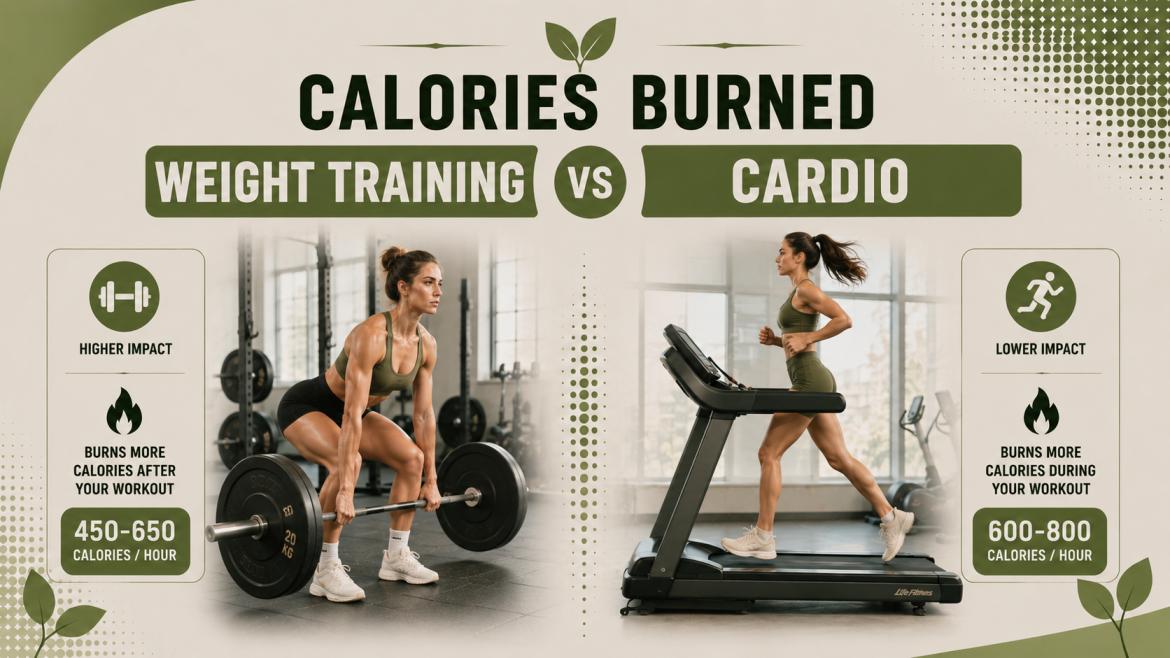
Cardio burns more calories per session than weight training at equal duration. Running at 5 mph burns approximately 581 calories per hour for a 154 lb (70 kg) person. Vigorous weight training burns approximately 420 calories per hour. The gap is real. The full picture, however, includes 24-hour calorie impact, long-term metabolic change, and sustainable training volume over months.
Use the weight training calorie calculator to get a personalised session calorie estimate for lifting at any body weight and intensity.
The weightlifting vs cardio debate is one of the most frequently searched fitness topics. Neither approach is universally superior. The right answer depends on training goal, time available, injury history, and how each person's body responds to volume over a training block.
This article covers MET-based calorie comparisons at 30 and 60 minutes, EPOC differences by activity type, the long-term metabolic impact of lean mass gain from lifting, and a practical framework for choosing or combining both.
Calories Burned Weight Training vs Cardio: Direct Comparison
The MET formula makes direct calorie comparisons transparent. Every activity has an assigned MET value based on measured oxygen consumption. Comparing MET values and applying them to the same body weight and duration gives a fair session-level calorie comparison.
For the full weight training hub covering all lifting formats and durations, see the calories burned weight training guide. For the full cross-activity reference, see the calories burned guide.
Weight Training vs Cardio: MET and 60-Minute Calorie Comparison (154 lb / 70 kg)
Activity | MET | Calories / 30 Min | Calories / 60 Min |
|---|---|---|---|
Weight training, general | 3.5 | 123 kcal | 245 kcal |
Brisk walking, 3.5 mph | 4.3 | 151 kcal | 301 kcal |
Weight training, vigorous | 6.0 | 210 kcal | 420 kcal |
Cycling, moderate | 6.8 | 238 kcal | 476 kcal |
Circuit training | 8.0 | 280 kcal | 560 kcal |
Running, 5 mph | 8.3 | 290 kcal | 581 kcal |
Running, 6 mph | 9.8 | 343 kcal | 686 kcal |
HIIT, vigorous | 10.0 | 350 kcal | 700 kcal |
Source: 2024 Adult Compendium of Physical Activities (Ainsworth et al.)
At equivalent session duration, cardio consistently produces more direct calories than general weight training. Vigorous lifting (MET 6.0) burns 28% less per hour than running at 5 mph (MET 8.3). Circuit training (MET 8.0) produces nearly identical output to running at 5 mph.
EPOC: Weight Training vs Cardio Afterburn Comparison
EPOC (excess post-exercise oxygen consumption) is the calorie burn that continues after exercise ends. Weight training produces significantly more EPOC than steady-state cardio in both duration and magnitude.
EPOC Comparison: Weight Training vs Cardio
Activity | EPOC Magnitude | EPOC Duration | Extra Calories (154 lb, 60-min session) |
|---|---|---|---|
Steady-state cardio (running) | 3 to 7% | 2 to 4 hours | +17 to 41 kcal |
Moderate cycling | 3 to 7% | 2 to 4 hours | +14 to 33 kcal |
Vigorous weight training | 6 to 15% | 24 to 38 hours | +25 to 63 kcal |
Circuit training | 6 to 15% | 12 to 24 hours | +34 to 84 kcal |
HIIT | 6 to 15% | 12 to 24 hours | +42 to 105 kcal |
Source: Børsheim and Bahr (2003), Sports Medicine; LaForgia et al. (2006), Journal of Sports Sciences.
Weight training's EPOC lasts 24 to 38 hours versus 2 to 4 hours for steady-state cardio. A vigorous one-hour lifting session for a 154 lb person adds approximately 25 to 63 additional calories over the following 38 hours. A comparable running session adds approximately 17 to 41 calories over just 2 to 4 hours.
Over a week of five sessions, weight training's EPOC advantage adds approximately 125 to 315 more post-workout calories than cardio's EPOC contribution, partially closing the per-session calorie gap.
24-Hour Total Calorie Impact: Lifting vs Running
Adding EPOC to session calories gives a more complete 24-hour calorie comparison between lifting and running.
24-Hour Calorie Impact: Vigorous Lifting vs Running at 5 mph (154 lb / 70 kg, 60 Min)
Metric | Vigorous Lifting | Running 5 mph |
|---|---|---|
Session calories | 420 kcal | 581 kcal |
EPOC (mid-range estimate) | +42 kcal | +17 kcal |
24-hour total | ~462 kcal | ~598 kcal |
Remaining gap | — | +136 kcal/session |
Running still produces approximately 136 more calories per session when EPOC is factored in for a 154 lb person. Over five weekly sessions, that gap equals approximately 680 additional weekly calories from running compared to vigorous lifting.
Long-Term Calorie Advantage of Weight Training: Lean Mass Effect
The comparison shifts over months of consistent training. Weight training builds lean muscle. Each kilogram of lean muscle tissue burns approximately 13 calories per day at rest. Fat tissue burns approximately 4.5 calories per kilogram per day (American Council on Exercise).
A trainee gaining 3 kg of lean muscle over 6 months of consistent lifting adds approximately 39 daily resting calories. That is 273 additional calories per week from resting metabolism alone, independent of session output. Over year two and beyond, that lean-mass-driven metabolic increase continues to compound.
Cardio does not produce meaningful lean mass accrual. A runner training five days per week for 12 months burns more calories per session than an equivalent lifter but does not raise resting metabolic rate through the same lean mass mechanism.
Weight Training vs Cardio for Weight Loss: Which Is Better?
The evidence supports a combined approach as the most effective for fat loss. Research published in Obesity (Willis et al., 2012) directly compared resistance training, aerobic training, and combined training over 8 months. Combined training produced the greatest reduction in fat mass and the best improvements in body composition. Resistance training alone produced similar fat loss to aerobic training despite lower per-session calorie burn, driven by EPOC and lean mass accrual.
Which to Prioritise by Goal
Primary Goal | Better Choice | Why |
|---|---|---|
Maximum calorie burn per session | Cardio | Higher direct MET output |
Fat loss, long-term | Combined | Lean mass + calorie deficit together |
Body composition improvement | Weight training | Muscle gain alongside fat loss |
Metabolic rate elevation | Weight training | Lean mass raises RMR |
Lowest injury risk | Weight training | Lower impact per session |
Time efficiency | Circuit training | High MET with minimal time |
For EPOC data in full detail including how to maximise afterburn from lifting sessions, see the weight training afterburn EPOC guide. For circuit training calorie data showing the hybrid approach, see the calories burned circuit training guide. For one-hour lifting calorie data and deficit planning, see the calories burned lifting weights 1 hour guide.
Using This Comparison for Weekly Programme Planning
A practical weekly programme for fat loss combines cardio sessions for per-session calorie burn with weight training sessions for lean mass accrual and EPOC. Research supports a 3:2 ratio (three cardio sessions, two to three strength sessions per week) as producing superior fat loss to either approach alone.
For a 154 lb person, this hybrid weekly output is approximately:
Three 30-minute running sessions at 5 mph: 3 × 290 = 870 kcal direct + ~51 kcal EPOC = ~921 kcal
Three vigorous one-hour lifting sessions: 3 × 420 = 1,260 kcal direct + ~126 kcal EPOC = ~1,386 kcal
Weekly total: approximately 2,307 calories
Over 12 weeks of consistent combined training, that weekly output and the lean mass gained from lifting sessions produce a compounding fat loss effect. The cardio contribution stays approximately constant. The lifting contribution grows as technique improves, load increases, and EPOC magnitude rises with training volume. By week 12, a trainee who started with vigorous 60-minute sessions may handle 20 to 30% more total volume, raising effective per-session output above the initial MET estimate.
This progressive increase in training stimulus is why combined programmes outperform fixed-cardio programs in body composition studies over periods longer than 8 weeks.
Use the TDEE calculator to find your maintenance calories. Mapping weekly exercise output against TDEE shows the exact deficit created by any training combination.
Frequently Asked Questions About Weight Training vs Cardio Calories
Does Weight Training Burn as Many Calories as Cardio?
Per session, cardio burns more calories than weight training at equal duration. Running at 5 mph burns approximately 581 calories per hour for a 154 lb person versus 420 from vigorous lifting. Including EPOC, the 24-hour gap narrows to approximately 136 calories. Over months, weight training's lean mass accrual raises resting metabolic rate further, partially closing the gap on a weekly basis.
Is Lifting Weights or Cardio Better for Fat Loss?
Both work, and combined approaches outperform either alone. Research from Willis et al. (2012) found that combined resistance and aerobic training produced the greatest fat mass reduction over 8 months. Cardio burns more per session. Weight training adds EPOC over 24 to 38 hours and raises long-term resting metabolism through lean mass gain. The optimal approach depends on time available, training preference, and injury history.
Does Weight Training Burn More Calories Than Walking?
Vigorous weight training (MET 6.0) burns approximately 420 calories per hour for a 154 lb person. Brisk walking (MET 4.3) burns approximately 301 calories per hour. Vigorous lifting burns approximately 40% more per hour than brisk walking. General weight training (MET 3.5) burns approximately 245 calories per hour, which is 19% below brisk walking. For walking calorie data at all paces, see the calories burned walking guide.
How Does Weight Training EPOC Compare to Cardio EPOC?
Weight training EPOC lasts 24 to 38 hours at 6 to 15% above session calories. Steady-state cardio EPOC lasts 2 to 4 hours at 3 to 7% above session calories. For a vigorous 60-minute lifting session, EPOC adds approximately 25 to 63 calories. For a 60-minute run, EPOC adds approximately 17 to 41 calories. Weight training's EPOC advantage is duration, not necessarily magnitude per hour.
Should I Do Cardio or Weights First for Maximum Calorie Burn?
Research from the Journal of Strength and Conditioning Research (Chtara et al., 2005) found that completing cardio before weights in the same session produced higher fat oxidation during the cardio component. However, lifting before cardio preserves strength performance. For calorie burn maximisation in combined sessions, either order produces similar 24-hour totals. Programme priority (which goal matters more per session) should determine the order.
How Many Extra Calories Does Weight Training Burn After the Workout Compared to Cardio?
After a vigorous 60-minute lifting session, a 154 lb person burns approximately 25 to 63 additional post-workout calories from EPOC over the following 24 to 38 hours. After a 60-minute run at 5 mph, the same person burns approximately 17 to 41 additional calories over just 2 to 4 hours. Weight training produces a longer EPOC window even when magnitude is comparable, making the post-workout calorie advantage of lifting measurable over an extended recovery period. Over a week of five sessions, this duration advantage adds approximately 40 to 120 more post-workout calories from lifting than from equivalent-duration running.