
Cardio or Diet: Which Should Create Your Deficit?
Most people treat cardio and diet as rival methods and pick a side. They are actually two separate levers on the same calorie deficit, and one of them does far more of the work than people assume.

Your body has a number. Let's find it.
We calculate the exact calorie target your body needs, built from your stats and goal, then track everything against it daily. Log meals, add workouts, set a weight goal, and watch your numbers update in real time. Check in weekly to see calories, water, and weight trend in one place.
No spreadsheets. No guessing. Just results.
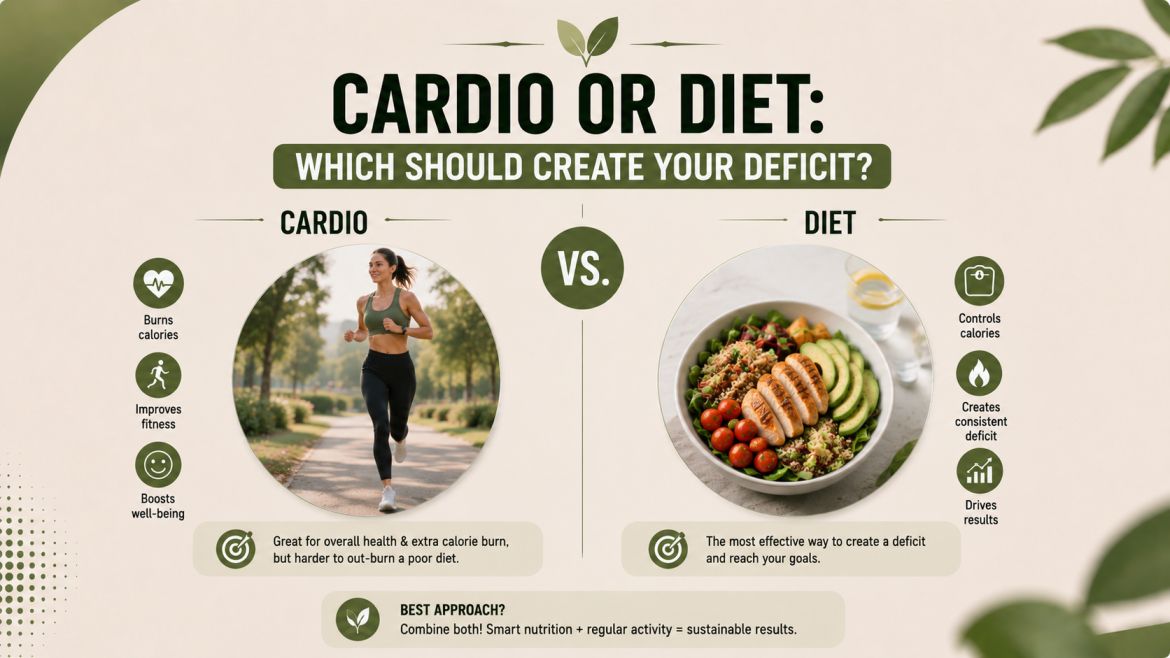
Most weight loss advice frames this as a competition. Cardio versus diet, pick a side, commit to it. That framing gets the mechanics wrong from the start.
Cardio and diet are two separate levers that both create a calorie deficit, and each one pulls that lever in a completely different way. Every deficit decision sits on top of your Total Daily Energy Expenditure, the total number of calories your body burns in a day. Get that number from the TDEE calculator first, since everything in this guide sits on top of that figure rather than replacing it.
This guide covers why diet creates a deficit more efficiently than cardio, why cardio partly cancels itself out through a well-documented compensation effect, and when combining both levers beats using either one alone. It ends with a decision framework for choosing which lever to pull first.
What Is the Real Question Behind Cardio vs Diet?
The cardio-versus-diet debate is not really about cardio or diet as activities. It is about which side of the energy balance equation should carry the deficit.
TDEE breaks down into four components, and only one of them, Exercise Activity Thermogenesis (EAT), responds directly to cardio. Diet works on the intake side. Cardio works on a narrow slice of the output side.
Lever | What It Changes | Typical Contribution to a Deficit | Effort Required |
|---|---|---|---|
Diet | Calories eaten (intake side) | Can produce the full deficit alone | Low time cost, high adherence cost |
Cardio | EAT, one TDEE component (output side) | Adds a partial deficit, rarely the full amount | High time cost, lower adherence cost |
Why this distinction matters practically: neither lever is inherently better. The real question is which one should carry most of the deficit, and where the other adds value beyond raw calorie math.
Why Does Diet Create a Deficit More Efficiently Than Cardio?
Diet wins on raw efficiency for a simple reason. Cutting food removes calories directly. Cardio has to burn through movement first, then survive the body's compensation response, before any net deficit remains.
How Many Calories Does Cardio Actually Burn Compared to TDEE?
Exercise Activity Thermogenesis accounts for only 5 to 10% of total daily calorie burn for most adults who train regularly. That share surprises most people who assume cardio drives most of their daily number.
A 45-minute moderate-intensity cardio session burns roughly 250 to 400 calories, depending on body weight and intensity. Spread across a full week, three sessions add an average of only 107 to 171 calories per day to TDEE. For the complete breakdown of how planned training contributes to daily expenditure, see what EAT actually is and how it affects TDEE.
Why Is Cutting Food Easier Than Burning It Off?
Removing 500 calories from a day takes seconds. Skip a sugary drink, swap a sauce, or trim a portion by a third, and the deficit is locked in immediately. Burning the same 500 calories through cardio takes a genuine block of time and physical effort.
Method | Time or Action Needed | Calories Removed |
|---|---|---|
Cutting food (diet) | Skip 1 large snack or drink | ~500 kcal |
Moderate cardio (jogging) | 45 to 60 minutes | ~400 to 500 kcal |
Vigorous cardio (cycling, HIIT) | 30 to 40 minutes | ~450 to 500 kcal |
This is not an argument against cardio. It is the reason diet, not cardio, should carry the majority of most deficit plans, especially for people without much training time to spare.
Does Cardio Cancel Itself Out Through Compensation?
Partially, yes. The constrained energy expenditure model, developed by researcher Herman Pontzer, found that added physical activity does not raise total daily burn on a simple one-to-one basis. The body offsets a portion of the extra movement elsewhere.
A 2015 analysis in Current Biology found total daily expenditure rose by only about 30% of what a simple additive model predicted once aerobic training increased. The body appears to protect its energy budget rather than letting it climb freely with more exercise.
Where that offset actually comes from:
Reduced NEAT after training. People often sit or stand still more on heavy training days without noticing it happen.
Increased hunger and food-seeking behavior. A hard session raises appetite, which can quietly erase part of the calorie gap through eating.
Improved movement efficiency. Trained muscle burns marginally fewer calories to do the same workload over time.
Reduced fidgeting and spontaneous movement. Small, unconscious daily motion drops when structured training volume rises.
This compensation effect is one reason how physical activity affects your TDEE is more complicated than a simple calories-in-versus-calories-out chart suggests. Adding cardio without watching food intake often produces a smaller real-world deficit than the workout calories alone would predict.
What Happens When You Combine Cardio and Diet?
Diet drives the deficit. Cardio protects what the deficit costs. That is the practical division of labor once both levers get used together instead of pitted against each other.
How Does Cardio Protect Muscle During a Diet Phase?
A controlled crossover study comparing food restriction against exercise-only deficits found food restriction produced greater total weight loss, but exercise produced greater fat loss specifically. Diet-only groups lost more scale weight, but a larger share of that loss came from lean tissue rather than fat.
What the newer research adds: a 2025 systematic review in Frontiers in Nutrition found resistance training under caloric restriction preserved lean body mass more effectively than diet alone. Roughly 25% of weight lost through diet without training comes from fat-free mass instead of fat.
What Is the Risk of Relying on Cardio Alone?
Cardio-only deficits run into the compensation problem described above, plus a hard ceiling on how much time most people can realistically train. Diet-only deficits carry the opposite risk, losing muscle, unless protein intake and resistance training get added alongside the food cut.
Approach | Deficit Efficiency | Muscle Preservation | Practical Sustainability |
|---|---|---|---|
Diet only | High, easy to control precisely | Lower without added protein or lifting | High short term, harder long term |
Cardio only | Lower, limited by compensation and time | Higher fat loss share than diet-only | Time-intensive, hard to sustain |
Diet plus cardio | High, most reliable overall | Best when resistance training is included | Highest long-term adherence in research |
The practical takeaway: a 2023 obesity-management systematic review found combined diet-and-exercise approaches outperformed either strategy in isolation, particularly when resistance and endurance training were both layered onto the dietary change.
Should You Ever Skip Cardio and Rely on Diet Alone?
Yes, a sustained food-only deficit works mechanically the same way a combined approach does, since weight loss depends on total calorie balance rather than the source of the gap.
The tradeoff is durability, not effectiveness. Diet-only deficits tend to feel harder to sustain, since there is no exercise-driven appetite regulation or metabolic buffer helping offset a bad day. For the complete diet-first fat loss protocol, including deficit sizing and muscle preservation, read how to lose weight with TDEE.
Diet-only makes the most sense for people who are injured, genuinely time-constrained, or simply prefer not to train while dieting. It is a valid lever on its own. It just is not the lever that protects lean mass or cardiovascular fitness the way cardio does.
Which Lever Should You Pull First?
Use this sequence to decide how much of the deficit diet should carry versus cardio, based on your goal and constraints.
Calculate your TDEE. Use the TDEE calculator to find your maintenance number before setting any deficit.
Set the deficit size first, from food. Aim for 300 to 500 calories below TDEE through diet as the primary lever.
Add resistance training, not cardio, as the second priority. Lifting protects the lean mass a diet-only approach puts at risk.
Layer cardio in as a buffer, not the main driver. Two to three sessions a week widen the deficit modestly and support cardiovascular health.
Track weight for two to three weeks before adjusting. Confirm the real-world deficit matches the plan before changing either lever.
This order keeps the efficient lever, diet, in charge of the bulk of the deficit, while cardio and resistance training handle the parts diet alone cannot reach: muscle retention, fitness, and long-term appetite regulation.
How Do Individual Factors Change the Cardio vs Diet Decision?
The general framework holds for most adults, but starting point and physiology shift how much weight each lever should carry.
How Should Women Approach the Cardio vs Diet Decision?
Hormonal fluctuation across the menstrual cycle changes appetite and resting burn by phase, which can make food-based deficits feel less consistent week to week. Leaning slightly more on the cardio lever during high-hunger phases can help smooth out the weekly average. Anyone using the TDEE calculator for women should treat these ranges as a personal starting point rather than a rigid rule.
How Should Athletes Approach the Cardio vs Diet Decision?
Athletes already carry a high EAT share from training, so adding more cardio on top of a full training load rarely produces a meaningful extra deficit. Diet becomes the more effective lever once training volume is already high, since the exercise side is close to its practical ceiling. Training volume itself is already accounted for directly inside the TDEE calculator for athletes.
How Should Desk-Job Beginners Approach the Cardio vs Diet Decision?
People with sedentary jobs and no training history see the largest relative gains from adding light cardio, since their starting EAT sits close to zero. Even here, diet still creates the deficit faster. Light cardio works best as a supporting lever rather than the primary one.
What Are Common Mistakes When Choosing Between Cardio and Diet?
Treating cardio calories as extra calories available to eat. This is the fastest way to quietly erase a deficit, since wearables commonly overstate workout calorie burn.
Skipping resistance training during a diet-only approach. Food restriction without lifting increases the share of weight lost from muscle instead of fat.
Adding cardio volume without adjusting food intake. Compensation research shows the body often offsets part of the extra burn through hunger and reduced daily movement.
Pushing both levers hard at once. Combining a large food cut with heavy cardio volume raises the risk of excessive muscle loss and poor adherence.
Watching the scale without asking what created the change. The same weekly weight change can hide very different amounts of fat loss versus muscle loss depending on which lever produced it.
Frequently Asked Questions
Is Cardio or Diet More Effective for Losing Weight?
Diet is more efficient for creating the deficit itself, since cutting food removes calories directly without the compensation effect that partly offsets cardio. Cardio adds value through fat-specific loss and muscle preservation, not through raw deficit size.
How Much Cardio Equals a 500-Calorie Deficit?
A 45 to 60-minute moderate cardio session burns roughly 400 to 500 calories for most adults, close to what a single food cut of similar size removes in seconds. Reaching that gap through cardio alone requires consistent daily time few people can sustain long term.
Can You Lose Weight Through Diet Alone Without Cardio?
Yes. A sustained calorie deficit through food alone produces real weight loss, since total calorie balance drives the outcome regardless of source. The main tradeoff is a higher share of lean mass loss unless resistance training and adequate protein are included.
Does Skipping Cardio Cause Muscle Loss During a Diet?
Not directly. Skipping resistance training during a food-only deficit is the actual driver, since lifting, not cardio, provides the signal that protects lean mass during restriction.
Should Beginners Start With Diet or Cardio First?
Set the deficit through diet first, then add resistance training, then layer light cardio in afterward as a supporting lever. Starting with cardio alone often produces a smaller deficit than expected once compensation effects are accounted for.
Does More Cardio Always Burn More Total Calories?
No. Research on the constrained energy expenditure model shows total daily burn does not rise in a simple straight line with added exercise, since the body offsets part of the increase elsewhere. Beyond a certain training volume, extra cardio sessions add diminishing returns to the overall deficit.