
How Physical Activity Affects Your TDEE?
Physical activity contributes 15 to 40% of TDEE through two separate components. Research shows the body compensates for close to half of any exercise increase, and the effect grows larger when combined with dieting. This guide covers the EAT-NEAT split and what the data actually supports.

Your body has a number. Let's find it.
We calculate the exact calorie target your body needs, built from your stats and goal, then track everything against it daily. Log meals, add workouts, set a weight goal, and watch your numbers update in real time. Check in weekly to see calories, water, and weight trend in one place.
No spreadsheets. No guessing. Just results.
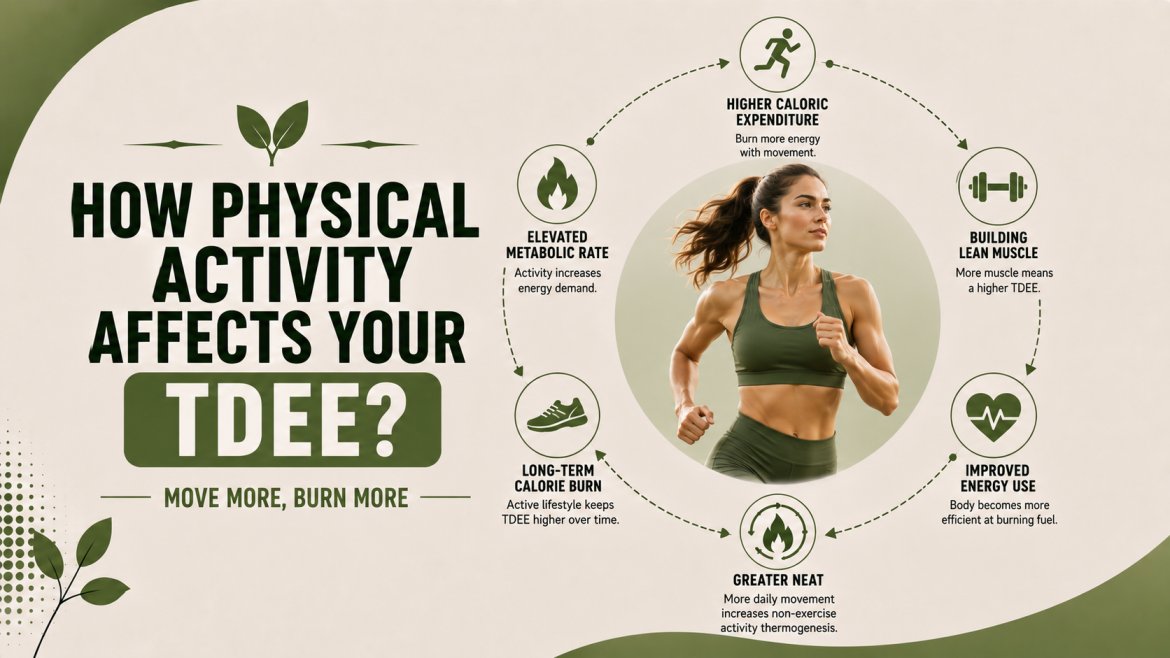
Physical activity contributes to TDEE through two separate components. Exercise Activity Thermogenesis (EAT) covers planned workouts. Non-Exercise Activity Thermogenesis (NEAT) covers everything else, from walking to fidgeting to standing rather than sitting.
Together these components account for 15 to 40% of total TDEE, making activity the most variable factor between two otherwise similar people. Recent research complicates the simple assumption a TDEE calculator makes: that more exercise always means proportionally more calories burned.
This guide covers the EAT-NEAT split in detail and the constrained energy model, which explains why exercise does not raise TDEE as linearly as expected. It also covers why fitness trackers overestimate calorie burn, and how much exercise realistically adds to daily expenditure.
What Is the EAT-NEAT Split?
EAT and NEAT are structurally different even though both fall under the physical activity umbrella, as the dedicated EAT guide explains for the exercise-specific half. Understanding the difference explains why they respond so differently to fatigue, stress, and dieting.
Component | Definition | Typical Share of TDEE | Variability |
|---|---|---|---|
EAT | Structured, intentional exercise | 0 to 15% | High between people, controllable |
NEAT | Incidental daily movement | 15 to 30% | Very high, often unconscious |
NEAT is the larger and more variable of the two for most people. A person with a physically demanding job can generate more daily calorie burn through NEAT alone. That figure can exceed what a sedentary office worker generates through a daily gym session.
In practice: Two people with identical gym routines can have meaningfully different TDEE values depending entirely on how much they move outside the gym. This is one of the sharper examples among every factor covered in this cluster.
That variation sits within the NEAT component, one of the four core building blocks the complete TDEE guide defines.
The dedicated NEAT guide covers NEAT's full range and its biggest individual drivers.
What Is the Constrained Energy Model?
The constrained energy model challenges the assumption that TDEE rises in direct proportion to activity level. It proposes instead that the body regulates total energy expenditure within a narrower range than raw activity would predict.
Research published in Current Biology in 2016 examined this directly. Herman Pontzer and colleagues compared total energy expenditure across populations with very different activity levels, including Hadza hunter-gatherers and sedentary Western populations.
Population | Physical Activity Level | Total Energy Expenditure |
|---|---|---|
Hadza hunter-gatherers | Very high | Similar to sedentary Western adults after body size adjustment |
Sedentary Western adults | Low | Similar to Hadza after adjustment |
The Hadza walk and forage for hours daily. Yet their total energy expenditure did not exceed far less active Western populations once body size was accounted for. This finding suggested the body actively compensates for high activity levels elsewhere in its energy budget.
What compensation means in practice: The body appears to reduce energy allocated to other processes, potentially including immune function and reproductive hormone production, when activity levels rise substantially and consistently over time.
Why Don't Fitness Trackers Match Your TDEE?
Wearable devices are widely reported to overestimate calorie burn, and the compensation effect is only part of the explanation. Device algorithms themselves carry substantial built-in error.
A 2017 study published in the Journal of Personalized Medicine examined wearable accuracy directly. Shcherbina and colleagues at Stanford tested seven popular devices against a validated laboratory measure of energy expenditure.
Finding | Detail |
|---|---|
Devices tested | 7 popular consumer wearables |
Calorie estimate error range | 27% to 93% |
Most accurate metric | Heart rate, typically within 5% |
Least accurate metric | Calorie burn estimates |
Heart rate tracking performed reasonably well across devices. Calorie estimates derived from that heart rate data performed far worse. Converting heart rate to calories involves assumptions about fitness level and efficiency that vary widely between users.
Why this matters for TDEE planning: Adding a device's exercise calorie estimate directly to a formula-based TDEE and eating back that full amount risks a meaningful overestimate of true intake allowance, compounding with the constrained energy model's own compensation effect.
EAT vs NEAT: Which Matters More?
Both components matter, but they behave very differently under stress, fatigue, and dieting, which affects which one is more reliable to plan around.
Variable | EAT | NEAT |
|---|---|---|
Resistance to compensation | Lower, more affected by constrained energy model | Higher, more directly controllable day to day |
Sensitivity to sleep debt | Moderate | High |
Sensitivity to stress | Moderate | High |
Ease of tracking | High, sessions are discrete events | Low, continuous and often unconscious |
Typical response to dieting | Often maintained if habitual | Frequently drops without the person noticing |
NEAT tends to be the more fragile component under real-world conditions. Chronic stress and sleep debt both suppress it specifically, while a person's committed exercise sessions often continue even during difficult periods.
The compounding risk: Someone maintaining their gym schedule while unknowingly losing 1,000 to 2,000 daily NEAT steps to stress or fatigue can see a stalled result despite feeling like their activity level has not changed.
The mechanisms behind that NEAT loss are covered in the chronic stress and TDEE guide.
A parallel pathway runs through fatigue rather than stress, covered separately in the sleep and TDEE guide.
How Much Does Exercise Really Raise TDEE?
Applying the constrained energy model in practice does not mean exercise fails to raise TDEE. It means the raise is smaller than a simple calories-burned estimate suggests, particularly for people already reasonably active.
Starting Activity Level | Adding 3 Weekly Exercise Sessions | Approximate Net TDEE Increase |
|---|---|---|
Sedentary | 3x 45-min moderate sessions | Close to the full estimated calorie burn |
Lightly active | 3x 45-min moderate sessions | Roughly 70 to 85% of estimated burn |
Already very active | 3x 45-min moderate sessions | Roughly 50 to 65% of estimated burn |
Compensation grows larger as baseline activity rises, matching the pattern researchers observed between the Hadza and sedentary comparison groups. Someone starting from sedentary sees close to the expected calorie return, while someone already training hard sees a smaller marginal return per session.
This does not argue against exercise. Structured training builds and preserves lean mass, which raises BMR independent of the session's direct calorie burn.
That pathway is covered in the guide to building muscle with TDEE.
For the direct session contribution alone, the calories burned calculator estimates any specific workout's output.
Does the Type of Exercise Change the TDEE Effect?
Resistance training and cardiovascular exercise contribute to TDEE differently, beyond their immediate calorie burn during the session itself. The distinction matters for anyone deciding how to allocate limited training time.
Exercise Type | Direct Session Burn | Effect on Lean Mass | Long-Term TDEE Impact |
|---|---|---|---|
Resistance training | Moderate | Builds or preserves | Raises BMR through added lean tissue |
Steady-state cardio | Moderate to high | Neutral to slightly negative in a deficit | Direct burn only, no BMR change |
High-intensity interval training | High per minute | Neutral to positive | Some EPOC contribution, modest |
Resistance training is the only category with a durable, compounding TDEE effect through lean mass. Cardio produces a larger single-session calorie burn but contributes nothing to resting energy use once the session ends.
Why this matters during a deficit specifically: Sizing a deficit correctly while including resistance training protects against the lean mass loss that would otherwise lower TDEE independent of activity level entirely. Muscle tissue lost during a poorly structured deficit does not distinguish between how the deficit was created, whether through diet alone or through excessive cardio without adequate recovery.
The connection between activity choice and lean mass preservation runs directly through the mechanism covered in the muscle loss and TDEE guide. That guide details how much lean tissue different deficit and training combinations typically cost.
How Should You Use This Information Practically?
The constrained energy model and tracker inaccuracy point toward the same practical conclusion. Activity-based calorie estimates deserve scepticism, whether from a formula's multiplier or a wearable's session summary.
Three adjustments improve real-world accuracy for most people:
Treat wearable exercise calorie estimates as an upper bound, not a precise figure, and consider eating back only 50 to 70% of the reported amount
Choose an activity multiplier honestly based on typical weekly activity rather than an aspirational target, using the activity multipliers guide to match the right category
Track actual weight trend over 2 to 3 weeks as the final check on whether the combined TDEE and activity estimate is working, rather than trusting any single number in isolation
The bigger picture: None of this means exercise does not matter. It means the calorie math around exercise is noisier than most tools present it, and building the habit itself, particularly resistance training, matters more than precisely quantifying any single session's burn.
Frequently Asked Questions About Physical Activity and TDEE
Does Exercise Actually Raise TDEE?
Yes, but not in direct proportion to calories burned during the session. The constrained energy model, based on Pontzer's 2016 Current Biology research, shows the body compensates for a meaningful share of any activity increase. This is most pronounced once baseline activity is already moderate to high.
Should I Eat Back the Calories My Fitness Tracker Shows?
Generally not the full amount. Wearable calorie estimates carry substantial error, commonly 27 to 93% based on Stanford research. The constrained energy model also means the actual TDEE increase from a session is often smaller than the device reports. Eating back 50% of a tracker's estimate is a more conservative approach.
Is NEAT or EAT More Important for Weight Loss?
Both matter, but NEAT is the more commonly overlooked and more fragile of the two. It responds strongly to sleep and stress without the person noticing. Structured exercise sessions, by contrast, tend to persist through difficult periods since they are scheduled and deliberate.
Why Do Very Active People See Smaller Returns From Extra Exercise?
The constrained energy model suggests the body has a ceiling on how much total activity translates into total energy expenditure. Someone already training extensively adds a new session against a body that is already compensating elsewhere. The same session produces a smaller marginal TDEE increase than it would in a sedentary person.
Can Fitness Trackers Be Trusted at All?
Heart rate tracking on most modern wearables performs reasonably well, typically within about 5% of validated measures. Calorie burn estimates derived from that heart rate data are far less reliable, with documented error rates as high as 93% in controlled testing.
Does Physical Activity Affect Everyone's TDEE the Same Way?
No. Individual differences in NEAT responsiveness, training experience, and baseline activity level all change how much a given amount of exercise raises TDEE. Two people doing identical workouts can see meaningfully different real-world results.
Does Standing at a Desk Actually Increase TDEE?
Standing desks produce a real but modest NEAT increase compared to sitting, typically 8 to 10 calories per hour for an average adult. Over a full 8-hour workday, that totals roughly 65 to 80 additional calories, meaningful but not transformative on its own.
The larger benefit of standing desks may be indirect. People who stand more often also tend to shift position, walk short distances, and fidget more than those seated continuously. These secondary habits compound the direct postural calorie difference.