
Muscle Loss, Body Composition, and Your TDEE
Muscle tissue burns roughly three times more energy per kilogram than fat at rest. Losing it during a diet lowers TDEE permanently unless the tissue is rebuilt. This guide covers sarcopenia, diet-driven muscle loss, and the protocol that reverses both.

Your body has a number. Let's find it.
We calculate the exact calorie target your body needs, built from your stats and goal, then track everything against it daily. Log meals, add workouts, set a weight goal, and watch your numbers update in real time. Check in weekly to see calories, water, and weight trend in one place.
No spreadsheets. No guessing. Just results.
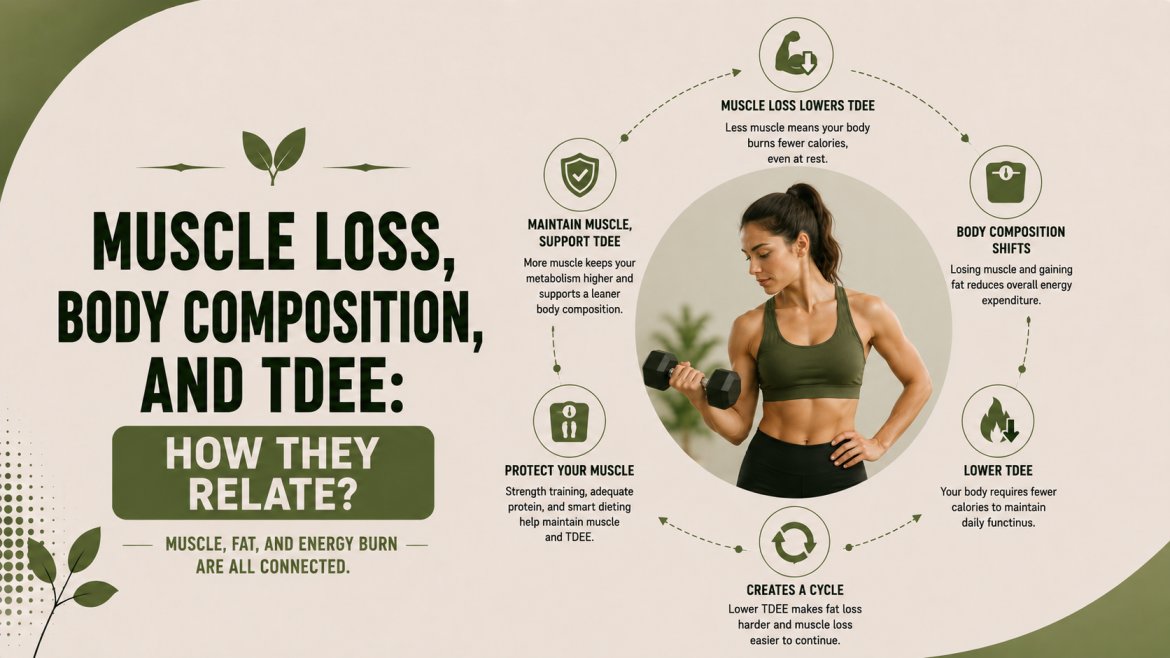
Muscle tissue burns more calories at rest than fat tissue. Losing lean mass during a diet lowers TDEE independent of any other factor, including metabolic adaptation.
Two situations drive most muscle loss. Crash dieting without adequate protein or resistance training removes lean tissue directly. Age-related sarcopenia removes it gradually over decades, a shift no TDEE calculator can see coming from stats alone.
This guide covers what sarcopenia actually is and what causes muscle loss during a deficit. It also covers how much lean mass different diet approaches typically cost, and the reversal protocol built around protein and resistance training.
Why Does Muscle Loss Lower TDEE?
Resting energy use depends heavily on tissue type, not just total body weight. Muscle is metabolically active. Fat is comparatively inert.
Tissue Type | Resting Energy Use | Relative to Muscle |
|---|---|---|
Skeletal muscle | ~13 kcal/kg/day | Baseline |
Fat tissue | ~4.5 kcal/kg/day | About one third |
Liver | ~200 kcal/kg/day | Highest of any organ |
Brain | ~240 kcal/kg/day | Fixed, does not respond to training |
Muscle burns roughly three times more per kilogram than fat at rest. Two people at the same body weight can differ by several hundred daily calories.
This is one of the clearest examples among every factor covered in this cluster.
In practice: Losing 5 kg of muscle instead of 5 kg of fat during a diet removes approximately 65 kcal per day of resting burn rather than approximately 23 kcal. The composition of the loss matters as much as the amount.
What Is Sarcopenia?
Sarcopenia is the age-related loss of muscle mass, strength, and physical function. It begins earlier than most people expect, and it sits entirely outside what the complete TDEE guide's base formula can predict from stats alone.
A review of skeletal muscle ageing published in Clinical Interventions in Aging found muscle mass decreases approximately 3 to 8% per decade after 30. The rate accelerates further past 60, covered in full by decade.
Age Range | Typical Muscle Mass Change | Notes |
|---|---|---|
20 to 30 | Peak muscle mass | Baseline for later comparison |
30 to 60 | -3 to -8% per decade | Gradual, often unnoticed |
60 to 80 | Accelerated decline | Rate roughly doubles |
80+ | Most pronounced loss | Highest fracture and frailty risk |
The Atherosclerosis Risk in Communities (ARIC) cohort study tracked sarcopenia incidence in adults from 65 to 90+ years between 2011 and 2023. Prevalence rose from 5.0% at ages 65 to 69 to 36.0% at ages 85 to 89.
What Causes Muscle Loss During a Diet?
Diet-driven muscle loss is distinct from sarcopenia, though the two compound when they overlap. Four factors determine how much lean tissue a deficit costs.
Deficit size, since larger deficits force the body toward greater catabolic tissue breakdown
Protein intake, since inadequate protein removes the raw material needed to preserve muscle
Resistance training, since the absence of a mechanical stimulus signals the body that muscle is expendable
Rate of weight loss, since faster loss consistently costs more lean mass per kilogram lost
Age adds a fifth factor on top of these four. Sarcopenia means older adults start any deficit with a smaller and more fragile muscle reserve than younger dieters at the same body weight.
How Much Muscle Can You Lose Dieting?
The share of total weight loss that comes from lean mass varies enormously by protocol. Training status and protein intake are the two biggest levers.
Diet Protocol | Approximate Lean Mass Share of Total Loss |
|---|---|
Moderate deficit, resistance training, high protein | 5 to 15% |
Moderate deficit, resistance training, moderate protein | 15 to 25% |
Moderate deficit, no training | 20 to 30% |
Aggressive deficit, no training | 30 to 40% |
Very aggressive deficit, no training, low protein | 40%+ |
A 154 lb (70 kg) person losing 20 lb (9 kg) under the worst-case protocol could lose 3.6 to 4 lb of that as muscle. Under the best-case protocol, that figure drops to roughly 1 to 1.5 lb.
Why this matters for TDEE specifically: Losing 4 lb of muscle instead of 1.5 lb removes an additional 12 to 15 daily resting calories permanently. Sizing the deficit correctly from the start, covered in the guide to losing weight with TDEE, is the single biggest lever over which protocol a dieter follows.
Muscle vs Fat: Resting Energy Comparison
The composition question is not abstract. It changes the actual calorie math for anyone tracking a diet's long-term effect on TDEE.
Scenario | Weight Lost | Muscle Lost | Resting Calorie Cost |
|---|---|---|---|
Well-managed diet, 20 lb lost | 20 lb | 2 lb | ~26 kcal/day permanent BMR loss |
Poorly managed diet, 20 lb lost | 20 lb | 7 lb | ~91 kcal/day permanent BMR loss |
Difference between the two | Same | 5 lb | ~65 kcal/day |
That 65 kcal gap does not sound dramatic in isolation. Compounded across a year of maintenance eating, it represents roughly 23,700 calories.
At the same intake level, that is close to 7 lb of additional fat gain potential. Tracking composition with a body fat percentage calculator every few weeks catches this trend before it compounds further.
How Do You Reverse Muscle Loss?
Reversing lost lean mass takes longer than losing it and requires a deliberate surplus or recomposition approach rather than passive maintenance eating.
Set protein at 1.6 to 2.2 grams per kilogram of body weight daily
Perform resistance training at least twice weekly, prioritising progressive overload
Recalculate TDEE with the Katch-McArdle formula once body fat percentage is known
Eat at maintenance or a small surplus, since a deficit cannot simultaneously build tissue
Prioritise sleep and manage stress, since both cortisol and poor recovery blunt muscle protein synthesis
Track body composition rather than scale weight to confirm the gain is lean tissue, not fat
Rebuilding lost muscle typically takes 6 to 24 months depending on training age, starting deficit severity, and consistency. Beginners and those returning after a long break tend to recover fastest due to a phenomenon researchers call muscle memory.
Muscle memory refers to the persistence of myonuclei, cell nuclei added to muscle fibres during earlier training, even after the fibre itself shrinks. When training resumes, those retained nuclei allow faster regrowth than a person who never trained that tissue before.
Population | Typical Recovery Timeline | Why |
|---|---|---|
Previously trained, recent loss | 3 to 6 months | Muscle memory accelerates regrowth |
Previously trained, long break | 6 to 12 months | Some nuclei retained, detraining adds time |
Never trained that tissue before | 12 to 24 months | No prior adaptation to draw on |
Older adult, any training history | Add 20 to 30% to above | Slower protein synthesis response |
In practice: Someone who lifted for years, took two years off, and lost muscle during that gap will typically regain it faster than a beginner starting from the same lean mass. The guide to building muscle with TDEE covers surplus sizing for that rebuilding phase.
Where protein fits the picture: The full breakdown of daily protein targets by goal and body weight sits in the protein and TDEE guide, which covers timing and distribution across meals as well as total daily amount.
How Muscle Loss Compounds With Other TDEE Factors
Muscle loss rarely happens in isolation from the other factors that move TDEE. Metabolic adaptation and muscle loss both lower resting energy expenditure through different mechanisms.
Dieters who experience one are more likely to experience the other. The full mechanism behind metabolic adaptation covers how the two interact across a long deficit.
The strongest lever against it: Physical activity, specifically resistance training, does more than any other single factor to protect lean mass during a deficit. The complete guide to physical activity and TDEE covers how EAT and NEAT both interact with preservation.
Frequently Asked Questions About Muscle Loss and TDEE
How Much Does Losing Muscle Lower TDEE?
Each kilogram of lean mass lost removes approximately 13 kcal of daily resting energy use. A 5 kg muscle loss, common in poorly managed diets, removes roughly 65 kcal per day permanently unless the tissue is rebuilt through training.
Can You Lose Fat Without Losing Any Muscle?
Complete prevention is difficult but not impossible. Diets combining a moderate deficit, resistance training, and protein above 1.6 g/kg typically keep lean mass loss to 5 to 15% of total weight lost. That is close to the practical minimum.
At What Age Does Sarcopenia Start?
Muscle mass typically peaks in the late 20s to early 30s. Sarcopenia begins gradually after 30 at a rate of 3 to 8% per decade, per a Clinical Interventions in Aging review. That rate accelerates measurably after 60.
How Do I Know If I'm Losing Muscle or Just Fat?
Scale weight alone cannot distinguish the two. A body fat percentage measurement taken every 4 to 6 weeks is the most accessible check. Stable or improving strength numbers in the gym alongside that measurement confirm fat loss without lean mass loss.
Does Cardio Cause More Muscle Loss Than Weight Training?
Excessive cardio combined with a large deficit and no resistance training does increase lean mass loss risk. Resistance training performed alongside cardio largely offsets this by providing the mechanical stimulus muscle needs to be preserved.
Can Older Adults Still Build Back Lost Muscle?
Yes. Research consistently shows resistance training produces meaningful muscle and strength gains in adults into their 70s and 80s. The rate of gain is typically slower than in younger adults, but the tissue remains responsive to training at any age.