
Metabolic Adaptation: Why Your TDEE Drops During a Diet?
Metabolic adaptation is the drop in energy expenditure that exceeds what body composition change predicts. Biggest Loser contestants measured 499 calories per day below prediction six years after their diet ended. This guide covers the mechanisms, the magnitude, the recovery timeline, and how to test for it yourself.

Your body has a number. Let's find it.
We calculate the exact calorie target your body needs, built from your stats and goal, then track everything against it daily. Log meals, add workouts, set a weight goal, and watch your numbers update in real time. Check in weekly to see calories, water, and weight trend in one place.
No spreadsheets. No guessing. Just results.
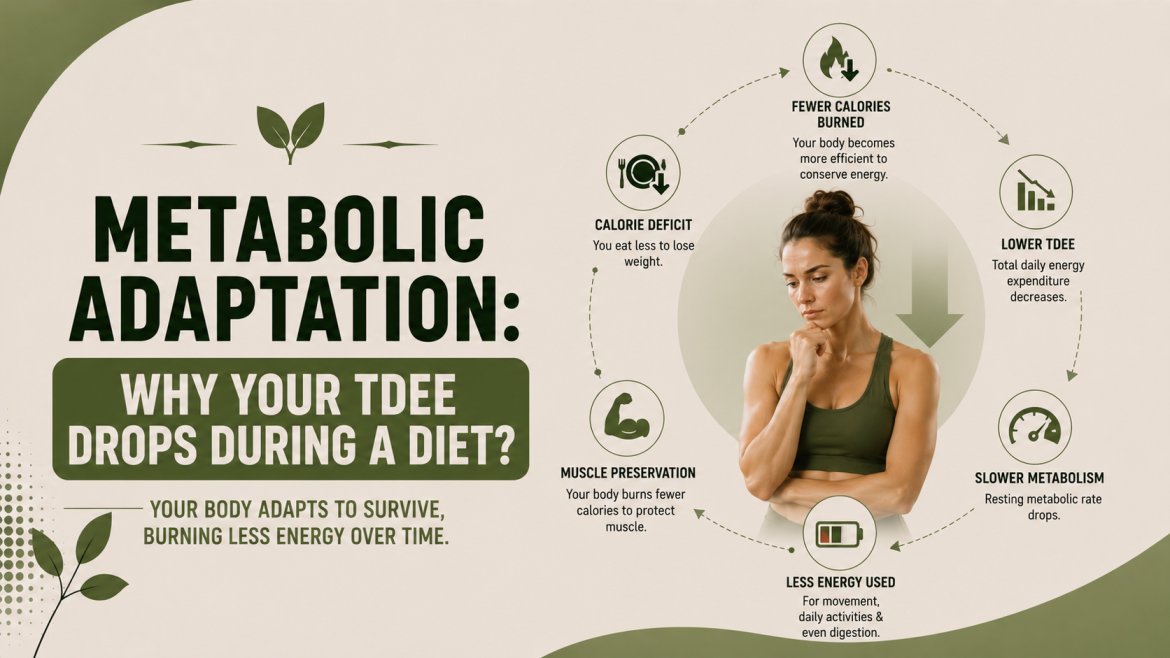
Metabolic adaptation is a reduction in energy expenditure that goes beyond what body composition change predicts. It is also called adaptive thermogenesis in the research literature.
Losing weight always lowers Total Daily Energy Expenditure (TDEE). A smaller body burns fewer calories. Metabolic adaptation is the additional drop on top of that expected decline.
The size of this effect is frequently understated. Contestants from the Biggest Loser measured 499 calories per day below prediction six years after their competition ended. That gap persisted despite most of the weight returning.
This guide covers what metabolic adaptation is and what the research measures. It also covers the four mechanisms driving it, how long it lasts, and how to identify it in your own numbers. The final sections separate the documented effect from the starvation mode myth and cover what reverses it.
What Is Metabolic Adaptation?
Metabolic adaptation is the difference between your predicted energy expenditure and your measured energy expenditure after weight loss. Prediction comes from body composition. Measurement comes from indirect calorimetry or doubly labelled water.
A worked example makes the distinction clear. Consider a 100 kg adult with a 2,600 kcal TDEE who loses 20 kg over six months.
Metric | Value | What It Represents |
|---|---|---|
Starting TDEE at 100 kg | 2,600 kcal/day | Baseline before dieting |
Predicted TDEE at 80 kg | 2,250 kcal/day | Expected from smaller body mass alone |
Measured TDEE at 80 kg | 1,980 kcal/day | Actual burn after the diet |
Metabolic adaptation | 270 kcal/day | The unexplained gap |
The 350 kcal drop from 2,600 to 2,250 is normal and expected. Smaller bodies cost less to run. The further 270 kcal drop to 1,980 is metabolic adaptation.
This gap is why a calculator stops matching reality mid-diet. The formula sees your current weight and returns 2,250. Your body is running at 1,980. Recalculating with the TDEE calculator will not close that gap, because the formula has no input for dieting history.
What Does the Research Show?
Four studies define what is known about metabolic adaptation. Each measured a different population under different conditions, and together they establish both the size and the persistence of the effect.
Study | Population | Key Finding | Duration Measured |
|---|---|---|---|
Keys et al., 1950 (Minnesota Starvation Experiment) | 36 men, 24 weeks semi-starvation | BMR fell approximately 40% below baseline | 24 weeks plus recovery |
Leibel, Rosenbaum and Hirsch, 1995 (New England Journal of Medicine) | 41 subjects, 10% weight loss | Total energy expenditure fell 15% below prediction | Short-term |
Rosenbaum and Leibel, 2010 (International Journal of Obesity) | Weight-reduced subjects | Leptin replacement reversed most of the adaptation | Variable |
Fothergill et al., 2016 (Obesity) | 14 Biggest Loser contestants | 610 kcal/day below prediction at 30 weeks | 6-year follow-up |
The Fothergill study is the most cited because of its follow-up window. Most adaptation research measures weeks or months. This one tracked contestants for six years after the competition.
The Six-Year Finding That Changed the Conversation
Time Point | Resting Metabolic Rate vs Prediction | Weight Status |
|---|---|---|
Pre-competition baseline | Matched prediction | 149 kg average |
End of 30-week competition | 610 kcal/day below | 91 kg average |
6 years post-competition | 499 kcal/day below | 132 kg average |
The final row is the result that matters. Contestants regained roughly 70% of the lost weight. Their metabolic rate did not recover with it. Adaptation persisted at nearly 500 calories per day.
The Rosenbaum and Leibel leptin finding points to why. When researchers restored leptin to pre-diet levels in weight-reduced subjects, most of the measured adaptation reversed. This identified leptin signalling as a primary driver rather than a side effect.
How Much Does Metabolic Adaptation Lower Your TDEE?
Magnitude scales with three variables: deficit size, diet duration, and total weight lost. Aggressive and prolonged deficits produce larger adaptation than moderate and shorter ones.
Diet Profile | Typical Adaptation | Approximate Effect |
|---|---|---|
10 to 15% deficit, 8 to 12 weeks | 3 to 5% below prediction | 60 to 110 kcal/day |
20 to 25% deficit, 12 to 16 weeks | 5 to 10% below prediction | 110 to 230 kcal/day |
25%+ deficit, 20+ weeks | 10 to 15% below prediction | 230 to 350 kcal/day |
Extreme deficit, competition prep or Biggest Loser conditions | 15 to 25% below prediction | 350 to 600 kcal/day |
A 2014 review in the Journal of the International Society of Sports Nutrition by Trexler and colleagues examined adaptation in athletes and physique competitors. The review found the largest reductions in those using the most aggressive deficits over the longest periods.
The practical reading of this table is that adaptation is dose-dependent. A moderate deficit does not eliminate adaptation. It keeps the size manageable, and the risk curve steepens sharply past a 25% deficit.
What Causes Metabolic Adaptation?
Four mechanisms drive the effect. They operate on different timescales and account for different shares of the total drop.
Mechanism | Share of Total Adaptation | Onset Speed | Reversible? |
|---|---|---|---|
NEAT suppression | 30 to 50% | Days to weeks | Yes, quickly |
Thyroid hormone reduction (T3) | 20 to 30% | 1 to 3 weeks | Yes, with refeeding |
Increased mitochondrial efficiency | 15 to 25% | Weeks to months | Slowly |
Reduced lean tissue mass | 10 to 25% | Weeks to months | Only with training |
NEAT Suppression
Non-Exercise Activity Thermogenesis falls first and falls hardest. Dieting reduces spontaneous movement, fidgeting, posture changes, and general daily activity. None of this is a conscious decision.
Step counts commonly drop 1,000 to 3,000 per day during an extended deficit without the dieter noticing. For a 75 kg adult, that alone accounts for 40 to 120 calories per day. Non-exercise activity thermogenesis is the most variable TDEE component in any condition, and dieting amplifies that variability.
Thyroid Hormone Reduction
Triiodothyronine (T3) is the active thyroid hormone setting basal metabolic rate. Sustained calorie restriction lowers T3 conversion from T4, reducing BMR independent of tissue mass.
This is a normal regulatory response, not thyroid disease. It reverses when calories return to maintenance. Thyroid sits alongside leptin, ghrelin, cortisol, insulin, and sex hormones as one of six hormone systems that shape TDEE.
Increased Mitochondrial Efficiency
Muscle tissue becomes more efficient during a prolonged deficit. It performs the same mechanical work using less energy. Research by Müller and colleagues published in the American Journal of Clinical Nutrition in 2015 documented this at the cellular level.
Efficiency is beneficial in a survival context and inconvenient in a fat loss context. The same workout burns measurably fewer calories after twelve weeks of dieting than it did in week one.
Reduced Lean Tissue Mass
Losing muscle lowers BMR directly, since muscle burns roughly 13 kcal per kilogram per day at rest. This portion is technically not adaptive thermogenesis, because prediction models account for it. It compounds the total drop regardless.
Aggressive deficits without resistance training can lose 30 to 40% of total weight as lean mass. That degree of diet-driven muscle loss lowers BMR permanently unless the tissue is rebuilt.
How Long Does Metabolic Adaptation Last?
Recovery depends on which mechanism is being reversed. The fast components return within weeks. The slow components can persist for years.
Component | Recovery Timeline | What Triggers Recovery |
|---|---|---|
NEAT suppression | 1 to 4 weeks | Return to maintenance calories |
T3 and thyroid signalling | 2 to 6 weeks | Increased calorie and carbohydrate intake |
Leptin signalling | 4 to 12 weeks | Restored fat mass and energy availability |
Mitochondrial efficiency | 6 to 12 months | Sustained maintenance eating |
Lean mass restoration | 6 to 24 months | Resistance training plus adequate protein |
The Fothergill six-year data shows the worst case rather than the typical one. Contestants underwent extreme deficits combined with very high exercise volumes over 30 weeks. Most dieters do not produce adaptation of that severity or persistence.
The practical expectation: For a moderate 12 to 16 week diet, most measurable adaptation resolves within 4 to 12 weeks of returning to maintenance. A gradual calorie increase over that window recovers the fast components while limiting fat regain.
How Do You Know If You Have Metabolic Adaptation?
Metabolic adaptation cannot be diagnosed from a single measurement. It requires comparing your actual intake and weight change against what the formula predicts, over a period long enough to filter noise.
Run this five-step protocol before concluding adaptation is the cause:
Log every calorie consumed for 14 consecutive days, weighing solid food where possible
Weigh yourself daily under identical conditions and take the 7-day average at the start and end
Calculate your actual TDEE: average daily intake plus or minus the weight change converted to calories, using 7,700 kcal per kilogram
Compare that measured figure against your formula estimate
Repeat over a second 14-day block to confirm the result is stable
A worked example clarifies step three. If you averaged 1,900 kcal per day for 14 days and lost 0.4 kg, your measured TDEE is approximately 2,120 kcal per day. That is 1,900 plus (0.4 × 7,700 ÷ 14).
Ruling Out the More Common Explanations
Most suspected metabolic adaptation is something else. Work through this table before accepting the adaptation explanation.
Symptom | More Likely Cause | How to Test |
|---|---|---|
Weight flat for under 3 weeks | Water retention or glycogen shifts | Extend the measurement window |
Weight flat despite "eating 1,400 kcal" | Under-reported intake, typically 20 to 30% | Weigh all food for 14 days |
Progress stalled after several weeks | Genuine adaptation or reduced NEAT | Run the 14-day protocol above |
Never lost weight from the start | Formula overestimate, not adaptation | Recalculate using measured TDEE |
Rapid stall with high stress or poor sleep | Cortisol and NEAT suppression | Review sleep and stress first |
Under-reporting is the most common finding by a wide margin. Work down the table in order before concluding that adaptation is responsible.
Metabolic Adaptation vs Starvation Mode
Starvation mode is a popular term that misstates the science. Metabolic adaptation is real and measurable. Starvation mode as commonly described is not.
Claim | Starvation Mode Version | What Research Shows |
|---|---|---|
Eating too little stops weight loss entirely | Weight loss halts completely | Weight loss slows, never stops in a real deficit |
Metabolism "shuts down" | BMR crashes to near zero | Maximum measured reduction is 15 to 25% |
You must eat more to lose weight | Raising calories causes fat loss | Raising calories to maintenance stops fat loss |
The effect is permanent | Metabolism never recovers | Most components recover within weeks to months |
It happens within days | Immediate onset | Meaningful adaptation requires weeks of deficit |
The Minnesota Starvation Experiment produced the most extreme reduction ever documented at roughly 40% below baseline BMR. Participants were restricted to approximately 1,570 kcal per day while walking 35 kilometres per week for 24 weeks.
Even under those conditions, participants continued losing weight. They reached approximately 25% below starting body weight. Adaptation slowed the rate of loss but never reversed it.
How Do You Reverse Metabolic Adaptation?
Three interventions have research support. They differ in duration, application, and which mechanism they target.
Intervention | Duration | Primary Target | Best Applied |
|---|---|---|---|
Refeed day | 1 to 2 days | Leptin, T3, glycogen | Weekly during an extended deficit |
Diet break | 1 to 2 weeks at maintenance | NEAT, thyroid, adherence | Every 6 to 12 weeks of dieting |
Reverse diet | 4 to 12 weeks, incremental | Full recovery to maintenance | After a diet phase ends |
The strongest evidence for diet breaks comes from the MATADOR study, published by Byrne and colleagues in the International Journal of Obesity in 2018. Researchers compared continuous dieting against intermittent dieting over 30 weeks.
The intermittent group alternated two weeks of deficit with two weeks at maintenance. That group lost more fat and showed less reduction in resting energy expenditure than the continuous group, despite equal total deficit days.
What this means in practice: Interrupting a deficit periodically produces better outcomes than pushing through continuously. The break needs to reach genuine maintenance calories to work, not a smaller deficit.
How Do You Limit Metabolic Adaptation While Dieting?
Adaptation cannot be eliminated during a genuine deficit. It can be kept small. Six practices reduce the magnitude without slowing fat loss meaningfully.
Keep the deficit at 15 to 20% of TDEE rather than 25% or more
Perform resistance training at least twice per week throughout the diet
Set protein at 1.6 to 2.2 grams per kilogram of body weight daily
Track daily steps and hold them at a fixed target rather than letting them drift
Schedule a maintenance phase of 1 to 2 weeks every 8 to 12 weeks of dieting
Prioritise 7 to 9 hours of sleep, since restriction compounds hormonal disruption
Step four addresses the mechanism most people miss entirely. NEAT accounts for 30 to 50% of total adaptation and drops without conscious awareness. A step target converts an invisible variable into a tracked one.
Why steps three and six matter separately: Protein preserves the lean mass that drives BMR. Sleep operates on a different system entirely, since sleep restriction raises ghrelin and lowers leptin within two nights.
Chronic psychological stress compounds both. Elevated cortisol from sustained psychological stress suppresses the same daily movement that dieting already reduces.
Frequently Asked Questions About Metabolic Adaptation
How Much Does Metabolic Adaptation Lower Your TDEE?
Metabolic adaptation typically lowers TDEE by 5 to 15% below prediction for most dieters. That is roughly 100 to 350 calories per day at a 2,300 kcal TDEE.
Extreme cases reach 15 to 25%, as measured in the Fothergill 2016 Biggest Loser cohort at 610 kcal per day. Magnitude scales with deficit size, diet duration, and total weight lost.
Is Metabolic Adaptation Permanent?
Most components are not permanent. NEAT suppression resolves within 1 to 4 weeks of returning to maintenance. Thyroid signalling recovers in 2 to 6 weeks. Mitochondrial efficiency changes take 6 to 12 months. The Fothergill six-year persistence reflects an extreme case involving very large deficits and high exercise volumes, not a typical dieting outcome.
Does Metabolic Adaptation Mean I Should Eat More to Lose Weight?
No. Raising calories to maintenance stops fat loss by definition. What adaptation means is that your actual maintenance level is lower than the formula predicts. The correct response is to measure your real TDEE over 14 days. Set a moderate deficit from that measured number rather than the formula estimate.
How Do I Know If It Is Metabolic Adaptation or Under-Eating Reporting?
Under-reporting is far more common. Research consistently shows self-reported intake underestimates actual intake by 20 to 30%. Test by weighing all food on a digital scale for 14 consecutive days, including cooking oils and drinks. If measured intake matches your log and weight still stalls, adaptation becomes the likelier explanation.
Does Everyone Experience Metabolic Adaptation?
Effectively everyone in a sustained deficit experiences some degree of it. The variation is in magnitude rather than presence. Individual differences in thyroid response and NEAT reactivity influence how large the effect becomes, and inherited metabolic variation explains part of that spread.
Does Age Change How Much Metabolic Adaptation You Experience?
Age itself does not appear to change adaptation magnitude directly. What changes is the interaction with lean mass. Older adults lose muscle faster during a deficit due to sarcopenia, which adds to the total drop. The underlying age-related decline in TDEE only begins after 60 according to the 2021 Science data.
What Should I Do After Finishing a Diet?
Move to maintenance deliberately rather than abruptly. A structured increase over 4 to 12 weeks allows NEAT, thyroid signalling, and leptin to recover while limiting fat regain. Returning immediately to pre-diet intake while TDEE remains suppressed produces rapid regain.
Where this sits in the wider picture: Metabolic adaptation is one of ten factors that change your TDEE, and it interacts with several of the others on that list.
Understanding where it sits requires the full TDEE explanation, which covers how the four energy components combine into a single daily number.