
Genetics and Metabolism: How Much Does DNA Decide?
Genetics sets a real range around your TDEE through inherited variation in BMR, fat storage genes, and NEAT, with twin studies placing BMR heritability between 40% and 80%. This guide breaks down the specific gene variants involved and how to calibrate an accurate calorie target despite that genetic variation.

Your body has a number. Let's find it.
We calculate the exact calorie target your body needs, built from your stats and goal, then track everything against it daily. Log meals, add workouts, set a weight goal, and watch your numbers update in real time. Check in weekly to see calories, water, and weight trend in one place.
No spreadsheets. No guessing. Just results.
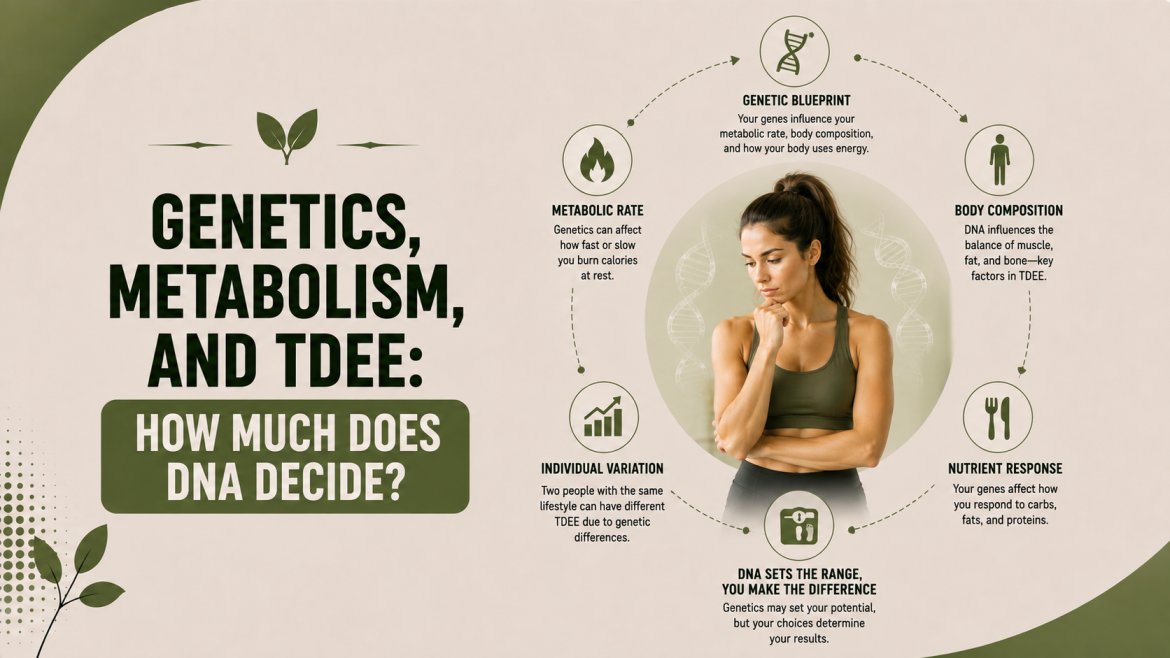
Genetics sets a range for metabolic rate rather than a fixed outcome. Twin studies estimate resting metabolic rate as moderately heritable, but behaviour explains far more variation between individuals than DNA does on its own.
This guide covers what twin research actually measured and what the FTO gene does and does not explain. A TDEE calculator has no genetic input at all.
The final sections cover how genetic and behavioural factors compare in size, and which genetic factors cannot be changed through lifestyle.
How Heritable Is Metabolic Rate?
Heritability describes what share of variation in a trait across a population traces to genetic differences rather than environment. It does not describe how much any one individual's metabolism is fixed by their genes.
A landmark 1990 study in the New England Journal of Medicine examined this question directly. Claude Bouchard and colleagues overfed 12 pairs of identical twins by 1,000 calories per day for 100 days under controlled conditions.
Finding | Result |
|---|---|
Weight gain within twin pairs | Highly similar between the two twins |
Weight gain between different pairs | Varied widely, roughly 3x more variation |
Fat distribution pattern | Consistent within pairs, variable between pairs |
Interpretation | Genetics strongly influences response to a given surplus |
Twins within the same pair, sharing identical DNA, gained weight in strikingly similar amounts and patterns. Unrelated pairs, despite eating the identical controlled surplus, showed roughly three times more variation in outcome.
What this actually shows: Genetics does not determine whether weight is gained on a surplus. It strongly influences how efficiently that surplus converts to stored fat, one variable among every factor covered in this cluster.
What Does the FTO Gene Do?
The FTO gene is the most extensively studied genetic variant linked to body weight and energy balance. It does not control metabolic rate directly but influences appetite regulation in the hypothalamus.
A 2007 study in Science by Timothy Frayling and colleagues analysed genetic data from over 38,000 people and identified the FTO variant's population-level effect.
Genetic Status | Average Weight Difference | Mechanism |
|---|---|---|
Non-carrier | Baseline | Standard appetite regulation |
One risk allele | Approximately 1.5 kg heavier on average | Modestly elevated hunger response |
Two risk alleles | Approximately 3 kg heavier on average | Elevated hunger response, higher obesity risk |
Roughly 16% of people of European ancestry carry two copies of the FTO risk variant. Carriers report measurably stronger hunger signals and slower satiety after eating, rather than a lower resting metabolic rate. FTO acts on appetite rather than any of the four components the complete TDEE guide covers.
A worked comparison: A 30-year-old carrying two FTO risk alleles and a non-carrier of identical height, age, and activity level might show a genuine 3 kg difference in typical body weight. That gap is roughly equivalent to what 8 to 12 weeks of consistent resistance training can add in lean mass alone, before any dietary change is even considered.
In practice, a 3 kg average difference is meaningful at population level across millions of people. It remains small next to what consistent diet and activity changes produce for any single individual using a properly sized calorie deficit.
Genetics vs Behaviour: What the Data Shows
Comparing the scale of genetic and behavioural effects puts both in proper context. Neither operates in isolation from the other.
Factor | Typical Magnitude | Modifiable? |
|---|---|---|
FTO gene (2 risk alleles) | ~3 kg average population difference | No |
Twin-study heritability of RMR | Moderate, exact figures vary by study | No |
Consistent resistance training over 6 months | 2 to 4 kg lean mass gain, raising RMR | Yes |
Sustained moderate calorie deficit | Highly variable, driven by adherence | Yes |
Combined lifestyle change over 1 year | Frequently exceeds any single gene's effect | Yes |
The practical comparison favours behaviour by a wide margin. A single genetic variant with the largest documented individual effect, FTO, produces roughly the same magnitude of change as six months of consistent resistance training. Genetic influence on the hormone systems covered in the hormones and TDEE guide follows a similar pattern of modest individual effect.
Where this connects to age: Heritable differences in how efficiently metabolic rate is maintained also interact with the age-related decline covered in the guide to age and TDEE, since some individuals appear genetically more resistant to age-related muscle loss than others.
What Genetic Factors Are Not Modifiable?
Some genetic influences on metabolism sit entirely outside behavioural control, regardless of diet or training quality. Understanding which ones these are prevents wasted effort chasing an unmodifiable target.
Baseline resting metabolic rate variation not explained by body composition
Individual FTO and related appetite-regulation gene variants
Genetic contribution to fat distribution pattern, independent of total body fat
Inherited variation in muscle fibre type ratio, which affects both strength potential and resting energy use
None of these genetic factors prevent meaningful change. They set the starting conditions and a ceiling on certain outcomes, not the outcome itself. Genetics sets a range rather than a fixed number for BMR, TDEE, and RMR alike.
A useful reframe: Genetics determines how hard a given result is to achieve, not whether it is achievable. Two people can reach the same fat loss goal through the same protocol, with one finding it considerably harder than the other for reasons entirely outside their control.
Does Genetics Predict How You'll Respond to a Diet?
Individual variation in diet response is well documented beyond what FTO or any single gene explains. Two people following an identical calorie deficit can show meaningfully different rates of loss, even after accounting for reported adherence.
Part of this traces to individual variation in metabolic adaptation itself. Some people experience larger and faster resting metabolic rate reductions during a deficit than others at the same starting stats and same deficit size.
Response Pattern | Approximate Population Share | Practical Implication |
|---|---|---|
Fast, predictable loss matching calculated deficit | Roughly one third | Standard formula and protocol work well |
Moderate adaptation, slower than expected loss | Roughly one third | Recalibration after 2 to 3 weeks improves accuracy |
Significant adaptation, considerably slower loss | Roughly one third | Requires closer tracking and possibly diet breaks |
These proportions are approximate and drawn from the broader pattern seen across weight-loss trial data rather than a single definitive genetic study. The practical takeaway holds regardless of exact figures.
What actually helps regardless of genetic response type: Measuring your own real TDEE from tracked data, rather than relying solely on the formula estimate, corrects for genetic variation in adaptation without needing to know the specific mechanism. The full protocol for measuring metabolic adaptation covers exactly how to do this over a 14-day window.
Frequently Asked Questions About Genetics and Metabolism
Can Genetics Alone Explain Why I Can't Lose Weight?
Genetics can make weight loss more difficult through stronger hunger signalling or a body composition predisposition. It rarely explains a complete inability to lose weight. A consistently applied deficit produces loss regardless of genetic background, even if the rate or difficulty differs.
Is There a Test for a "Slow Metabolism" Gene?
Commercial genetic tests can identify FTO and related variants, but no single test measures overall metabolic rate directly. Resting metabolic rate is best measured through indirect calorimetry or estimated using body composition. The best TDEE calculators review covers which tools handle that estimation most accurately.
Do Identical Twins Always Have the Same TDEE?
Not exactly, even with identical DNA. The Bouchard 1990 study found twins responded very similarly to identical overfeeding. Real-world differences in activity level, muscle mass, and lifestyle still produce measurable TDEE differences between twin pairs over time.
How Much of Obesity Risk Is Genetic?
Population-level heritability estimates for body weight vary across studies but consistently show a meaningful genetic component alongside a larger environmental and behavioural one. No single gene, including FTO, accounts for more than a small fraction of individual variation.
Should Knowing I Have "Bad Genetics" Change My Approach?
It can inform expectations without changing the fundamentals. Someone with a stronger genetic hunger signal may benefit more from strategies targeting satiety. Higher protein and fibre intake tend to help more than assuming standard approaches will not work at all.
Are Genetic Testing Kits for Diet and Fitness Worth It?
Direct-to-consumer genetic testing for diet and fitness has grown popular, but the evidence supporting personalised nutrition recommendations from these tests remains limited. Most commercial panels report on a small number of well-studied variants like FTO, which explain only a fraction of individual variation.
A test result showing an FTO risk variant is not particularly actionable on its own. It largely confirms what already applies to everyone: prioritise protein and fibre for satiety, and track composition with a body fat percentage calculator. Appetite management still takes deliberate effort regardless of the result.
The practical value of these tests is lower than their marketing typically suggests.