
Why Your Food Log Is Wrong And How to Fix It?
A landmark study found diet-resistant subjects underreported their food log by 47% when measured against doubly labelled water. This guide covers why logs go wrong, whether weighing actually beats eyeballing, how accurate nutrition labels really are, and the fixes that close the gap.

Your body has a number. Let's find it.
We calculate the exact calorie target your body needs, built from your stats and goal, then track everything against it daily. Log meals, add workouts, set a weight goal, and watch your numbers update in real time. Check in weekly to see calories, water, and weight trend in one place.
No spreadsheets. No guessing. Just results.
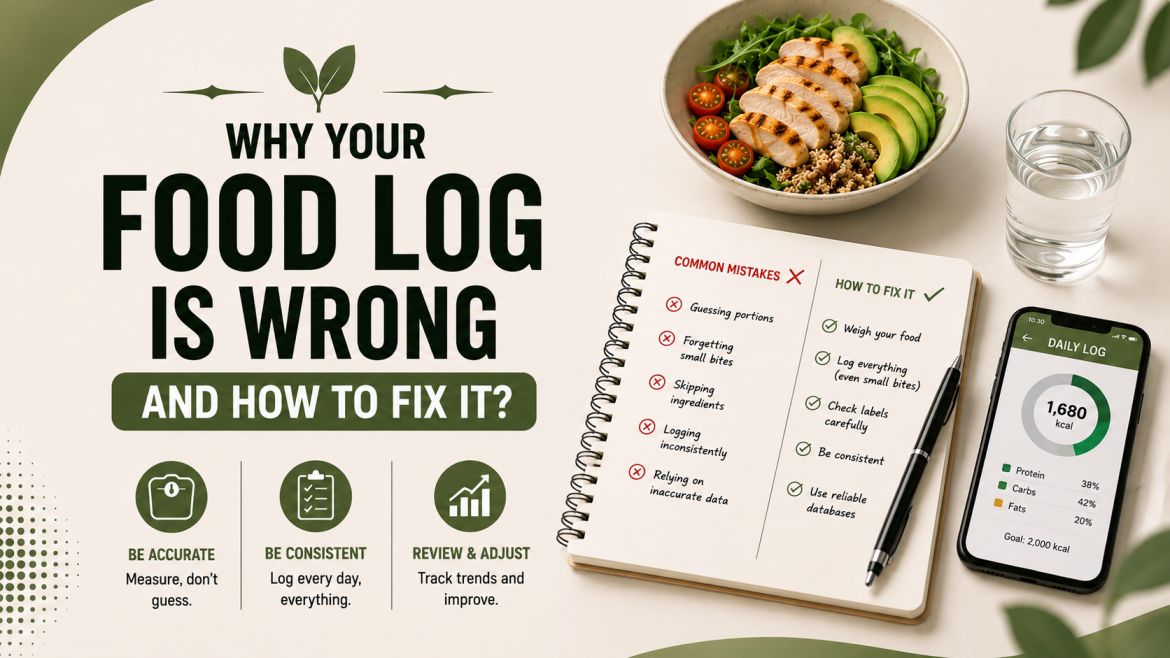
Why Is Your Food Log Wrong And How Do You Fix It?
Most food logs understate real intake, often by a wide margin. Run the TDEE calculator to get your target number first, since everything below is about how accurately your log actually reflects that target.
This is not a question of honesty. It is a question of measurement, and measurement without a scale is consistently, predictably wrong in one direction.
This guide covers how large the gap really is and why certain foods disappear from logs more than others. It also covers whether weighing food meaningfully beats eyeballing it, and how accurate a nutrition label actually is once you understand the regulations behind it.
How Inaccurate Is the Average Food Log?
The scale of food log error is larger than most people assume, and it has been measured directly against objective science for decades.
Study or Data Source | Population | Underreporting Found |
|---|---|---|
Lichtman et al., 1992 (NEJM) | Diet-resistant subjects | 47% below true intake |
Same Study, Exercise Reporting | Diet-resistant subjects | 51% above true exercise |
NHANES Validation Data | General US population | ~23% below true intake |
General Food Diary Studies | Mixed populations | 17 to 29% below true intake |
The Lichtman study used doubly labelled water, the same gold-standard method used to validate TDEE formulas themselves. Subjects who insisted they were following their prescribed diet were, on average, eating nearly half again more than they logged.
Why this matters beyond honesty: under-reporting is the single most common alternative explanation whenever a correctly sized deficit appears to stop working. The metabolic adaptation guide covers how to rule this out before assuming your metabolism itself has changed.
Why Does Food Logging Go Wrong in the First Place?
Under-reporting is not random. It follows predictable patterns tied to memory, portion perception, and which foods are easiest to forget.
What Foods Get Underreported Most?
Certain categories of food consistently disappear from logs more than others, largely because they are consumed without a clear serving boundary.
Cooking oils and butter added during preparation, rarely measured
Sauces, dressings, and condiments added at the table
Drinks consumed alongside a meal, especially anything other than water
Small bites and tastes while cooking, which accumulate unnoticed
Second helpings that go unlogged because the first serving was already recorded
The common thread: none of these are single, discrete eating events. They blend into the background of a meal, which makes them the easiest calories to lose track of entirely.
Does Weighing Food Actually Beat Eyeballing It?
This is one of the more precisely measured questions in dietary research, and the data is clear enough to settle the debate.
A 2021 study in the Journal of Human Nutrition and Dietetics tested this directly. Lucassen and colleagues compared portion estimation against true weighed intake, testing two common estimation methods.
Estimation Method | Median Error | Reports Within 10% of True Intake |
|---|---|---|
Text-Based Description | 0% median error | 31% of reports |
Image-Based Estimation | 6% median error | 13% of reports |
Direct Weighing (Reference) | Near-zero by definition | Used as the accuracy standard |
Even the better-performing estimation method in this study still left the majority of reports outside a reasonably tight accuracy band. Weighing remains the only method that reliably closes that gap.
What Does the Research Say About Hand and Household Measures?
A separate study published in the Journal of Nutritional Science compared using hands as a reference, household measures like cups and spoons, and direct weighing. Estimated methods consistently showed considerable error compared to weighed records, regardless of which specific tool was used.
In practice: weighing is not a marginal improvement over other methods. It is a categorically different level of accuracy, and no estimation aid, however well designed, closes that gap completely.
How Accurate Are Restaurant and Packaged Food Estimates?
Two separate accuracy problems live inside this question: whether the printed label is correct, and whether a restaurant dish matches its menu description at all.
Are Nutrition Labels Actually Correct?
Nutrition labels are not required to be exact. FDA regulation 21 CFR 101.9(g) sets an asymmetric tolerance system that most consumers never learn about.
Nutrient Category | Allowed Variance |
|---|---|
Calories, Fat, Sodium, Sugars | Can exceed the label by up to 20% (120% of declared value) |
Protein, Fibre, Vitamins, Minerals | Can fall short but not exceed declared value freely |
Rounding Rule for Calories | Rounded to the nearest 5 or 10 kcal per serving |
What this means in real terms: a protein bar labelled 200 calories can legally contain up to 240 and still comply. Across several packaged items in a single day, that rounding and tolerance compound into a real, cumulative gap between logged and actual intake.
How Do You Estimate Restaurant Meals More Accurately?
Restaurant meals carry the largest single-meal error in most logs. Portion size, cooking oil, and preparation method all vary by kitchen, even for the identical dish name.
Search the restaurant's published nutrition data before ordering, when available
Add a 15 to 20% buffer to any dish with visible oil, sauce, or butter
Choose the closest matching database entry rather than skipping the entry entirely
Log drinks and sides separately, since these are the most commonly forgotten components
Chain restaurants publish nutrition data far more consistently than independent kitchens, which makes them the easier category to estimate accurately.
Do Food Tracking Apps Fix This Problem Automatically?
Modern tracking apps pull from enormous food databases, which creates an impression of precision that the underlying data does not always support.
Why Do Database Entries Vary So Widely for the Same Food?
Most large food databases blend two very different sources: verified manufacturer or USDA data, and entries submitted directly by other users. The two are not held to the same standard.
Entry Source | Typical Reliability | Common Problem |
|---|---|---|
USDA or Verified Brand Data | High | Rarely an issue on its own |
User-Submitted Entries | Highly variable | Wrong portion size, outdated recipe, incorrect scan |
Barcode-Scanned Packaged Foods | Generally reliable | Regional formula differences, mismatched scans |
Generic "Chicken Breast" Style Entries | Low without preparation detail | Cooking method changes calories significantly |
A single popular food can carry dozens of database entries with different calorie counts, and the app has no reliable way to surface the most accurate one automatically. Selecting the verified brand or USDA-sourced entry, when available, avoids inheriting someone else's earlier mistake.
Preparation method compounds this further. A generic "chicken breast" entry might assume grilled and skinless. The actual meal could be pan-fried in oil or breaded instead. That gap alone can shift the true calorie count by 50% or more.
How Much Does Logging Accuracy Actually Matter for TDEE?
A 20 to 30% underreporting gap is large enough to fully explain a stalled result at a deficit that looks correct on paper.
A worked example makes this concrete: someone logging 1,800 calories while actually eating 2,200, a 22% gap consistent with the research above, believes they are in a 400-calorie deficit from a 2,200 TDEE. In reality, they are eating at maintenance.
This is why correctly sizing a deficit depends on logging accuracy just as much as it depends on the calculation itself. Neither one works without the other.
This problem scales with the numbers involved. Athletes face a compounded version of it, since higher food volume creates more individual entries where error can accumulate. The TDEE calculator for athletes sets the target number, but that number is only as reliable as the log measured against it.
Smaller calorie targets face a different version of the same issue. The TDEE calculator for women often produces a lower daily target, which means the same gram-level errors represent a larger percentage of the total.
How Do You Fix Under-Reporting Without Making Logging a Chore?
The fix is procedural rather than a matter of trying harder to remember accurately. A short, focused period of precise logging recalibrates portion judgement for months afterward.
Weigh dense, calorie-heavy foods every time for two full weeks, since these carry the largest error per gram
Log before eating rather than after, removing the temptation to round down from memory
Re-weigh regular staple meals every few months, since recipes and brands change over time
Accept the 20% label tolerance as real, and lean toward the higher end of a range when a dish looks generously portioned
Return to full weighing periodically even after building good estimation habits, since accuracy drifts back toward eyeballing over time
This connects directly to the wider system. Accurate logging is also what makes macro tracking meaningful, since a protein target built on an inaccurate log inherits all the same error.
Logging accuracy also affects how a weekly weight trend gets interpreted. The weekly weigh-in protocol works best when the intake side of the equation is trustworthy too.
Both sit within the same larger system: the full tracking methods hub.
Frequently Asked Questions About Food Logging Accuracy
How Much Do Food Logs Typically Underestimate Intake?
Research consistently finds a range of 17 to 30% underreporting in general populations. More extreme cases reach 47% in controlled studies using doubly labelled water as the reference standard. The gap tends to be largest for oils, sauces, and drinks.
Is Weighing Food Really Necessary, or Is Eyeballing Close Enough?
Research directly comparing estimation methods to weighed intake found even the better-performing estimation approach left the majority of reports outside a 10% accuracy band. Weighing remains meaningfully more accurate than any estimation method tested.
Can I Trust the Calorie Count on a Nutrition Label?
Labels are legally allowed to understate calories with no floor. They can also exceed the declared amount by up to 20% under FDA regulation 21 CFR 101.9(g). Treating a label as an exact figure rather than a close estimate avoids a common source of tracking error.
Why Do Restaurant Meals Throw Off My Calorie Count More Than Home Cooking?
Restaurant kitchens vary in portion size, oil use, and preparation method even for identically named dishes. Home cooking with weighed ingredients removes most of that variability, which is why restaurant meals consistently produce the largest single-entry errors in most logs.
Does Under-Reporting Explain Every Weight Loss Plateau?
Not every plateau, but it is the most statistically likely explanation before assuming metabolic adaptation or another biological cause. Testing this requires a genuinely precise two-week logging period using a food scale before ruling it out.
How Long Should I Weigh My Food Before I Can Trust My Eyeballing Again?
Two consistent weeks of weighing is generally enough to meaningfully recalibrate portion judgement. Accuracy still drifts gradually afterward, so periodic re-weighing every few months maintains the benefit long term.
Does Food Logging Accuracy Matter Less Once I Know My Maintenance Calories?
No, it matters just as much. An inaccurate log at maintenance produces an incorrect maintenance number from the start. That same error then carries into every deficit or surplus calculated from it.
Where to read next: the complete TDEE guide covers how the number itself is calculated before any of this tracking begins.
Muscle-focused goals depend on the same logging precision, covered in the guide to building muscle with TDEE.