
Pumping vs Nursing: Which Burns More Calories?
Pumping and nursing get compared constantly for calorie burn, but no calorimetry study has actually tested the two head-to-head. This guide covers what real doubly-labeled water research shows about the energy cost of lactation, why milk volume matters more than removal method, and how to eat accordingly.

Your body has a number. Let's find it.
We calculate the exact calorie target your body needs, built from your stats and goal, then track everything against it daily. Log meals, add workouts, set a weight goal, and watch your numbers update in real time. Check in weekly to see calories, water, and weight trend in one place.
No spreadsheets. No guessing. Just results.
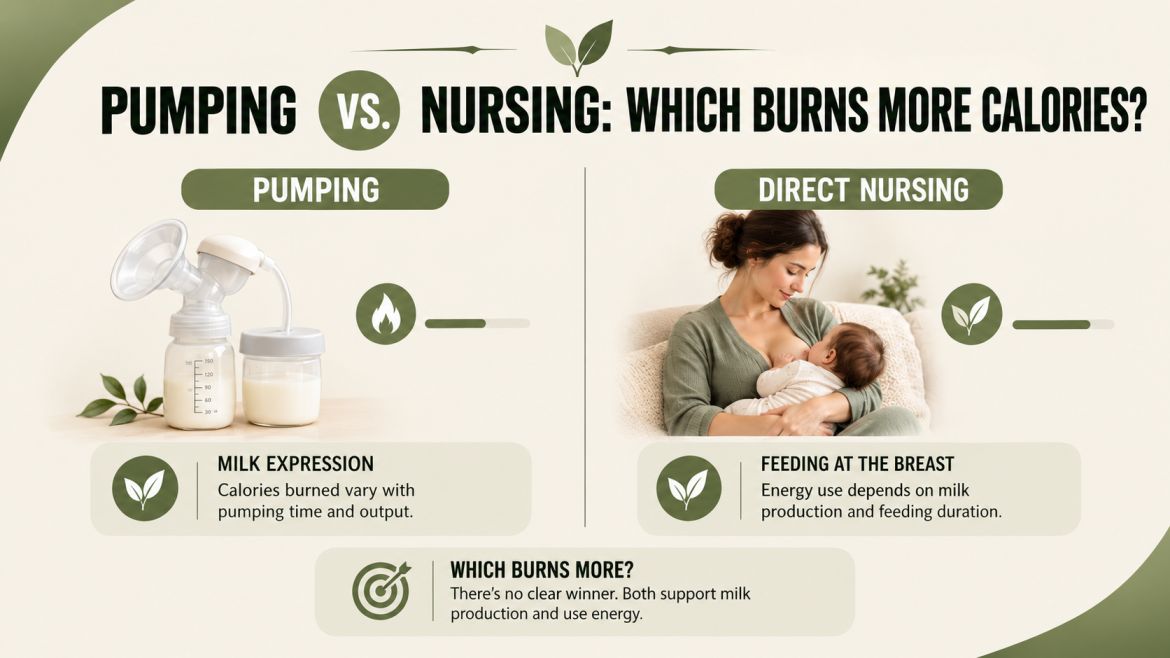
This comparison gets asked constantly, and most answers online rely on reasonable-sounding logic rather than an actual study measuring the two methods directly.
Run the TDEE calculator for breastfeeding to get a starting calorie target. The number that matters most is milk volume, not which method produces it.
This guide covers what real lactation research shows about the energy cost of milk production and why no study has directly compared pumping against nursing. It also covers what the underlying physiology suggests instead.
Roughly 84% of infants in the United States start out breastfed. A substantial share of those parents rely at least partly on pumping alongside or instead of direct nursing. The calorie question this guide addresses affects a genuinely large population making real feeding decisions.
How Does Your Body Actually Burn Calories During Lactation?
The most rigorous data on this topic comes from doubly-labeled water research, considered the gold standard for measuring real-world energy expenditure.
What Did This Research Actually Find?
A study measured total energy expenditure, milk energy output, and body composition in 24 well-nourished women during exclusive breastfeeding at 3 months postpartum. Researchers used doubly-labeled water, bomb calorimetry, and DEXA scanning.
Measure | Finding |
|---|---|
Total Energy Expenditure (Lactating) | 10.0 MJ/day (about 2,390 kcal) |
Total Energy Expenditure (Non-Lactating) | 10.6 MJ/day (about 2,530 kcal) |
Mean Milk Energy Output | 2.02 MJ/day (about 483 kcal) |
Tissue Mobilization From Fat Stores | Roughly 155 kcal/day |
Total energy expenditure did not differ significantly between the lactating and non-lactating state in this study. The energy cost of milk production was met primarily by eating more, with some contribution from fat store mobilization, rather than a dramatic rise in overall expenditure independent of intake.
How Much Energy Does Milk Production Actually Cost?
Understanding the underlying energy math clarifies why this whole comparison centers on milk volume rather than delivery method.
What Is the “Efficiency" of Milk Synthesis?
A classic study on the energy cost of human lactation found the process operates at roughly 90% efficiency. Producing milk costs somewhat more energy than the milk itself contains. A separate widely cited review used an efficiency estimate closer to 80%.
This range, 80 to 90% efficiency, means the true cost of producing milk runs 10 to 25% above the milk's raw energy content. A separate study measuring Dutch lactating women found a comparable total energy cost of roughly 650 kcal daily, tied to milk production around 745 grams per day.
Does the Body Cover This Cost the Same Way for Everyone?
The same Dutch research found lactating women met this energy cost through a combination of factors. Eating more, mobilizing tissue stores, and in some cases reducing energy expenditure elsewhere all played a role.
Adaptation | Approximate Contribution |
|---|---|
Increased Food Intake | The largest single contributor in most studies |
Tissue Store Mobilization | Roughly 35 to 155 kcal/day depending on the study |
Reduced Non-Lactation Expenditure | A smaller, more variable contribution |
No single pathway fully explains how any individual meets this cost. The proportions found in research vary by study, body composition, and how well-nourished the population studied actually was.
Does Milk Composition Affect the Calorie Calculation Too?
Milk energy density is not perfectly uniform across a single session. Hindmilk, the fattier milk released later in a feed or pump session, carries more calories per ounce than foremilk released earlier.
This variation matters more for understanding total output than for the pumping-versus-nursing question specifically. Since both methods draw from the same overall milk composition across a full session, this variation applies equally regardless of removal method.
Does Pumping Burn Different Calories Than Direct Nursing?
This is the specific question this guide's title promises to answer, and the honest response starts with acknowledging what has and hasn't actually been studied.
Factor | Direct Nursing | Pumping |
|---|---|---|
Primary Energy Cost | Milk synthesis (~400–500 kcal/day at typical volume) | Milk synthesis (~400–500 kcal/day at typical volume) |
Secondary Physical Activity | Holding and positioning a baby | Equipment setup, cleaning, hands-on massage |
Directly Studied Head-to-Head? | No calorimetry study confirms this | No calorimetry study confirms this |
Milk Volume, Trackable? | Difficult to measure precisely per session | Easily logged as exact ounces |
Overall Calorie Burn at Matched Volume | Comparable, based on synthesis-driven physiology | Comparable, based on synthesis-driven physiology |
The table's middle rows differ; its bottom line doesn't. Each method carries its own distinct physical demands, but neither has been shown to meaningfully change the total energy cost once milk volume is matched.
Has This Actually Been Tested Directly?
No calorimetry study identified in current research has directly compared energy expenditure between pumping and direct nursing at matched milk volumes. Every specific claim comparing the two circulating online traces back to lactation consultancy content or breast pump manufacturer blogs, not peer-reviewed measurement.
This is a genuine gap worth stating plainly rather than papering over. The absence of a direct study does not mean the question is unanswerable, but it does mean confident claims about a "20% difference" or similar specific figures are not backed by the kind of measurement this guide relies on elsewhere.
What Does the Underlying Physiology Suggest?
The energy cost documented in the research above comes from milk synthesis itself, the biological process of manufacturing milk from nutrients in the bloodstream. That process does not distinguish between milk headed toward a bottle or a baby.
This makes a reasoned inference, not a directly tested finding: for the same milk volume, the core synthesis cost should be similar regardless of removal method. Direct nursing likely adds a small additional energy cost from holding, positioning, and physically engaging with a baby, though this specific difference has not been separately measured or quantified in available research.
How Large Could That Physical Activity Difference Actually Be?
Holding an infant for a 20 to 40 minute feeding session involves sustained low-level muscular effort. This is comparable to holding a light weight for an extended period, not anything resembling structured exercise.
Even a generous estimate would place this difference at a modest number of additional calories per session, nowhere close to the 400 to 500 kcal daily cost of milk synthesis itself. Framing this as a meaningful weight-management lever overstates what the physical activity difference could plausibly contribute.
Does Pumping Have Its Own Separate Physical Demands?
Pumping involves its own physical tasks: cleaning parts, setting up equipment, and for some parents, hands-on breast massage during sessions to encourage better output.
These tasks likely offset at least some of the activity gap from not holding a baby directly. Neither pumping nor nursing involves enough physical activity to meaningfully change the overall calorie picture compared to the synthesis cost driving the vast majority of energy expenditure.
How Many Calories Should You Actually Eat While Breastfeeding or Pumping?
Given that milk volume drives the calorie question more than method, the practical target should scale with actual output rather than a single fixed number.
Feeding Pattern | Typical Additional Calories Needed |
|---|---|
Exclusive Breastfeeding or Pumping | 400–500 kcal/day above pre-pregnancy TDEE |
Partial (Combination Feeding) | 200–350 kcal/day, scaled to actual output |
Occasional or Tapering | Minimal addition, adjust based on session frequency |
These figures are starting estimates based on typical milk volumes, not fixed prescriptions. A calculator that applies a specific adjustment based on your actual feeding pattern works better than a single population-wide average.
The full breakdown of how this adjustment works across different feeding patterns sits in the full breastfeeding and TDEE guide, which covers this in more depth than the volume-focused comparison this article makes.
Does Exclusive Pumping Change the Calorie Math?
Exclusive pumping does not appear to change the underlying calorie calculation, since the same volume-driven principle covered throughout this guide applies regardless of removal method.
An exclusive pumper who produces the same daily ounces as an exclusively nursing parent faces essentially the same energy cost. This follows the synthesis-driven mechanism this guide has covered in detail. Total daily output, trackable directly through pump logs, becomes a genuinely useful data point for exclusive pumpers specifically.
This tracking advantage is one practical benefit exclusive pumping offers over direct nursing. A nursing parent has no easy way to measure exact ounces consumed per session, while a pumping parent can calculate calorie needs from logged output with more precision.
Does This Mean Exclusive Pumpers Should Track Every Ounce?
Daily logging is common practice among exclusive pumpers already, since supply monitoring and feeding schedules typically require it regardless of any calorie question.
Repurposing data already being tracked for supply purposes toward calorie planning adds minimal extra effort. A rolling weekly average from existing pump logs gives a more stable number than trying to estimate output from a nursing session alone.
Nursing parents without this same output data can still apply the same volume principle indirectly. Baby weight gain, wet diaper counts, and typical feeding frequency all serve as reasonable proxies for output when direct measurement isn't practical.
What Actually Explains the Intense Hunger After Feeding or Pumping?
The hunger many parents describe immediately after a feeding or pumping session has a real physiological basis worth understanding.
Prolactin and oxytocin, the hormones driving milk production and ejection, both influence appetite regulation alongside their reproductive functions. The doubly-labeled water research covered earlier found increased food intake was the primary way lactating women met their elevated energy needs. Expenditure alone did not rise dramatically.
This suggests hunger signals during lactation function as intended, not as something to override. The body increasing appetite to match the real energy cost of milk production is the mechanism, not a separate problem requiring correction.
How Do You Lose Weight Safely While Breastfeeding or Pumping?
Milk volume ties directly to calorie needs during this period. Any weight loss approach needs to account for that connection rather than ignoring it.
A protein calculator helps set an adequate intake target, since protein needs remain elevated during lactation alongside the general postpartum recovery period. A gradual approach, generally no more than 1 pound weekly, protects both milk supply and recovery.
Aggressive restriction risks reducing milk supply, not just slowing weight loss. Cutting too far below the calculated lactation-adjusted target removes the buffer this guide's research shows the body actually relies on to meet milk production costs.
What Common Misconceptions Confuse This Comparison?
A few persistent misconceptions make this specific question harder to answer clearly than it needs to be.
Do People Assume One Method Is Definitively Better for Weight Loss?
Content promoting either pumping or nursing as the superior weight-loss method typically cites the same unverified specific percentages. None trace back to an actual calorimetry study measuring the two methods directly.
Do People Ignore Milk Volume as the Real Variable?
Comparing two parents' calorie burn based on method alone misses the real variable entirely. How much milk each actually produces is the dominant factor this guide's research identifies.
Misconception | What's Actually Supported |
|---|---|
"Nursing Burns Significantly More" | No direct study confirms a specific percentage difference |
"Pumping Burns Less Because It's Passive" | Synthesis cost, not removal effort, drives most of the calorie expenditure |
"Method Matters More Than Volume" | Milk volume is the variable research consistently identifies as central |
"A Specific Percentage Difference Is Established" | No calorimetry study has quantified this specific gap |
Getting this right changes how the whole question should be approached. Comparing two people's calorie burn by method alone, without knowing their respective milk volumes, compares the wrong variable entirely.
Frequently Asked Questions About Pumping vs Nursing Calories
Does Pumping Burn Fewer Calories Than Breastfeeding?
No direct study has tested this comparison. Available research indicates the energy cost comes from milk synthesis, not removal method. The reasoned expectation is similar calorie burn at matched milk volumes, though this has not been separately measured.
How Many Calories Does Breast Milk Actually Contain?
Research measuring milk energy directly through bomb calorimetry found an average output of roughly 483 kcal per day during exclusive breastfeeding. Total output and calorie content both vary by individual and feeding pattern.
Does Direct Nursing Burn More Calories From Holding the Baby?
This is a reasonable physiological inference, since holding and positioning a baby involves more physical activity than pumping. The specific size of this difference has not been separately quantified in available research.
Why Am I So Hungry After Pumping or Nursing?
Increased appetite reflects the real energy cost of milk production, driven partly by prolactin and oxytocin alongside general caloric need. Research found increased food intake was the primary way lactating women met this energy cost.
Does Exclusively Pumping Require More Calories Than Combination Feeding?
It depends on total milk volume produced rather than the pumping itself. An exclusive pumper producing high volumes needs more calories than someone combination feeding at lower total output, following the same volume-based principle throughout this guide.
Can I Lose Weight While Exclusively Pumping?
Yes, following the same gradual approach appropriate for direct nursing. Since exclusive pumpers can track exact ounces produced, calorie needs can be calculated with somewhat more precision than nursing parents typically can.
Does Pumping Efficiency Affect How Many Calories I Burn?
Pump efficiency affects how much milk gets removed per session, which in turn affects overall supply and demand signaling. The underlying calorie cost still traces back to total milk volume produced.
Should I Eat Differently on Days I Pump More Versus Nurse More?
Total daily or weekly milk volume matters more than which specific method produced it on any given day. Tracking output over several days gives a more reliable picture than adjusting intake based on a single session's method.
Does Tandem Feeding or Feeding Twins Change This Comparison?
The same volume-driven principle still applies, though total output naturally runs higher when feeding multiples or tandem nursing. The calorie target should scale with combined milk volume rather than treating each child's feeding separately.
Is There Any Benefit to Switching Between Pumping and Nursing for Calorie Burn Specifically?
Based on current research, no meaningful calorie advantage exists to favor one method over the other for this reason specifically. Method choice is better guided by practical factors like schedule, supply goals, and personal preference than by an unverified metabolic difference.
Does Weaning Change How Many Calories I Need Overnight?
No. Milk volume, and the corresponding calorie need, typically decreases gradually as feeding frequency reduces during weaning, rather than dropping suddenly. Adjusting intake gradually alongside declining output matches how the underlying energy cost actually changes.