
Extra Active Multiplier (1.9) | TDEE for Physical Jobs and Daily Hard Training
The extra active multiplier is 1.9. Learn who qualifies, how it's used in TDEE calculations, and how it differs from the very active level.

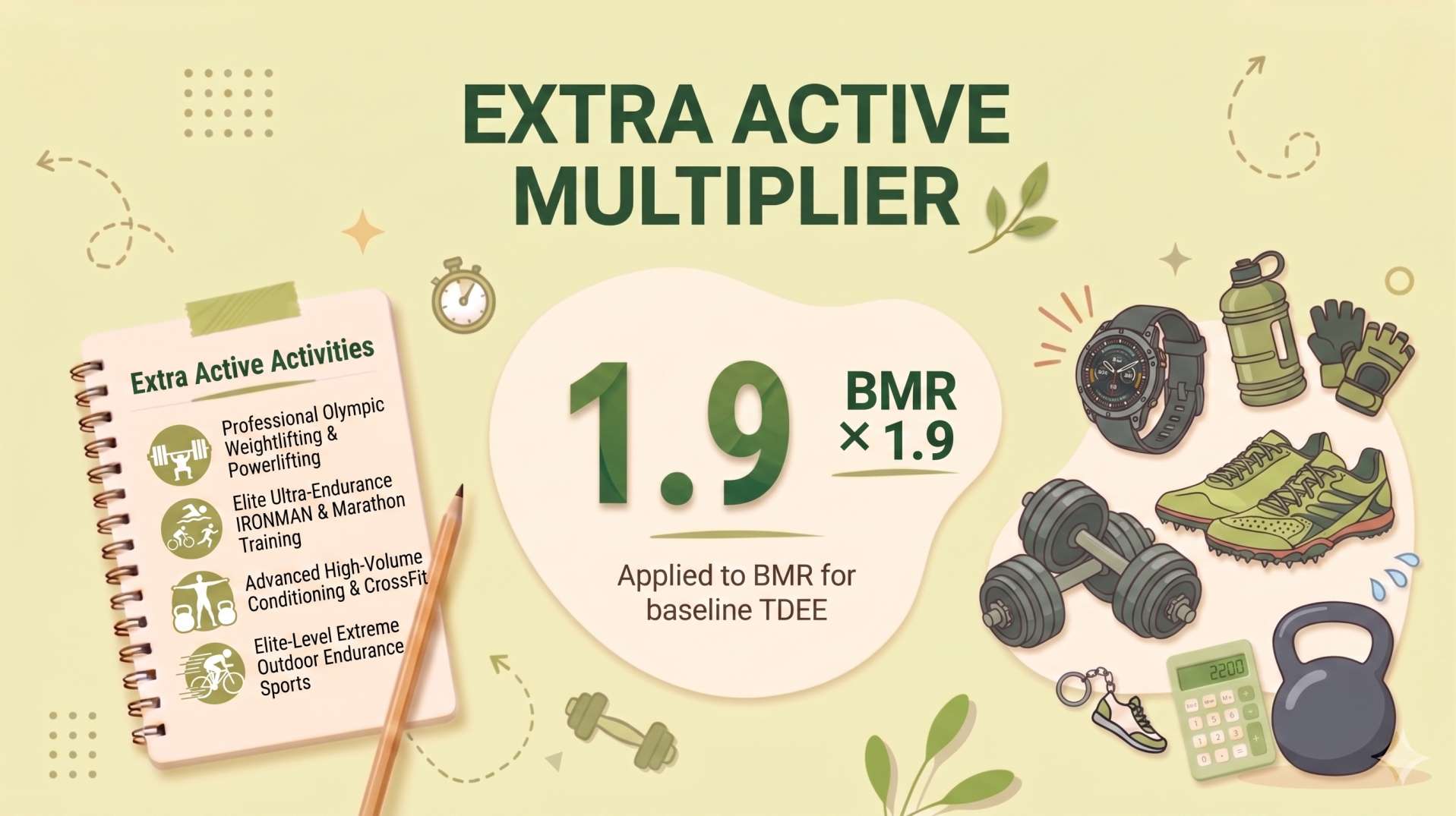
The extra active multiplier is 1.9. It is the highest value on the five-level activity scale used in TDEE calculations. It applies only to a narrow group: people who combine physically demanding work with structured daily training.
This multiplier raises your Basal Metabolic Rate by 90% to estimate total daily energy expenditure. That near-doubling of BMR reflects one of the most energy-intensive lifestyles that the standard TDEE framework accounts for.
The 1.9 level is regularly misapplied in both directions. Some very active athletes overestimate and reach for this level when they should be at the very active multiplier (1.725). Others with genuinely extra active lives stay at a lower level and chronically underfuel.
This article explains what 1.9 means, who it accurately fits, how it works across TDEE formulas, and how to verify it is the right choice for your situation.
What Does the 1.9 Multiplier Represent?
The extra active multiplier reflects a lifestyle where high physical output occurs both during structured exercise and during working hours. This is a compound load that most activity scales treat as a ceiling case.
Research on total energy expenditure in highly active populations — including military personnel, manual laborers, and elite athletes — finds daily expenditure ranging from 75% to 100% above resting rate. The 1.9 multiplier is positioned at the high end of that range. It is an appropriate estimate only when both legs of that compound load are consistently present.
The Core Formula
TDEE = BMR × Activity Multiplier
At the extra active level:
TDEE = BMR × 1.9
This applies to all BMR formulas. The Mifflin-St Jeor equation, the Harris-Benedict formula, and the Katch-McArdle formula all feed into the same multiplier structure.
The Full Scale in Context
Activity Level | Multiplier | Guide |
|---|---|---|
Sedentary | 1.2 | |
Lightly Active | 1.375 | |
Moderately Active | 1.55 | |
Very Active | 1.725 | |
Extra Active | 1.9 | This page |
The jump from very active to extra active is 0.175. For a BMR of 2,000 kcal, that represents 350 additional calories per day above the very active estimate.
Who Qualifies as Extra Active?
Extra active is the most restrictive category on the scale. The defining feature is a double activity load: sustained physical output at work plus dedicated structured training.
Criteria for Extra Active
You are extra active if your typical week includes:
A job that involves heavy physical labor for most of the working day, every day
Structured exercise or training on top of that job, most days of the week
Consistent, sustained physical output for the majority of each 24-hour period
Occupations that contribute to an extra active status include:
Construction workers doing heavy lifting and manual tasks daily
Roofers, landscapers, and demolition workers
Agricultural workers during harvest or intensive farming seasons
Full-time firefighters with physically demanding station duties and active call-outs
Military personnel in field or training positions
Moving and logistics workers doing all-day physical loading
This physical job load must be combined with regular training to reach 1.9. A construction worker who goes home and rests in the evening is very active at most, not extra active. A construction worker who also trains six days per week in the gym or on the field reaches the extra active threshold.
Athletic Profiles That Can Reach Extra Active
Professional and elite-level athletes occasionally qualify, particularly:
Elite endurance athletes in peak training with two-a-day sessions
Professional team sport players during full training schedules
Military athletes in selection or intensive training courses
The common thread is total daily physical output sustained across both structured sessions and an active occupation or daily training volume that far exceeds recreational levels.
How Does the 1.9 Multiplier Work in TDEE Calculations?
With a BMR established, the extra active multiplier produces the highest TDEE output on the standard scale.
Worked Example
A 30-year-old male construction worker, 180 cm, 85 kg, doing heavy labor daily and training five days per week.
Step | Value |
|---|---|
BMR (Mifflin-St Jeor) | 1,930 kcal |
Activity multiplier | × 1.9 (extra active) |
TDEE result | 3,667 kcal/day |
At the very active level (1.725), his TDEE would be 3,329 kcal — a gap of 338 calories per day. Over a month, that difference totals over 10,000 calories.
Formula Comparison at This Multiplier
BMR Formula | Example BMR | TDEE at 1.9 |
|---|---|---|
Mifflin-St Jeor | 1,930 kcal | 3,667 kcal |
Harris-Benedict | 1,975 kcal | 3,753 kcal |
Katch-McArdle (lean) | Varies | Varies |
For individuals with high muscle mass from physical work or training, the Katch-McArdle formula can give a more accurate BMR because it accounts for lean body mass directly.
Use the TDEE calculator to calculate your result at this multiplier automatically.
Extra Active vs. Very Active: The Key Distinction
These two levels are the most commonly confused on the scale. The distinction comes down to one criterion: the presence of a physically demanding job.
The Defining Test
Ask one question: Does your daily physical output come from training alone, or from both a physical job and training?
Training alone, even at very high volume: Very active (1.725)
Physical job and training combined: Extra active (1.9)
A competitive marathon runner who works at a desk and trains twice daily is very active, not extra active. A competitive marathon runner who also coaches outdoor physical education classes for eight hours a day is extra active.
Calorie Difference Between These Levels
BMR | Very Active (×1.725) | Extra Active (×1.9) | Difference |
|---|---|---|---|
1,600 | 2,760 kcal | 3,040 kcal | +280 kcal |
2,000 | 3,450 kcal | 3,800 kcal | +350 kcal |
2,400 | 4,140 kcal | 4,560 kcal | +420 kcal |
The daily calorie difference is substantial. At a BMR of 2,000 kcal, using very active when you are genuinely extra active creates a 350-calorie daily shortfall — roughly 10,500 calories per month.
Real TDEE Numbers at the Extra Active Level
BMR (kcal) | TDEE at 1.9 (Extra Active) |
|---|---|
1,400 | 2,660 kcal/day |
1,600 | 3,040 kcal/day |
1,800 | 3,420 kcal/day |
2,000 | 3,800 kcal/day |
2,200 | 4,180 kcal/day |
2,400 | 4,560 kcal/day |
These are maintenance values, the calorie intake at which body weight stays stable for an extra active individual at that BMR.
Calorie figures above 3,500 per day feel large to most people. They are realistic for individuals doing sustained heavy physical work and structured training combined. Undereating relative to these targets is the primary error at this activity level.
Physical Jobs and Training Together: Calorie Reality
The extra active lifestyle represents a significant and often underappreciated caloric demand. Understanding the component parts helps explain why the 1.9 multiplier produces such high TDEE values.
Components of Extra Active Expenditure
Component | Description | Estimated Daily Contribution |
|---|---|---|
BMR | Resting metabolic rate | Base value |
Occupational EE | Physical labor for 6–9 hours | 500–900 kcal above a sedentary job |
Training EEE | Structured workout sessions | 300–700 kcal per session |
NEAT | Incidental movement throughout the day | Elevated vs sedentary baseline |
EPOC | Post-exercise elevated metabolism | 100–250 kcal per training session |
When these factors stack, the total daily expenditure reaches the level that the 1.9 multiplier represents.
Seasonal and Schedule Variability
Many physical jobs vary in intensity seasonally. A roofer in summer does more hours and harder physical work than in winter. A farm laborer during harvest works far more intensely than during the off-season.
This variability means that extra active may not be a year-round classification for everyone. During low-intensity work periods, dropping to very active or even moderately active may be more accurate. The multiplier should reflect your current routine, not your peak or average across the year.
Risks of Misjudging the Extra Active Level
Risk 1: Using Extra Active Without the Physical Job Component
Athletes who train intensely every day sometimes reach for the 1.9 multiplier because their training feels extreme. Without a physical job or equivalent daily non-training load, very active (1.725) is the correct level.
Overestimating with extra active when very active is correct, creating a 300 to 400 calorie surplus per day. Over months, this leads to unintended body fat accumulation.
Risk 2: Using Very Active When You Are Extra Active
This error is more common and more damaging. People with physical jobs often underestimate their occupational energy expenditure. They count only their training calories and classify themselves as very active.
The result is a sustained underfueling state. Physical job workers who also train at high frequency are among the most likely to experience cumulative energy deficit without realizing it.
Risk 3: Not Adjusting for Off-Season or Recovery Periods
Extra active individuals who stop training due to injury or take extended time off still have the physical job component. During training breaks, very active (1.725) or moderately active (1.55) may be more appropriate depending on the job's intensity and hours.
When to Reassess and Which Level to Move To
The extra active multiplier requires regular reassessment because the conditions that qualify for it change.
When to Stay at Extra Active
You remain extra active as long as both conditions are present: a physically demanding job and consistent training at high frequency. Both must be true simultaneously.
When to Move to Very Active
Move to the very active level (1.725) when:
You change to a desk job or a less physical role
You stop structured training, but keep the physical job
Your training frequency drops significantly below daily
When to Move to Moderately Active
Move to the moderately active level (1.55) if both your job activity and training volume decrease simultaneously — during a recovery phase, seasonal low period, or lifestyle change.
Lower Levels
For extended periods of low activity, the lightly active (1.375) and sedentary (1.2) guides cover those thresholds. For a complete comparison of all five activity levels, see the activity multipliers overview.