
Very Active Multiplier (1.725) | TDEE for Hard Training 6–7 Days a Week
The very active multiplier is 1.725. Learn who qualifies, how it's applied in TDEE calculations, and how it differs from moderately active and extra active levels.

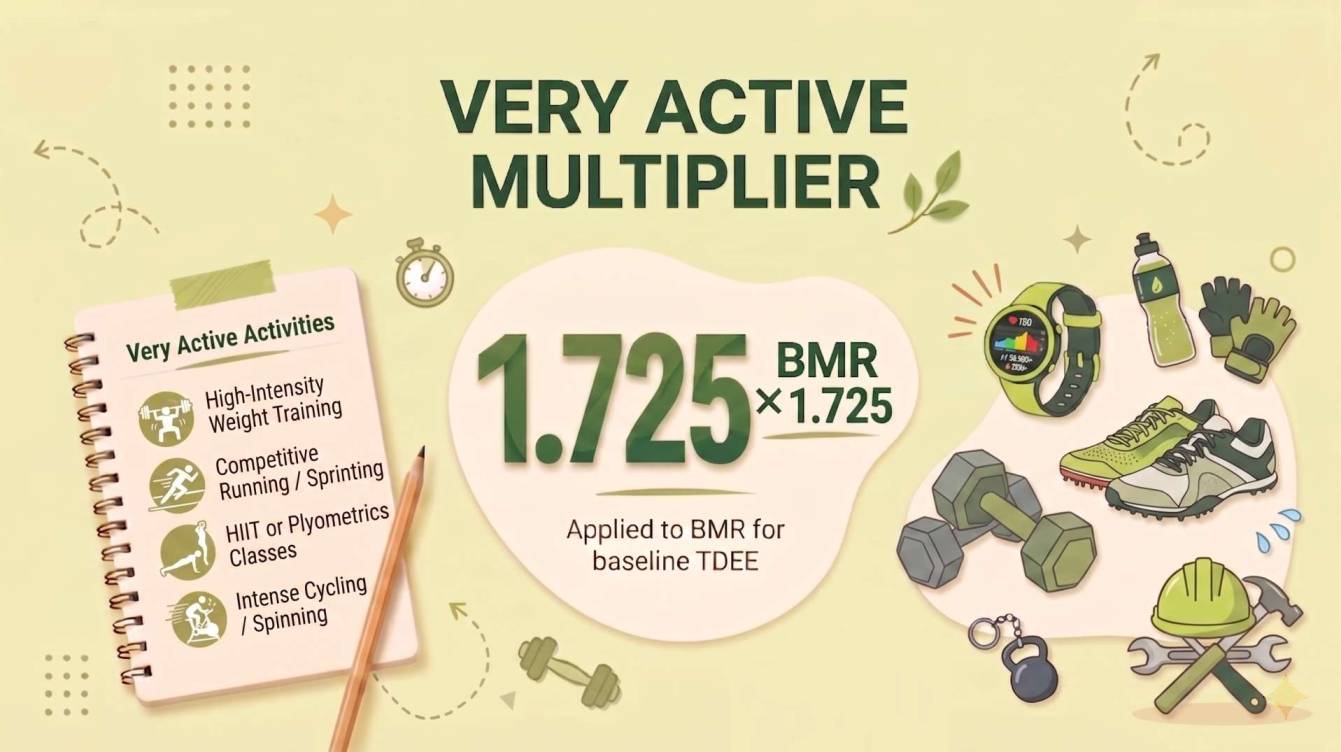
The very active multiplier is 1.725. It is the fourth level on the five-point activity scale used in TDEE calculations. It applies to people who train hard most days of the week with consistent, structured, high-intensity effort.
This multiplier scales your Basal Metabolic Rate by 72.5% to estimate total daily energy expenditure. That is a substantial increase. It reflects the real calorie demands of daily hard training combined with normal daily living activities.
The very active level fits serious athletes, people in high-volume training phases, and individuals whose routine includes hard exercise nearly every day. It is commonly underused. Many people who belong in this category stay at the moderately active level (1.55) and chronically underfuel their training.
This article covers what 1.725 means, who it fits, how it applies across TDEE formulas, and how to tell whether you are between this level and the levels on either side.
What Does the 1.725 Multiplier Represent?
The 1.725 figure captures the total energy cost of living and training as a highly active person. Research using doubly labeled water in high-training populations shows total daily expenditure ranging from 65% to 80% above resting rate. The 1.725 multiplier sits near the center of that range.
This is not just about exercise, but calories burned during workouts. It accounts for three compounding factors:
Exercise energy expenditure (EEE): Calories burned during training sessions
Excess post-exercise oxygen consumption (EPOC): Elevated metabolism after hard training
NEAT elevation: More movement throughout the day in active individuals
The Core Formula
TDEE = BMR × Activity Multiplier
At the very active level:
TDEE = BMR × 1.725
The same BMR inputs apply. The Mifflin-St Jeor equation, the Harris-Benedict formula, and the Katch-McArdle formula all use this multiplier scale.
Where Does 1.725 Sit in the Scale?
Activity Level | Multiplier |
|---|---|
Sedentary | 1.2 |
Lightly Active | 1.375 |
Moderately Active | 1.55 |
Very Active | 1.725 |
Extra Active | 1.9 |
The gap between moderately active and very active is 0.175. For a BMR of 2,000 kcal, that step up adds 350 calories per day to the maintenance estimate.
Who Qualifies as Very Active?
The very active category is narrower than most people assume. It requires both high frequency and genuine effort in most training sessions.
Criteria for Very Active
You are very active if your typical week includes:
Intense training or hard exercise 6 to 7 days per week
Session duration of 60 to 120 minutes at high effort
A structured program with volume and progression
No more than one full rest day per week
Profiles that typically fit this level:
Competitive amateur athletes in season
Powerlifters, Olympic weightlifters, or bodybuilders in high-volume phases
Endurance athletes running or cycling six-plus days per week
CrossFit athletes following a high-frequency program
People doing twice-daily training sessions, such as morning and evening workouts
The Frequency-Intensity Rule
Both frequency and intensity must be high to qualify as very active. Training six days per week at low intensity does not reach this level. The moderately active multiplier (1.55) is more accurate when intensity is low, even at high frequency.
Conversely, three days of extremely intense training do not qualify either. The multiplier reflects average daily energy expenditure across the week, not peak effort on a single day.
How Does the 1.725 Multiplier Work in TDEE Calculations?
Once BMR is known, applying the multiplier is straightforward. The output often surprises people who have been using a lower level.
Worked Example
A 25-year-old male competitive runner, 175 cm, 70 kg, training 6 days per week.
Step | Value |
|---|---|
BMR (Mifflin-St Jeor) | 1,800 kcal |
Activity multiplier | × 1.725 (very active) |
TDEE result | 3,105 kcal/day |
At the moderately active level, his TDEE would have been 2,790 kcal — a 315-calorie difference per day. Over a month, that gap equals roughly 9,450 calories, or close to 1.2 kg of body mass error.
Comparing Formulas at This Multiplier
BMR Formula | Example BMR | TDEE at 1.725 |
|---|---|---|
Mifflin-St Jeor | 1,800 kcal | 3,105 kcal |
Harris-Benedict | 1,843 kcal | 3,179 kcal |
Katch-McArdle (with LBM) | Varies | Varies |
For lean athletes with known body composition data, the Katch-McArdle formula often gives the most precise BMR. It accounts for lean body mass directly, which matters more at high training volumes where muscle mass is elevated.
Use the TDEE calculator to apply this multiplier with your chosen formula.
Very Active vs. Moderately Active and Extra Active
The two neighboring levels are frequently confused with very active. Understanding the boundaries helps calibrate accurately.
Very Active vs. Moderately Active
The moderately active multiplier (1.55) fits people who train three to five days per week with real effort. Very active requires six to seven days with hard sessions.
The most common mistake: someone who trains five days per week but whose sessions are genuinely intense labels themselves moderately active. If those five sessions are each 75 to 90 minutes of hard work, very active may actually be more accurate.
A useful test: are you taking two or more proper rest days per week? If yes, moderately active is likely right. If you take one rest day or none, very active is more appropriate.
Very Active vs Extra Active
The extra active multiplier (1.9) applies to people who combine daily hard training with a physically demanding job. Very active applies when training is the primary activity load.
A professional construction worker who also trains daily is extra active. A competitive athlete who has a desk job and trains daily is very active, not extra active.
The difference between these two levels is 0.175 multiplier points — roughly 300 to 400 calories per day for most BMR values. It is a meaningful gap, but the criterion for extra activity is clear: physical labor in addition to hard daily training.
Real TDEE Numbers at the Very Active Level
The table below shows maintenance calories at the very active level across a range of BMR values.
BMR (kcal) | TDEE at 1.725 (Very Active) |
|---|---|
1,400 | 2,415 kcal/day |
1,600 | 2,760 kcal/day |
1,800 | 3,105 kcal/day |
2,000 | 3,450 kcal/day |
2,200 | 3,795 kcal/day |
2,400 | 4,140 kcal/day |
These maintenance figures can feel high to people who have been eating at lower activity estimates for years. The high numbers are accurate for genuine, very active training loads.
Cross-Level Comparison at BMR 2,000 kcal
Level | Multiplier | TDEE |
|---|---|---|
Moderately Active | 1.55 | 3,100 kcal |
Very Active | 1.725 | 3,450 kcal |
Extra Active | 1.9 | 3,800 kcal |
The span from moderately active to extra active at this BMR is 700 calories per day. Accurate classification makes a substantial practical difference.
Why Very Active Athletes Often Underfuel?
Underfueling is the dominant real-world error at the very active level. It happens for several reasons.
Reason 1: Using Too Low a Multiplier
The most common cause is staying at the moderately active level while actually training at very active volume. This produces a maintenance estimate that is 300 to 400 calories too low. Eating at that estimate creates a chronic deficit that erodes performance and recovery over weeks.
Reason 2: Not Accounting for EPOC
High-intensity training raises metabolism for hours after the session ends. This is EPOC (Excess Post-Exercise Oxygen Consumption). A 90-minute hard workout does not end when the workout ends. EPOC from intense sessions can add 100 to 200 extra calories to the day's total. The 1.725 multiplier captures this through the aggregate scaling, but only if it is actually applied.
Reason 3: Intentional Undereating for Weight Goals
Athletes trying to stay in a weight class or achieve a certain body composition sometimes choose a lower multiplier deliberately. This creates an unrecognized deficit that can impair training adaptations, hormone function, and immune response over time.
Signs You Are Underfueling
Persistent fatigue during sessions that should feel manageable
Slow recovery between workouts
Stalled strength or performance despite consistent training
Increased frequency of minor illnesses or injuries
If several of these apply, recalculating with the very active multiplier and adjusting intake accordingly is a productive first step.
When to Change Your Activity Level?
Move Up to Extra Active
Move to the extra active level (1.9) when you add a physically demanding job to your existing daily training schedule. A construction job, manual labor role, or full-time coaching or training position alongside daily workouts qualifies.
Move Down to Moderately Active
Move to the moderately active level (1.55) when:
You enter a planned deload week or recovery phase
Your training frequency drops below five days for an extended period
The off-season begins, and training volume reduces significantly
Lower Levels
If injury or illness significantly limits your training for more than two weeks, recalculate at the appropriate lower level. Holding a very active multiplier during a forced rest period causes unintended caloric surplus.
For lower activity contexts, the lightly active (1.375) and sedentary (1.2) guides explain those thresholds in detail.
See the activity multipliers overview for a side-by-side comparison of all five levels. The TDEE calculator applies the correct multiplier automatically once you select your activity level.