
Katch-McArdle Equation | Formula, Lean Body Mass Calculation, and TDEE Application
The Katch-McArdle equation calculates BMR from lean body mass, not total weight. Learn the formula, how to find lean body mass, worked examples by body fat percentage, and when it outperforms Mifflin-St Jeor.

Your body has a number. Let's find it.
We calculate the exact calorie target your body needs, built from your stats and goal, then track everything against it daily. Log meals, add workouts, set a weight goal, and watch your numbers update in real time. Check in weekly to see calories, water, and weight trend in one place.
No spreadsheets. No guessing. Just results.
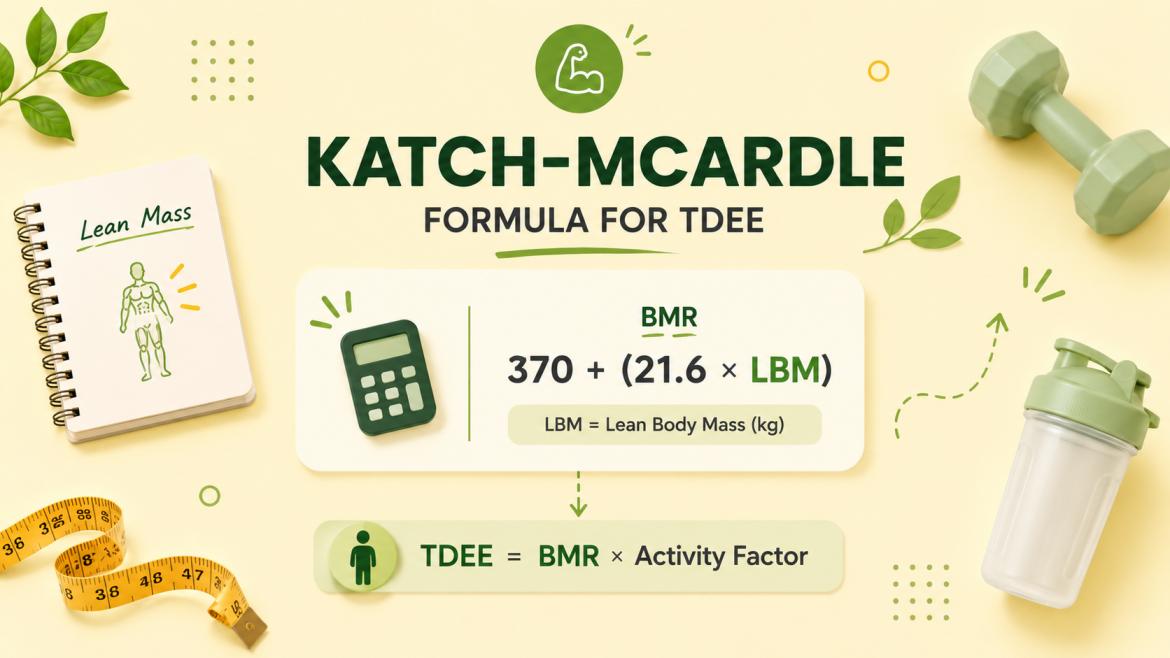
The Katch-McArdle equation calculates Basal Metabolic Rate (BMR) from lean body mass rather than total body weight. Developed by Frank I. Katch and William D. McArdle, the formula removes fat mass from the calculation entirely, operating on the principle that metabolically active tissue, primarily muscle, organs, and bone, drives resting energy expenditure more directly than total body weight alone.
Most BMR formulas use weight, height, age, and sex as inputs. The Katch-McArdle equation uses one input i.e. lean body mass in kilograms. It also makes it substantially more accurate than weight-based formulas for individuals whose body composition differs from population averages, specifically athletes with low body fat and individuals with high body fat percentages. For a complete TDEE calculation using any of the three main formulas, use the TDEE Calculator.
Research validation studies comparing the Katch-McArdle formula against indirect calorimetry, the laboratory gold standard for measuring resting metabolic rate, show correlation coefficients of 0.85 to 0.92 in athletic populations. This article covers the full Katch-McArdle formula, worked examples across multiple body fat levels, and TDEE outputs by activity level.
What Is the Katch-McArdle Equation?
The Katch-McArdle equation is a BMR prediction formula that uses lean body mass (LBM) as its sole input variable. Lean body mass is the portion of total body weight that is not fat: muscles, organs, bones, skin, and water. Because fat tissue has a significantly lower metabolic rate than muscle and organ tissue, removing fat mass from the BMR calculation produces a more physiologically accurate estimate of resting calorie burn for individuals with atypical body composition.
The equation was developed to address a fundamental limitation of total-weight-based formulas. Two people with identical body weight, height, age, and sex can have very different metabolic rates if their body composition differs. A 90 kg person with 12% body fat has approximately 79 kg of metabolically active lean mass. A 90 kg person with 35% body fat has approximately 58.5 kg of lean mass. Weight-based formulas assign both individuals the same BMR. The Katch-McArdle equation assigns them BMR values that reflect their actual tissue composition.
Why Lean Body Mass Predicts BMR More Accurately Than Total Weight?
Muscle tissue burns approximately 13 calories per kilogram per day at rest, according to ScienceDirect research on metabolic tissue activity. Fat tissue burns approximately 4 to 5 calories per kilogram per day at rest. As the ratio of lean mass to fat mass shifts, resting metabolic rate changes proportionally, even when total body weight stays the same.
Tissue Type | Approximate Resting Calorie Burn | Proportion of BMR Contribution |
|---|---|---|
Skeletal muscle | ~13 kcal per kg per day | Largest single contributor |
Organ tissue (liver, brain, heart, kidneys) | ~200-440 kcal per organ per day | High per-unit metabolic rate |
Bone tissue | ~2-3 kcal per kg per day | Low but stable |
Adipose (fat) tissue | ~4-5 kcal per kg per day | Metabolically active but at low rate |
This metabolic difference between tissue types explains why the Katch-McArdle equation outperforms total-weight formulas at the extremes of body composition. It also explains why two individuals at the same body weight but different body fat percentages require different calorie intakes to maintain, lose, or gain weight at the same rate.
For a complete breakdown of how BMR feeds into Total Daily Energy Expenditure and its four components, visit the TDEE overview.
What Is the Katch-McArdle Formula?
The Katch-McArdle formula is a single linear equation applied to lean body mass in kilograms. There is no separate male or female version of the formula. Sex differences in BMR are already captured through body composition: males and females with the same lean body mass will receive the same BMR output, which reflects an accurate biological reality when LBM is measured correctly.
The Katch-McArdle BMR Formula
BMR = 370 + (21.6 x lean body mass in kg)
Lean Body Mass Calculation
Lean body mass must be derived from total body weight and body fat percentage before the formula can be applied.
Step 1. Calculate fat mass
Fat mass (kg) = total body weight (kg) x (body fat percentage / 100)
Step 2. Calculate lean body mass
Lean body mass (kg) = total body weight (kg) - fat mass (kg)
This can be expressed in a single step:
LBM = total body weight x (1 - body fat percentage expressed as a decimal)
What the Formula Coefficients Represent
Element | Value | What It Represents |
|---|---|---|
Base constant | 370 | Fixed resting energy floor accounting for non-lean-mass metabolic processes |
LBM coefficient | 21.6 | Each kilogram of lean body mass adds 21.6 calories per day to BMR |
The 21.6 coefficient per kilogram of lean mass reflects the blended metabolic rate of all lean tissue types combined: skeletal muscle, organ tissue, bone, and water. It is not derived from muscle metabolism alone.
How to Calculate BMR Using the Katch-McArdle Equation?
Applying the Katch-McArdle equation requires two inputs: total body weight in kilograms and body fat percentage from a reliable measurement method. The worked examples below use consistent weight inputs to isolate the effect of body composition on BMR output.
Step-by-Step Calculation Process
Record total body weight in kilograms
Obtain body fat percentage from a reliable measurement (DEXA, hydrostatic weighing, or calibrated skinfold calipers)
Multiply body weight by body fat percentage expressed as a decimal to calculate fat mass
Subtract fat mass from total body weight to get lean body mass
Multiply lean body mass by 21.6
Add 370 to get the final BMR
Worked Example 1: 80 kg Person at 12% Body Fat (Lean Athlete)
Fat mass = 80 x 0.12 = 9.6 kg
Lean body mass = 80 - 9.6 = 70.4 kg
BMR = 370 + (21.6 x 70.4)
BMR = 370 + 1,520.64 = 1,890.64 calories per day
Worked Example 2: 80 kg Person at 22% Body Fat (Population Average)
Fat mass = 80 x 0.22 = 17.6 kg
Lean body mass = 80 - 17.6 = 62.4 kg
BMR = 370 + (21.6 x 62.4) = 1,717.84 calories per day
Worked Example 3: 80 kg Person at 35% Body Fat (High Body Fat)
Fat mass = 80 x 0.35 = 28 kg
Lean body mass = 80 - 28 = 52 kg
BMR = 370 + (21.6 x 52) = 1,493.20 calories per day
BMR Comparison Across Body Fat Percentages at 80 kg
Body Fat % | Fat Mass | Lean Body Mass | Katch-McArdle BMR |
|---|---|---|---|
10% | 8 kg | 72 kg | 1,924.8 cal |
15% | 12 kg | 68 kg | 1,838.8 cal |
20% | 16 kg | 64 kg | 1,752.4 cal |
25% | 20 kg | 60 kg | 1,666.0 cal |
30% | 24 kg | 56 kg | 1,579.6 cal |
35% | 28 kg | 52 kg | 1,493.2 cal |
40% | 32 kg | 48 kg | 1,406.8 cal |
The same total body weight of 80 kg produces a 518-calorie BMR range depending solely on body composition. This range expands at higher body weights. At 100 kg, the BMR difference between 10% and 40% body fat exceeds 648 calories per day. Standard weight-based formulas assign all of these individuals the same BMR output, creating systematic over- and underestimation errors that compound through the activity multiplier.
To run these calculations automatically using any of the three BMR formulas side by side, use the BMR Calculator.
How to Calculate TDEE With the Katch-McArdle Equation
Once BMR is established using the Katch-McArdle formula, TDEE is calculated using the same two-step process as all other BMR-based formulas. BMR is multiplied by an activity multiplier that reflects weekly exercise volume and daily non-exercise movement. For a full guide to choosing the correct multiplier, visit the activity multipliers page.
TDEE Outputs by Activity Level: Worked Example (80 kg, 12% Body Fat, BMR = 1,891)
Activity Level | Multiplier | TDEE Estimate | Profile Description |
|---|---|---|---|
Sedentary | 1.2 | 2,269 calories | Desk job, no gym, under 5,000 steps per day |
Lightly Active | 1.375 | 2,600 calories | 1-3 gym sessions per week, mostly seated work |
Moderately Active | 1.55 | 2,931 calories | 3-5 gym sessions per week, some daily movement |
Very Active | 1.725 | 3,262 calories | 6-7 training days per week, active lifestyle |
Extra Active | 1.9 | 3,593 calories | Daily intense training plus a physical job |
TDEE Outputs by Activity Level: Worked Example (80 kg, 35% Body Fat, BMR = 1,493)
Activity Level | Multiplier | TDEE Estimate | Profile Description |
|---|---|---|---|
Sedentary | 1.2 | 1,792 calories | Desk job, no gym, minimal movement |
Lightly Active | 1.375 | 2,053 calories | Light exercise 1-3 days per week |
Moderately Active | 1.55 | 2,314 calories | Regular gym attendance, some walking |
Very Active | 1.725 | 2,575 calories | Frequent training, active lifestyle |
Extra Active | 1.9 | 2,837 calories | Manual labor plus regular training |
The TDEE difference between the 12% and 35% body fat individuals at the same body weight and the same activity level reaches 617 calories per day at moderately active. A weight-based formula would assign both the same TDEE.
Using an inflated TDEE estimate for the higher body fat individual would require them to eat 617 calories more than their actual maintenance to maintain weight, turning any planned deficit into a much smaller one.
How Accurate Is the Katch-McArdle Equation?
The Katch-McArdle equation is the most accurate BMR formula available for individuals whose body composition is well-measured and falls outside population averages. Its accuracy depends entirely on the quality of the lean body mass input. When LBM is accurately measured, BMR prediction error drops compared to weight-based formulas. When body fat percentage is poorly measured, error propagates directly into the BMR output.
Accuracy Compared to Other Formulas
Research validation studies show the following accuracy profiles when comparing formulas against indirect calorimetry:
Formula | Accuracy for General Adults | Accuracy for Athletes (Low BF) | Accuracy for High BF Individuals |
|---|---|---|---|
Mifflin-St Jeor | Within 10% for 82% of subjects | Underestimates by up to 250 cal | Overestimates by 150-550 cal |
Harris-Benedict (Revised) | Overestimates by approximately 5% | Overestimates by up to 300 cal | Overestimates by up to 500 cal |
Katch-McArdle (with measured BF) | Comparable to Mifflin for average BF | Within 5-8% accuracy | Within 5-8% accuracy when BF is measured |
Katch-McArdle (with estimated BF) | Variable; depends on estimation method | May introduce 65-120 cal error at BMR level | May introduce 100-200 cal error at BMR level |
A 3 to 5 percentage point error in body fat measurement (the typical range for bioelectrical impedance analysis compared to DEXA) produces a BMR error of 65 to 108 calories at the BMR level. This error amplifies through the TDEE multiplier, creating a downstream TDEE error of 100 to 168 calories.
The 2005 Journal of the American Dietetic Association systematic review (Frankenfield, Roth-Yousey, and Compher) noted that lean-mass equations reduce estimation error significantly for individuals at body composition extremes.
What Causes Katch-McArdle Errors?
Error Source | Estimated BMR Error | Downstream TDEE Error at 1.55 |
|---|---|---|
BIA body fat error of 3-5% vs DEXA | 65-108 calories at BMR | 100-167 calories at TDEE |
Visual or generic estimation of body fat | 150-300+ calories at BMR | 230-465+ calories at TDEE |
Not recalculating after 3-5 kg weight change | 65-108 calories at BMR | 100-167 calories at TDEE |
Metabolic adaptation during dieting | 100-300 calories below prediction | Only detectable through weight tracking |
The critical implication is that Katch-McArdle with an imprecise body fat input can perform worse than Mifflin-St Jeor with no body fat input at all. The formula is only more accurate than weight-based equations when the body fat percentage it receives is more accurate than what the demographic coefficients in those equations assume.
What Body Fat Measurement Methods Work With Katch-McArdle?
Body fat percentage measurement accuracy directly determines Katch-McArdle accuracy. Measurement methods vary widely in precision, accessibility, and cost. Using an imprecise method as input to the formula introduces the same errors the formula was designed to eliminate.
Body Fat Measurement Methods Ranked by Accuracy
Method | Precision Error | Availability | Katch-McArdle Suitability |
|---|---|---|---|
DEXA (Dual-Energy X-ray Absorptiometry) | 0.8 to 1.8% precision error | Specialist clinics, some gyms | Highest suitability; reference standard for clinical use |
Hydrostatic weighing | 1 to 2% error | University labs, specialist facilities | High suitability; historically the gold standard |
Air displacement plethysmography (BodPod) | 1 to 3% error | Research facilities, some commercial gyms | High suitability; non-invasive alternative to hydrostatic |
Calibrated skinfold calipers (7-site method, trained technician) | 3 to 4% error | Personal trainers, sports clinics | Acceptable suitability; precision depends on technician skill |
Bioelectrical impedance analysis (BIA scales) | 3 to 5% average offset vs DEXA | Consumer products, most gyms | Low-to-moderate suitability; use results with caution |
Visual estimation or online calculators | 5 to 15%+ error | Freely available | Not suitable for Katch-McArdle input |
DEXA (Dual-Energy X-ray Absorptiometry) is the reference standard for body composition assessment in both clinical and research settings. A 2024 military medicine study published in Oxford Academic's Military Medicine journal confirmed DEXA precision error of 1.5 to 1.8% for lean tissue mass and fat-free mass across multiple scan types. This level of precision produces a Katch-McArdle BMR error of under 30 calories, which is within acceptable tolerance for practical nutrition planning.
Bioelectrical impedance analysis (BIA), including smart scales and handheld devices, shows a systematic offset of approximately 3 to 5% compared to DEXA according to a 2024 NCBI study. This offset is directional in some populations: BIA typically underpredicts body fat in lean individuals and may overpredict in individuals with higher body fat. Using a BIA body fat reading in Katch-McArdle without understanding this offset introduces a consistent directional error into the BMR output.
Practical Guidance by Measurement Situation
If DEXA or hydrostatic results are available: Katch-McArdle is the preferred BMR formula over all weight-based alternatives
If calibrated skinfold by a trained practitioner is the best available measurement: Katch-McArdle is still more accurate than weight-based formulas for individuals with clearly atypical body composition
If BIA scale is the only available method: Katch-McArdle may still outperform weight-based formulas for lean athletes, but validate the output with two to three weeks of weight tracking before relying on the number.
How Does Katch-McArdle Compare to Mifflin-St Jeor?
The Mifflin-St Jeor equation is the most widely validated BMR formula for general healthy adults. The Katch-McArdle equation is more accurate for individuals whose body composition differs meaningfully from population averages. The comparison between the two formulas is not about which is universally better. It is about which performs better for a specific individual's body composition profile.
For the full Mifflin-St Jeor formula, worked examples, and TDEE output tables, see the Mifflin-St Jeor formula page.
Direct BMR and TDEE Comparison at 80 kg Male, 30 Years Old, 178 cm
Body Fat % | Katch-McArdle BMR | Katch-McArdle TDEE (1.55) | Mifflin-St Jeor BMR | Mifflin-St Jeor TDEE (1.55) | Mifflin Error vs Katch |
|---|---|---|---|---|---|
10% | 1,925 cal | 2,984 cal | 1,768 cal | 2,740 cal | Underestimates by 244 cal |
15% | 1,839 cal | 2,850 cal | 1,768 cal | 2,740 cal | Underestimates by 110 cal |
20% | 1,753 cal | 2,717 cal | 1,768 cal | 2,740 cal | Overestimates by 23 cal |
25% | 1,666 cal | 2,582 cal | 1,768 cal | 2,740 cal | Overestimates by 158 cal |
30% | 1,580 cal | 2,449 cal | 1,768 cal | 2,740 cal | Overestimates by 291 cal |
35% | 1,493 cal | 2,314 cal | 1,768 cal | 2,740 cal | Overestimates by 426 cal |
40% | 1,407 cal | 2,181 cal | 1,768 cal | 2,740 cal | Overestimates by 559 cal |
At approximately 20% body fat, Mifflin-St Jeor and Katch-McArdle produce nearly identical outputs. This is the body fat percentage range the Mifflin-St Jeor equation was calibrated against. The further body fat moves from 20%, in either direction, the larger the Mifflin-St Jeor error becomes relative to Katch-McArdle.
A 559-calorie daily TDEE overestimate means a planned 500-calorie fat loss deficit becomes a 59-calorie surplus. The person eating at what they believe is a deficit is actually gaining weight over time. This is the real-world consequence of using a formula calibrated for average body composition on an individual with 40% body fat.
Mifflin-St Jeor vs Katch-McArdle: Choosing the Right Formula
Situation | Recommended Formula | Reason |
|---|---|---|
No body fat measurement available | Mifflin-St Jeor | Requires only weight, height, age, sex |
Body fat 15-25% (males), 22-32% (females) | Either formula | Both produce similar outputs in this range |
Body fat below 12% (males) or below 18% (females) | Katch-McArdle | Mifflin-St Jeor underestimates BMR significantly |
Body fat above 30%, reliably measured | Katch-McArdle | Mifflin-St Jeor overestimates BMR significantly |
Resistance-trained athlete with DEXA result | Katch-McArdle | Most accurate formula for this profile |
Body recomposition phase, tracking lean mass changes | Katch-McArdle | Lean mass-based formula captures the metabolic change |
How Does Katch-McArdle Compare to Harris-Benedict?
The revised Harris-Benedict equation (Roza and Shizgal, 1984) uses weight, height, age, and sex with different coefficients than Mifflin-St Jeor. It consistently overestimates BMR by approximately 5% compared to measured values in modern sedentary populations. The 2005 Journal of the American Dietetic Association review confirmed that Mifflin-St Jeor outperforms revised Harris-Benedict for most adults.
Katch-McArdle outperforms Harris-Benedict for the same population segments where it outperforms Mifflin-St Jeor, with the added advantage that the Harris-Benedict overestimation bias compounds the body composition error at higher body fat levels. For a complete breakdown of the Harris-Benedict formula and its limitations, visit the Harris-Benedict formula page.
The only contexts where Harris-Benedict remains appropriate over Katch-McArdle are clinical settings requiring consistency with prior records calculated under that formula.
When Should You Use the Katch-McArdle Equation?
The Katch-McArdle equation is the correct formula when two conditions are both true: a reliable body fat measurement is available, and body composition falls outside the range that weight-based formulas were calibrated against.
Profiles Where Katch-McArdle Is the Preferred Formula
Lean athletes: Body fat below 12% for males or below 18% for females, with a DEXA or hydrostatic measurement. Mifflin-St Jeor underestimates BMR by up to 244 calories per day at these composition levels.
Individuals with high body fat: Body fat above 30%, with a reliable measurement. Mifflin-St Jeor overestimates by up to 559 calories per day, turning planned deficits into actual surpluses.
Body recomposition tracking: Individuals simultaneously losing fat and gaining muscle. Recalculating Katch-McArdle as lean mass changes provides a more accurate metabolic update than recalculating Mifflin-St Jeor at the same total weight.
Competitive bodybuilders and physique athletes: Regularly measured body fat puts these individuals consistently below formula calibration range for weight-based equations.
Clinical sports nutrition settings: Practitioners need precise BMR input for performance and recovery nutrition planning.
Profiles Where Katch-McArdle Is Not the Right Starting Formula
No reliable body fat measurement is available
Body fat is estimated by bioelectrical impedance only and the individual is not lean
Body composition is within the population average range
The individual is new to tracking calories and does not yet have measurement data
For all profiles without a reliable body fat measurement, the Mifflin-St Jeor equation is the appropriate starting point. Once a DEXA or equivalent measurement is obtained, switching to Katch-McArdle and recalibrating from the new baseline is straightforward.
How Does Weight or Lean Mass Change Affect the Katch-McArdle Output?
The Katch-McArdle equation responds to lean body mass changes rather than total weight changes. This makes it uniquely useful during active fat loss or muscle-building phases where body composition is shifting alongside total weight.
Recalculation Scenarios During Active Diet or Training Phases
Change Scenario | Impact on LBM | Katch-McArdle BMR Change | TDEE Change at 1.55 | Action Required |
|---|---|---|---|---|
Lose 5 kg fat, maintain muscle | LBM unchanged | No change in BMR | No change in TDEE | No recalculation needed on BMR alone |
Lose 5 kg total (fat and muscle, typical dieting ratio) | LBM falls ~3 kg | BMR falls ~65 cal | TDEE falls ~100 cal | Recalculate to close narrowing deficit |
Gain 3 kg muscle (controlled surplus) | LBM rises 3 kg | BMR rises ~65 cal | TDEE rises ~100 cal | Recalculate; maintenance calories have increased |
Lose 10 kg total at 70/30 fat-to-muscle ratio | LBM falls ~3 kg | BMR falls ~65 cal | TDEE falls ~100 cal | Recalculate every 3-4 kg of total weight loss |
Body recomp: gain 2 kg muscle, lose 3 kg fat | LBM rises 2 kg | BMR rises ~43 cal | TDEE rises ~67 cal | Recalculate; body has become more metabolically active |
The most important practical point is that Katch-McArdle captures body recomposition in a way Mifflin-St Jeor cannot. If a person loses 3 kg of fat and gains 2 kg of muscle, total body weight falls by 1 kg. Mifflin-St Jeor would show a slightly lower BMR based on that 1 kg weight reduction. Katch-McArdle, recalculated with an updated lean body mass, would show a slightly higher BMR because lean mass increased.
Standard practice for individuals using Katch-McArdle during active training is to recalculate every four to six weeks or following any new body composition measurement, rather than recalculating every few kilograms of total weight change.
Frequently Asked Questions About the Katch-McArdle Equation
What does the Katch-McArdle equation calculate?
The Katch-McArdle equation calculates Basal Metabolic Rate (BMR), the number of calories the body burns per day at complete rest. BMR is then multiplied by an activity multiplier to calculate Total Daily Energy Expenditure (TDEE). Unlike other BMR formulas, Katch-McArdle uses lean body mass as its input, not total body weight, height, age, or sex.
Is there a separate Katch-McArdle formula for males and females?
No. The Katch-McArdle equation applies the same formula to both sexes because it uses lean body mass rather than total weight. Sex-based differences in metabolic rate are already captured through body composition: males typically carry more lean mass relative to total body weight than females, which is reflected in a higher lean body mass input and therefore a higher BMR output. The formula itself does not need a sex constant.
How accurate is the Katch-McArdle equation?
Katch-McArdle is highly accurate when the lean body mass input comes from a reliable measurement. Research validation against indirect calorimetry shows correlation coefficients of 0.85 to 0.92 in athletic populations. A 3 to 5% body fat measurement error from bioelectrical impedance analysis translates to a BMR error of 65 to 108 calories, which amplifies to 100 to 168 calories at the TDEE level. DEXA-measured body fat produces a BMR error of under 30 calories.
Can I use Katch-McArdle if I only have a scale body fat percentage?
Yes, but with caution. Bioelectrical impedance analysis scales show an average offset of approximately 3 to 5% compared to DEXA according to 2024 NCBI research. For lean individuals, BIA typically underpredicts body fat, which overstates lean mass and overstates BMR. For higher body fat individuals, BIA may overpredict body fat, which understates lean mass and understates BMR. If BIA is the only available measurement, validate the Katch-McArdle TDEE output with two to three weeks of weight tracking before treating it as confirmed.
When should I use Katch-McArdle instead of Mifflin-St Jeor?
Use Katch-McArdle when a reliable body fat measurement is available and body composition falls outside the 15 to 25% range for males or 22 to 32% range for females. At body fat above 30% or below 12% for males, Katch-McArdle outperforms Mifflin-St Jeor by 150 to 559 calories per day at the TDEE level. Use the TDEE Calculator to run both formulas simultaneously for direct comparison.
How often should I recalculate using Katch-McArdle?
Recalculate whenever a new body composition measurement is obtained, or every four to six weeks during an active diet or training phase. Katch-McArdle responds to lean mass changes rather than total weight changes, so recalculation timing should be driven by measurement availability rather than a fixed weight-change threshold.
Where does the Katch-McArdle formula fit in the TDEE calculation?
The Katch-McArdle equation produces BMR, which is the first of two steps in TDEE calculation. BMR is then multiplied by an activity multiplier to produce TDEE. For a detailed breakdown of how TDEE is structured and what each component contributes to total daily calorie burn, visit the TDEE vs BMR guide.