
TDEE Activity Multipliers | What Each Level Means and How to Choose Correctly?
TDEE activity multipliers convert BMR into total daily calorie burn. Learn what sedentary, lightly active, moderately active, very active, and extra active actually mean, with step counts, job types, and calorie error tables.

Your body has a number. Let's find it.
We calculate the exact calorie target your body needs, built from your stats and goal, then track everything against it daily. Log meals, add workouts, set a weight goal, and watch your numbers update in real time. Check in weekly to see calories, water, and weight trend in one place.
No spreadsheets. No guessing. Just results.
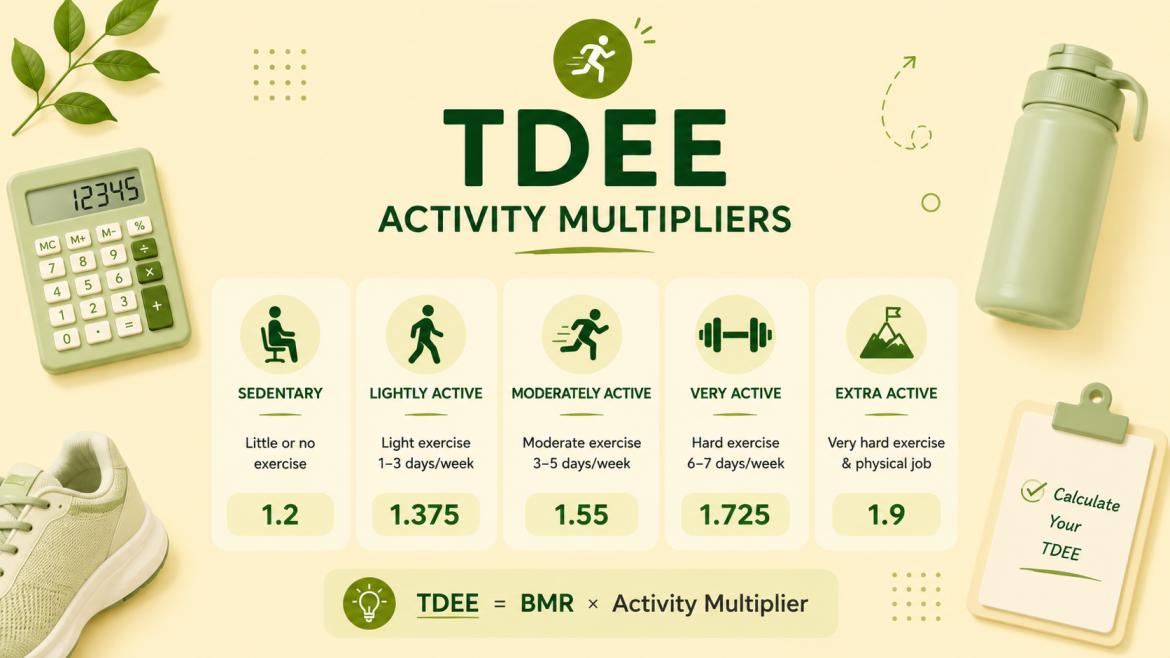
Activity multipliers are the second step in calculating Total Daily Energy Expenditure (TDEE). Once Basal Metabolic Rate (BMR) is established using a formula such as Mifflin-St Jeor or Katch-McArdle, it is multiplied by an activity factor ranging from 1.2 to 1.9. The result is an estimate of the total calories burned per day across all forms of movement, work, and thermogenesis.
The five standard multiplier values were popularized alongside the Harris-Benedict equation and refined through physical activity level (PAL) research. PAL is formally defined as total energy expenditure divided by resting energy expenditure, a ratio validated through doubly labeled water studies and indirect calorimetry research in free-living adults.
Choosing the wrong multiplier is the most common source of error in TDEE estimation. Research from CalcFit and training analysis sources consistently shows that selecting one level too high adds 250 to 500 calories to the daily estimate. Use the TDEE Calculator to apply your multiplier directly once you have identified the correct level.
This article covers what each of the five activity levels means in measurable terms, the calorie consequence of common multiplier errors, and how to validate your chosen multiplier through weight tracking.
What Are TDEE Activity Multipliers?
Activity multipliers are numerical coefficients applied to BMR to convert a resting calorie estimate into a full-day energy expenditure figure. The formula is simple: TDEE equals BMR multiplied by the activity factor corresponding to a person's typical daily movement and exercise volume.
The multiplier captures three distinct energy expenditure components that are not included in BMR output:
Exercise Activity Thermogenesis (EAT): Calories burned during planned, structured workouts
Non-Exercise Activity Thermogenesis (NEAT): Calories burned through all non-workout movement including walking, standing, fidgeting, and occupational activity
Thermic Effect of Food (TEF): Energy used to digest and process food, approximately 10% of total calories consumed
BMR alone accounts for 60 to 70% of total daily energy expenditure according to the 2005 Frankenfield, Roth-Yousey, and Compher systematic review. The activity multiplier captures the remaining 30 to 40%, which varies enormously between individuals based on occupation and lifestyle.
Why the Range Spans 1.2 to 1.9?
The sedentary multiplier of 1.2 means total daily calorie burn is 20% above resting metabolic rate. The extra active multiplier of 1.9 means total burn is 90% above resting metabolic rate. The gap between these two endpoints produces a TDEE difference of 600 to 1,400 calories per day depending on the individual's BMR.
Levine (2007), published in the Journal of Internal Medicine, documented that NEAT alone can vary by up to 2,000 kilocalories per day between two people of the same body size. This finding explains why the multiplier range spans such a wide interval and why a person's occupation and daily lifestyle matter as much as formal exercise volume.
The TDEE Formula With Activity Multiplier
TDEE = BMR x Activity Multiplier
Activity Level | Multiplier | What It Represents |
|---|---|---|
Sedentary | 1.2 | BMR plus 20% for minimal daily activity |
Lightly Active | 1.375 | BMR plus 37.5% for light movement and some exercise |
Moderately Active | 1.55 | BMR plus 55% for regular training and moderate daily movement |
Very Active | 1.725 | BMR plus 72.5% for frequent hard training or active occupation |
Extra Active | 1.9 | BMR plus 90% for daily intense training and physical labor |
For a full explanation of what BMR measures and how it is derived before the multiplier is applied, see the TDEE vs BMR guide.
What Does Each Activity Level Mean?
Each of the five activity levels corresponds to a defined pattern of daily movement, occupation type, and structured exercise volume. The descriptions below use step counts as a secondary reference because step volume is a measurable proxy for daily NEAT that most people can verify with a phone or wearable device.
Sedentary (Multiplier: 1.2)
The sedentary activity multiplier applies to individuals whose job involves prolonged sitting and who do little to no structured exercise during the week.
Profile characteristics:
Desk job with no standing or walking requirements
Under 5,000 steps per day on most days
Zero to one gym session per week, or none at all
Minimal leisure movement outside of work
Important clarification: Sedentary does not mean completely motionless. It means the daily movement pattern produces a PAL close to 1.2. A person who walks to a kitchen, uses stairs, and does light household tasks but still sits for 10 or more hours per day typically falls within this range.
Who this applies to:
Occupation Type | Exercise Pattern | Correct Level |
|---|---|---|
Software developer, no exercise | None | Sedentary (1.2) |
Data analyst, desk-bound | 1 short gym session per week | Sedentary (1.2) |
Driver or dispatcher | No structured exercise | Sedentary (1.2) |
Work-from-home professional | Occasional walks only | Sedentary (1.2) |
The sedentary multiplier is frequently underused. Many people who exercise three times per week assume they are moderately or very active. If those three sessions total three hours out of a 168-hour week spent largely sedentary, the remaining 165 hours dominate the energy expenditure picture. A desk worker who gyms three times per week is more accurately classified as lightly active unless daily steps and non-gym movement are consistently high.
Lightly Active (Multiplier: 1.375)
Lightly active TDEE multiplier applies to individuals with a predominantly seated lifestyle who incorporate some structured exercise or meaningfully higher daily step counts than a sedentary individual.
Profile characteristics:
Desk job or similar low-movement occupation
5,000 to 7,500 steps per day
One to three gym or exercise sessions per week
Some daily movement outside of workouts: walking errands, light household activity
Who this applies to:
Occupation Type | Exercise Pattern | Correct Level |
|---|---|---|
Office worker | 2-3 gym sessions per week | Lightly Active (1.375) |
Teacher (low-movement school) | 1-2 cardio sessions per week | Lightly Active (1.375) |
Desk job with lunch walks | No gym, 6,000 steps daily | Lightly Active (1.375) |
Student (non-athlete) | 2 gym sessions per week | Lightly Active (1.375) |
The most common misclassification error in TDEE estimation places lightly active individuals into the moderately active category. A person who trains three times per week but sits at a desk for eight hours, drives to work, and spends evenings watching television burns closer to 1.375 times their BMR than 1.55 times. The gym sessions add exercise activity thermogenesis, but a low-movement remainder of the day keeps total TDEE closer to the lightly active range.
Moderately Active (Multiplier: 1.55)
Moderately active multiplier applies to individuals who combine consistent structured exercise with meaningfully higher daily movement outside of workouts.
Profile characteristics:
Three to five workout sessions per week of moderate to hard intensity
7,500 to 10,000 steps per day outside of gym sessions
Some occupational movement or active commuting
Non-exercise daily movement noticeably higher than a typical desk job
Who this applies to:
Occupation Type | Exercise Pattern | Correct Level |
|---|---|---|
Office worker, active commuter | 4 gym sessions per week, 9,000 daily steps | Moderately Active (1.55) |
Retail or service industry worker | 3 sessions per week, on feet 4-6 hours per day | Moderately Active (1.55) |
Teacher with active classroom | 3-4 sessions per week | Moderately Active (1.55) |
Freelancer who trains regularly | 5 sessions per week, high daily steps | Moderately Active (1.55) |
Moderately active is the most appropriate level for consistent gym-goers who have active habits outside the gym. The key distinction from lightly active is the daily step count and non-gym movement. Reaching 7,500 to 10,000 steps on training days alone does not qualify if rest days involve under 4,000 steps. The multiplier reflects the average across the full week, not peak activity days.
Very Active (Multiplier: 1.725)
Very active applies to individuals with high training frequency combined with high daily movement, or those with physically demanding occupations who also train regularly.
Profile characteristics:
Six to seven structured training sessions per week
10,000 to 14,000 steps per day
Physically demanding occupation or consistently high NEAT
Organized sport participation at a competitive or semi-competitive level
Who this applies to:
Occupation Type | Exercise Pattern | Correct Level |
|---|---|---|
Construction worker who gyms | 4-5 sessions per week | Very Active (1.725) |
Nurse or hospital professional | 5-6 sessions per week | Very Active (1.725) |
Competitive amateur athlete | 6 training sessions per week | Very Active (1.725) |
Personal trainer, full client load | 5-6 sessions, high daily steps | Very Active (1.725) |
Very active is frequently overselected. The 1.725 multiplier requires both high training frequency and high daily movement outside of training. A person who trains six days per week but has a sedentary office job between sessions does not meet the profile for this level. Their structured exercise adds significant EAT, but low NEAT outside the gym keeps their true PAL closer to 1.55.
Extra Active (Multiplier: 1.9)
Extra active TDEE multiplier applies to individuals who combine daily intense training with a physically demanding job, or who train twice daily with consistently high NEAT throughout the day.
Profile characteristics:
Daily hard training sessions, often twice-daily
Physically demanding occupation (construction, agriculture, manual labor)
Over 14,000 steps per day consistently
Professional or elite-level athlete in-season training volume
Who this applies to:
Occupation Type | Exercise Pattern | Correct Level |
|---|---|---|
Roofer or scaffolder | Daily hard training | Extra Active (1.9) |
In-season competitive athlete | Twice-daily training | Extra Active (1.9) |
Military training program participant | Daily high-volume sessions | Extra Active (1.9) |
Agricultural worker with training habit | Daily intense sessions | Extra Active (1.9) |
Extra active is the correct level for a small percentage of the population. It requires both high structured exercise volume and genuinely high occupational or lifestyle physical activity simultaneously. Most recreational athletes who train hard will not meet both criteria and are more accurately classified at very active or moderately active.
What Is the Calorie Error From Choosing the Wrong Multiplier?
Each step between multiplier levels creates a predictable TDEE error. The magnitude of that error depends on the individual's BMR, which scales with body size. The tables below use two BMR reference points to show the practical impact.
TDEE Error per One-Level Multiplier Misclassification
Transition | Multiplier Change | TDEE Error (BMR 1,500) | TDEE Error (BMR 1,900) |
|---|---|---|---|
Sedentary to Lightly Active | +0.175 | +263 calories | +333 calories |
Lightly Active to Moderately Active | +0.175 | +263 calories | +333 calories |
Moderately Active to Very Active | +0.175 | +263 calories | +333 calories |
Very Active to Extra Active | +0.175 | +263 calories | +333 calories |
A person with a BMR of 1,900 who selects moderately active instead of the correct lightly active classification overestimates their TDEE by 333 calories per day. Over 30 days, this produces a 9,990-calorie surplus above what they believe they are eating. At that rate, a person targeting fat loss with a 500-calorie deficit is actually consuming 333 calories more than their true maintenance, resulting in a net 167-calorie daily deficit instead of the planned 500.
Two-Level Misclassification: Total Error
Transition | Multiplier Change | TDEE Error (BMR 1,500) | TDEE Error (BMR 1,900) |
|---|---|---|---|
Sedentary to Moderately Active | +0.35 | +525 calories | +665 calories |
Lightly Active to Very Active | +0.35 | +525 calories | +665 calories |
Moderately Active to Extra Active | +0.35 | +525 calories | +665 calories |
A two-level overestimate at a BMR of 1,900 creates a 665-calorie daily TDEE error. For someone targeting a 500-calorie deficit, this transforms their plan into a 165-calorie per-day surplus instead. They would gain body fat consistently while believing they are in a deficit.
Practical guidance: When uncertain between two adjacent levels, select the lower one. It is easier to identify that fat loss is occurring faster than expected and increase calories than to diagnose why planned fat loss is not occurring when the root cause is a multiplier overestimate.
How NEAT Affects Multiplier Selection
Non-Exercise Activity Thermogenesis is the single most variable and most underestimated component of total daily energy expenditure. Levine (2005, 2007) documented that NEAT varies by up to 2,000 kilocalories per day between individuals of similar body size, driven primarily by occupation and habitual daily movement patterns.
Strenuous physical labor can require over 1,500 additional kilocalories per day compared to desk work, according to Wikipedia's documentation of NEAT energy expenditure in occupational settings. This is why occupation type is a more important multiplier determinant than workout frequency for many individuals.
NEAT Contribution by Occupation Type
Occupation Category | Estimated Daily NEAT Above BMR | Multiplier Implication |
|---|---|---|
Desk job, no standing | 200-400 calories | Sedentary to Lightly Active baseline |
Teacher, retail, service industry | 400-700 calories | Lightly Active to Moderately Active baseline |
Nurse, hospital worker, tradesperson | 700-1,100 calories | Moderately Active to Very Active baseline |
Construction, agriculture, manual labor | 1,100-1,500+ calories | Very Active to Extra Active baseline |
These NEAT ranges explain why a construction worker who does no formal exercise can have a higher TDEE than an office worker who trains five days per week. The occupational NEAT gap between the two individuals exceeds what five gym sessions can add to the desk worker's total daily burn.
The Gym Hours Problem
Most people's exercise sessions occupy one to two hours per day. The remaining 22 to 23 hours define the NEAT contribution. Levine (2007) noted that the majority of people who exercise do so for less than two hours per week, producing an average EAT of under 100 kilocalories per day.
Even for those exercising five days per week for one hour, the gym hours represent under 5% of total weekly waking time. This means the activity multiplier should primarily reflect:
Occupational movement and standing time
Daily step count and habitual walking
Lifestyle movement such as active commuting, household activity, and leisure walking
Structured exercise volume as a secondary adjustment
Ranking structured exercise above occupational NEAT is the most frequent cause of multiplier overestimation among desk workers who train consistently.
How to Choose the Correct Activity Multiplier for Your Profile?
Selecting the correct activity multiplier requires assessing the full week of movement, not just gym days. The framework below provides a structured approach.
Step 1. Identify Your Baseline Occupation Category
Occupation Description | NEAT Level | Starting Multiplier |
|---|---|---|
Seated work, minimal standing, short daily walks | Low | 1.2 (Sedentary) |
Seated work with regular standing breaks or moderate walking | Moderate-Low | 1.375 (Lightly Active) |
Part-standing, part-moving work (teacher, retail light) | Moderate | 1.375 to 1.55 |
Active occupation, on feet most of the day | High | 1.55 to 1.725 |
Physical labor, heavy occupational movement | Very High | 1.725 to 1.9 |
Step 2. Adjust for Exercise Frequency and Intensity
Starting from your occupation baseline, adjust upward based on structured training:
Zero to one session per week: no upward adjustment
Two to three sessions per week: add 0 to 0.175 (move up at most one level)
Four to five sessions per week: add 0.175 (one level up from occupation baseline)
Six to seven sessions per week: add 0.175 to 0.35 (one to two levels up)
Step 3. Check Average Daily Steps
Daily step count is the most objective proxy for total NEAT outside of formal exercise.
Average Daily Steps | NEAT Level Implied |
|---|---|
Under 5,000 | Sedentary NEAT |
5,000 to 7,500 | Lightly Active NEAT |
7,500 to 10,000 | Moderately Active NEAT |
10,000 to 14,000 | Very Active NEAT |
Over 14,000 | Extra Active NEAT |
If occupation baseline and step count point to different levels, use a weighted average. A desk worker averaging 9,000 steps per day through active commuting sits between lightly active and moderately active regardless of occupation classification.
Step 4. Default to the Lower Level When Uncertain
If the profile sits on the boundary between two adjacent levels, select the lower one. Validate the choice with two to three weeks of weight tracking at the estimated maintenance intake. If weight is stable, the multiplier is correct. If weight is falling, increase calories by 100 to 150 per day. If weight is rising, reduce by 100 to 150 per day and recheck.
Common Multiplier Selection Mistakes
Most TDEE errors in self-directed nutrition tracking trace back to one of four multiplier mistakes. Understanding each prevents months of stalled progress.
Mistake 1: Rating by Gym Days Rather Than Full-Week Average
An individual who trains hard on Monday, Wednesday, Friday, and Saturday but is sedentary on the other three days is not very active across the full week. Their full-week TDEE average corresponds to the moderately active range, not very active, because the sedentary days reduce the weekly mean.
Mistake 2: Ignoring Occupational NEAT in Favor of Exercise
A nurse who does not exercise but works 10-hour shifts on their feet burns far more daily calories than a marketing manager who trains five days per week. The exercise sessions add EAT, but the occupational NEAT gap between these two profiles is larger. Multiplier selection must weight occupational movement heavily.
Mistake 3: Not Updating After Lifestyle Changes
A person who changes from an active job to a desk job, starts or stops a regular exercise program, or moves from a city with walking infrastructure to a car-dependent suburban environment should recalculate multiplier selection immediately. TDEE is not fixed. It changes with lifestyle, and the multiplier must reflect current habits, not historical ones.
Mistake 4: Using Exercise Calorie Estimates From Wearables as Additive
Wearable device calorie readouts during exercise are known to overestimate burned calories by 27% to 93% according to studies reviewed in the fitness technology literature. Adding these estimates on top of a TDEE that already includes an activity multiplier creates double-counting of exercise energy expenditure. The activity multiplier already accounts for exercise volume. Do not add wearable calorie readouts on top.
Practical TDEE Examples Using Each Multiplier
The examples below apply all five multipliers to two BMR reference points to show the full TDEE range at each activity level.
BMR = 1,600 (approximate for a 35-year-old female at population average body composition)
Activity Level | Multiplier | TDEE | Example Calorie Targets |
|---|---|---|---|
Sedentary | 1.2 | 1,920 | Fat loss: 1,420-1,520 cal / Maintenance: 1,920 cal / Gain: 2,070-2,170 cal |
Lightly Active | 1.375 | 2,200 | Fat loss: 1,700-1,800 cal / Maintenance: 2,200 cal / Gain: 2,350-2,450 cal |
Moderately Active | 1.55 | 2,480 | Fat loss: 1,980-2,080 cal / Maintenance: 2,480 cal / Gain: 2,630-2,730 cal |
Very Active | 1.725 | 2,760 | Fat loss: 2,260-2,360 cal / Maintenance: 2,760 cal / Gain: 2,910-3,010 cal |
Extra Active | 1.9 | 3,040 | Fat loss: 2,540-2,640 cal / Maintenance: 3,040 cal / Gain: 3,190-3,290 cal |
BMR = 1,900 (approximate for a 30-year-old male at population average body composition)
Activity Level | Multiplier | TDEE | Example Calorie Targets |
|---|---|---|---|
Sedentary | 1.2 | 2,280 | Fat loss: 1,780-1,880 cal / Maintenance: 2,280 cal / Gain: 2,430-2,530 cal |
Lightly Active | 1.375 | 2,613 | Fat loss: 2,113-2,213 cal / Maintenance: 2,613 cal / Gain: 2,763-2,863 cal |
Moderately Active | 1.55 | 2,945 | Fat loss: 2,445-2,545 cal / Maintenance: 2,945 cal / Gain: 3,095-3,195 cal |
Very Active | 1.725 | 3,278 | Fat loss: 2,778-2,878 cal / Maintenance: 3,278 cal / Gain: 3,428-3,528 cal |
Extra Active | 1.9 | 3,610 | Fat loss: 3,110-3,210 cal / Maintenance: 3,610 cal / Gain: 3,760-3,860 cal |
Fat loss targets use a 400 to 500 calorie daily deficit. Lean gain targets use a 150 to 250 calorie daily surplus. These ranges produce approximately 0.3 to 0.5 kg of fat loss per week or 0.2 to 0.3 kg of lean mass gain per month under controlled conditions.
How to Validate Your Activity Multiplier Through Weight Tracking
Formula-based TDEE estimates are starting points, not confirmed values. The multiplier in particular introduces subjective error that only real-world tracking can correct.
The Two-Week Validation Protocol
This protocol converts a formula estimate into a confirmed personal maintenance number.
Calculate TDEE using the selected BMR formula and chosen activity multiplier
Set daily calorie intake at exactly the TDEE maintenance estimate for the first week
Weigh at the same time each morning, before eating or drinking, for 14 consecutive days
Calculate the average body weight for week one and week two separately
Compare the two weekly averages
Interpreting the Weight Tracking Result
Outcome | Interpretation | Adjustment |
|---|---|---|
Weekly average stable within 0.2 kg | Multiplier is accurate | No adjustment needed |
Weekly average falling by 0.3 to 0.5 kg per week | TDEE estimate is slightly above true maintenance | Increase intake by 100 to 150 calories; retest |
Weekly average falling by more than 0.5 kg per week | TDEE is substantially above true maintenance | Increase intake by 200 to 300 calories; retest |
Weekly average rising by 0.2 to 0.4 kg per week | TDEE estimate is slightly below true maintenance | Reduce intake by 100 to 150 calories; retest |
Weekly average rising by more than 0.4 kg per week | TDEE is substantially below true maintenance | Reduce intake by 200 to 300 calories; retest |
Adjust in steps of 100 to 150 calories rather than jumping between multiplier categories. The multiplier provides a starting estimate. Weight tracking data provides the correction. Once a stable maintenance is confirmed through tracking, adjustments for fat loss or lean gain are applied to the validated number, not the formula output.
How Activity Multipliers Interact With BMR Formula Choice?
The multiplier and the BMR formula are multiplied together, so error in either component amplifies in the final TDEE output.
Combined Error: BMR Formula Overestimation Plus Multiplier Overestimation
BMR Formula Error | Multiplier Error | Combined TDEE Error |
|---|---|---|
Harris-Benedict overestimates BMR by 80 cal | One level too high (+263 cal at 1.55 vs 1.375) | +343 calories total |
Mifflin-St Jeor at average body composition | One level too high (+263 cal) | +263 calories total |
Mifflin-St Jeor at average body composition | Two levels too high (+525 cal) | +525 calories total |
Using the Harris-Benedict formula with a one-level multiplier overestimate produces a combined TDEE error of approximately 343 calories per day for an individual with a true BMR near 1,900 calories. This transforms a planned 500-calorie deficit into a 157-calorie deficit, reducing expected fat loss from approximately 0.5 kg per week to under 0.2 kg per week.
For most adults without a measured body fat percentage, the Mifflin-St Jeor formula page covers the recommended BMR calculation approach. For individuals with a reliable body fat measurement, the Katch-McArdle formula page covers how lean body mass changes the BMR output before the multiplier is applied.
Frequently Asked Questions About TDEE Activity Multipliers
What activity multiplier should I use if I have a desk job and go to the gym three times per week?
Lightly active (1.375) is the correct starting point for most desk workers who train three days per week. If those sessions are moderate to hard and daily steps outside of gym sessions consistently reach 7,500 or above, moderately active (1.55) may apply. If daily steps are under 5,000 on non-gym days, lightly active is more accurate. Validate with two weeks of weight tracking at maintenance.
What is the difference between lightly active and moderately active?
The primary difference is daily non-exercise movement, not just workout frequency. Lightly active (1.375) typically corresponds to 1 to 3 exercise sessions per week with 5,000 to 7,500 daily steps. Moderately active (1.55) corresponds to 3 to 5 sessions per week with 7,500 to 10,000 daily steps and consistently higher NEAT outside of workouts. A person who trains four days per week but sits for the other 20 hours is more often lightly active than moderately active.
Can I use a different multiplier on gym days versus rest days?
Yes. Averaging activity across the week produces the most accurate single TDEE estimate, but some practitioners use a dual approach: a higher multiplier on training days and a lower one on rest days. This produces slightly different daily calorie targets for different day types. The weekly calorie totals from both methods should be similar if the averages are correctly weighted.
How does physical activity level (PAL) relate to the standard multipliers?
PAL is the formal research framework defined as total energy expenditure divided by resting energy expenditure. The five consumer calculator multipliers (1.2, 1.375, 1.55, 1.725, 1.9) are derived from and broadly consistent with PAL research but apply fixed values rather than continuously measured ratios. FAO and WHO PAL ranges for moderately active adults sit between 1.70 and 1.99, which is higher than the consumer calculator convention of 1.55.
The difference reflects how activity categories are defined and which behaviors each system includes. The consumer multipliers are calibrated to produce practical TDEE estimates, not to directly replicate PAL measurement.
How often should I recalculate my TDEE multiplier?
Review multiplier selection any time daily activity patterns change meaningfully. A job change, a move to a different city, starting or stopping a regular exercise program, or a significant shift in daily step count all warrant a multiplier review.
Even without a lifestyle change, recalculating every eight to twelve weeks and re-validating through two to three weeks of weight tracking prevents drift between the estimated and actual maintenance number.
Does the activity multiplier account for the thermic effect of food?
Yes, the standard activity multipliers include an implicit approximation of the thermic effect of food (TEF) in their total energy expenditure estimate. TEF contributes approximately 10% of total daily calorie burn and is baked into the multiplier framework's overall structure. No separate TEF addition is needed when using the standard BMR times multiplier TDEE formula. A detailed breakdown of all four TDEE components is covered on the TDEE overview page.