
Does Intermittent Fasting Change Your TDEE? How to Track
Intermittent fasting does not raise or lower your TDEE on its own. It restricts the window in which you eat, not the calories your body burns. This guide covers the landmark trial data, how the major protocols compare, and what the muscle preservation research actually shows.

Your body has a number. Let's find it.
We calculate the exact calorie target your body needs, built from your stats and goal, then track everything against it daily. Log meals, add workouts, set a weight goal, and watch your numbers update in real time. Check in weekly to see calories, water, and weight trend in one place.
No spreadsheets. No guessing. Just results.
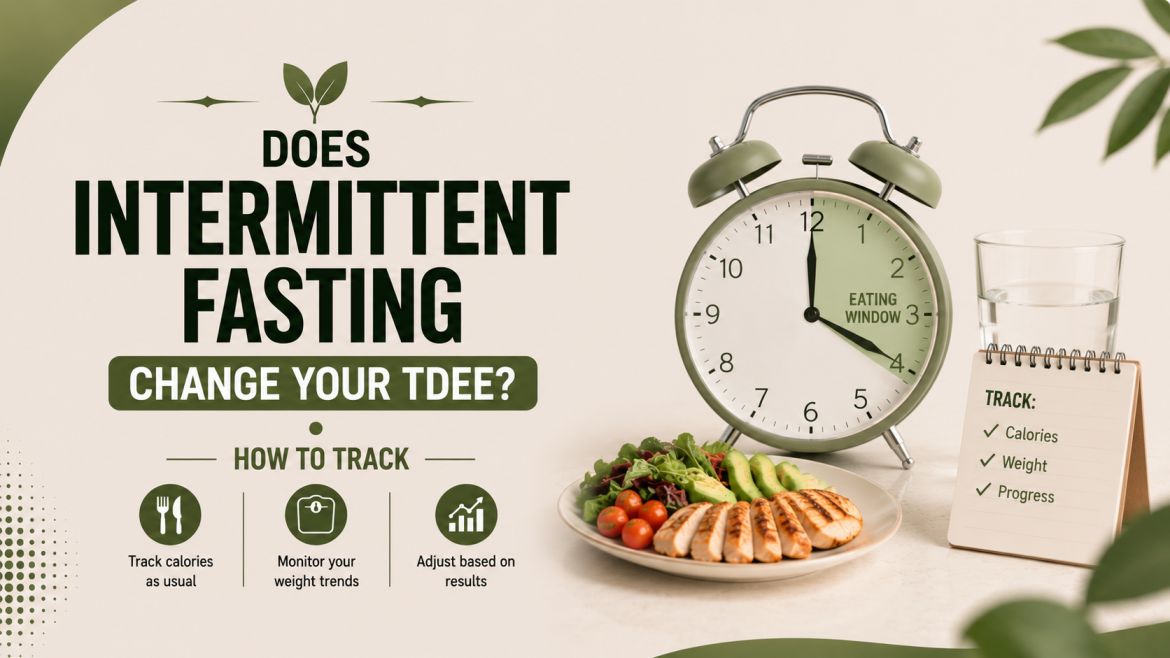
Intermittent fasting restricts the window in which you eat. It does not restrict, raise, or lower the calories your body burns in a day. Run the TDEE calculator to find that baseline number first, since fasting protocols work with it rather than replacing it.
This distinction matters more than most fasting content admits. Popular claims about fasting "boosting metabolism" or "burning fat differently" do not hold up against controlled research once total calorie intake is matched.
This guide covers what fasting actually does mechanically and what the landmark trials found when IF was tested against matched calorie restriction. It also covers how the major protocols compare and what current body composition research shows about muscle preservation.
What Is Intermittent Fasting, Mechanically?
Every intermittent fasting protocol does the same basic thing: it compresses eating into a shorter daily or weekly window. The mechanism is scheduling, not a change to metabolic rate.
Protocol | Eating Window | Typical Structure |
|---|---|---|
16:8 | 8 hours daily | Most common entry-level protocol |
18:6 | 6 hours daily | Slightly more restrictive version of 16:8 |
OMAD | 1 hour daily | One meal a day, most restrictive |
5:2 | Normal 5 days, restricted 2 days | Roughly 500 to 600 kcal on fasting days |
Alternate-Day Fasting (ADF) | Alternating normal and fasting days | Fasting days near-zero or very low calorie |
Each protocol changes when food is consumed. None of them contain an inherent calorie target. Total intake still has to be tracked separately for any protocol to produce a predictable result.
Does Fasting Actually Change Your TDEE Number?
The honest answer, based on current research, is no. Fasting changes eating behaviour, not the four components that make up TDEE.
What Did the Landmark Trial Find?
A 2017 randomised controlled trial in JAMA Internal Medicine by Trepanowski and colleagues tested this question directly. Researchers compared alternate-day fasting against daily calorie restriction matched for total weekly intake.
Trial Detail | Finding |
|---|---|
Groups Compared | Alternate-day fasting vs daily calorie restriction |
Calorie Matching | Total weekly intake held equal between groups |
Weight Loss Outcome | Statistically similar between both groups |
Duration | 12 months, including maintenance follow-up |
In Practice: When calories are held equal, fasting and continuous restriction produce the same result. The scheduling itself is not the active ingredient.
Multiple systematic reviews since have reached the same conclusion. Intermittent fasting works as well as, but not better than, matched calorie restriction for weight loss specifically.
Why Does Intermittent Fasting Work When It Works?
If fasting does not change TDEE directly, its real value has to come from somewhere else. The research points clearly to one answer.
Is It an Adherence Tool Rather Than a Metabolic One?
A 14-week randomised controlled trial published in Nutrients tested this directly. Isenmann and colleagues compared 16:8 time-restricted eating against a macronutrient-based continuous diet in adults with a BMI above 25.
Both groups achieved meaningful body composition improvements. The researchers specifically tracked adherence alongside outcomes, since the study's stated aim was comparing how well each approach was actually followed.
The practical takeaway: fasting removes the need to make repeated food decisions throughout the day. For some people, fewer decisions mean fewer opportunities to break a deficit, which is a psychological advantage rather than a metabolic one.
This mirrors a broader pattern already established in weight loss research. Any calorie deficit works when it is followed consistently, and the method followed most consistently tends to win regardless of mechanism.
Does Fasting Cause More Muscle Loss Than Regular Dieting?
This is the most searched safety question around intermittent fasting, and the evidence here is more reassuring than popular fitness content often suggests.
What Does the Body Composition Research Show?
A widely cited 2016 study in the Journal of Translational Medicine tested this in trained lifters. Moro and colleagues ran 8 weeks of 16:8 time-restricted feeding in resistance-trained males already following a structured programme.
Outcome Measured | Result in the TRE Group |
|---|---|
Fat Mass | Decreased significantly |
Lean Mass | Preserved, no significant loss |
Maximal Strength | Maintained across all lifts tested |
Testosterone | No significant negative change |
Similar findings appear in endurance populations. A study of elite cyclists on a 16:8 protocol found similar results. Body weight dropped 2% and fat mass percentage dropped 1.1%, with no change in fat-free mass over four weeks of high-level training.
Does Fasting Affect Muscle Protein Synthesis Directly?
A more recent controlled trial went further than measuring body composition outcomes. Researchers directly measured muscle protein synthesis rates in men following an 8-hour eating window against a 12-hour control window, using deuterated water tracing for precision.
The finding matters mechanistically. Time-restricted eating did not lower daily muscle protein synthesis rates compared to a longer eating window, at matched protein intake. This suggests the muscle preservation seen in body composition studies is not a coincidence.
The consistent thread across this research is protein intake, not meal timing. The same protein-first logic that protects lean mass in any deficit applies fully within a compressed eating window. The full mechanism is covered in the muscle loss and TDEE guide.
Does Fasting Change Insulin and Blood Sugar Response?
Fasting's effect on insulin sensitivity is one of the more consistently positive findings in the research, separate from the weight loss question entirely.
What Do the Secondary Markers Show?
A systematic review and meta-analysis of randomised controlled trials examined this in overweight and obese adults. Glucose metabolism markers were tracked alongside body weight as secondary outcomes.
Marker | Typical Direction Under TRE |
|---|---|
Fasting Insulin | Tends to decrease |
HOMA-IR (Insulin Resistance) | Tends to improve |
HbA1c | Generally stable to modestly improved |
Fasting Glucose | Often unchanged or mildly improved |
Why this happens independent of weight loss: extending the overnight fast gives insulin more time to return to baseline before the next meal, which is a direct consequence of the eating window itself rather than the calorie deficit within it.
This is a genuine mechanistic effect of fasting, distinct from the TDEE question this guide focuses on. It explains why some people report feeling better on a fasting protocol even before meaningful weight change appears on the scale.
How Do the Major Fasting Protocols Compare?
Beyond the basic window length, protocols differ meaningfully in how sustainable and how restrictive they are day to day.
Protocol | Sustainability | Best Fit |
|---|---|---|
16:8 | High, fits most schedules | Beginners, general fat loss |
18:6 | Moderate | Those already comfortable with 16:8 |
5:2 | Moderate, two hard days per week | People who prefer normal eating most days |
ADF | Lower, near-daily discipline required | Short-term, research-supervised contexts |
OMAD | Lowest, single meal is demanding | Rarely recommended as a first protocol |
Protocols with shorter, more frequent restriction, such as 16:8, tend to show better long-term adherence than protocols requiring near-total restriction on fasting days. This aligns with the adherence-driven explanation for why fasting works when it does.
Does Fasting Affect Athletic Performance?
Training performance is a common concern, particularly for anyone combining fasting with a structured exercise programme.
A study of endurance-trained runners found the same pattern. Four weeks of 16:8 time-restricted feeding decreased fat mass without a significant change in fat-free mass or measured performance, including a 10 km time trial. The Moro 2016 resistance-training study found the same pattern for maximal strength specifically.
In practice: performance appears well preserved across both endurance and strength contexts when total calorie and protein intake are managed properly within the eating window. Athletes with high training volumes should still use the TDEE calculator for athletes, since the calorie target itself, not the fasting window, is what needs the most precision for this population.
How Do You Track TDEE Accurately While Fasting?
Fasting does not remove the need for standard tracking. If anything, a compressed eating window makes precise tracking more important, since there is less room across the day to correct an inaccurate estimate.
What Changes About Weigh-Ins and Macros?
Weigh-in timing becomes more relevant under a fasting protocol. The fasted state itself can produce a lower reading than the same person would show mid-eating-window. Consistency in when you weigh in matters more than ever. The weekly weigh-in protocol covers how to build a reliable trend regardless of eating pattern.
Macro targets do not disappear inside a shorter window either. Hitting a daily protein target within 8 hours instead of 16 is a real logistical challenge some people underestimate. The macro tracking guide covers how to structure that target regardless of the eating window it needs to fit into.
What Common Fasting Mistakes Undermine Results?
Fasting fails in a specific, predictable set of ways, almost always tied to what happens inside the eating window rather than the fasting window itself.
Do You Overeat to Compensate for Fasting?
The single most common mistake is treating the fasted hours as license to eat freely once the window opens. This compensation pattern can erase or even reverse the deficit fasting was meant to create.
Mistake | Why It Happens | The Fix |
|---|---|---|
Compensation Eating | Hunger builds, then overrides planned portions | Plan the first meal in advance, not in the moment |
Ignoring Total Calories | Window compliance feels like the whole job | Track total intake exactly as with any other method |
Skipping Protein Planning | Shorter window makes protein harder to fit | Front-load protein at the first meal of the window |
Breaking the Fast Poorly | High-sugar first meals spike hunger again | Break the fast with protein and fibre, not simple carbs |
Why compensation eating is so common: appetite hormones do not simply switch off during the fasting hours. They accumulate, and the discipline required to eat a planned amount after 16 hours without food is genuinely harder than after a normal 4-hour gap between meals.
Who Should Consider Intermittent Fasting?
Fasting is a scheduling tool, which means the right fit depends entirely on lifestyle and food relationship rather than any special metabolic advantage.
Good candidates typically include people who naturally skip breakfast without discomfort. This also includes those who prefer fewer, larger meals, and those who find continuous all-day eating harder to control than a defined window.
Who Should Avoid It or Use Caution?
Fasting is not appropriate for everyone. People with a history of disordered eating should avoid unsupervised protocols. The same applies to anyone pregnant or breastfeeding, or managing a condition requiring regular food or medication timing.
Women in particular should approach aggressive fasting windows carefully, since some research suggests female hormonal response to extended fasting differs from male response. The TDEE calculator for women accounts for the broader hormonal context that any calorie or fasting plan needs to sit within.
Frequently Asked Questions About Intermittent Fasting and TDEE
Does Intermittent Fasting Boost Your Metabolism?
No. Controlled research, including the Trepanowski 2017 JAMA Internal Medicine trial, found no metabolic advantage to fasting over matched calorie restriction. TDEE is determined by body size, composition, and activity, not by meal timing.
Is Intermittent Fasting Better Than Regular Calorie Counting?
Not inherently better, but potentially easier to follow for some people. Research shows similar weight loss outcomes between fasting and matched continuous calorie restriction, with the main difference being adherence rather than metabolic effect.
Does Fasting Cause Muscle Loss?
Current evidence does not support this concern when protein intake and resistance training are maintained. Multiple trials, including an 8-week resistance training study, found lean mass and strength preserved during 16:8 time-restricted eating.
Which Fasting Protocol Is Best for Beginners?
16:8 is the most commonly recommended starting protocol. It offers a meaningful eating window reduction without the difficulty of near-total daily restriction found in more aggressive protocols like alternate-day fasting or OMAD.
Can You Build Muscle While Doing Intermittent Fasting?
Yes, provided total calories and protein intake support a surplus within the eating window. Time-restricted eating during a structured bulking phase has shown muscle and strength gains comparable to unrestricted eating windows in controlled trials.
Does Intermittent Fasting Hurt Exercise Performance?
Research in both endurance runners and resistance-trained lifters found no significant performance decline under 16:8 protocols. This held provided calorie and protein targets were met within the window.
How Long Before Intermittent Fasting Shows Results?
Results follow the same timeline as any calorie deficit, typically 2 to 3 weeks before a reliable weight trend emerges. Fasting does not accelerate this timeline, since the underlying driver is still total calorie balance.
For the full set of tracking methods this guide belongs to, see the tracking methods hub.
Where to read next: the complete TDEE guide covers how BMR, NEAT, EAT, and TEF combine into the number every fasting protocol still has to work within.
Fasting also interacts with the same hormonal systems covered in the hormones and TDEE guide.
Its long-term calorie effects follow the same metabolic adaptation patterns as any other sustained deficit.