
Macro Tracking vs. Calorie Tracking: Which Wins?
Total calories determine whether you gain, lose, or maintain weight. Macros determine what that weight is made of. This guide covers exactly when macro tracking is worth the extra effort, when calories alone are enough, and what the adherence research actually shows.

Your body has a number. Let's find it.
We calculate the exact calorie target your body needs, built from your stats and goal, then track everything against it daily. Log meals, add workouts, set a weight goal, and watch your numbers update in real time. Check in weekly to see calories, water, and weight trend in one place.
No spreadsheets. No guessing. Just results.
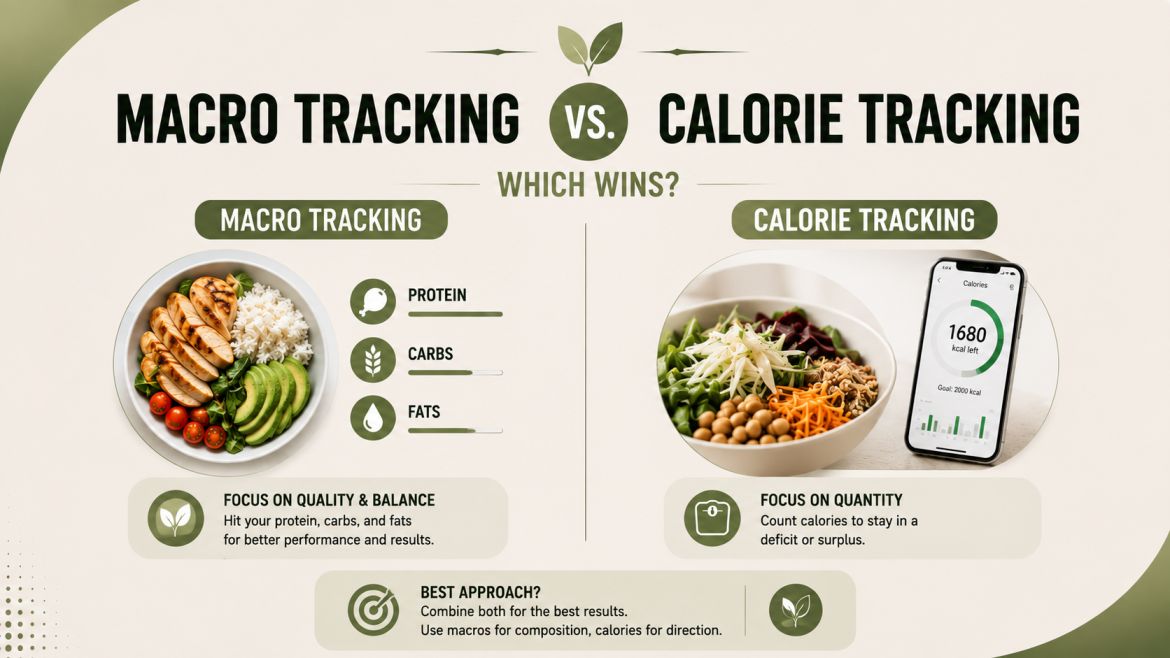
Total calories determine whether you gain, lose, or maintain weight. Macros determine what that weight is made of and how you feel while getting there. Run the TDEE calculator first if you have not already, since both tracking methods start from that same baseline number.
For straightforward fat loss with no training goal, calories alone are usually sufficient. Once body composition, strength, or performance enters the picture, protein and macro distribution start to matter independently of the total.
This guide covers the real mechanical difference between the two methods and when each one earns its place. It also covers what adherence research shows about which approach people stick to longer. Both methods sit alongside the complete TDEE guide as part of the same energy-balance picture.
What Is the Real Difference Between Macro and Calorie Tracking?
Calorie tracking logs one number a day. Macro tracking logs four: total calories, plus grams of protein, carbohydrate, and fat that add up to that total.
Aspect | Calorie Tracking | Macro Tracking |
|---|---|---|
What It Measures | Total energy intake only | Energy intake plus its composition |
Daily Effort | Lower, one number to hit | Higher, three numbers to balance |
Best Fit | Simple weight change goals | Body composition and performance goals |
Logging Precision Needed | Moderate | Higher, since macros compound rounding errors |
Both methods still depend on the same input: an accurate food log. Neither one works if the underlying entries are wrong, which is why logging accuracy matters more than which numbers you track. The food logging accuracy guide covers how to fix the underreporting that undermines both approaches equally.
This comparison is one piece of a larger system. The full tracking methods hub covers all seven methods, including where macro tracking fits alongside weigh-ins, step counts, and progress photos.
Why Do Calories Determine Weight But Macros Determine Composition?
A calorie surplus adds mass. A calorie deficit removes it. This holds regardless of whether those calories come from protein, carbohydrate, or fat, since a calorie deficit is fundamentally an energy balance equation.
What a deficit or surplus cannot control on its own is which tissue changes. Two people eating an identical 500-calorie deficit can lose very different ratios of fat to muscle depending on their protein intake.
What Does the Research Say About Protein and Body Composition?
Higher protein intake during a calorie deficit consistently preserves more lean mass than the same deficit at lower protein. This finding holds across dozens of controlled trials with different total calorie levels.
The mechanism is well established. Protein signals the body to prioritise muscle retention even while total energy is restricted. Carbohydrate and fat do not carry that same signal, which is why a 1,800-calorie diet at 150 g protein produces a different body composition outcome than the same 1,800 calories at 80 g protein.
This is the core reason macro tracking exists as a distinct method. It is not about losing weight faster. It is about controlling what kind of weight gets lost or gained.
When Does Calorie-Only Tracking Work Just Fine?
Not every goal needs macro precision. For a large share of people, tracking total calories alone produces every result they actually want.
Who Is a Good Fit for Simple Calorie Counting?
Calorie-only tracking works well for a specific kind of goal. The primary target is a number on the scale, without a strong secondary goal around strength, muscle retention, or performance.
Someone losing weight with no resistance training component and no concern about lean mass
Someone in the early weeks of learning to track anything at all, where simplicity drives consistency
Someone maintaining a stable weight who just needs a general calorie ceiling
Someone whose goal is general health improvement rather than body composition change
Adding macro complexity to any of these situations rarely improves the outcome. It mainly adds friction that can reduce how long the habit actually lasts.
When Does Macro Tracking Actually Earn Its Extra Effort?
Macro tracking pays off specifically when body composition, not just body weight, is the actual goal. Three situations consistently justify the added complexity.
What Happens When You Diet Without Tracking Protein?
Calorie-only tracking during a deficit still produces weight loss. A meaningful share of that loss can come from muscle rather than fat when protein runs low. The scale alone cannot tell the difference.
This is where macro tracking becomes protective. The muscle loss and TDEE guide covers exactly how much lean tissue different deficit and protein combinations typically cost, and why that number varies so widely between people eating the identical total calories.
Does Macro Tracking Help With Muscle Gain Too?
Building muscle requires a calorie surplus. An unmonitored surplus at low protein tends to produce more fat gain than muscle gain for the same total calories. Macro tracking keeps that ratio in check.
For a full walkthrough of surplus sizing and protein targets during a muscle-building phase, see the guide to building muscle with TDEE.
When Does a Deficit Alone Fail to Protect Lean Mass?
A deficit sized correctly for fat loss can still cost meaningful lean mass if macro distribution is ignored entirely. Deficit size and protein intake work as two separate levers, not one.
The guide to losing weight with TDEE covers how to size the deficit itself, which macro tracking then protects once that deficit is in place.
What Does Adherence Research Show About Macro Tracking?
The comparison between macro tracking and calorie tracking is not just about outcomes. It is also about which approach people actually sustain.
A landmark 2018 trial in JAMA tested this directly. The DIETFITS study by Gardner and colleagues assigned participants to a low-fat or low-carbohydrate diet with matched calorie and protein targets. Weight loss outcomes were statistically similar after 12 months.
Trial | What It Tested | Key Finding |
|---|---|---|
DIETFITS, 2018 (JAMA) | Low-fat vs low-carb, matched protein | No significant weight loss difference between macro splits |
Pounds Lost, 2009 (NEJM) | Four different macro ratios, matched calories | All four ratios produced similar average weight loss |
The pattern across this research is consistent. The specific macro ratio matters less for weight loss than whether the plan is followed consistently. Protein intake was the one variable in both trials that meaningfully affected body composition, even when total weight loss looked identical.
The practical takeaway is simple. Track macros when protein and composition are the actual goal, not because a particular carb-to-fat ratio outperforms others for weight loss itself.
How Do You Start Tracking Macros Without It Becoming Overwhelming?
The biggest reason people abandon macro tracking is starting with unnecessary precision. A simplified entry point keeps the habit sustainable long enough to matter.
What Is a Simple Beginner Macro Split?
Setting a single protein target first removes most of the daily friction while still capturing the main benefit. Carbohydrate and fat can then fill the remaining calories loosely.
Step | What to Set | Why This Order |
|---|---|---|
1. Total Calories | From your TDEE and goal | This is the number that determines weight change |
2. Protein Target | 1.6 to 2.2 g/kg body weight | This is the number that determines composition |
3. Fat Floor | 0.5 to 0.8 g/kg minimum | Protects hormone production |
4. Carbohydrate | Remaining calories | Least critical to track with precision |
This sequence lets a beginner hit the two numbers that actually drive outcomes: calories and protein. Exact precision on the other two matters far less for most goals.
How Do You Calculate Your Macro Targets From TDEE?
Every macro target starts from the same TDEE-based calorie number, then splits that total using the sequence above. A worked example makes the process concrete.
What Does This Look Like for a Real Person?
Take a 70 kg adult with a TDEE of 2,400 calories, targeting a 500-calorie deficit for fat loss. The calculation runs in four steps once the total is set.
Step | Calculation | Result |
|---|---|---|
1. Set Calorie Target | 2,400 TDEE minus 500 deficit | 1,900 kcal/day |
2. Set Protein Target | 1.8 g/kg × 70 kg | 126 g protein (504 kcal) |
3. Set Fat Floor | 0.7 g/kg × 70 kg | 49 g fat (441 kcal) |
4. Fill Remaining With Carbs | 1,900 minus 504 minus 441, ÷ 4 | 239 g carbohydrate |
The order matters more than the math itself. Protein and fat are set first because they serve specific physiological roles. Carbohydrate absorbs whatever calories remain, needing the least precise tracking of the three.
This same four-step sequence works in reverse for a surplus. Only the sign on step one changes, from subtracting a deficit to adding one.
How Do You Know If Your Macro Tracking Is Actually Working?
Macro tracking, like calorie tracking, only proves its value through the same weekly trend data every other method relies on.
A rising or stable strength trend alongside a falling scale weight is the clearest signal that protein and calorie targets are working together correctly. The reverse pattern, falling strength alongside weight loss, usually signals protein is too low for the current deficit.
Weight trend still matters most. The weekly weigh-in protocol covers how to read a 7-day average correctly, which applies identically whether the underlying method is calorie-only or full macro tracking.
Athletes in particular benefit from combining macro precision with the TDEE calculator for athletes. Training volume creates larger day-to-day calorie swings that a calorie-only approach can miss.
Women tracking across a menstrual cycle see a similar benefit. The TDEE calculator for women accounts for shifts that water retention would otherwise obscure in the scale-based feedback macro tracking depends on.
What Common Mistakes Undermine Macro Tracking Specifically?
Macro tracking fails in different ways than calorie-only tracking does. The errors below are specific to managing three numbers instead of one.
Do You Chase Carb and Fat Precision You Do Not Need?
Treating all three macros as equally critical is the most common mistake. Protein is the number that changes outcomes; carbohydrate and fat mainly need to land in a reasonable range.
Macro-Specific Mistake | Why It Happens | The Fix |
|---|---|---|
Equal Precision on All Three | Apps display all three with the same visual weight | Prioritise protein, relax on carbs and fat |
Static Targets as Weight Changes | Macros set once and never revisited | Recalculate protein grams every 4 to 6 weeks |
Ignoring Fibre Within Carbs | Total carb grams tracked without checking quality | Note fibre separately, since it affects satiety |
Protein From Supplements Only | Shakes hit the number without whole-food benefits | Prioritise food sources, use shakes to fill gaps |
Why Static Targets Cause the Most Drift: protein needs scale with body weight, so a target set at 90 kg becomes inaccurate once weight drops to 82 kg. Recalculating alongside each TDEE update keeps the protein number honest.
Frequently Asked Questions About Macro Tracking vs Calorie Tracking
Is Macro Tracking More Effective Than Calorie Tracking for Weight Loss?
Not for weight loss specifically. The DIETFITS and Pounds Lost trials both found that different macro distributions at matched calories produced similar weight loss. Macro tracking's real advantage is body composition control, not superior weight loss.
Do I Need to Track Macros to Build Muscle?
Not strictly, but it helps considerably. A calorie surplus alone builds mass. An unmonitored surplus at low protein, though, tends to add more fat relative to muscle than the same surplus with a deliberate protein target.
How Precise Do My Macros Need to Be Each Day?
Hitting protein within 5 to 10 grams of target and total calories within 50 to 100 is sufficient for almost every practical goal. Chasing exact gram precision on carbohydrate and fat adds effort without a meaningful outcome difference for most people.
Can I Switch From Calorie Tracking to Macro Tracking Later?
Yes, and this is a common and reasonable progression. Many people start with calorie-only tracking to build the logging habit. Adding a protein target once that habit is consistent works better than attempting full macro precision from day one.
Does Macro Tracking Work Differently for Weight Loss vs Weight Gain?
The core mechanics are the same in both directions. Protein protects lean mass during a deficit and directs a surplus toward muscle rather than fat. The same protein-first approach applies whether the calorie target sits above or below maintenance.
Is Tracking Macros Necessary If I Am Not Trying to Build Muscle?
Generally no. If the primary goal is a specific number on the scale with no strong composition concern, calorie tracking alone typically delivers that result. It also carries a lower risk of abandoning the habit altogether.
What Happens If I Hit My Calorie Target but Miss My Protein Target Every Day?
Total weight change will still track closely with the calorie number. Body composition outcomes still drift in a predictable direction. Expect more lean mass loss during a deficit or more fat gain during a surplus. Protein is the variable most tied to which tissue actually changes.