
Does HRT Cause Weight Gain During Menopause?
HRT gets blamed for menopause weight gain more often than the evidence supports. A Cochrane review of 28 randomized trials found no significant weight difference between HRT users and non-users. This guide covers what the research actually shows, why the confusion persists, and what actually drives weight change during this transition.

Your body has a number. Let's find it.
We calculate the exact calorie target your body needs, built from your stats and goal, then track everything against it daily. Log meals, add workouts, set a weight goal, and watch your numbers update in real time. Check in weekly to see calories, water, and weight trend in one place.
No spreadsheets. No guessing. Just results.
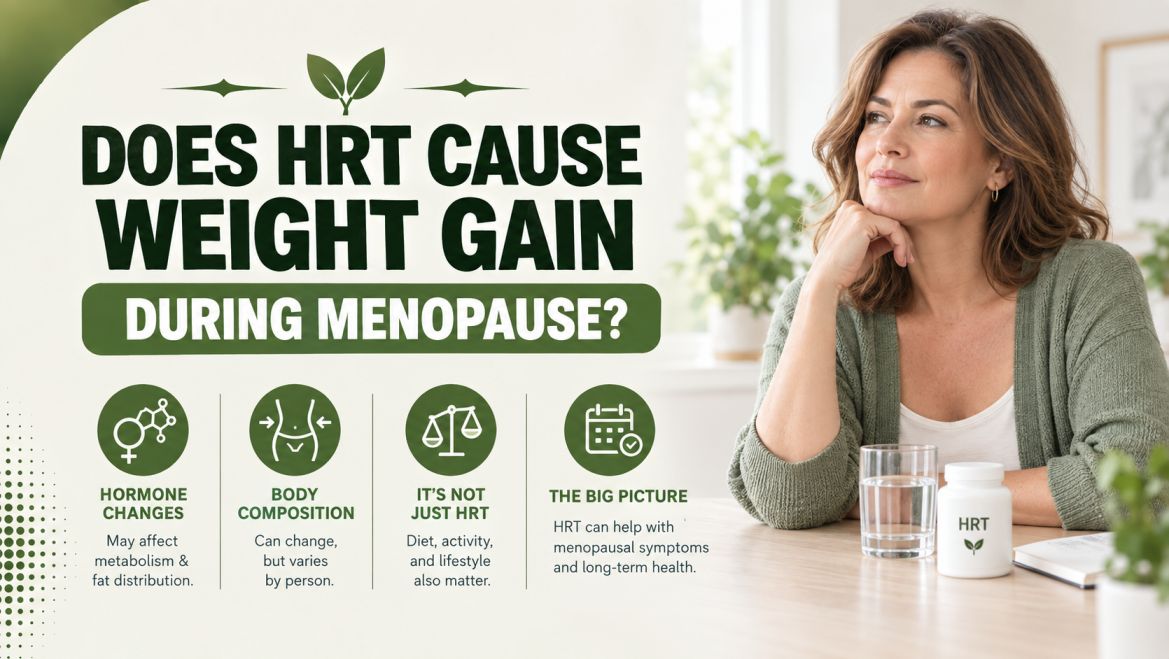
HRT is one of the most commonly blamed causes of menopause weight gain. Decades of randomized trial data have found no meaningful connection between the two.
Get your calorie target from the TDEE calculator for menopause first. That number matters more to weight outcomes during this transition than whether HRT is part of the picture.
Menopause affects an estimated 1.3 million women annually in the United States alone. Weight-related questions consistently rank among the most common concerns raised during this transition.
This guide covers what the largest studies on HRT and weight actually found and why so many women believe otherwise. It also covers what the research suggests actually drives weight change, part of the broader picture in the full menopause and TDEE guide.
What Does the Research Actually Say About HRT and Weight Gain?
The evidence base here is unusually large and consistent for a nutrition or hormone-related question, spanning multiple decades and tens of thousands of participants.
What Did the Largest Systematic Review Find?
A Cochrane systematic review pooled 28 randomized controlled trials covering 28,559 women, comparing HRT users against non-users on weight and body mass index outcomes.
Comparison | Weight Difference | Statistical Significance |
|---|---|---|
Unopposed Estrogen vs No HRT | 0.03 kg | Not significant |
Estrogen + Progestogen vs No HRT | 0.04 kg | Not significant |
BMI, Unopposed Estrogen | -0.14 | Not significant |
BMI, Combined Therapy | -0.10 | Not significant |
A difference of 0.03 to 0.04 kg is functionally zero. Across 28,559 women in randomized, controlled conditions, HRT users and non-users ended up at essentially identical weights, regardless of which hormone formulation was used.
Has This Finding Held Up in More Recent Research?
A follow-up systematic review and meta-analysis updated the original Cochrane data with trials published after 2005. It added ten more randomized controlled trials covering 2,588 HRT users against 764 non-users.
The updated review reached the same conclusion as the original. Across different regimens, dosages, and administration routes, no consistent pattern emerged showing HRT itself drives weight gain, reinforcing findings that were already two decades old.
Does the Women's Health Initiative Change This Picture?
The Women's Health Initiative is one of the largest and most influential trials in menopause research. It followed participants well beyond the original treatment period into extended follow-up analysis.
Published follow-up data from this trial examined health outcomes during and after the active treatment phase. It adds to the broader body of evidence that HRT's risks and benefits do not meaningfully include a weight-gain effect.
This trial is worth knowing about specifically because of its scale and influence. Findings from a study of this size carry substantial weight in shaping clinical guidelines, and its conclusions align with the Cochrane data rather than contradicting it.
Is Menopause Itself the Real Cause of Weight Gain?
Separating HRT from the menopause transition itself is where most of the confusion in this topic actually originates.
Weight gain during the menopause transition is well documented and happens whether or not a woman uses HRT. Declining estrogen affects fat distribution, muscle mass, and metabolic rate independent of any treatment decision made alongside it.
This is precisely why controlled trials matter so much here. Comparing HRT users only against their own before-and-after weight, without a non-HRT control group experiencing the same transition, would make menopause itself look like an HRT side effect. The trials above avoided that error by comparing against women going through the identical transition without treatment.
Does HRT Change Where Fat Is Stored, Even Without Changing Total Weight?
Total weight is not the only outcome worth checking. HRT could theoretically redistribute fat without changing the number on the scale, which a properly designed trial can also measure directly.
What Did the Controlled Fat-Distribution Trial Show?
A randomized, double-blind, placebo-controlled trial followed 76 postmenopausal women for two years. Researchers used CT scans and DXA imaging to directly measure intraabdominal and subcutaneous fat, not just total body weight.
Measurement | Result Between HRT and Placebo Groups |
|---|---|
Intraabdominal Fat | No significant difference over 2 years |
Subcutaneous Abdominal Fat | No significant difference |
Total Fat and Fat-Free Mass | No significant difference |
Overall Body Weight | No significant difference |
This directly addresses the fat redistribution question, not just total weight. Using imaging rather than just a scale, this trial found HRT did not measurably shift where fat accumulated compared to placebo over a full two-year period.
The mechanism behind menopause-related fat redistribution toward the abdomen, independent of HRT use, is covered in the menopause belly fat guide, which addresses why this shift happens and what actually influences it.
Does HRT Affect Insulin Sensitivity?
The same trial measuring fat distribution also tracked insulin sensitivity directly. This is where the results genuinely diverge from a simple "HRT changes nothing" conclusion.
Insulin sensitivity did not change in the placebo group over the study period. In the HRT group, it decreased by 17% at 6 months and remained lower through the full 2-year mark. This happened despite no measurable change in weight or fat distribution.
This effect reversed after stopping treatment. One year after the trial ended, insulin sensitivity in former HRT users rose by 25%, returning to a level similar to the placebo group, confirming the change was tied to active treatment rather than a permanent shift.
Insulin sensitivity connects to the same hormonal mechanisms covered elsewhere on this site. The full explanation of how hormones affect metabolism covers this insulin pathway in more general depth, relevant here even though this specific finding did not translate into measurable weight or fat changes.
Why Do So Many Women Believe HRT Causes Weight Gain?
Given how consistent the trial evidence is, the persistence of this belief deserves its own explanation, and timing is the most likely culprit.
Does Starting HRT Just Coincide With Weight Gain That Was Already Happening?
Many women start HRT around the same time menopause symptoms, and menopause-related weight changes, are already becoming noticeable. That timing overlap creates an intuitive but mistaken cause-and-effect impression.
This is a classic correlation-versus-causation problem. Weight gain that would have happened regardless gets attributed to whichever new variable, HRT, appeared around the same time, even when controlled trials find no actual causal link between the two.
Individual experience also varies. Some women do report weight changes after starting HRT, and dismissing that experience outright is not the goal here. The population-level trial data simply shows no consistent pattern across thousands of women, which does not rule out individual variation in either direction.
Does Media Coverage Contribute to This Belief?
Popular health content frequently repeats the HRT-weight-gain connection without citing the controlled trial data that actually exists. Repetition reinforces the belief far more than evidence does.
This creates a feedback loop worth recognizing. A claim repeated often enough starts to feel true independent of what the underlying research actually shows, which is a pattern worth being skeptical of on any health topic, not just this one specifically.
Does the Type or Route of HRT Matter?
Not every HRT formulation works identically. The research includes enough variation in formulation and delivery method to say something about whether this matters for weight specifically.
HRT Variable | What the Evidence Shows |
|---|---|
Oral vs Transdermal | No consistent weight difference identified between routes |
Estrogen Alone vs Combined With Progestogen | Both show equally minimal weight effect in Cochrane data |
Dosage Variation | Included across trials without changing the overall null result |
The consistency across formulations strengthens the overall finding. If a specific delivery method or dosage caused meaningful weight change, pooling that many trials with varied protocols would likely have revealed it rather than continuing to show a null result.
Does HRT Affect Appetite or Food Intake?
A separate prospective study tracked food intake directly alongside body composition in early postmenopausal women, comparing those starting HRT against those who declined treatment.
Both groups began with similar baseline weight, BMI, fat mass, and waist-to-hip ratio. Total caloric intake and food composition were also similar before the study started. This matched baseline strengthens confidence in whatever difference, or lack of difference, emerged over the study period.
Tracking food intake directly, not just outcomes, adds an important layer of evidence. If HRT changed weight primarily by altering hunger or eating patterns, a study measuring intake directly would be positioned to detect it, providing another angle beyond outcome measurements alone.
Does HRT Change How the Body Responds to Exercise?
This specific question has less direct trial data than the weight and fat distribution questions covered above. The available evidence does not suggest HRT meaningfully changes exercise responsiveness.
Symptom improvement may indirectly support better exercise consistency. Reduced hot flashes, improved sleep, and better mood, all documented benefits of HRT for many women, can make maintaining a consistent exercise routine easier, even without HRT directly changing the physiological response to that exercise.
This distinction matters for how to think about HRT's role. It may support weight management indirectly, through better symptom control enabling more consistent exercise and eating habits, without directly altering metabolism or fat storage itself.
Does This Apply Equally in Perimenopause and Postmenopause?
Most of the trial data referenced throughout this guide focused on postmenopausal women specifically, with less direct research isolating the perimenopausal transition period alone.
Hormonal fluctuation tends to be more erratic during perimenopause than after menopause is fully established. This could theoretically create different dynamics than the more stable hormonal state most trials studied.
This is a reasonable gap to acknowledge rather than paper over. The core finding, that HRT does not appear to independently drive weight gain, is well supported in postmenopausal populations specifically, with somewhat less direct evidence available for the perimenopausal transition itself.
What Should You Actually Focus On for Menopause Weight Management?
If HRT itself is not the driver, the practical question becomes what actually does affect weight during this transition, and where effort is best directed.
Muscle mass is the bigger lever most women overlook. It naturally declines with age, and that decline affects resting metabolic rate independent of HRT status. Preserving lean mass through adequate protein and resistance training addresses a mechanism the trials above did not find HRT itself resolves.
Sarcopenia, the age-related loss of muscle mass, accelerates around menopause independent of any hormone therapy decision. Resistance training is arguably more impactful here than the HRT question this guide opened with.
Getting the calorie target itself right matters just as much as any single intervention. The general TDEE calculator for women covers the broader life-stage adjustments relevant beyond menopause specifically.
Tracking composition, not just scale weight, gives a clearer picture during this transition than the number alone ever could. Water retention and normal day-to-day fluctuation can easily mask a real trend for weeks at a time.
A body fat percentage calculator adds that missing layer of data, helping distinguish genuine fat change from the noise a scale alone cannot filter out.
Are There Alternatives or Complements to HRT Worth Considering?
Several evidence-based options exist outside hormone therapy itself. This matters for women who cannot or choose not to use HRT, or who want to combine it with other supportive strategies.
Since HRT does not appear to be the weight-gain culprit, stopping or avoiding it specifically to manage weight is unlikely to help based on current evidence. The decision to use HRT should rest on its established benefits for symptom management and bone health, discussed with a doctor, rather than a weight-related concern this research does not support.
The specific supplements with research support during menopause, separate from hormone therapy itself, are covered in the menopause supplements guide. It addresses options worth discussing alongside or instead of HRT.
How Should You Actually Decide About HRT and Weight Together?
Separating the two decisions clearly makes both easier to think through. A weight concern the evidence doesn't support should not cloud a decision that has its own legitimate considerations.
What Questions Actually Matter for the HRT Decision?
The evidence-supported factors relevant to starting or continuing HRT center on symptom severity, bone health, and cardiovascular risk factors. Personal and family medical history matter too, but weight change does not.
Consideration | Relevant to HRT Decision? |
|---|---|
Symptom Severity (Hot Flashes, Sleep) | Yes, well-established benefit |
Bone Density Protection | Yes, well-established benefit |
Personal or Family Cancer History | Yes, relevant risk factor to discuss |
Weight Gain Concern Specifically | Not supported by controlled trial evidence |
This reframing matters practically, not just academically. A woman avoiding HRT specifically due to weight concerns may be missing out on genuine symptom and bone health benefits based on a connection the research does not actually support.
What Questions Actually Matter for the Weight Management Decision?
Weight management during menopause benefits from the same evidence-based approach relevant at any life stage. An accurate calorie target, adequate protein, and resistance training all counter age-related muscle loss.
These two decisions can be made entirely independently of each other. Choosing to start, continue, or avoid HRT does not need to factor in weight management strategy, since the two operate through largely separate mechanisms based on current evidence.
Frequently Asked Questions About HRT and Weight Gain
Does Starting HRT Cause Immediate Weight Gain?
Randomized trial data does not support this. A Cochrane review of 28 trials and 28,559 women found no significant weight difference between HRT users and non-users. This held true even in the months immediately following treatment initiation.
Will Stopping HRT Help Me Lose Weight?
Current evidence does not support this expectation. HRT itself was not found to cause weight gain in controlled trials. Stopping it specifically to lose weight is unlikely to help, and it removes established symptom and bone health benefits.
Does HRT Affect Belly Fat Specifically?
A controlled trial using CT and DXA imaging found no significant difference in intraabdominal or subcutaneous fat between HRT users and placebo over two years. HRT does not appear to meaningfully redistribute fat toward or away from the midsection.
Why Did I Gain Weight After Starting HRT If the Research Says It Doesn't Cause This?
Timing overlap is the most likely explanation. Weight gain related to the menopause transition itself often becomes noticeable around the same time many women start HRT. Controlled trials do not support this correlation as causation.
Does HRT Affect Blood Sugar or Insulin Sensitivity?
One controlled trial found insulin sensitivity decreased by 17% at 6 months in the HRT group, reversing after treatment stopped. This occurred without any corresponding change in weight or body composition in the same trial.
Is Transdermal HRT Better Than Oral HRT for Weight?
Current evidence does not show a consistent weight difference between administration routes. Both oral and transdermal formulations show similarly minimal effects on weight across the pooled trial data.
Should I Avoid HRT If I'm Worried About Weight Gain?
Based on current evidence, weight gain concerns alone are not a well-supported reason to avoid HRT, since controlled trials consistently find no meaningful weight effect. The decision should be made with a doctor based on HRT's established benefits and individual health factors.
What Actually Causes Weight Gain During Menopause If Not HRT?
Declining estrogen independently affects fat distribution and muscle mass during this transition, alongside age-related metabolic changes that occur regardless of HRT use. These factors, not hormone therapy itself, appear to be the more consistent drivers based on current research.
Does HRT Affect Muscle Mass During Menopause?
The controlled trials referenced in this guide measured fat-free mass alongside fat mass. No significant difference emerged between HRT and placebo groups, suggesting HRT does not meaningfully preserve or reduce muscle mass on its own.
Is There Any Scenario Where HRT Could Contribute to Weight Gain?
Individual variation exists even when population-level data shows no consistent effect. A small subset of women may experience genuine changes tied to HRT specifically. This cannot be predicted from the group-level trial data covered throughout this guide.
How Reliable Is a Single Study Compared to the Cochrane Review?
The Cochrane review carries more weight due to its scale. Pooling 28 separate randomized trials and 28,559 participants matters more than relying on any single study's results. This pooled approach reduces the chance that one unusual trial result skews the overall conclusion.
This is worth keeping in mind whenever a single small study or anecdotal report seems to contradict a large pooled review. Individual trials can vary due to chance, population differences, or methodology. Systematic reviews exist specifically to average out that noise.
Does This Research Apply to Bioidentical Hormone Therapy Too?
The trials referenced primarily studied conventional HRT formulations such as conjugated estrogens and medroxyprogesterone acetate. Bioidentical formulations were not the primary focus of the pooled Cochrane data, so this specific question deserves a direct conversation with a prescribing doctor.
Should I Track My Weight Differently While on HRT?
The same tracking principles apply regardless of HRT status. A weekly average rather than daily readings, alongside waist measurements or body composition tracking, gives the clearest picture of genuine change.
Does the Timing of When I Start HRT Relative to Menopause Matter for Weight?
The trials referenced in this guide primarily studied early postmenopausal women. Timing relative to the transition itself is not something separate weight-specific trial data has isolated in detail. This is a reasonable question to raise with a doctor given individual variation in menopause timing and symptom onset.
Can HRT Help With the Motivation to Exercise During Menopause?
Indirectly, yes, through symptom relief rather than a direct physiological effect on exercise capacity. Better sleep and fewer hot flashes, both well-documented HRT benefits, can make maintaining a consistent training routine considerably easier for many women.