
Protein After Menopause: How Much Do Women Need?
A protein serving that works fine before menopause can fail to trigger muscle building afterward. Controlled research found postmenopausal women need a larger stimulus than younger women to get the same result. This guide covers exactly how much protein that requires and why the old target no longer applies.

Your body has a number. Let's find it.
We calculate the exact calorie target your body needs, built from your stats and goal, then track everything against it daily. Log meals, add workouts, set a weight goal, and watch your numbers update in real time. Check in weekly to see calories, water, and weight trend in one place.
No spreadsheets. No guessing. Just results.
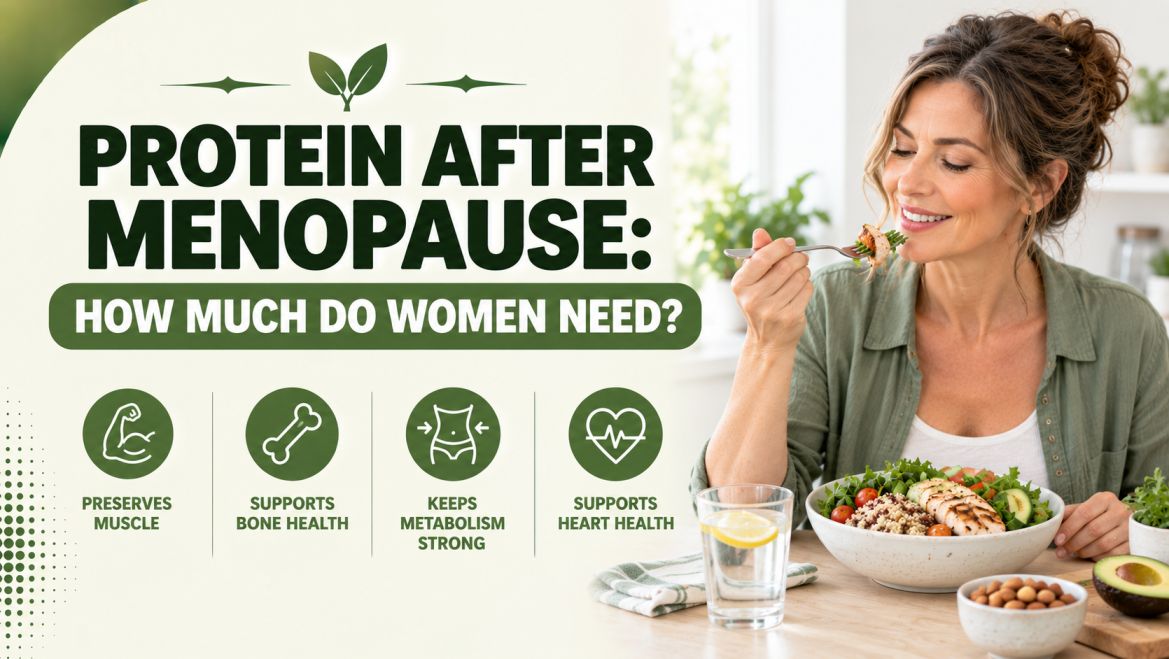
A protein intake that maintained muscle before menopause may not be enough afterward. Controlled trial data shows the body's response to protein itself changes at this life stage, not just the calorie math around it.
Run the TDEE calculator for menopause first to establish your calorie target. Protein needs sit on top of that number, and getting both right matters more here than at earlier life stages.
This guide covers what the research found when a standard protein serving was tested directly in postmenopausal women. It also covers how much protein actually works and why timing matters less than most advice suggests.
An estimated 1.3 million women reach menopause in the United States each year. Muscle loss is among the most consistently documented, yet least discussed, changes during this transition.
Why Does Menopause Change Your Protein Needs?
The mechanism here is specific to postmenopausal physiology, not simply the general effect of getting older that applies to everyone.
What Is Anabolic Resistance?
Anabolic resistance describes a blunted response to the normal signals that trigger muscle protein synthesis. The same amount of protein produces less muscle-building effect than it would in a younger person.
This connects directly to muscle loss during any calorie deficit, but the mechanism runs deeper here. It is not just that dieting risks muscle loss. The body's baseline ability to build and maintain muscle from a given protein intake has itself changed.
A landmark comparison found postmenopausal women show greater anabolic resistance than even older men. This is not simply an aging effect applied equally across sexes. Something specific to the postmenopausal hormonal state appears to compound the general age-related decline.
What Did the Research Find About Protein and Muscle Building?
A controlled trial tested this question as directly as research design allows. Researchers used muscle biopsies and stable isotope tracers rather than relying on indirect outcome measures.
Did a Standard Protein Serving Actually Work?
Researchers gave postmenopausal women 15 grams of whey protein, a serving size commonly recommended in general nutrition guidance. Muscle protein synthesis was directly measured afterward using biopsy sampling.
Finding | Result |
|---|---|
15g Whey Protein Alone | Failed to stimulate myofibrillar protein synthesis |
Resistance Exercise Alone | Produced a modest, temporary increase |
Comparison to Younger Women | Postmenopausal baseline synthesis rates differed measurably |
A serving size considered adequate in general guidance did not produce the expected muscle-building response in this specific population. This is not a subtle statistical difference. It is a directly measured failure of a standard protein dose to trigger the biological process it is meant to activate.
The researchers concluded that postmenopausal women require a greater stimulus than younger women. That stimulus can come through a larger protein dose, more intense exercise, or both together.
How Much Protein Should You Actually Eat?
Given that standard servings underperform in this population, the practical target needs to move meaningfully higher than general population guidance suggests.
Most research on muscle preservation and building in older adults supports a range toward the higher end of general recommendations. This generally means 25 to 40 grams of high-quality protein per meal, rather than smaller servings.
Body Weight | Total Daily Protein Target | Per-Meal Target (3 Meals) |
|---|---|---|
60 kg (132 lb) | 108–132 g | 36–44 g |
70 kg (154 lb) | 126–154 g | 42–51 g |
80 kg (176 lb) | 144–176 g | 48–58 g |
Calculating this precisely, rather than estimating, matters given how much higher this target sits than general advice. The protein calculator provides an exact figure based on your specific weight, removing the guesswork this shift in requirements demands.
Does This Apply Regardless of Whether You're Trying to Lose Weight?
The elevated protein target holds whether the goal is weight loss, maintenance, or muscle building. Anabolic resistance affects the underlying biology regardless of the calorie context surrounding it.
A calorie deficit specifically adds urgency here. Inadequate protein during a deficit combines two separate pressures toward muscle loss: the deficit itself, and the anabolic resistance already covered.
Sizing that deficit correctly matters alongside the protein target, not instead of it. Anyone factoring in broader life-stage adjustments beyond menopause specifically can also reference the general TDEE calculator for women for that wider context.
Best Protein Sources After Menopause
Hitting 130 to 175 grams daily depends heavily on which foods carry that protein most efficiently. Some sources deliver a complete amino acid profile in a much smaller portion than others.
Which Sources Deliver the Most Per Serving?
Leucine content matters specifically here. It is the amino acid most directly responsible for triggering muscle protein synthesis, and anabolic resistance means that threshold takes more effort to reach.
Source | Protein Per Typical Serving | Notes |
|---|---|---|
Chicken Breast (100g) | 31g | High leucine, complete amino acid profile |
Greek Yogurt (200g) | 20g | Complete profile, convenient for breakfast |
Eggs (2 large) | 12g | High leucine density relative to calories |
Salmon (100g) | 25g | Complete profile, adds omega-3s |
Cottage Cheese (200g) | 24g | Slow-digesting, useful before longer gaps |
Lentils (1 cup cooked) | 18g | Incomplete alone, pair with grains |
Tofu (200g) | 20g | Complete plant-based option |
Whey Protein (1 scoop) | 24g | Fast-digesting, highest leucine per gram |
Animal sources generally reach the leucine threshold in a smaller portion than plant sources. This does not rule out a plant-based approach, but it does mean plant-based eaters typically need larger portions or more deliberate combining to match the same trigger effect per meal.
Does Combining Sources Help at Each Meal?
Pairing a moderate-leucine source with a complementary one can help reach an adequate per-meal threshold. Eggs alongside Greek yogurt is one practical example, without relying on a single very large portion.
This matters most for anyone struggling to eat large single portions of one food. Building a meal from two or three moderate sources often feels more manageable than one oversized serving of a single item, while still reaching the same total gram target.
Does Protein Timing Matter After Menopause?
General fitness content places heavy emphasis on post-workout protein timing. Whether this matters specifically for postmenopausal women is a reasonable question with a directly researched answer.
A controlled trial in postmenopausal women followed a structured weight loss and exercise program. Researchers compared immediate versus delayed protein ingestion after resistance training, tracking muscle protein synthesis over 24 hours.
The trial found no meaningful advantage to immediate versus delayed timing. Total daily protein intake, not the specific timing of ingestion around exercise, emerged as the more important variable for maintaining fat-free mass during the weight loss program studied.
This mirrors a pattern seen broadly across protein research. Hitting the total daily target consistently matters more than optimizing the precise hour it gets consumed, which simplifies practical planning considerably.
Does Protein Affect Belly Fat and Body Composition Too?
Protein's role here extends beyond simply preventing muscle loss. It connects directly to the composition shift many women notice during this specific transition.
Preserving muscle mass through adequate protein intake directly opposes the same process driving the visceral fat increase common during menopause. Less muscle means lower resting energy expenditure working against any calorie target.
The mechanism connecting reduced muscle mass to this specific fat redistribution pattern is covered in the menopause belly fat guide, which addresses the estrogen-driven shift in more depth than this protein-focused guide covers directly.
Should You Consider Protein or Collagen Supplements?
Whole food protein sources form the foundation of any adequate intake, but supplementation questions come up frequently enough at this life stage to address directly.
Collagen supplements specifically generate significant interest given collagen's role as the primary protein in bone matrix. Research does associate higher overall protein intake with greater bone mineral density here, particularly alongside adequate calcium and vitamin D.
Whether a specific supplement adds value beyond simply hitting your total protein target through any source is covered in the menopause supplements guide, which evaluates collagen and other commonly discussed options against the current evidence.
Does Bone Health Depend on Protein Beyond Just Collagen?
Bone tissue relies on adequate total protein intake for the structural matrix collagen forms part of. This makes overall protein intake relevant to bone health, independent of any specific collagen supplement decision.
This creates overlap between the muscle-focused target in this guide and bone health outcomes. The same 1.8 to 2.2 g/kg range supporting muscle protein synthesis also aligns with research linking higher protein intake to greater bone mineral density in this population, when paired with adequate calcium and vitamin D.
Bone density loss accelerates during the same postmenopausal window covered throughout this guide. The protein target serving muscle preservation also happens to align with this second, separate health priority.
How Do You Actually Hit This Target Each Day?
Reaching 130 to 175 grams of daily protein requires more deliberate planning than the smaller targets that sufficed at earlier life stages.
What Does This Look Like in Practice?
Distributing protein across three main meals works better than concentrating it into one large serving. Each meal should land in the 25 to 40 gram range the research above supports.
Greek yogurt or cottage cheese at breakfast, both delivering 20+ grams per typical serving
A palm-and-a-half portion of poultry, fish, or lean meat at lunch and dinner, each contributing 35 to 45 grams
A protein shake as a practical top-up on days where whole food alone falls short of target
Given the anabolic resistance covered throughout this guide, erring toward the higher end of each range makes more sense than aiming for the minimum. A standard smaller serving has already been shown not to work as expected in this specific population.
What Common Mistakes Undermine Protein Intake After Menopause?
A handful of predictable errors explain most cases where protein intake looks adequate on paper but underperforms against the research covered in this guide.
Do You Rely on Pre-Menopause Portion Habits?
Continuing to eat the same protein portions that worked well before menopause is one of the most common mistakes. Those portions were calibrated to a biology that has since changed.
Do You Assume Any Protein Serving Size Works Equally?
Spreading a smaller total protein intake thinly across many small snacks works against the dose-response relationship the anabolic resistance research points to. Concentrating it into fewer, larger servings of 25 to 40 grams works better.
Mistake | Why It Backfires | The Fix |
|---|---|---|
Using Pre-Menopause Portions | Calibrated to biology that has since changed | Recalculate using current body weight and this guide's targets |
Spreading Protein Too Thin | Small servings may fall below the threshold needed | Concentrate into 3 servings of 25–40g rather than many small ones |
Skipping Resistance Training | Protein alone has a limited effect without the exercise stimulus | Pair adequate protein with regular resistance training |
Assuming Supplements Alone Suffice | Collagen lacks a complete amino acid profile | Prioritize complete protein sources, use collagen as an addition |
The pattern across these mistakes is treating this transition as unchanged from earlier decades. The research throughout this guide points to a specific, measurable shift in how the body responds to protein, which the old habits and assumptions do not account for.
Frequently Asked Questions About Protein After Menopause
How Much Protein Should a Postmenopausal Woman Eat Daily?
Research supports roughly 1.8 to 2.2 grams per kilogram of body weight daily, higher than general population guidance. For a 70 kg woman, that works out to 126 to 154 grams daily, distributed across meals of 25 to 40 grams each.
Why Did a Standard Protein Serving Fail in the Research?
A controlled trial found 15 grams of whey protein did not stimulate muscle protein synthesis in postmenopausal women. That same dose works adequately in younger populations. This points to anabolic resistance requiring a larger stimulus to achieve the same result.
Is This Different From Normal Age-Related Protein Needs?
Yes, at least partially. Research directly comparing postmenopausal women to older men found greater anabolic resistance in the women studied. Something specific to the postmenopausal hormonal state appears to compound general age-related decline.
Does Protein Timing Around Exercise Matter More Now?
Research found no significant advantage to immediate versus delayed protein timing after exercise in postmenopausal women. Total daily intake mattered more than the specific timing of any individual serving.
Can Collagen Supplements Replace Regular Protein Intake?
Collagen supports bone matrix specifically, but it is not a complete protein source the way whey, meat, or dairy protein are. It lacks a full amino acid profile. It works best as an addition to, not a replacement for, adequate total protein intake.
Does HRT Change How Much Protein I Need?
Current research has not directly isolated this specific interaction. The anabolic resistance findings in this guide apply broadly to postmenopausal women regardless of hormone therapy status. The studies referenced did not stratify results by treatment.
How Long Does It Take to See Results From Increasing Protein Intake?
Muscle protein synthesis responds within hours of an adequate dose. Visible strength and composition changes typically take several weeks of consistent intake combined with resistance training.
Should I Eat More Protein Even If I'm Not Trying to Build Muscle?
Yes. Preserving existing muscle mass matters just as much as building new muscle. Muscle mass connects directly to resting energy expenditure and the composition changes common during this life stage.
Does Plant-Based Protein Work as Well for Postmenopausal Women?
The research establishing anabolic resistance and the 15g threshold used whey protein specifically. Plant-based sources can still contribute to total intake. Larger portions are typically needed to match the complete amino acid profile animal sources provide more efficiently.
Can I Get Too Much Protein at This Life Stage?
For healthy women without kidney disease, intake within the 1.8 to 2.2 g/kg range studied in this research carries no established risk. Extremely high intakes well beyond this range have not been specifically studied in postmenopausal populations.
Does Exercise Type Matter Alongside Protein Intake?
Resistance training specifically, rather than cardiovascular exercise alone, provides the mechanical stimulus needed here. It combines with protein intake to drive muscle protein synthesis, based on the research covered throughout this guide.
How Is This Different From What I Needed in My 30s?
Standard recommendations around 0.8 to 1.2 g/kg often suffice earlier in life. The anabolic resistance documented specifically in postmenopausal women pushes that requirement meaningfully higher, roughly 1.8 to 2.2 g/kg, to achieve a comparable muscle-building response.
Does Perimenopause Also Require Higher Protein Intake?
The research establishing anabolic resistance specifically studied postmenopausal women rather than the perimenopausal transition itself. A gradual increase in protein intake as the transition progresses is a reasonable precaution even without perimenopause-specific trial data confirming the exact same threshold applies.
What Happens If I Don't Increase Protein Intake After Menopause?
Continued reliance on pre-menopause protein habits likely means a slower muscle protein synthesis response and accelerated muscle mass loss over time. A lower resting metabolic rate tends to follow, based on the mechanisms covered throughout this guide.