
Intermittent Fasting for PCOS: Does It Help TDEE?
Intermittent fasting has research behind it for PCOS specifically, not just general weight loss. A 2025 meta-analysis of 632 women found measurable improvements in insulin sensitivity and testosterone. This guide covers which protocol the evidence actually supports and how fasting fits into a PCOS-adjusted TDEE.

Your body has a number. Let's find it.
We calculate the exact calorie target your body needs, built from your stats and goal, then track everything against it daily. Log meals, add workouts, set a weight goal, and watch your numbers update in real time. Check in weekly to see calories, water, and weight trend in one place.
No spreadsheets. No guessing. Just results.
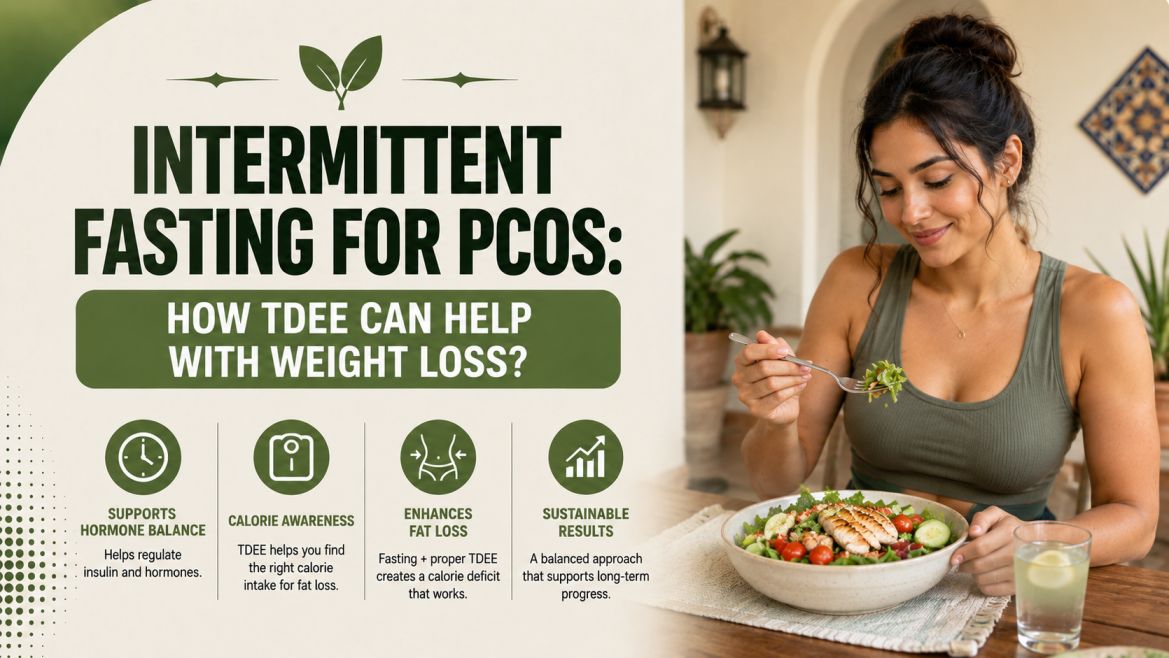
Intermittent fasting research specific to PCOS goes beyond the general "does fasting work" question most content answers. Recent trials measure insulin sensitivity and androgen levels directly, not just weight change.
Run the TDEE calculator for PCOS first to establish your calorie target. Fasting is a scheduling method for hitting that number, not a replacement for calculating it.
This guide covers what PCOS-specific fasting research actually shows and which protocol the evidence supports most. It also covers how fasting fits into a calorie plan already adjusted for insulin resistance.
PCOS affects an estimated 8 to 13% of women of reproductive age. Insulin resistance features in a large share of those cases, regardless of body weight. The research below focuses specifically on that population rather than general fasting studies extrapolated to fit.
Does Intermittent Fasting Actually Help PCOS Specifically?
The research base here is larger and more specific than most general fasting content acknowledges, with results measured directly against the mechanisms driving PCOS symptoms.
What Does the Research Show?
A 2025 meta-analysis in the Journal of the Endocrine Society tested this directly. Researchers pooled ten randomized trials covering 632 women with PCOS, evaluating fasting protocols against standard dietary approaches.
Outcome Measured | Result |
|---|---|
Insulin Sensitivity | Significant improvement (SMD -0.62) |
Serum Testosterone | Significant reduction (-13.4 ng/dL) |
Studies Included | 10 randomized trials |
Total Participants | 632 women with PCOS |
These are not small effects for a lifestyle intervention. A standardized mean difference of -0.62 represents a meaningful, clinically relevant improvement in insulin sensitivity, not a marginal statistical result.
How Does Fasting Fit Into Your PCOS-Adjusted TDEE?
Fasting changes when calories get eaten, not the calorie target itself. That target still needs to reflect the insulin resistance adjustment specific to PCOS before any fasting schedule gets layered on top.
Standard formulas can overestimate calorie needs for PCOS by 5 to 10%, depending on phenotype and insulin resistance severity. A fasting window applied to an unadjusted number still produces the same overestimate, just delivered inside fewer hours.
This is why calculating the target correctly comes first. Phenotype-specific corrections need to happen before any scheduling decision, since fasting alone cannot substitute for that adjustment.
Which Fasting Protocol Works Best for PCOS?
Not every fasting format has been tested in PCOS populations specifically. The formats that have been studied show real differences worth knowing about.
What Does 16:8 Time-Restricted Feeding Show?
A trial testing a 16-hour daily fast over 5 to 6 weeks studied women with anovulatory PCOS specifically. It found meaningful weight loss alongside significant drops in insulin, insulin resistance, and androgen markers.
What About 14:10 Early Time-Restricted Eating?
A separate randomized trial tested an earlier, slightly shorter 14:10 window instead. It found no greater benefit on blood pressure or inflammatory markers compared to a standard diet.
The distinction between these two results matters. A longer 16-hour window produced measurable hormonal change. A shorter 14-hour window, even timed earlier in the day, did not clearly outperform standard dieting on the markers that trial measured.
What About 5:2 Fasting?
A 5:2 protocol has also been tested specifically in obese PCOS patients as an alternative structure to daily time restriction. It uses two non-consecutive 500-calorie days per week, combined with meal replacement products.
Protocol | Evidence Summary |
|---|---|
16:8 Daily Fasting | Significant improvement in insulin, IR, and androgens over 5–6 weeks |
14:10 Early TRF | No clear advantage over standard diet on blood pressure or CRP |
5:2 With Meal Replacement | Tested as an alternative structure, distinct mechanism from daily TRF |
The 16-hour window has the clearest supporting evidence among protocols tested head-to-head. This does not rule out other formats, but it does mean 16:8 carries the strongest direct evidence for this population specifically.
What Does a Sample Weekly Schedule Look Like?
Applying a 16:8 window consistently across a week matters more than any single day done perfectly, particularly for anyone new to the protocol.
Day | Eating Window | Notes |
|---|---|---|
Monday to Friday | 12 PM to 8 PM | Consistent window supports habit formation |
Saturday | 12 PM to 8 PM | Same window, flexible meal content |
Sunday | 11 AM to 7 PM | Slight shift is fine if social plans require it |
Consistency in window timing matters more than rigid precision to the exact hour. A window that shifts by an hour occasionally still delivers the fasting duration research has tested, while a schedule abandoned entirely after one difficult day delivers nothing.
How Should You Break Your Fast for Stable Blood Sugar?
The first meal after a fasting window carries outsized importance for PCOS specifically. A poorly chosen breaking meal can spike blood sugar sharply after several hours without food.
What Should the First Meal Contain?
Breaking a fast with a high-glycemic meal produces a sharper insulin response than the same calories eaten earlier in a normal pattern. Refined carbohydrates and sugary drinks are the main culprits.
Lead with protein and fiber rather than simple carbohydrates, which blunts the glucose response considerably
Include a source of healthy fat, which further slows glucose absorption from the meal
Avoid breaking a fast with fruit juice or other liquid sugar sources specifically, since these absorb fastest of all
This single choice affects the entire day's blood sugar pattern, not just the first meal. A sharp spike after breaking a fast tends to produce a corresponding crash and increased hunger later, undermining the same insulin stability the fasting window was meant to support.
Does Exercise Timing Matter Alongside Fasting for PCOS?
Combining fasting with resistance training raises a practical question about whether workouts should happen inside or outside the eating window.
Should You Train Fasted or Fed?
Both approaches have research support in general fasting populations, without PCOS-specific data directly comparing the two. Training fasted does not appear to impair strength performance for most people, provided the session is not excessively long or high-volume.
For PCOS specifically, the practical consideration outweighs the theoretical one. Training later inside the eating window makes it easier to consume adequate protein around the session, which matters more here given the elevated protein targets this population's research supports.
Someone who trains early and prefers fasted sessions can still hit protein targets by shifting the eating window earlier. Total daily intake and timing around training should stay consistent from week to week.
Does Hydration Matter Differently During a Fasting Window?
Fasting protocols typically permit water, black coffee, and plain tea during the fasting hours. None of these break the metabolic state fasting is meant to create.
Adequate hydration matters more here, not less. A longer gap without food makes it easier to under-hydrate without noticing, and mild dehydration can independently affect energy levels and training performance in ways unrelated to the fasting protocol itself.
Electrolyte intake, particularly sodium, sometimes needs slight attention during longer fasting windows. A compressed eating schedule can reduce overall sodium intake compared to a normal pattern.
Does Fasting Outperform Standard Calorie Restriction for PCOS?
The broader fasting research base, not limited to PCOS, generally finds fasting matches standard calorie restriction rather than beating it. This holds true when total intake is held equal between approaches.
The PCOS-specific evidence tells a more nuanced story. Some trials found fasting produced hormonal improvements beyond what calorie matching alone would predict, suggesting a scheduling effect on top of the calorie effect, though this is not consistent across every study included in the meta-analysis.
The general mechanics of how fasting works, independent of any specific health condition, are covered in the complete guide to intermittent fasting and TDEE. Protocol comparisons and adherence research there apply regardless of PCOS status.
Does Fasting Lower Androgens and Improve Cycles, Not Just Weight?
The testosterone reduction found in the 2025 meta-analysis points to an effect beyond simple weight loss. Androgen levels connect directly to several PCOS symptoms beyond body composition alone.
Why Would Fasting Affect Testosterone Specifically?
Insulin and androgen production are mechanistically linked in PCOS. Elevated insulin stimulates ovarian androgen production directly, so an intervention that improves insulin sensitivity has a plausible pathway to lowering testosterone as a downstream effect.
This mirrors the same mechanism other insulin-sensitizing interventions target. The connection between insulin improvement and hormonal change is not unique to fasting, but the meta-analysis data confirms fasting produces this effect at a magnitude worth taking seriously.
Menstrual cycle regularity was not consistently reported across every trial in the meta-analysis. This remains a promising but less firmly established outcome than the insulin and testosterone findings.
Does This Explain Why Some Women Notice Changes Fasting Alone Can't?
Not every PCOS symptom traces back to insulin and androgens alone, which is worth acknowledging honestly rather than overselling fasting as a complete solution.
Hirsutism, acne, and hair thinning can persist even when insulin and testosterone markers improve. These symptoms depend partly on how sensitive individual hair follicles and skin are to circulating androgens, not just the absolute hormone level.
This does not diminish what the research does show. A significant reduction in testosterone and improved insulin sensitivity are meaningful outcomes on their own, even without guaranteeing every visible symptom resolves at the same pace.
Can You Get Enough Protein While Fasting for PCOS?
Compressing meals into a shorter window creates a genuine practical challenge for hitting the higher protein targets PCOS-specific research supports.
Research on high-protein diets in PCOS populations finds meaningful improvements in insulin and inflammatory markers at elevated protein intake. This typically means 1.8 to 2.0 g/kg of body weight. Fitting that total into fewer eating occasions requires larger portions per meal rather than a lower overall target.
This exact challenge is covered in depth elsewhere. The protein for PCOS guide breaks down specific gram targets and how to distribute them across a compressed eating window without falling short.
Does Fasting Help or Hurt PCOS Belly Fat Specifically?
Visceral and central fat accumulation, common in PCOS, connects to the same insulin resistance mechanism fasting research targets directly.
Insulin resistance is strongly linked to the central fat storage pattern many women with PCOS experience. An intervention that measurably improves insulin sensitivity has a plausible mechanism for affecting that distribution over time.
The specific mechanism connecting insulin resistance to fat distribution is covered in full elsewhere. The PCOS belly fat guide breaks down what current research shows about this pattern and what it means for calorie strategy.
Should You Combine Fasting With Inositol?
Fasting and inositol supplementation target the same underlying mechanism through different pathways. This raises a reasonable question about whether combining them adds benefit or simply duplicates effort.
Inositol works pharmacologically to improve insulin signalling at the cellular level. Fasting works behaviourally, through meal timing and its downstream effects on insulin exposure across the day. Neither approach has been directly tested in combination in the research reviewed for this guide.
There is no evidence the two conflict, and a plausible case that their mechanisms complement each other. The full inositol and PCOS guide covers dosing and realistic timelines for anyone considering pairing the two approaches.
Who Should Be Cautious With Fasting and PCOS?
Fasting is not appropriate for every woman with PCOS, and certain circumstances specifically warrant caution or medical guidance before starting.
What Situations Deserve Extra Care?
A history of disordered eating warrants a conversation with a doctor before starting a fasting protocol. The same applies to current pregnancy, active attempts to conceive, or diabetes medication requiring careful blood sugar management.
Women actively trying to conceive should discuss fasting with a fertility specialist, since some research populations specifically excluded this group
Anyone on insulin or insulin-sensitizing medication should coordinate fasting timing with a doctor to avoid hypoglycemia risk
A history of disordered eating patterns makes structured fasting windows a meaningful risk factor worth discussing with a mental health professional first
None of this means fasting is inherently unsafe for PCOS. It means the research populations these trials studied do not automatically represent every woman with a PCOS diagnosis, and individual circumstances should guide the decision.
What Common Mistakes Undermine Fasting Results for PCOS?
A handful of predictable errors explain most cases where fasting looks correct on paper but fails to produce the results the research above would predict.
Do You Overeat to Compensate for the Fasting Window?
Treating the fasting hours as license to eat freely once the window opens is the single most common mistake. It can fully erase the deficit fasting was meant to create.
Do You Ignore Total Calories Entirely?
Some approach fasting as though window compliance alone guarantees results, without tracking whether total intake still matches a properly calculated, phenotype-adjusted target.
Mistake | Why It Backfires | The Fix |
|---|---|---|
Compensation Eating | Erases the deficit the window was meant to create | Plan meals in advance, not in the moment |
Ignoring Total Calories | Window compliance alone does not guarantee a deficit | Track total intake against the PCOS-adjusted target |
Breaking the Fast Poorly | High-glycemic first meals spike insulin sharply | Lead with protein and fiber, not refined carbohydrates |
Abandoning After One Hard Day | A single difficult day is treated as total failure | Judge the protocol over weeks, not one session |
The pattern across all four mistakes is the same. Each one treats fasting as a standalone solution rather than one piece of a system that still requires an accurate calorie target underneath it. The full PCOS and TDEE guide covers how that underlying system fits together beyond fasting alone.
Frequently Asked Questions About Intermittent Fasting and PCOS
Does Intermittent Fasting Really Help PCOS or Is It Just Weight Loss?
Research suggests effects beyond simple weight change. A 2025 meta-analysis of 632 women found significant improvements in insulin sensitivity and testosterone. Both are mechanistically tied to PCOS symptoms rather than fully explained by weight loss alone.
What Is the Best Fasting Protocol for PCOS Specifically?
Among protocols tested, a 16-hour daily fasting window has the clearest supporting evidence. One trial showed significant improvements in insulin, insulin resistance, and androgen markers over 5 to 6 weeks.
Does a Shorter Fasting Window Still Work for PCOS?
Evidence is less clear for shorter windows. A 14:10 early time-restricted trial found no significant advantage over a standard diet on blood pressure or inflammatory markers. It was not directly compared to the 16:8 protocol in the same study.
Can Intermittent Fasting Replace a PCOS-Adjusted Calorie Target?
No. Fasting changes when calories are eaten, not how many calories the body actually needs. That target still has to be calculated correctly first, with phenotype-specific corrections applied, before any fasting schedule gets built around it.
Is 5:2 Fasting Better Than Daily Time-Restricted Eating for PCOS?
The evidence does not currently establish one approach as superior to the other for this population. Both have been tested as distinct structures rather than head-to-head against each other in the same trial.
Should Women Trying to Conceive With PCOS Try Intermittent Fasting?
This deserves a direct conversation with a fertility specialist. Some fasting research populations specifically excluded women actively trying to conceive. The evidence base for this specific situation is more limited than for general weight management.
Does Fasting Work Differently for PCOS Compared to Women Without It?
The core calorie mechanics are identical. PCOS-specific trials do measure additional outcomes, insulin sensitivity and androgen levels, that general population fasting research does not typically track. The general TDEE calculator for women covers the broader mechanics that apply regardless of a PCOS diagnosis.
How Long Before Fasting Shows PCOS-Specific Results?
The clearest trial showing hormonal improvement measured outcomes at 5 to 6 weeks. Menstrual cycle changes, where reported, typically take longer to become consistent than insulin or testosterone markers.
Will Fasting Clear Up Acne or Hirsutism From PCOS?
Not necessarily, even when insulin and testosterone improve. These visible symptoms depend partly on individual follicle and skin sensitivity to androgens, not just the circulating hormone level. Improvement is possible but not guaranteed at the same pace as bloodwork markers.
Can I Do Intermittent Fasting on Metformin for PCOS?
This requires direct medical guidance rather than general advice. Metformin's timing relative to meals affects both its effectiveness and its side effect profile, so any fasting schedule should be coordinated with the prescribing doctor.
Does Fasting Help With PCOS-Related Weight Regain After Stopping a Diet?
The research reviewed here focused on active weight loss and metabolic improvement rather than weight maintenance specifically. The general principles of maintaining results after any diet phase still apply regardless of whether fasting was the method used to lose the weight.
Is There a Minimum Fasting Duration Below Which PCOS Benefits Disappear?
The research showing clear benefit used a full 16-hour window. Shorter windows, such as the 14:10 protocol tested separately, did not show the same clear advantage on the markers measured in that specific trial.
Should I Track My Cycle While Trying Intermittent Fasting for PCOS?
This is a reasonable practice given how directly fasting research ties to hormonal outcomes. Tracking cycle length and regularity alongside weight provides a fuller picture than weight alone. Cycle improvement was one of the less consistently measured outcomes in the research reviewed here.
Does the Meta-Analysis Distinguish Between PCOS Phenotypes?
The 2025 meta-analysis pooled results across included trials without consistently breaking outcomes down by specific phenotype. Individual response may still vary by insulin resistance severity, similar to the pattern seen with calorie deficit adjustments.
Can Intermittent Fasting Be Combined With a Low-Carb Approach for PCOS?
Yes, and many women naturally combine both, since a compressed eating window often reduces overall carbohydrate opportunities simply through fewer meals. Neither approach excludes the other, and both target aspects of the same underlying insulin resistance.