
Calories Burned Doing HIIT By Intensity, Weight, Duration, and Protocol
How many calories does HIIT burn? Full MET-based tables by body weight and intensity. Covers moderate HIIT, Tabata, vigorous intervals, EPOC afterburn, and HIIT vs running comparison.

Your body has a number. Let's find it.
We calculate the exact calorie target your body needs, built from your stats and goal, then track everything against it daily. Log meals, add workouts, set a weight goal, and watch your numbers update in real time. Check in weekly to see calories, water, and weight trend in one place.
No spreadsheets. No guessing. Just results.
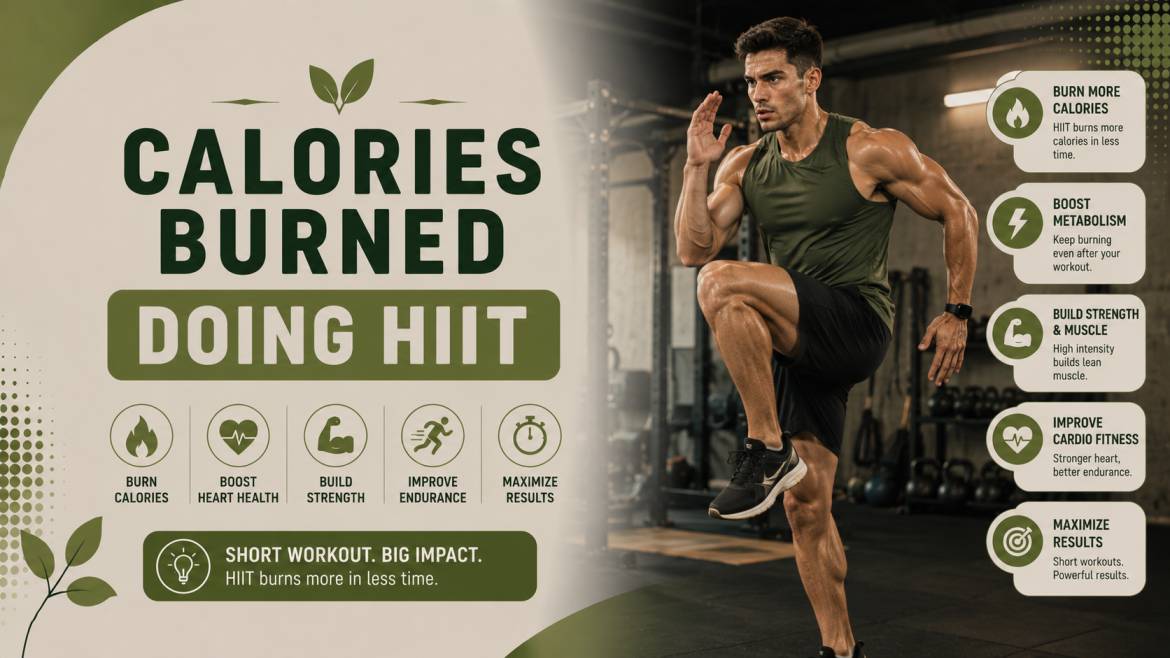
High-intensity interval training burns between 200 and 600 calories per 30-minute session for most adults. Body weight, intensity level, and the specific protocol used determine where in that range any session lands. A 154 lb (70 kg) person doing moderate HIIT at MET 7.0 burns approximately 245 calories per 30 minutes. The same person doing vigorous Tabata at MET 11.0 burns approximately 385 calories in the same window.
Use the HIIT calorie calculator to get a personalised estimate based on your weight, protocol, and session length. The calories burned calculator covers all activity formats in one place.
HIIT is not a single workout. It is a training structure: alternating high-effort work intervals with rest or low-effort recovery periods. The calorie output changes significantly depending on the work-to-rest ratio, exercise selection, and how hard the work intervals actually are. This hub covers every angle: MET values by protocol, calorie tables by weight, EPOC afterburn, and how HIIT compares to steady-state cardio.
How Many Calories Does HIIT Burn?
The MET formula (Metabolic Equivalent of Task) is the standard method for calculating HIIT calorie output. The formula is:
Calories = MET x Body Weight (kg) x Duration (hours)
The 2024 Adult Compendium of Physical Activities assigns MET 7.0 to moderate HIIT and MET 11.0 to vigorous interval training and Tabata protocols. These are the research-backed reference values used throughout this hub.
The TDEE calculator shows how HIIT sessions sit within your total daily energy balance. A 20-minute vigorous HIIT session covers approximately 12 to 18% of daily TDEE for most adults, according to traincalc.com analysis using 2024 Compendium data.
HIIT MET Values by Protocol (2024 Compendium)
Protocol | MET Value | Intensity Classification |
|---|---|---|
Moderate HIIT (circuit, intervals) | 7.0 | Vigorous |
Vigorous calisthenics HIIT | 7.5 | Vigorous |
HIIT / Tabata protocol | 11.0 | Very vigorous |
Sprint interval training (proxy) | 14.0 | Maximal |
Source: 2024 Adult Compendium of Physical Activities (Ainsworth et al.)
MET values above 6.0 are classified as vigorous by the Compendium. Standard HIIT at MET 7.0 already sits well above the vigorous threshold. True Tabata at MET 11.0 demands roughly 57% more energy per minute than moderate HIIT. The gap between these two is why protocol choice matters as much as duration.
How Many Calories Does HIIT Burn by Body Weight?
Body weight scales HIIT calorie output linearly. The MET formula multiplies weight in kilograms, so every additional kilogram of body weight adds proportional calories burned at the same intensity.
The table below applies the 2024 Compendium MET values across common body weights for a 30-minute HIIT session.
Calories Burned in 30 Minutes of HIIT by Body Weight and Protocol
Body Weight | Moderate HIIT (MET 7.0) | Vigorous HIIT (MET 11.0) | Tabata (MET 11.0) |
|---|---|---|---|
120 lb (54 kg) | 189 kcal | 297 kcal | 297 kcal |
140 lb (64 kg) | 224 kcal | 352 kcal | 352 kcal |
150 lb (68 kg) | 238 kcal | 374 kcal | 374 kcal |
154 lb (70 kg) | 245 kcal | 385 kcal | 385 kcal |
165 lb (75 kg) | 263 kcal | 413 kcal | 413 kcal |
185 lb (84 kg) | 294 kcal | 462 kcal | 462 kcal |
200 lb (91 kg) | 319 kcal | 501 kcal | 501 kcal |
215 lb (97 kg) | 340 kcal | 534 kcal | 534 kcal |
30-minute session, active work time only. Source: 2024 Adult Compendium MET values.
A 200 lb person doing vigorous HIIT for 30 minutes burns 501 calories, more than double the output of a 120 lb person at the same session length. This weight-scaling effect makes HIIT especially efficient for heavier individuals relative to the time investment.
HIIT Calories Per Hour by Intensity
Per-hour figures are useful for planning longer sessions and comparing HIIT against steady-state cardio on equal time. Most genuine HIIT sessions last 20 to 30 minutes. Sessions beyond 40 minutes at true vigorous intensity typically see intensity drop, effectively shifting into moderate-intensity cardio.
HIIT Calories Per Hour by Body Weight (Full-Session Reference)
Body Weight | Moderate HIIT (MET 7.0) | Vigorous HIIT (MET 11.0) |
|---|---|---|
120 lb (54 kg) | 378 kcal | 594 kcal |
140 lb (64 kg) | 448 kcal | 704 kcal |
154 lb (70 kg) | 490 kcal | 770 kcal |
165 lb (75 kg) | 525 kcal | 825 kcal |
185 lb (84 kg) | 588 kcal | 924 kcal |
200 lb (91 kg) | 637 kcal | 1,001 kcal |
For the full per-hour breakdown across protocols and body weights, see the HIIT calories per hour page.
What Factors Affect HIIT Calorie Burn?
Six variables determine how many calories a HIIT session actually produces. Understanding each one helps set realistic expectations and makes session design more effective.
Work-to-Rest Ratio
The ratio of hard effort to recovery directly controls average session intensity. A 2:1 work-to-rest ratio (40 seconds work, 20 seconds rest) produces a higher effective MET than 1:2. As rest time increases relative to work time, the session moves closer to moderate-intensity cardio in total energy cost.
Exercise Selection
Compound movements that recruit more muscle mass burn more calories per minute. Exercises like burpees, thrusters, squat jumps, and rowing use the legs, core, and upper body simultaneously. Isolated exercises like bicep curls produce far less metabolic demand per interval. The research cited in PubMed (2014) found that HIIT using a hydraulic resistance system burned 12.62 kcal/min versus 8.83 kcal/min for traditional weight training.
Session Duration
Longer sessions accumulate more total calories, but true vigorous HIIT is hard to sustain past 30 minutes. According to traincalc.com analysis using 2024 Compendium data, sessions beyond 30 minutes at vigorous HIIT intensity typically involve a drop in output, which means applying the MET 11.0 value to 45-minute sessions overstates actual burn.
Body Weight
Weight scales calorie output directly. A 185 lb person burns 56% more per HIIT session than a 120 lb person at the same protocol, duration, and intensity.
Fitness Level
Trained individuals may burn fewer calories than beginners at the same apparent intensity because they are more mechanically efficient. Their cardiovascular systems manage high-intensity work with less total energy expenditure per unit of effort. A beginner doing Tabata at perceived maximum effort may produce a higher actual calorie burn than a trained athlete at the same perceived effort.
Rest Interval Activity
Active rest (walking, slow jogging, slow pedalling) during recovery intervals contributes more calories than complete rest. BiteKit notes that slow pedalling during HIIT rest at MET 2.5 burns meaningfully more than sitting at MET 1.5 over a full session.
HIIT Exercises and Their Calorie Burn
Exercise selection within a HIIT session changes calorie output more than most people realise. Compound movements that recruit large muscle groups produce significantly higher energy demand per interval than isolated or low-load exercises. The table below shows estimated calorie burn per minute for common HIIT exercises at vigorous effort for a 154 lb (70 kg) person, based on MET values from the 2024 Adult Compendium of Physical Activities.
Calories Burned Per Minute by HIIT Exercise (154 lb / 70 kg, Vigorous Effort)
Exercise | MET (Vigorous) | Calories Per Minute | Primary Muscles |
|---|---|---|---|
Burpees | 8.0 | 9.3 kcal | Full body |
Jump squats | 8.0 | 9.3 kcal | Quads, glutes, calves |
Mountain climbers | 8.0 | 9.3 kcal | Core, hip flexors, shoulders |
Sprint intervals (treadmill or outdoor) | 14.0 | 16.3 kcal | Full body, legs dominant |
Battle ropes | 10.0 | 11.7 kcal | Shoulders, arms, core |
Kettlebell swings | 9.8 | 11.4 kcal | Posterior chain, core |
Box jumps | 8.0 | 9.3 kcal | Quads, glutes, calves |
Jump rope (vigorous) | 11.8 | 13.7 kcal | Calves, shoulders, cardiovascular |
Rowing machine (vigorous) | 12.0 | 14.0 kcal | Back, legs, arms |
High-knee running in place | 9.8 | 11.4 kcal | Hip flexors, legs, core |
Plyo push-ups | 8.0 | 9.3 kcal | Chest, triceps, shoulders |
Lunge jumps | 8.0 | 9.3 kcal | Quads, hamstrings, glutes |
MET values from the 2024 Adult Compendium of Physical Activities. Per-minute rates represent vigorous-effort work intervals only.
Sprint intervals and rowing at vigorous pace produce the highest per-minute calorie output. Both recruit the posterior chain, legs, and cardiovascular system under near-maximal load. Jump rope at MET 11.8 also sits close to the sprint-level output while requiring no equipment beyond the rope itself.
Which HIIT Exercises Burn the Most Calories?
The exercises that burn the most calories per minute share three characteristics:
Full-body recruitment: The more muscle mass activated per rep, the more oxygen consumed per minute. Burpees, sprint intervals, and kettlebell swings all engage the legs, core, and upper body simultaneously.
Plyometric or explosive component: Jump squats and box jumps require maximal force production in a short window. This explosive demand elevates heart rate faster and higher than slow-tempo movements.
Continuous cardiovascular demand: Exercises that keep heart rate elevated between rep transitions produce higher sustained MET values than movements with long pause phases.
Isolated exercises like bicep curls or calf raises produce MET values of 3.0 to 5.0 at vigorous effort. Adding them to a HIIT circuit lowers the average session MET and reduces total calorie output per minute of work.
HIIT Exercises by Calorie Burn Category
Highest calorie burn (above 11 kcal/min for a 70 kg person): Sprint intervals, rowing machine, jump rope, battle ropes, kettlebell swings, high-knee running
Moderate calorie burn (8 to 11 kcal/min for a 70 kg person): Burpees, box jumps, jump squats, mountain climbers, lunge jumps, plyo push-ups
Lower calorie burn (below 8 kcal/min for a 70 kg person): Bodyweight squats (non-explosive), standard push-ups, plank holds, step-ups
A HIIT circuit built entirely from the highest-calorie category produces output close to MET 11.0 to 14.0 for the full session. A mixed circuit averaging moderate and high-calorie exercises typically lands at MET 7.0 to 9.0 for the session.
At-Home vs Gym HIIT Exercises
Exercise setting does not affect calorie burn. A burpee performed at home produces the same MET and calorie output as a burpee in a gym. What changes between settings is equipment access, which determines which high-calorie exercises are available.
High-calorie at-home HIIT exercises (no equipment required): Burpees, jump squats, mountain climbers, lunge jumps, high-knee running in place, plyo push-ups, jump rope
High-calorie gym or equipment-based HIIT exercises: Rowing machine, battle ropes, kettlebell swings, sled pushes, assault bike, weighted thrusters
At-home bodyweight HIIT can reach MET 11.0 when work intervals are held at near-maximal effort with compound exercises. The equipment advantage in a gym is that resistance tools sustain high MET values with less technique-driven effort compared to bodyweight-only protocols.
HIIT Afterburn: EPOC Calories Explained
EPOC stands for Excess Post-Exercise Oxygen Consumption. It is the elevated oxygen use and calorie burn that continues after a workout ends. HIIT produces a larger EPOC response than steady-state cardio at the same session length.
EPOC from a vigorous HIIT session adds approximately 6 to 15% to total session calorie output. A 154 lb person who burns 385 calories during a 30-minute vigorous HIIT session may burn an additional 23 to 58 calories in the hours following the workout.
EPOC by HIIT Intensity (154 lb / 70 kg)
Session Type | During Session | EPOC Range (6-15%) | Total Estimated Burn |
|---|---|---|---|
Moderate HIIT, 20 min | 163 kcal | 10 to 24 kcal | 173 to 187 kcal |
Moderate HIIT, 30 min | 245 kcal | 15 to 37 kcal | 260 to 282 kcal |
Vigorous HIIT, 20 min | 257 kcal | 15 to 39 kcal | 272 to 296 kcal |
Vigorous HIIT, 30 min | 385 kcal | 23 to 58 kcal | 408 to 443 kcal |
Research from Arizona State University found that sprint interval training produced 110 calories of post-exercise burn in the three hours following exercise, compared to 83 calories for standard HIIT and 64 calories for steady-state cardio. This EPOC advantage is real but modest. It narrows the gap between HIIT and steady-state cardio rather than doubling it.
For the full EPOC breakdown and a guide on how afterburn works mechanically, see the HIIT afterburn and EPOC calories page.
Calories Burned in 20 Minutes of HIIT
A 20-minute HIIT session is the most common recreational workout length. At moderate intensity (MET 7.0), a 154 lb person burns approximately 163 calories. At vigorous Tabata intensity (MET 11.0), the same person burns approximately 257 calories.
20-Minute HIIT Calories by Body Weight
Body Weight | Moderate (MET 7.0) | Vigorous / Tabata (MET 11.0) |
|---|---|---|
120 lb (54 kg) | 126 kcal | 198 kcal |
150 lb (68 kg) | 158 kcal | 248 kcal |
154 lb (70 kg) | 163 kcal | 257 kcal |
185 lb (84 kg) | 196 kcal | 308 kcal |
215 lb (97 kg) | 227 kcal | 356 kcal |
By doing just 20 minutes of HIIT, a person can burn up to 320 calories at vigorous effort according to VeryWellFit analysis. The 20-minute session length is frequently recommended for beginners because the short duration allows near-maximum effort throughout, which is the defining characteristic of true HIIT.
For the complete 20-minute guide covering work-to-rest ratios, exercise types, and the effect of bodyweight versus equipment, see the 20-minute HIIT calories page.
Calories Burned in 30 Minutes of HIIT
A 30-minute HIIT session at moderate intensity burns approximately 245 calories for a 154 lb person. At vigorous intensity the same person burns approximately 385 calories. BetterMe reports that a 30-minute HIIT workout burns between 250 and 400 calories in most adults, which aligns with the MET 7.0 to 11.0 range.
Thirty minutes represents the upper limit of sustained true HIIT for most recreational exercisers. Research indicates that sessions exceeding 30 minutes at genuine vigorous intensity typically involve a decline in output quality. The effective MET drops as fatigue limits work interval intensity.
For the full 30-minute calorie breakdown including at-home protocols and female-specific estimates, see the 30-minute HIIT calories page.
HIIT vs Running: Which Burns More Calories?
The comparison between HIIT and running calorie output depends entirely on duration, intensity, and whether EPOC is included.
During a session of equal length, steady-state running often produces more total calories than HIIT. A 40-minute moderate run burns approximately 300 calories for a 154 lb person. A 20-minute vigorous HIIT session burns approximately 230 calories plus roughly 65 calories of EPOC for a total of 295 calories. Over the same clock time as the run, HIIT closes the gap significantly.
HIIT vs Running Calorie Comparison (154 lb / 70 kg)
Activity | Duration | During Session | EPOC | Total |
|---|---|---|---|---|
Steady-state run (MET 9.8) | 40 min | 320 kcal | ~25 kcal | ~345 kcal |
Vigorous HIIT (MET 11.0) | 20 min | 257 kcal | ~39 kcal | ~296 kcal |
Vigorous HIIT (MET 11.0) | 30 min | 385 kcal | ~54 kcal | ~439 kcal |
Running (MET 9.8) | 30 min | 240 kcal | ~18 kcal | ~258 kcal |
Estimates based on 154 lb / 70 kg individual. EPOC range uses 6-15% midpoint.
A 30-minute vigorous HIIT session produces approximately 70% more total calorie output than a 30-minute moderate run. The advantage comes from HIIT's higher MET value when intensity is truly sustained. Where HIIT falls short is over long durations: a 60-minute run at MET 9.8 produces approximately 640 calories that HIIT cannot match in the same window while maintaining vigorous intensity.
The running calories hub covers running calorie data across speeds, distances, and body weights with full MET reference tables.
What Affects Total HIIT Calorie Output During Weight Loss?
HIIT contributes to a calorie deficit through two mechanisms: the calories burned during the session and the EPOC that follows. The practical contribution to weekly calorie deficit for a 154 lb person on a typical HIIT schedule looks like this:
Weekly HIIT Calorie Contribution (154 lb / 70 kg)
Frequency | Protocol | Per Session | Weekly Total (incl. EPOC) |
|---|---|---|---|
3 x per week | Moderate HIIT, 20 min | ~173 kcal | ~519 kcal |
3 x per week | Vigorous HIIT, 30 min | ~415 kcal | ~1,245 kcal |
4 x per week | Vigorous HIIT, 30 min | ~415 kcal | ~1,660 kcal |
2 x per week | Vigorous HIIT, 30 min | ~415 kcal | ~830 kcal |
The main calories burned guide provides a full cross-activity comparison showing where HIIT sits relative to swimming, cycling, walking, and strength training on a weekly calorie basis.
Does HIIT Burn More Calories Than Steady-State Cardio?
The answer depends on how the comparison is structured.
Per minute of active effort, vigorous HIIT at MET 11.0 burns significantly more than moderate steady-state cardio at MET 5.0 to 7.0. Per session of equal clock time, the gap narrows because HIIT includes rest periods while steady-state cardio does not. Per session including EPOC, HIIT typically matches or slightly exceeds steady-state cardio of the same duration.
The distinct advantage of HIIT is time efficiency. Three 20-minute vigorous HIIT sessions per week produce comparable total weekly calories (including EPOC) to three 40-minute moderate cardio sessions. This makes HIIT the more practical choice for people with limited training time.
HIIT also produces what researchers call an interference effect when combined with resistance training. The high glycogen depletion from vigorous intervals can reduce strength adaptation when HIIT and heavy lifting are performed in the same session. This is the variable most general HIIT content ignores. If the primary goal is muscle gain, session sequencing matters as much as total calorie burn.
HIIT Protocol Types and Their Calorie Output
Not all HIIT is equal. The protocol determines the effective MET value, which directly sets calorie output. Understanding the differences helps match the right protocol to a specific calorie or fitness goal.
Tabata
Tabata is a fixed protocol: 20 seconds of maximal effort followed by 10 seconds of rest, repeated for 8 rounds per exercise. One complete Tabata block takes 4 minutes. The protocol was developed by Dr. Izumi Tabata and validated in a 1996 study that showed improvements in both aerobic and anaerobic capacity. At MET 11.0, a 154 lb person burns approximately 34 calories per 4-minute round.
Sprint Interval Training
Sprint interval training uses near-maximal speed efforts of 10 to 30 seconds followed by full recovery periods of 2 to 4 minutes. The work intervals are shorter and more intense than standard HIIT. The 2024 Compendium assigns a proxy MET of approximately 14.0 for true sprint intervals. Arizona State University research found that sprint intervals produced the highest EPOC response (110 calories of post-exercise burn) of any interval format tested.
MetCon Circuits
Metabolic conditioning (MetCon) circuits combine compound movements back-to-back with minimal rest between exercises. Examples include combinations of kettlebell swings, box jumps, rowing, and pull-ups. MetCon typically runs at MET 7.0 to 9.0 depending on exercise selection and rest periods. A 154 lb person burning 30 minutes of MetCon at MET 8.0 burns approximately 280 calories.
AMRAP Intervals
AMRAP (As Many Rounds As Possible) sessions set a time cap and count completed rounds. The intensity is self-paced, which means actual MET varies between individuals. Most AMRAP sessions at moderate-to-vigorous effort sit between MET 7.0 and 9.0.
Summary: HIIT Protocol Calorie Comparison (154 lb / 70 kg, 30 Minutes)
Protocol | Effective MET | Calories in 30 Min |
|---|---|---|
Moderate circuit / AMRAP | 7.0 | 245 kcal |
MetCon circuits | 8.0 | 280 kcal |
Standard vigorous HIIT | 11.0 | 385 kcal |
Tabata (8 x 4-min rounds) | 11.0 | 385 kcal |
Sprint intervals | 14.0 | 490 kcal |
2024 Adult Compendium MET values. 30-minute active time.
Sprint intervals at MET 14.0 produce the highest per-session output but require the longest recovery. Most people can sustain true sprint interval quality for 20 to 25 minutes before the work intervals degrade. For the full per-hour reference across all body weights, see the HIIT calories per hour page.
Using HIIT Calorie Output for Weight Loss Planning
HIIT calorie data becomes actionable when mapped against a weekly deficit target. Fat loss requires a sustained calorie deficit. HIIT contributes to that deficit through session calories and EPOC. The size of the contribution depends on session frequency and intensity.
A 154 lb person targeting a 3,500 calorie weekly deficit for approximately 1 lb of weekly fat loss needs to create that deficit through a combination of reduced intake and exercise. Three vigorous 30-minute HIIT sessions per week produce approximately 1,245 calories of exercise contribution including EPOC. That covers about 36% of the weekly deficit target from exercise alone.
Three practical weekly HIIT structures for weight loss:
Beginner (3 sessions): Three moderate 20-minute sessions at MET 7.0 contribute approximately 519 weekly calories including EPOC for a 154 lb person.
Intermediate (3 sessions): Three vigorous 30-minute sessions at MET 11.0 contribute approximately 1,245 weekly calories including EPOC.
Advanced (4 sessions): Four vigorous 30-minute sessions contribute approximately 1,660 weekly calories including EPOC.
Adding HIIT frequency beyond four sessions per week risks recovery debt, which lowers work interval quality and reduces actual calorie burn per session over time. Three to four sessions per week is the practical ceiling for maximising total weekly HIIT calorie output.
Use the TDEE calculator to find your maintenance calories and calculate the combined deficit from HIIT sessions plus dietary adjustments.
Frequently Asked Questions About Calories Burned HIIT
How Many Calories Does HIIT Burn?
HIIT burns between 163 and 501 calories per 30 minutes depending on body weight and intensity. A 154 lb (70 kg) person at moderate HIIT (MET 7.0) burns approximately 245 calories per 30 minutes. At vigorous Tabata intensity (MET 11.0), the same person burns approximately 385 calories. EPOC afterburn adds an additional 6 to 15% of session calories in the hours following the workout.
How Many Calories Does 20 Minutes of HIIT Burn?
A 20-minute HIIT session burns approximately 163 calories at moderate intensity for a 154 lb person. At vigorous intensity (MET 11.0), the same person burns approximately 257 calories per 20 minutes. Including EPOC, a vigorous 20-minute session produces a total estimated burn of 272 to 296 calories for a 154 lb adult.
How Many Calories Does HIIT Burn Per Minute?
Moderate HIIT at MET 7.0 burns approximately 8.2 calories per minute for a 154 lb (70 kg) person. Vigorous HIIT at MET 11.0 burns approximately 12.8 calories per minute for the same person. Sprint interval training at MET 14.0 burns approximately 16.3 calories per minute. These rates apply to active work intervals only, not full session time including rest.
Does HIIT Burn More Calories Than Running?
Per minute of active effort, vigorous HIIT (MET 11.0) burns more than moderate running (MET 9.8). Per session of equal clock time, running often produces more total calories because it involves continuous movement without rest intervals. Including EPOC, a 30-minute vigorous HIIT session (approximately 439 kcal total) produces more than a 30-minute moderate run (approximately 258 kcal total) for a 154 lb person.
How Many Calories Does HIIT Burn for a 150-Pound Person?
A 150 lb (68 kg) person burns approximately 238 calories per 30 minutes of moderate HIIT. At vigorous Tabata intensity the same person burns approximately 374 calories per 30 minutes. Including EPOC, a 30-minute vigorous session produces approximately 395 to 430 total calories for a 150 lb adult.