
Calories Burned Running vs. Walking: Per Mile, Per Minute and by Weight
Does running or walking burn more calories? Full running vs walking comparison per mile, per minute, and by body weight. Covers same distance, weight loss, fat loss, 500-calorie targets, and power walking.

Your body has a number. Let's find it.
We calculate the exact calorie target your body needs, built from your stats and goal, then track everything against it daily. Log meals, add workouts, set a weight goal, and watch your numbers update in real time. Check in weekly to see calories, water, and weight trend in one place.
No spreadsheets. No guessing. Just results.
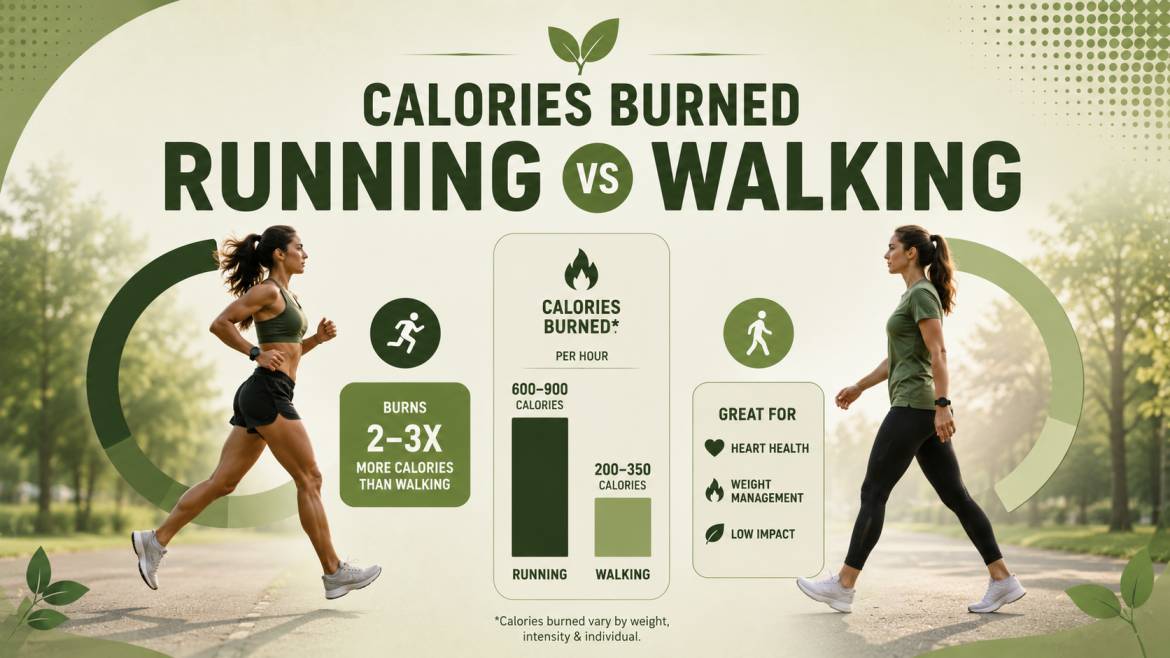
Running burns more calories than walking per minute and per mile, but the per-mile gap is smaller than most expect. A 154 lb (70 kg) person running at 6 mph burns approximately 686 calories per hour, versus approximately 350 calories per hour walking at 4 mph. Running vs walking calories burned diverge most by time, less by distance.
Use the running calorie calculator to compare your own output across pace and distance. The running calories hub links every running distance and time format. To compare both activities inside your daily budget, open the TDEE calculator.
This page covers running vs walking calories per mile, per minute, by weight, over the same distance, for weight loss, for fat loss, and the 500-calorie comparison. Every figure uses MET data from the 2024 Adult Compendium of Physical Activities.
Does Running or Walking Burn More Calories?
Running burns more calories than walking at every shared time window, because running carries a higher MET value. Running at 6 mph (MET 9.8) burns nearly double the calories per minute of brisk walking at 4 mph (MET 5.0).
The two framings produce different answers:
Per minute: Running wins clearly. Running 6 mph burns about 11.4 kcal/min for a 154 lb person; brisk walking 4 mph burns about 5.8 kcal/min.
Per mile: Running still wins, but the gap narrows to roughly 30%, because walking takes longer to cover the mile.
Per hour: Running 6 mph burns about 686 kcal; brisk walking 4 mph burns about 350 kcal, nearly double.
Walk vs run calorie burn depends entirely on whether the comparison fixes time or distance. Both framings appear in this guide, because each answers a different planning question.
Running vs Walking Calories Per Mile
Running vs walking calories per mile show a 30% gap at moderate paces, smaller than the per-minute gap. The table compares per-mile output for a 154 lb runner across paces.
Activity | Speed | Time Per Mile | Calories Per Mile (70 kg) |
|---|---|---|---|
Running | 6 mph | 10 min | 114 kcal |
Jogging | 5 mph | 12 min | 99 kcal |
Power walking | 4.5 mph | 13.3 min | 95 kcal |
Brisk walking | 4 mph | 15 min | 88 kcal |
Moderate walking | 3.5 mph | 17 min | 78 kcal |
Slow walking | 3 mph | 20 min | 65 kcal |
Gross calories, flat terrain, 154 lb runner.
Running at 6 mph burns approximately 30% more per mile than brisk walking at 4 mph. The gap exists because running includes a flight phase, where both feet leave the ground. That phase demands extra energy for landing and propulsion. The calories burned running per mile page covers the running side in full.
Running vs Walking Calories Per Minute
Running vs walking calories per minute show the largest gap, because running carries a far higher MET. Per minute is the framing where running dominates most clearly.
Activity | Speed | MET | Calories Per Minute (70 kg) |
|---|---|---|---|
Running | 6 mph | 9.8 | 11.4 kcal/min |
Jogging | 5 mph | 8.3 | 9.7 kcal/min |
Power walking | 4.5 mph | 6.3 | 7.4 kcal/min |
Brisk walking | 4 mph | 5.0 | 5.8 kcal/min |
Moderate walking | 3 mph | 3.5 | 4.1 kcal/min |
Gross calories, 154 lb person, 2024 Adult Compendium of Physical Activities.
Running 6 mph burns roughly twice the calories per minute of brisk walking. For anyone time-limited, running produces a larger burn in a fixed window. The calories burned running 30 minutes page shows the running side of a 30-minute session.
Calories Burned Jogging vs Walking the Same Distance
Calories burned jogging vs walking same distance favor jogging by 20 to 35%, because running mechanics cost more energy per mile than walking mechanics. Over a fixed 3-mile route:
Activity | Speed | Time for 3 Miles | Calories (70 kg) |
|---|---|---|---|
Jogging | 5 mph | 36 min | 297 kcal |
Power walking | 4.5 mph | 40 min | 285 kcal |
Brisk walking | 4 mph | 45 min | 264 kcal |
Moderate walking | 3 mph | 60 min | 195 kcal |
Jogging 3 miles burns approximately 297 kcal for a 154 lb person, versus 264 kcal brisk walking the same distance. The 12% gap at these paces narrows further against power walking. Over the same distance, the activity choice matters less than over the same time. The calories burned running 3 miles page covers the running side in detail.
Run vs Walk Calorie Burn by Weight
Run vs walk calorie burn by weight scales linearly for both activities, because the MET formula multiplies by body mass. The table compares 30 minutes of running at 6 mph against brisk walking at 4 mph.
Body Weight | Running 30 Min (6 mph) | Walking 30 Min (4 mph) | Difference |
|---|---|---|---|
130 lb (59 kg) | 289 kcal | 148 kcal | +141 kcal |
154 lb (70 kg) | 343 kcal | 175 kcal | +168 kcal |
185 lb (84 kg) | 412 kcal | 210 kcal | +202 kcal |
220 lb (100 kg) | 490 kcal | 250 kcal | +240 kcal |
Gross calories, flat terrain.
Heavier individuals see a larger absolute gap between running and walking, because both activities scale with body mass. A 220 lb person gains 240 extra calories from running 30 minutes instead of walking. The percentage gap stays constant across weights at roughly 96%.
Is Running or Walking Better for Weight Loss?
Running burns more calories per session, but walking sustains longer and carries lower injury risk. Both support weight loss when total weekly deficit stays positive. The better choice depends on time, joint health, and adherence.
Walking vs running for fat loss calories compare across a realistic week:
Running 3 miles, 5 days: approximately 1,690 kcal weekly for a 154 lb runner
Walking 3 miles, 5 days: approximately 1,320 kcal weekly for the same person
Walking 5 miles, 6 days: approximately 2,640 kcal weekly, exceeding the 3-mile running plan
Walking for fat loss works through volume and consistency. Running works through intensity in less time. Adherence drives results more than the per-mile gap. The calories burned running 5 miles page covers higher running mileage for comparison.
Walking vs Running to Burn 500 Calories
Walking vs running to burn 500 calories shows running reaching the target in roughly half the time. The table compares time-to-500-kcal for a 154 lb person.
Activity | Speed | Time to Burn 500 kcal | Distance Covered |
|---|---|---|---|
Running | 6 mph | 44 min | 4.4 miles |
Jogging | 5 mph | 52 min | 4.3 miles |
Brisk walking | 4 mph | 86 min | 5.7 miles |
Moderate walking | 3 mph | 122 min | 6.1 miles |
A 154 lb person burns 500 calories in 44 minutes running at 6 mph, versus 86 minutes brisk walking. Running reaches the target in roughly half the time but covers fewer miles. Brisk walking and slow running over the same distance land closer together. Calories burned running vs power walking narrow most, since power walking carries a MET near 6.3.
Frequently Asked Questions About Running vs Walking Calories
Does Running or Walking Burn More Calories?
Running burns more calories than walking at every shared time window. Running at 6 mph burns approximately 686 kcal per hour for a 154 lb person, versus 350 kcal per hour brisk walking at 4 mph. Per mile, running burns roughly 30% more than brisk walking.
How Many More Calories Does Running Burn Per Mile?
Running burns approximately 30% more calories per mile than brisk walking at moderate paces. A 154 lb person burns about 114 kcal per running mile at 6 mph, versus 88 kcal per brisk walking mile at 4 mph. The running flight phase drives the extra energy cost.
Is Walking or Running Better for Fat Loss?
Both walking and running support fat loss when weekly calorie deficit stays positive. Running burns more per session in less time. Walking sustains longer with lower injury risk. Adherence and total weekly volume drive results more than the per-mile difference.
How Long to Burn 500 Calories Walking vs Running?
A 154 lb person burns 500 calories in 44 minutes running at 6 mph, versus 86 minutes brisk walking at 4 mph. Running reaches the target in roughly half the time. Power walking at 4.5 mph closes the gap to about 70 minutes.
Does Power Walking Burn as Many Calories as Slow Running?
Power walking at 4.5 mph (MET 6.3) approaches slow jogging at 5 mph (MET 8.3) but stays roughly 20% lower per minute. Brisk walk vs slow run calories burned narrow at matched effort, because both raise heart rate similarly. For the running unit rate, see calories burned running per mile or calories burned running on a treadmill.