
Calories Burned Swimming By Stroke, Weight, Duration and Intensity
How many calories does swimming burn? Full MET-based tables by stroke, body weight, and session length. Covers freestyle, breaststroke, backstroke, butterfly, laps, and swimming vs running comparison.

Your body has a number. Let's find it.
We calculate the exact calorie target your body needs, built from your stats and goal, then track everything against it daily. Log meals, add workouts, set a weight goal, and watch your numbers update in real time. Check in weekly to see calories, water, and weight trend in one place.
No spreadsheets. No guessing. Just results.
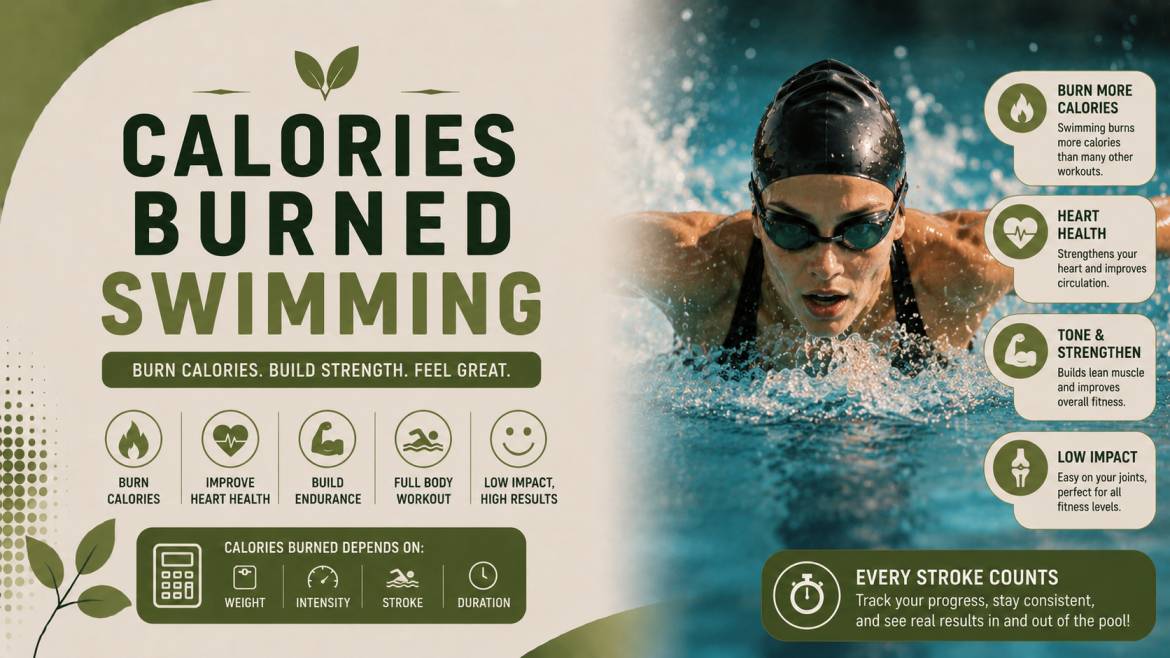
Swimming burns between 400 and 700 calories per hour for most adults, depending on stroke type, body weight, and intensity. A 154 lb (70 kg) swimmer doing moderate freestyle burns approximately 290 calories in 30 minutes, using a MET of 8.3 from the 2024 Adult Compendium of Physical Activities. Butterfly, the most demanding competitive stroke, reaches a MET of 13.8, burning close to 970 calories per hour for the same swimmer. No other common cardio activity produces that range within a single modality.
Swimming calorie output differs from land-based exercise in one fundamental way: water is 800 times denser than air. Every movement requires substantially more energy to overcome fluid resistance, which is why swimming generates high calorie burn even at moderate effort levels. A swimmer who looks relaxed may be working at an intensity equivalent to jogging, without the joint impact.
Use the swimming calorie calculator to get a personalized estimate by weight, stroke, and session length. The calories burned calculator covers all activity types in one place. The TDEE calculator places your swimming output within your full daily energy balance.
How Many Calories Does Swimming Burn by Stroke?
Stroke selection is the single most variable factor in swimming calorie burn. The four competitive strokes carry dramatically different MET values because each engages muscle groups in different combinations and forces the body to overcome water resistance through different mechanical patterns.
The calorie formula for swimming is identical to all MET-based activity estimates:
Calories = MET × Body Weight (kg) × Duration (hours)
The 2024 Adult Compendium of Physical Activities (Herrmann et al., Journal of Sport and Health Science, 2024) assigns these MET values to competitive swimming strokes:
Swimming Calories Per Hour by Stroke (154 lb / 70 kg)
Stroke | MET | Calories Per Hour | Intensity Level |
|---|---|---|---|
Backstroke | 4.8 | 336 kcal | Moderate |
Breaststroke (moderate) | 5.3 | 371 kcal | Moderate |
Freestyle (moderate) | 7.0 | 490 kcal | Moderate |
Freestyle (vigorous) | 9.8 | 686 kcal | Vigorous |
Breaststroke (vigorous) | 10.3 | 721 kcal | Vigorous |
Butterfly | 13.8 | 966 kcal | Very vigorous |
Source: 2024 Adult Compendium of Physical Activities. 70 kg reference weight.
Butterfly burns approximately 57% more calories per hour than moderate freestyle for the same swimmer. The catch: most recreational swimmers sustain butterfly for 10 to 15 minutes at most before technique degrades and output drops sharply. In practical terms, vigorous freestyle or vigorous breaststroke produces the highest sustainable calorie output over a full training session.
For the complete stroke-by-stroke breakdown, see the individual stroke guides:
How Many Calories Does Swimming Burn by Body Weight?
Body weight scales swimming calorie output in a direct linear relationship. The MET formula multiplies by kilograms, so a 215 lb swimmer burns approximately 40% more calories than a 125 lb swimmer doing the same stroke and duration.
Swimming Calories Per Hour by Body Weight (Moderate Freestyle, MET 7.0)
Body Weight | Calories Per Hour | Calories Per 30 Min |
|---|---|---|
120 lb (54 kg) | 378 kcal | 189 kcal |
140 lb (64 kg) | 448 kcal | 224 kcal |
154 lb (70 kg) | 490 kcal | 245 kcal |
165 lb (75 kg) | 525 kcal | 263 kcal |
185 lb (84 kg) | 588 kcal | 294 kcal |
200 lb (91 kg) | 637 kcal | 319 kcal |
215 lb (97 kg) | 679 kcal | 340 kcal |
Moderate freestyle, MET 7.0, flat terrain, 2024 Compendium.
A 200 lb swimmer at moderate freestyle burns 637 calories per hour more than a 154 lb runner at 6 mph (590 kcal/hr) over the same duration. Body weight matters more than stroke selection for most recreational swimmers, because the additional mass must be moved through water resistance with every stroke cycle.
How Many Calories Does Swimming 30 Minutes Burn?
A 30-minute swim at moderate freestyle burns approximately 245 calories for a 154 lb (70 kg) swimmer. At vigorous freestyle the same swimmer burns 343 calories in 30 minutes. The stroke-and-weight combination defines the 30-minute output more than pace does, because swimming pace variations within a stroke are more constrained than in running or cycling.
30-Minute Swimming Calories by Stroke and Body Weight
Stroke | MET | 120 lb | 154 lb | 185 lb |
|---|---|---|---|---|
Backstroke | 4.8 | 170 kcal | 168 kcal | 202 kcal |
Breaststroke (moderate) | 5.3 | 143 kcal | 185 kcal | 222 kcal |
Freestyle (moderate) | 7.0 | 189 kcal | 245 kcal | 294 kcal |
Freestyle (vigorous) | 9.8 | 265 kcal | 343 kcal | 412 kcal |
Butterfly | 13.8 | 373 kcal | 483 kcal | 580 kcal |
30 minutes active swim time, rests not included. 2024 Compendium MET values.
The 30-minute swimming calories page covers this breakdown in full across all body weights, including the effect of pool rests on total session output.
How Many Calories Does Swimming 1 Hour Burn?
A 154 lb swimmer at moderate freestyle burns approximately 490 calories in 1 hour. At vigorous freestyle the hourly output reaches 686 calories. The 1-hour swimming session is the most studied duration in exercise physiology research because it aligns with standard training blocks and laboratory measurement protocols.
1-Hour Swimming Calories by Stroke and Body Weight
Stroke | MET | 140 lb (64 kg) | 154 lb (70 kg) | 185 lb (84 kg) | 215 lb (97 kg) |
|---|---|---|---|---|---|
Backstroke | 4.8 | 307 kcal | 336 kcal | 403 kcal | 466 kcal |
Breaststroke (moderate) | 5.3 | 339 kcal | 371 kcal | 445 kcal | 515 kcal |
Freestyle (moderate) | 7.0 | 448 kcal | 490 kcal | 588 kcal | 679 kcal |
Vigorous freestyle | 9.8 | 627 kcal | 686 kcal | 823 kcal | 951 kcal |
Butterfly | 13.8 | 883 kcal | 966 kcal | 1,159 kcal | 1,339 kcal |
Source: 2024 Adult Compendium of Physical Activities.
The full hourly breakdown by stroke, weight, and cold water temperature adjustment is on the 1-hour swimming calories page.
How Many Calories Does Swimming Laps Burn?
Lap-based swimming calorie estimates depend on the pool length (25 metres vs 50 metres), the stroke used, and the swimmer's body weight. A single lap in a 25-metre pool is not the same as a 25-metre length in a competition pool. The most common recreational pool in the UK and Australia is the 25-metre pool; in the US, 25-yard pools are standard.
Calories Per Lap by Pool Length and Stroke (154 lb / 70 kg)
Pool | Stroke | Calories Per Lap | Laps per Mile |
|---|---|---|---|
25-metre | Freestyle moderate | 12 to 14 kcal | 64 laps |
25-metre | Breaststroke | 15 to 17 kcal | 64 laps |
50-metre | Freestyle moderate | 24 to 28 kcal | 32 laps |
25-yard (US) | Freestyle moderate | 11 to 13 kcal | 70 laps |
Estimates based on 2024 Compendium MET values and standard stroke pace benchmarks.
Swimming 20 laps in a 25-metre pool at moderate freestyle burns approximately 250 to 280 calories for a 154 lb swimmer. The same 20 laps at breaststroke burns approximately 300 to 340 calories because breaststroke's MET is higher per metre due to the slower pace and greater muscular work per stroke cycle.
The full lap count, distance, and weight-adjusted calorie reference is on the swimming laps calories page.
What Factors Affect How Many Calories Swimming Burns?
Six variables determine swimming calorie output beyond body weight and stroke selection. All six are well-documented in the exercise physiology literature and affect real-world calorie estimates by 10 to 30% individually.
Stroke Type Stroke type is the strongest post-weight variable, producing a 3x range from backstroke (MET 4.8) to butterfly (MET 13.8). Stroke selection represents the clearest controllable lever for increasing calorie output within a single swim session.
Intensity and Pace Moderate vs vigorous freestyle differs by 2.8 MET points (7.0 vs 9.8), adding 196 calories per hour for a 154 lb swimmer. Interval training that alternates vigorous efforts with short rests raises the effective MET above a steady moderate pace across the full session duration.
Swim Efficiency Efficient swimmers with lower drag produce less force against water resistance per metre than beginners. An inefficient swimmer expends approximately 10 to 15% more energy covering the same distance at the same apparent pace (swimmingregimen.com, 2026). This counterintuitive finding means beginner swimmers may burn more calories per session than intermediate swimmers at the same duration.
Body Weight The MET formula scales linearly with body weight. A 10 lb increase in body weight adds approximately 15 to 20 kcal per hour at MET 7.0. Body composition also plays a secondary role: swimmers with more lean muscle mass have a higher resting metabolic rate, though this does not directly affect the MET calculation during exercise.
Water Temperature Cold water below 20°C (68°F) increases calorie burn by approximately 5 to 12% above warm-pool estimates because the body activates thermogenesis to maintain core temperature (McArdle et al., Exercise Physiology, 8th edition). Open water swimmers in cool conditions routinely burn more calories per session than the same distance in a heated pool.
Rest Intervals Rests between laps reduce effective session MET. A swimmer who rests 2 minutes between every 50 metres burns substantially fewer calories than the MET formula suggests, because the formula assumes continuous effort. Shorter rest intervals (10 to 20 seconds between sets) maintain a higher effective hourly calorie output.
Treading Water Treading water carries a MET of approximately 3.5, burning around 245 kcal per hour for a 154 lb person. While much lower than active swimming strokes, treading water still provides cardiovascular activity and burns 3.5 times the resting metabolic rate. The treading water calories page covers calorie output by duration and intensity.
Swimming vs Running: Which Burns More Calories?
Swimming and running produce comparable hourly calorie outputs when matched at equivalent intensity levels. At moderate pace, a 154 lb person running 6 mph burns approximately 590 calories per hour. The same person swimming moderate freestyle burns approximately 490 calories per hour. Running produces about 20% more calories per hour than moderate freestyle at equivalent effort.
The gap closes at vigorous intensity. Vigorous freestyle at MET 9.8 produces 686 kcal/hr for a 154 lb swimmer, which slightly exceeds moderate running (MET 9.8, 686 kcal/hr) at the same MET value. This is not a coincidence: both activities carry identical MET values at this intensity band.
Swimming vs Running Calories Per Hour (154 lb / 70 kg)
Activity | Intensity | MET | Calories Per Hour |
|---|---|---|---|
Swimming freestyle | Moderate | 7.0 | 490 kcal |
Running | 6 mph (10 min/mile) | 9.8 | 686 kcal |
Swimming freestyle | Vigorous | 9.8 | 686 kcal |
Running | 7 mph (8.5 min/mile) | 11.0 | 770 kcal |
Swimming butterfly | Max effort | 13.8 | 966 kcal |
2024 Adult Compendium of Physical Activities.
Running holds the per-hour advantage for most recreational exercisers because vigorous freestyle is harder to sustain for 60 continuous minutes than a moderate run. However, swimming produces near-zero joint impact, making it accessible at higher weekly training volumes without the injury risk associated with high-mileage running. People returning from lower-body injuries can maintain cardiovascular fitness and calorie burn through swimming when running is not possible.
For the full cross-activity comparison, see the running calories hub and the walking calories hub for context across all three major cardio modalities.
Swimming vs Walking: Calorie Comparison
Swimming at moderate freestyle (MET 7.0) burns approximately 63% more calories per hour than brisk walking (MET 4.3) for the same body weight. A 154 lb person walking briskly at 3.5 mph burns approximately 301 kcal/hr compared to 490 kcal/hr swimming moderate freestyle.
The swimming advantage over walking is largest in the first hour and compounds with higher stroke intensity. Even backstroke (MET 4.8) produces 12% more calories per hour than brisk walking. At equal session times, swimming consistently outperforms walking for calorie output at every body weight and every stroke except very light freestyle.
The joint-impact difference between the two activities is the primary clinical reason many physiotherapists recommend swimming to patients who need cardiovascular exercise but face lower-body mobility limitations. Water supports approximately 90% of the swimmer's body weight, removing impact stress entirely.
How Does Swimming Compare to Cycling for Calories?
Swimming at moderate freestyle (MET 7.0) burns roughly the same calories per hour as moderate outdoor cycling at 12 to 14 mph (MET 8.0), with a gap of approximately 100 kcal per hour for a 154 lb person (cycling wins at 560 kcal/hr vs swimming at 490 kcal/hr). The comparison shifts significantly at higher intensities: vigorous freestyle at MET 9.8 slightly outpaces vigorous cycling at MET 10.0 in terms of gross hourly output.
The practical difference between the two activities is accessibility. Cycling on a stationary bike can be performed year-round at any resistance level without technique barriers. Swimming requires pool access, learned stroke technique, and comfort in water. Swimmers who have built stroke efficiency over years find the pool a more efficient calorie-burning environment than casual cyclists who ride at low intensity.
Both activities produce near-zero lower-body joint impact compared to running, making them the two most common clinical recommendations for cardiovascular conditioning in patients with knee or hip limitations.
How Does Open Water Swimming Affect Calorie Burn?
Open water swimming burns approximately 5 to 12% more calories than pool swimming at the same pace and duration, according to McArdle et al. (Exercise Physiology, 8th edition). Three mechanisms drive this increase:
Water temperature: Open water below 20°C (68°F) activates thermogenesis, the metabolic process by which the body generates additional heat to maintain core temperature. This thermoregulatory cost adds calories above what the MET formula captures, which is measured in temperature-controlled laboratory conditions.
Navigation and sighting: Open water swimmers regularly lift their heads to sight landmarks, a movement that disrupts body position and adds to drag. Each sighting costs additional energy compared to the streamlined turns in a pool.
Current and chop: Mild currents and surface chop increase the muscular work of every stroke cycle by introducing lateral forces that lane ropes eliminate in pool swimming. Even a 0.1 m/s opposing current measurably raises energy expenditure per metre.
For practical planning purposes, adding 8 to 10% to pool-based calorie estimates produces a reasonable open water approximation for sessions in cool conditions. Warm open water (above 24°C / 75°F) produces minimal additional calorie burn above pool estimates.
Swimming for Weight Loss: Weekly Calorie Planning
Swimming creates a calorie deficit through accumulated session output. For a 154 lb swimmer doing moderate freestyle, four 45-minute sessions per week produces approximately 1,470 kcal of weekly exercise output.
Weekly Swimming Calorie Output (154 lb / 70 kg, Moderate Freestyle)
Sessions Per Week | Session Length | Per Session | Weekly Total | Monthly Fat Loss (estimate) |
|---|---|---|---|---|
3 sessions | 30 min | 245 kcal | 735 kcal | ~0.85 lb |
3 sessions | 45 min | 368 kcal | 1,104 kcal | ~1.3 lb |
4 sessions | 45 min | 368 kcal | 1,472 kcal | ~1.7 lb |
5 sessions | 60 min | 490 kcal | 2,450 kcal | ~2.8 lb |
3,500 kcal approximately equals 1 lb of body fat. No dietary change.
Switching from moderate freestyle to vigorous freestyle adds approximately 39% more output per session at the same duration. Five vigorous 60-minute sessions per week produces approximately 3,430 weekly calories from swimming alone.
To see how swimming sessions fit within your full daily energy balance, the TDEE calculator produces your personalised maintenance target so you can calculate the exact combined deficit from exercise and dietary adjustment. The main calories burned guide covers all activity types across comparable weekly volumes.
Does Swimming Burn Belly Fat?
Swimming burns calories from all fat stores, not from a specific body region. Spot reduction of abdominal fat through any single exercise is not physiologically possible. Fat loss from the abdominal region occurs when total calorie expenditure consistently exceeds total calorie intake, creating a sustained deficit over weeks and months.
Swimming contributes to this deficit effectively because its low joint impact allows higher weekly session volumes than most land-based activities. A swimmer who completes 5 weekly sessions accumulates more total exercise calories per month than most runners, who typically reduce volume to avoid overuse injury.
The combination of cardiovascular calorie burn from swimming and the hormonal effects of regular aerobic exercise (reduced cortisol, improved insulin sensitivity) supports abdominal fat reduction as part of an overall calorie deficit programme.
Frequently Asked Questions About Calories Burned Swimming
The questions below answer the most common search queries about swimming calorie burn. Each answer uses MET values from the 2024 Adult Compendium of Physical Activities and references the detailed child pages in this cluster for extended data.
How Many Calories Does Swimming Burn?
Swimming burns 400 to 700 calories per hour for most adults at moderate intensity, depending on stroke and body weight. A 154 lb (70 kg) swimmer at moderate freestyle burns approximately 490 calories per hour. Butterfly swimming burns up to 966 calories per hour at the same body weight. The range across stroke types and effort levels is larger than any other common cardio activity.
Does Swimming Burn More Calories Than Running?
Swimming burns fewer calories than running per hour at matched moderate effort levels. A 154 lb person running at 6 mph burns approximately 686 kcal/hr versus 490 kcal/hr for moderate freestyle. At vigorous intensity, the outputs equalise: vigorous freestyle (MET 9.8) matches running at the same MET. Butterfly at MET 13.8 exceeds all common running speeds except sprinting.
How Many Calories Does Swimming Burn for a 150-Pound Person?
A 150 lb (68 kg) person swimming moderate freestyle burns approximately 476 calories per hour and approximately 238 calories in 30 minutes. At vigorous freestyle the same person burns approximately 667 calories per hour. Breaststroke at moderate effort produces approximately 361 calories per hour for a 150 lb swimmer.
Which Swimming Stroke Burns the Most Calories?
Butterfly burns the most calories of any competitive stroke, with a MET of 13.8 producing approximately 966 calories per hour for a 154 lb swimmer. Vigorous breaststroke ranks second at MET 10.3 (721 kcal/hr), followed by vigorous freestyle at MET 9.8 (686 kcal/hr). Backstroke produces the lowest calorie output of the four competitive strokes at MET 4.8 (336 kcal/hr) for the same swimmer.
Is 30 Minutes of Swimming Enough to Lose Weight?
Thirty minutes of moderate freestyle burns approximately 245 calories for a 154 lb swimmer. Over 5 weekly sessions, 30-minute swims produce 1,225 weekly exercise calories, contributing to approximately 0.35 lb of fat loss per week from swimming alone. Combined with a 200 to 300 kcal daily dietary reduction, 30-minute daily swimming sessions support approximately 0.7 to 1 lb of weekly fat loss for most adults.